

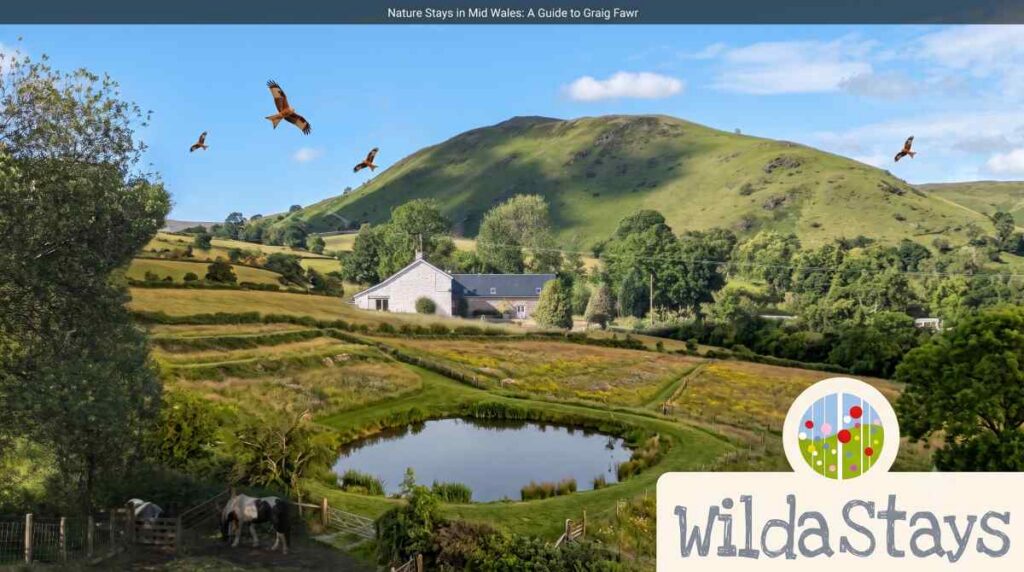
Nature Stays in Mid Wales: A Guide to Graig Fawr
Mid Wales is not the easiest place to find on a map, and that is exactly its appeal. Away from the busier coastal resorts and the crowds of Eryri, this stretch of the Cambrian Mountains has kept its wildlife, its dark skies and its quiet. For anyone looking for genuine nature stays in Mid Wales, the country around Llanafan Fawr and Beulah offers something increasingly hard to find: a working farm where red kites hunt over breakfast and the nearest streetlight is miles away.
This guide looks at what makes a nature stay in Mid Wales worth choosing, and why Graig Fawr — a stone barn conversion set within 40 acres of private conservation land near Builth Wells, Powys — has become a base for guests who want more than a comfortable bed. It sits within reach of the Elan Valley reservoirs, the red kite feeding station at Gigrin Farm, and over two thousand years of layered local history, without asking anyone to rough it.
Why Mid Wales suits a nature-focused break
The UK has lost the great majority of its wildflower meadows and lowland habitat since the 1930s, which makes unspoiled corners of the Cambrian foothills rarer than they should be. Mid Wales still has them: open pasture, hedgerows, old-growth woodland and water that has not been managed into submission.
Low visitor numbers help. There is no queue for a view here, and public transport is limited enough that most guests arrive by car and stay put once they do. That slower pace is precisely what draws people to nature stays in Mid Wales rather than a more polished coastal alternative — the landscape has not been tidied up for tourism.
The Cambrian Mountains form a natural buffer against the light and noise of larger settlements. Elevation and distance from towns keep the sky genuinely dark and the hedgerows genuinely full, which matters as much to a birdwatcher with a pair of binoculars as it does to a family wanting somewhere quiet to switch off.
What to look for in a nature stay in Mid Wales
Not every rural cottage delivers on the promise of “nature.” A proper nature stay needs private land guests can actually walk, not just a view of someone else’s field. It needs minimal light pollution for stargazing, water — a pond, stream or river — to support birdlife, and honest information about what is genuinely on the doorstep versus a twenty-minute drive away.
Graig Fawr was built around those requirements rather than retrofitted to meet them.
Graig Fawr: a working farm stay in the Cambrian foothills
Graig Fawr is a single-storey stone barn annexe at Tyn-Y-Clyn, sleeping two guests in a double bedroom with an en-suite walk-in shower. The kitchen-diner has sage-green cabinetry and a full run of integrated appliances; the sitting room has a Smart TV and a proper library. Oil central heating and underfloor heating keep the place warm through the Cambrian winter, and a raised private patio with a barbecue looks straight out over the farm’s wildlife pond.
The property holds Airbnb Guest Favourite status, sits in the top 5% of comparable stays, and carries a 4.97 rating across 61 reviews — cleanliness, accuracy, check-in, communication and location all score a full 5.0. There is no hot tub and no gimmick. The offer is quiet, privacy, and 40 acres to walk without seeing another guest.
View the full listing, photos and availability on Airbnb →
Wildlife through the seasons
Spring brings bluebells through the woodland and Canada geese nesting on the pond, alongside lambing, calving and foaling on the wider farm. By summer the meadows run to full wildflower cover, red kites and buzzards work the pastures, and swallows, house martins and tawny owls are regular company at dusk.
Autumn turns the Cambrian foothills through their hedgerow colours, with migratory birds passing through and raptors easier to spot against thinning cover. Winter brings frost, the occasional snowfall, and overwintering waterfowl on the pond — plus some of the clearest night skies in England or Wales, since there is no commercial lighting for miles.
Red kite watching from your doorstep
Red kites (Milvus milvus) were once reduced to a handful of pairs in Wales and have since become one of the country’s genuine conservation successes. Gigrin Farm, roughly 11 miles away near Rhayader, runs a daily feeding station where hundreds of kites gather over a working 200-acre sheep farm — a reliable, photograph-friendly spectacle from purpose-built hides.
Guests at Graig Fawr often see resident kites and buzzards directly from the patio, without the drive. It is one of the clearer illustrations of why a nature stay in Mid Wales earns its name rather than borrowing it from a brochure.
Elan Valley, dark skies and the Cambrian Mountains
The Elan Valley reservoirs, around 10–15 miles north, cover a 70-square-mile Victorian water catchment with stone-built dams, gravel cycling trails and open water that draws its own birdlife. Further west, the Devil’s Staircase in the Abergwesyn Valley and the shoreline at Llyn Brianne suit walkers and cyclists who want gradient and solitude. Bannau Brycheiniog (the Brecon Beacons) is around 50 minutes south for higher mountain routes.
With no significant light pollution at this elevation, clear nights turn into genuine dark-sky viewing without any special equipment — one of the quieter reasons guests return.
A dog-friendly nature stay
Graig Fawr allows up to two well-behaved dogs, with 40 acres of off-lead walking away from public paths. A working sheep field borders the property, so dogs need to be kept close near the boundary, but guests are not confined to a small garden — space and privacy are the main advantage here for anyone travelling with a reactive or anxious dog. The farm’s own donkeys, pony, horses and two resident dogs are part of the wider picture, with supervised interaction available for guests who want it.
History, food and getting here
Llanafan Fawr’s parish church stands on a prehistoric mound aligned with the midsummer sunrise, next to a yew tree the Conservation Society of London has certified at over 2,000 years old. Opposite, The Red Lion Inn has operated since at least the late 12th century and is recorded as a stopover for the chronicler Giraldus Cambrensis in 1189 — reputedly the oldest working pub in Powys.
Beulah, around 3.5 miles away, has a fuel station and shop, plus The Trout Cafe for breakfasts and home baking. Slightly further afield, the Drovers Rest and Neuadd Arms in Llanwrtyd Wells and the Prince Llewellyn in Cilmery offer proper pub food and local ales. Builth Wells, 11 miles east, covers supermarkets, banking and pharmacy needs. A car is essential — public transport in this part of Powys is minimal, and winter weather can occasionally isolate rural roads, so it is worth stocking up before arrival.
Book a nature stay in Mid Wales at Graig Fawr
Graig Fawr is co-managed by Superhost Kirstie and Paul, with over two years of guest reviews backing up the 4.97 rating. If you want red kites over breakfast, a pond outside the bedroom window and 40 acres to explore without another guest in sight, this is where to start looking.
Ready to get started?
Shop: Traditional Wildflower Meadow Mix →