
Quick Answer: Graig Fawr sits on a 40-acre conservation farm near Beulah, Powys, where red kites, buzzards and swallows fly over wildflower meadows, a wildlife pond hosts nesting Canada geese and moorhens, and tawny owls and bats appear at dusk. Gigrin Farm’s red kite feeding station is a 20-minute drive away.
You don’t need to go looking for wildlife at Graig Fawr. Sit on the patio with a cup of tea and it comes to you — a red kite riding the thermals above the meadow, a moorhen picking its way along the pond edge, a bat flickering past as the light goes. The 40 acres of farmland around the cottage are managed for conservation, not just grazing, and that difference shows up in what you see and hear from the moment you arrive.
This is a working farm, not a wildlife park, so nothing is staged and nothing is guaranteed on any single day. What follows is a realistic, season-by-season guide to what’s actually been seen on the land, so you know what to expect and when — plus how the farm connects to one of the great conservation stories in British wildlife, the return of the red kite to Mid Wales.
It also means the wildlife here is genuinely wild rather than habituated to visitors. Nothing is fed, baited, or brought in for guests to look at — what you see is what the land is actually supporting, day to day, whether or not anyone happens to be watching. That’s a different experience to a managed reserve, and it asks a little more patience of you, but it’s also considerably more honest about what this corner of Mid Wales actually holds.
A conservation farm built for wildlife
The land at Graig Fawr moves through several distinct habitats within a short walk of the cottage door: a raised garden patio, open pasture, a wildflower meadow left to flower rather than cut for silage, a central wildlife pond, and pockets of mature woodland. A sheep field borders the farm but isn’t part of it — worth knowing if you’re walking dogs, since it means livestock is close by even though it’s not on the land you’re exploring.
Mown trails cut through the meadow and pasture, giving low-impact walking routes that don’t disturb nesting birds or ground-feeding mammals in the process. It’s this pattern of leaving things alone — letting hedgerows grow out, letting the meadow flower and seed, keeping the pond margins soft rather than manicured — that has built up the range of species now resident or visiting through the year.
Spring: nesting birds and returning cuckoos
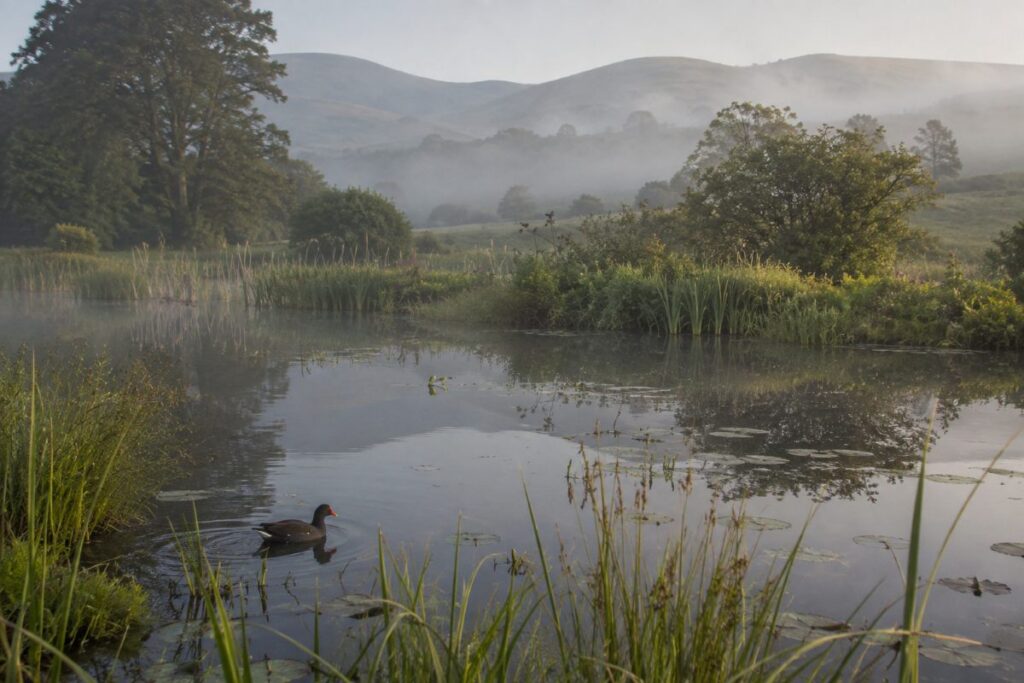
Spring is when the pond becomes the centre of activity. Canada geese nest on and around it, and moorhens and wild ducks are regular sightings from the patio or the path that runs alongside the water. Bluebells come through in the woodland sections of the farm, and the meadow flora starts pushing up beneath last year’s growth.
It’s also when the cuckoo arrives — still genuinely audible across this part of Mid Wales in a way that’s become rare in much of lowland Britain, where cuckoo numbers have fallen sharply. On neighbouring farms, lambing, calving and foaling are underway, which adds another layer of activity to the wider landscape beyond the farm’s own boundary, even though those animals aren’t part of Graig Fawr itself.
Summer: the meadow in full flower, and red kites overhead
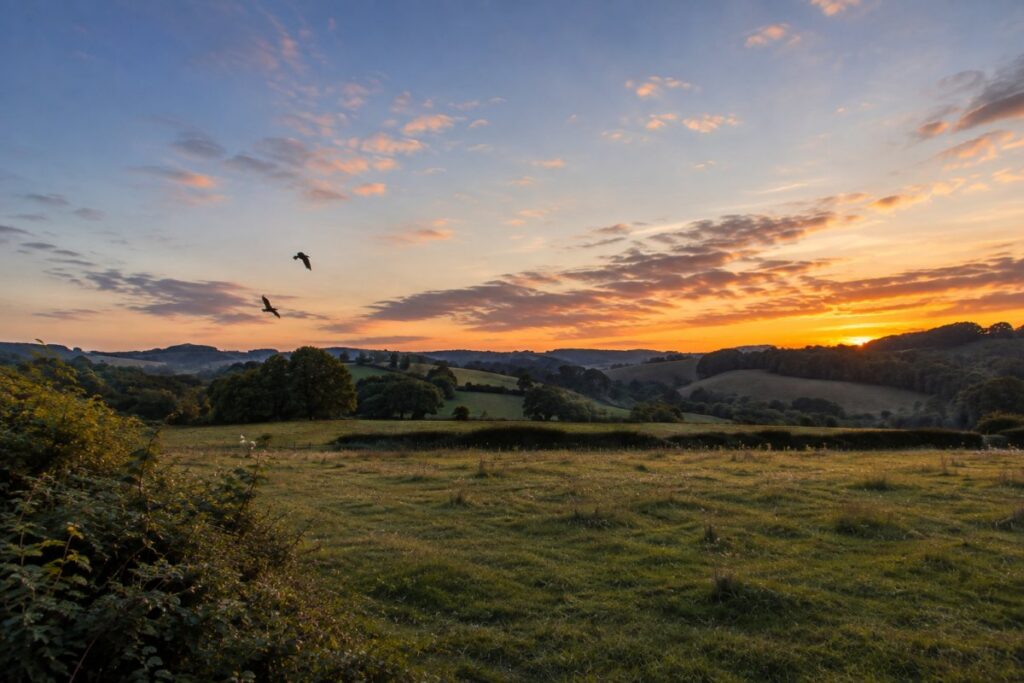
By summer the wildflower meadow is at its fullest, and the hedgerows around the farm have thickened into dense cover for nesting birds. This is the best stretch for raptors — red kites and buzzards are regularly overhead, and swallows and house martins hunt low over the grass in the evenings. As dusk comes in, bats start working the airspace above the patio and pond, and brown hares can sometimes be seen out in the open pasture, especially early or late in the day when the farm is quietest.
Tawny owls are present year-round but are easiest to hear in the warmer months when windows are open and evenings are spent outside — a call across the valley after dark is one of the more reliable wildlife moments guests report back on.
Autumn: colour, migration and a change of pace
Autumn brings a shift rather than a quiet period. The deciduous woodland across the Cambrian foothills turns through its usual range of colour, and the hedgerows around the farm fruit — useful if you’re inclined to forage as you walk, though as ever, only pick what you can identify with confidence. From early October, redwings and fieldfares start arriving from Scandinavia and Iceland, part of a broader wave of migratory movement that makes raptors more visible over the open pasture as territories shift and food sources change.
This is also a good period for photography, with lower light and richer colour across the land than the flatter light of high summer. The meadow, cut back after seeding, shows the shape of the mown trails more clearly, and the woodland edges catch the low sun in a way that’s harder to get in June or July.
Winter: overwintering waterfowl and dark skies
Winter thins the visible wildlife but doesn’t remove it. Overwintering waterfowl use the pond, and the farm’s complete lack of commercial light pollution comes into its own — this is genuinely good stargazing country in the colder, clearer months. Frost and occasional snow settle on the surrounding hills, and the air across the Cambrian foothills is often at its clearest of the year.
It’s worth being realistic here: winter in this part of Mid Wales can be properly wintry, and snow can temporarily make the property feel cut off. Graig Fawr is set up for it — air source heat pump and solar-powered underfloor heating throughout, and a straightforward self-check-in process — but it’s part of the honest picture of a genuinely rural stay, not a footnote.
Book direct and save
Book directly with the hosts — send a brief enquiry with your dates and they will come back to you with them confirmed. Direct rates start at £130 a night for a short break, or £105 a night for a week or more, and there are no booking fees. Prefer to see a live calendar first? Graig Fawr is on Airbnb too.
Red kites: Mid Wales’ conservation success story
Red kites are the bird most guests come hoping to see, and the story behind them is worth knowing. Through most of the 20th century, Mid Wales was the last British stronghold of the red kite, with the UK population reduced to just a handful of breeding pairs, all in this part of the country. Every red kite now seen across England and Scotland — following decades of reintroduction programmes — descends from that small surviving Welsh population. Seeing one over the meadow at Graig Fawr is, in a small way, seeing the result of that recovery in the place it actually happened.
For a closer, more concentrated view, Gigrin Farm Red Kite Centre near Rhayader is about 10.8 miles away — roughly a 20-minute drive. It’s a 200-acre working sheep farm that also operates as an official red kite feeding station, drawing hundreds of birds in for the daily afternoon feed and offering hide-based photography. Because Graig Fawr sits within the same wider kite population, resident birds are often visible directly from the patio without making the trip at all — Gigrin Farm is worth it for the concentration and the photography opportunity, not because kites are otherwise absent from the farm itself.
Worth saying plainly: the recovery is a genuine conservation success, but it’s not ancient history. Guests old enough to remember the 1970s and 80s can recall a time when seeing a red kite anywhere in Britain was remarkable rather than routine. Watching two or three drift over the meadow at Graig Fawr on an ordinary afternoon is, in that light, a fairly recent piece of good news.
The wildlife pond
The pond at the centre of the farm does double duty as a breeding ground for amphibians and a stopping point for waterfowl through the year. It sits close enough to the cottage that the bedroom looks out over it, so wildlife watching here doesn’t require an early start or a long walk — it’s genuinely doorstep. Guests who like to sit quietly with binoculars tend to get the most out of it; the animals using the pond are used to a working farm around them, but a still, patient guest sees considerably more than a passing one.
Getting the most from a wildlife stay
A few things make a real difference if wildlife is the main reason you’re visiting. Dawn and dusk are consistently the most active periods, for birds and mammals alike — worth building into your day rather than treating breakfast and dinner as fixed points. A decent pair of binoculars earns its space in the car far more than most other kit. And patience matters more than mileage: the farm’s 40 acres reward sitting and watching from the patio or a bench on the mown trails at least as often as walking further and faster.
None of this requires expertise. The wildlife here isn’t managed for visitors and doesn’t perform on schedule, but it is consistently present in a way that rewards slowing down for a couple of days rather than trying to see everything in one.
Why Graig Fawr
Graig Fawr is a stone barn conversion for two, set within the 40-acre conservation farm described above, at Tyn-Y-Clyn near Beulah in Powys. It’s a genuinely rural stay — no hot tub, no pool, and a car is needed to get around — but the trade-off is direct, doorstep access to a working conservation landscape rather than a view of one from a window. The cottage holds Airbnb Guest Favourite status with a 4.97 rating, and up to two well-behaved dogs are welcome, so the land is as accessible to your dog’s nose as it is to your binoculars.
Book Your Stay
Related: Watching Red Kites at Gigrin Farm: A Guide for Guests at Graig Fawr
Related: Spring in the Cambrian Mountains: Wildlife, Walks and the Land Waking Up
Related: A Year of Wildlife at Graig Fawr: January in the Winter Landscape
If a genuinely wild, working landscape is what you’re after, Graig Fawr puts it right outside the door. Check availability for Graig Fawr on Airbnb.