
Quick Answer
A genuinely secluded holiday cottage in Mid Wales is one where you are not overlooked, you share no outdoor space with other guests, and you can walk from the door without meeting anyone. Listing photos rarely show this. Ask who else is on site, what is shared, what the patio looks onto, and how far it is to the nearest road and neighbour.
“Secluded” is one of the most used words in holiday let listings, and one of the least reliable. It gets applied to a cottage at the end of a village street, to a unit in a converted farmyard with four others, and to a barn at the end of a mile of track with no neighbour in sight. All three might be lovely. Only one of them is secluded in the way most people mean when they search for secluded holiday cottages in Mid Wales.
The problem is that photographs are very good at hiding the thing you actually care about. A well-framed shot of a patio and a view tells you nothing about the cottage next door, the shared car park just out of shot, or the lane that runs past the bedroom window.
This guide is a way of cutting through that. It sets out what “secluded” and “private” really mean in practice, the questions that reveal the difference before you book, and the honest trade-offs of choosing somewhere genuinely quiet and remote. At the end we apply the same test to our own holiday let, Graig Fawr, including the parts that do not fit the picture-postcard version.
Secluded, private and remote are not the same thing
Listings use these three words as if they were interchangeable. They are not, and knowing which one you actually want makes the search much easier.
| Word | What it should mean | What to check |
|---|---|---|
| Secluded | Out of sight. Not overlooked by other houses, roads or paths. | What can you see from the windows and patio, and who can see you? |
| Private | Nothing shared with strangers. Your own entrance, outdoor space and parking. | Is anything shared with other guests: garden, hot tub, laundry, drive, car park? |
| Remote | A long way from things: towns, shops, main roads, other people. | How far is the nearest shop, main road and neighbour, and what is the last mile like? |
A cottage can be one without the others. A converted barn in a small holiday complex can be remote but not private. A townhouse with a walled garden can be private but not remote. What most people looking for a quiet getaway actually want is the overlap of all three: out of sight, nothing shared, and far enough from everything that the evening is silent.
Related: if “remote” is the part that matters most to you, our guide to off-grid and remote holiday cottages in Mid Wales covers the practical side: services, signal, supplies and access.
The privacy test: seven questions to ask before you book
None of these are awkward questions. A good host will answer all of them straightforwardly, and the way they answer tells you a lot on its own.
1. Who else is on site?
This is the single most important question, and listings almost never answer it clearly. Ask directly: are there other holiday lets on the same property? Does the owner live there? Are there staff, a farm business or a campsite sharing the land? One let on a property is a very different holiday from one of six.
2. Is anything shared?
Garden, patio, hot tub, laundry room, drive, parking, bins, walking paths. Shared facilities are not necessarily a problem, but they are where you meet other people. If you are booking for seclusion, you want the answer to be “nothing” or close to it.
3. What does the outdoor space look onto?
Ask what is in front of the patio and the main windows. A patio that faces a lane, a car park or another cottage’s garden is not private however nice the furniture is. One that looks onto a field, a pond or woodland is.
4. Can anyone see in?
Related but different. Public footpaths across a property, a lane that runs past the windows, or a neighbour’s house on the rise behind can all mean you are more visible than the photos suggest. Ask whether there is a public right of way near the cottage.
5. How far is the nearest road, and how busy is it?
Distance from a main road matters for noise as much as for privacy. Rural A-roads carry a surprising amount of traffic, including lorries and motorbikes on fine weekends. A cottage at the end of a single-track lane with passing places is quieter than one set back fifty yards from a through road.
6. Can you walk from the door without meeting anyone?
Seclusion is not just about the building. If every walk starts with a stretch along a lane or through a village, you will meet people. Land to walk on straight from the door changes the whole feel of a holiday.
7. What might make noise?
Working farms, game shoots, events venues, quarries, campsites and festival sites all have seasons when they are loud. Ask whether anything nearby is noisy at the time of year you are coming. Around Bonfire Night and New Year it is also worth asking about fireworks, remembering that sound carries a long way across open country.
Hosts who live on site: a drawback or an advantage?
A lot of the most secluded holiday cottages in rural Wales are annexes, barns or converted outbuildings next to the owner’s own home. That is simply how rural property works: the farmhouse came first and the buildings around it were converted later. It puts some people off, because they picture a host hovering at the door.
In practice, it usually works the other way. A host who lives next door has every reason to keep the place quiet, because it is their home too. There are no other guests, no parties in the next unit, and no stranger’s car arriving at midnight. And in a genuinely remote place, having someone nearby who knows the lanes, the weather and the land is useful rather than intrusive, particularly in winter.
What matters is how it is set up. The questions to ask are whether the cottage has its own entrance, its own outdoor space and its own parking, whether check-in is self-service, and whether the host will leave you alone unless you want company. If all of those are yes, living next door to your host is not a loss of privacy. It is often the reason the place is so quiet.
Signs a listing is less secluded than it looks
Most listings are honest, but the language of holiday lets has a few habits worth recognising.
- “Tucked away” with only close-up photos. If every exterior shot is tightly cropped, ask what is just out of frame.
- “Part of a small collection of cottages.” That means other guests. Possibly a shared car park, garden or hot tub.
- “Shared grounds” or “use of the gardens.” Lovely, but shared.
- “Easy access to the A-road.” Useful for driving. Also means the A-road is nearby.
- “On a working farm.” Can be wonderful. Can also mean machinery at six in the morning in harvest season. Ask what the farm does.
- “Village location” alongside “secluded”. These can both be true, but it is worth asking how.
- No exterior photo of the whole building. Often innocent. Always worth asking about.
The fix for all of these is the same: send the host a short message with the seven questions above before you book. It takes five minutes and saves a disappointing week.
Book direct and save
Book directly with the hosts — send a brief enquiry with your dates and they will come back to you with them confirmed. Direct rates start at £130 a night for a short break, or £105 a night for a week or more, and there are no booking fees. Prefer to see a live calendar first? Graig Fawr is on Airbnb too.
Who a secluded holiday cottage suits
Seclusion is not for everyone, and it is not a better kind of holiday, just a different one. It tends to suit a longer holiday as much as a weekend break, and works best for:
- Couples who want time together without other people around. Our guide to couples’ holidays in Mid Wales covers how to plan a week when you want different things.
- Solo travellers who want quiet without isolation. See our guide to holidays for one in the Cambrian Mountains.
- Writers and people with a project that needs uninterrupted days. We have written about a writer’s retreat in the Cambrian Mountains.
- Owners of nervous or reactive dogs, for whom a place with no other guests’ dogs and no stream of walkers is the difference between a relaxing week and a stressful one. See holidays with a nervous dog.
- Anyone who wants a proper rest from screens and noise. Our piece on a digital detox weekend in Mid Wales is about exactly that.
What seclusion costs you
It is worth being clear-eyed about the trade-offs before you book somewhere genuinely out of the way.
- You need a car. Secluded places are not on bus routes.
- Everything is a drive. Shops, pubs and restaurants are miles away, so a good kitchen matters more.
- Mobile signal can be patchy. Ask about wifi separately; it is often much better than the signal outside.
- The last mile can be slow. Single-track lanes, gates and farm tracks take longer than the satnav thinks, especially in the dark.
- Weather matters more. Snow can make rural lanes difficult for a day or two in winter.
- It is very dark at night. That is wonderful for stars and less wonderful when you have forgotten the torch.
None of those are reasons not to go. They are reasons to choose a place where the host is honest about them, and to plan accordingly.
How private is Graig Fawr? An honest answer
We would be doing this article a disservice if we did not run the same test on our own holiday cottage, so here it is, question by question.
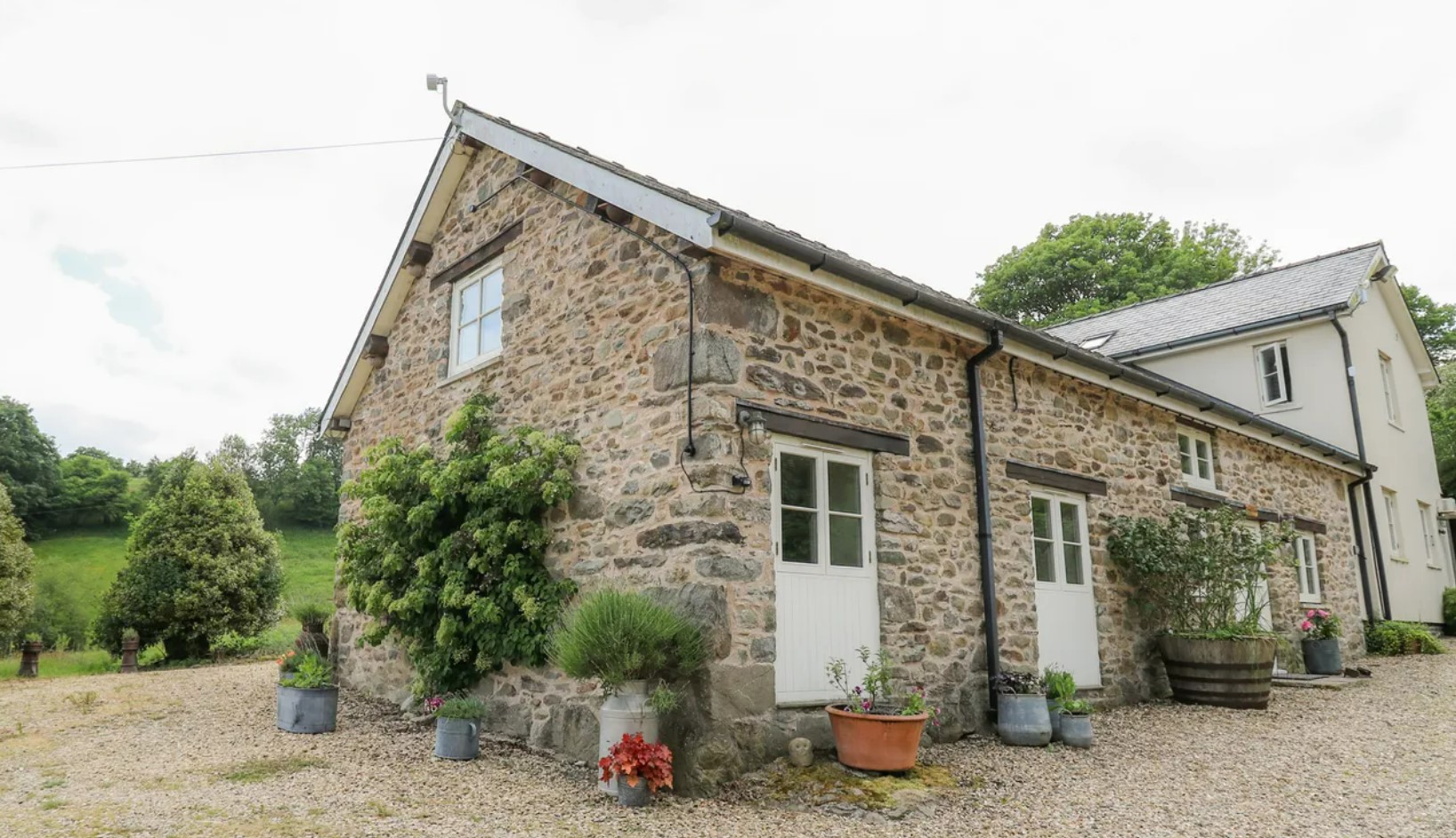
Who else is on site? Graig Fawr is a stone barn conversion that adjoins our own home at Tyn-Y-Clyn. The only people who live here are the two of us, Paul and Kirstie, with our dogs. There are no other holiday lets on the farm, so there are no other guests. Graig Fawr sleeps two, which means the most people on the whole property at any one time is four.
Is anything shared? The barn has its own front door, its own raised garden patio with outdoor furniture and a barbecue, and off-road parking for two cars. Check-in is self-service by key lockbox, so you arrive and leave in your own time.
What does the outdoor space look onto? The patio looks out over the farm’s central wildlife pond and pasture towards mature woodland. Not a road, not a car park and not another cottage.
Can you walk from the door without meeting anyone? Yes. Guests have private access to the full 40 acres of the conservation farm: pasture, wildflower meadow, pond and woodland, with mown trails across it. The land is not open to the public. Beyond it is open common land for longer walks.
How far is the nearest road and village? The approach is by single-track lanes with passing places. The nearest village, Beulah, is three and a half miles away, and Builth Wells, with its supermarkets, is about eleven.
What might make noise? Honestly, not much. There are three donkeys, an aged pony, two horses and our two dogs on the farm, a neighbour’s sheep field borders the land, and there are red kites and buzzards overhead. There is no commercial light pollution at night. There are no fireworks on the farm, though sound does carry across open countryside around Bonfire Night and New Year.
So, by the test above: secluded, yes. Private, yes, in every way that matters to a guest: your own entrance, patio and parking, no other guests, and 40 acres that are closed to the public. Next door to your hosts, also yes, and we think that is part of why it stays so quiet.
Why Graig Fawr suits a secluded holiday
Graig Fawr is a single-storey stone barn conversion on a 40-acre conservation farm in the parish of Llanafanfawr, near Beulah in Powys. It sleeps two in one double bedroom with an en-suite walk-in shower, and has a sitting room with a large book collection and a kitchen-diner with a dishwasher, oven and hob. Underfloor heating runs throughout, powered by air source heat pumps and solar panels that serve both the holiday let and the farm.
Up to two well-behaved dogs are welcome at no extra charge, with the whole 40 acres to walk. Indoor wifi is generally very good, though mobile signal outdoors is patchy depending on network. There is no hot tub and no pool; the property trades on quiet, privacy and land rather than built leisure.
Direct rates are from £130 per night for a short break of two to six nights, and from £105 per night for a holiday of seven nights or more, with no booking fees. The minimum stay is two nights, or three in July and August.
Related reading
- Off-Grid and Remote Holiday Cottages in Mid Wales: What to Know Before You Book
- Peaceful Rural Escapes in Mid Wales
- Why Graig Fawr Has No Hot Tub, and What You Get Instead
- Is Graig Fawr Dog-Friendly? A Guide for Owners of Reactive Dogs
- What Makes a Holiday Cottage Truly Nature-Friendly?
Book a secluded holiday cottage in Mid Wales
If you are looking for a secluded holiday cottage in Mid Wales with no other guests, your own patio over a wildlife pond and 40 private acres to walk, Graig Fawr is a quiet two-person holiday let near Builth Wells. Check availability for Graig Fawr on Airbnb, or email paul@wildahome.co.uk with any questions or to book direct with no booking fees. We are happy to answer every one of the seven questions above before you book.