
Quick answer: A renewably powered holiday cottage draws some or all of its energy from renewable sources, usually solar panels and a heat pump. The term has no fixed definition, so ask what it covers. At Graig Fawr, two air source heat pumps and solar panels run the underfloor heating, and heating is included in every booking.
“Renewably powered” is one of those phrases that sounds settled and isn’t. A renewably powered holiday cottage could mean a building that takes every unit of its energy from its own panels. It could mean a few solar panels on a barn roof and a mains supply doing most of the work. It could mean a green electricity tariff and nothing on site at all. All three might use the same words on a listing.
We use the phrase ourselves, so we think we owe you a straight account of it. Graig Fawr is a one-bedroom stone barn holiday cottage on a 40-acre conservation farm near Beulah, in the Cambrian Mountains. Two air source heat pumps and solar panels serve both the barn and the wider farm, and the underfloor heating throughout runs off them. This article explains what that kind of setup does in general terms, what it doesn’t do, and how to question any holiday let that makes a similar claim, including ours.
It sits alongside two other pieces worth reading before you book. What makes a holiday cottage truly nature-friendly? looks at the land, and off-grid and remote holiday cottages in Mid Wales sorts out what “off-grid” really means. This one is about the energy.
What does “renewably powered” mean on a holiday cottage listing?
There is no single definition that a holiday cottage has to meet before using the term, so treat it as the start of a conversation. In practice it usually points to one or more of these:
- On-site generation. Panels, or occasionally a wind turbine or small hydro scheme, make some of the electricity on the property.
- Renewable heat. A heat pump or similar system supplies the heating in place of an oil, LPG or gas boiler.
- A renewable tariff. The electricity comes through the mains from a supplier selling a green tariff. Nothing changes on site.
These are different things, and none of them tells you how much of the total energy is renewable. Each one can be perfectly honest. The trouble only starts when a listing lets you assume more than the owner could show you.
How does an air source heat pump heat a holiday cottage?
This section is general, and describes how these systems work rather than the particular one at Graig Fawr.
An air source heat pump works, as Which? explains, on the same principle as a fridge or freezer: it moves heat from one place to another. It takes heat from the outside air into a low-temperature refrigerant, a compressor raises the temperature, and that heat passes into the heating system.
The important point is that it moves heat instead of burning fuel to make it. It runs on electricity, and MCS, the UK certification body for these systems, notes that the heat produced exceeds the electricity needed. Which? puts the typical figure at 2.5 to 4 units of heat for each unit of electricity, though that is a general range for heat pumps and not a figure for any one building.
Do heat pumps work in cold weather?
This is the first question anyone sensible asks about a house in the Welsh hills. The general answer is yes, with less efficiency. There is still heat to extract from cold air. Which? says units are designed to work down to about -10°C, which covers most of the UK, and that efficiency falls in very cold weather. It also notes an automatic defrost mode that stops the unit icing up.
Why do heat pumps and underfloor heating go together?
Heat pumps supply cooler heat than oil or gas boilers, which is why, according to Which?, they suit homes with larger radiators or wet underfloor heating. The heat is spread across a much bigger surface and delivered for longer at a lower temperature. So a house heated this way tends to feel different from one with a boiler and small radiators: less of a blast in the morning and evening, more of a steady background warmth.
What do solar panels do, and what can’t they do?
Again, this is the general picture. Solar panels turn daylight into electricity. They still generate on grey days, as MoneySavingExpert’s guide points out, though they produce less, and they produce nothing after dark.
That second point matters more than it sounds. The times you most want heat, on a winter evening or a frosty early morning, are not the times a panel is working. So in almost any building with solar and a connection to the grid, electricity moves both ways. The panels supply what they can while it’s light, and the mains covers the rest. Surplus power from a panel array can be sent back to the grid, and the government-backed Smart Export Guarantee requires some suppliers to pay small generators for it.
Anyone who tells you a grid-connected cottage in Wales runs on sunshine alone, all winter, should be asked how.
Renewably powered, off-grid and carbon neutral are not the same thing
These three phrases get used as if they were interchangeable. They are separate claims, and each needs its own evidence.
- Renewably powered says something about where energy comes from. It doesn’t say all of it.
- Off-grid says the property has no mains connection and looks after its own supply. Our off-grid guide goes through what that means for a guest.
- Carbon neutral is an accounting claim about a total footprint. It needs measuring and a method behind it, which is a much larger undertaking than fitting panels.
Graig Fawr is not off-grid, and it is not carbon neutral. We would rather make a smaller claim that we can stand behind.
Book direct and save
Book directly with the hosts — send a brief enquiry with your dates and they will come back to you with them confirmed. Direct rates start at £130 a night for a short break, or £105 a night for a week or more, and there are no booking fees. Prefer to see a live calendar first? Graig Fawr is on Airbnb too.
Questions to ask before booking a renewably powered holiday let
Most hosts who have put real work into this will be glad you asked. A vague answer isn’t proof of anything, but a specific one is reassuring.
| What the listing says | What to ask the host |
|---|---|
| “Renewably powered” | What exactly runs on renewable energy: the heating, the hot water, the electrics, or all of them? |
| “Solar powered” | Are the panels on this property? What happens at night and in midwinter? |
| “Eco heating” | What is the heat source, and what is the backup if it fails? |
| “Green electricity” | Is this generated on site, or a tariff from a supplier? |
| “Carbon neutral” | How was that worked out, and by whom? |
| “Heating included” | Is it included all year, or is there a meter or a winter charge? |
The last row is worth asking whatever the heating system is. A surprise energy charge is a poor way to end a winter holiday.
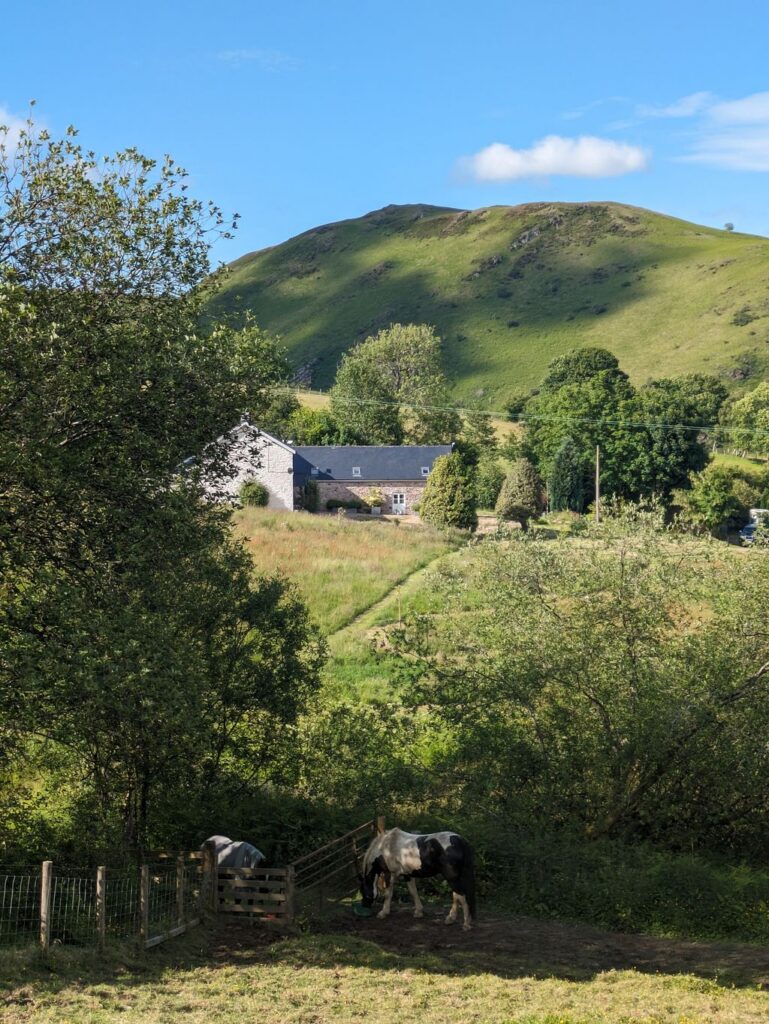
What a renewably powered holiday cottage means at Graig Fawr
Here is what we can say plainly about our own holiday cottage.
- Two air source heat pumps and solar panels serve both Graig Fawr and the wider farm at Tyn-Y-Clyn.
- The barn has underfloor heating throughout, and it runs off that system.
- Heating is included in every booking, so there is no separate charge for it.
Older descriptions of Graig Fawr may still mention oil central heating. That is out of date.
And here is what we are not claiming. We aren’t publishing generation or efficiency figures, and the property is neither off-grid nor carbon neutral. Solar panels don’t work at night, so please don’t picture a barn living on sunlight alone. As with any system, we also can’t guarantee heating in every circumstance.
What a guest gets from all this is simpler than the engineering. On a short break in January or a fortnight in February, the floor is warm when you come in from the hill, and the heating is one thing you don’t need to think about. If you want to know more about what longer visits are like, our guide to a fortnight in Mid Wales covers it.
Does a renewable setup make a holiday cottage better?
Not automatically. A heat pump doesn’t make a holiday cottage comfortable if the building leaks heat, and solar panels say nothing about how the land around them is treated. A cottage can have an impressive roof and a sprayed field next door. Another can have an older heating system and a host who has spent twenty years looking after a hedgerow. Energy is one honest measure among several, so weigh it alongside the land, the quiet and the people running the place.
What it does give you is a way to test a listing. A claim about energy is easier to check than a claim about atmosphere. Either the panels and the heat pump are there or they aren’t, and either the heating is part of the rate or it isn’t. That makes it a useful question for anyone comparing holiday lets, whether you’re booking a short break or a few weeks away. If a host answers this one clearly, that tells you something about how they’ll answer the others.
Why energy is part of a nature-friendly holiday
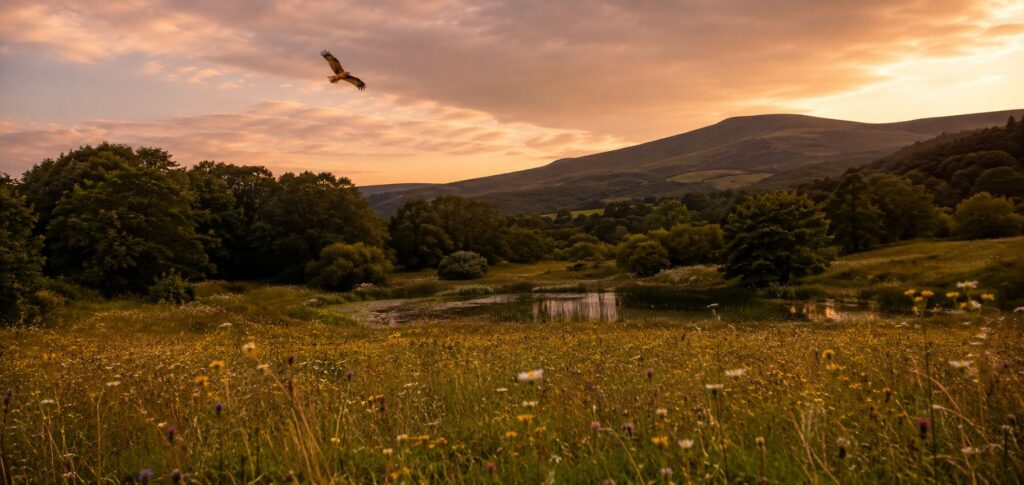
We see this as part of the same job as the meadow and the pond. The 40 acres around the barn are managed for conservation, and we’ve written about how we manage the land at Tyn-y-Clyn elsewhere. Running the heating on heat pumps and solar panels fits that thinking: if you care about what lives on a piece of land, how you heat the buildings on it is a fair question to ask yourself.
That said, the energy system isn’t the reason to come. A holiday here is about red kites over the pasture, bats at dusk, and very dark skies in the autumn and winter. The heat pumps are there so that you can come back indoors to a warm room afterwards, and forget about them.
Related reading
- What makes a holiday cottage truly nature-friendly?
- Off-grid and remote holiday cottages in Mid Wales: what to know before you book
- How we manage the land at Tyn-y-Clyn
- A fortnight in Mid Wales: longer holidays at Graig Fawr
- Autumn and winter short breaks in the Mid Wales countryside
Plan your holiday at Graig Fawr
If you’d like to know more about how the barn is heated, or anything else about a holiday here, email us at hello@wildahome.co.uk. We’re happy to answer questions before you book.
Graig Fawr sleeps two, and up to two dogs are welcome. Direct rates start from £130 a night, and from £105 a night for 7 nights or more, varying by season. The minimum is 2 nights, or 3 nights in July and August. You can see the details on the Graig Fawr listing page.
Ready to plan your stay? Check availability for Graig Fawr on Airbnb.