
Quick answer: A birdwatching holiday in Mid Wales works in every season. Spring brings pied flycatchers, redstarts and wood warblers to the oakwoods, winter brings hen harriers and wildfowl, and red kites stay all year. From a holiday cottage near Beulah, the Elan Valley, Gilfach and Cors y Llyn are all within easy reach.
A birdwatching holiday in Mid Wales rarely needs an early start and a long list of targets, though you can have both if you want them. This is a part of Britain where the birds are spread across a landscape that still has room for them: oakwoods hung on steep valley sides, fast rivers, reservoirs, wet bogs and miles of open moor.
The variety is the point. Within a single day you can stand in a Welsh oakwood listening to a wood warbler, watch a dipper work a stream, then scan open upland for a harrier. Few of these places are crowded, and several reward someone who is happy to sit still for an hour.
This guide is for anyone planning a holiday around birds, from the keen lister to the couple who simply want to learn what that song is. It sets out what to look for in each season and where to go. For the wider picture of reserves and walking routes, see our guide to nature trails, wildlife sites and reserves in Mid Wales.
Why Mid Wales suits a birdwatching holiday
Three habitats do most of the work here, and they sit close together.
The first is the western oakwood. These old, damp woods are the summer home of pied flycatcher, redstart and wood warbler, three species that are hard to see well in much of lowland Britain. The second is the river and reservoir system. Dippers and grey wagtails work the fast water, goosanders fish the rivers, and the reservoirs draw wintering duck. The third is the open upland of the Cambrian Mountains, with its moor grass, bog and scattered thorn, home to merlin, stonechat, wheatear and, in winter, hen harrier and short-eared owl.
History adds one more reason to come. Mid Wales was the last British stronghold of the red kite through most of the 20th century, when the population fell to a handful of breeding pairs. Today kites are a daily sight. Our guide to watching red kites at Gigrin Farm covers the feeding station in full, so we won’t repeat it here.
There is an honest caution too. Upland birds in Wales are in trouble. The Elan Valley Trust notes that golden plover and dunlin numbers have declined and that curlew now breed only in small numbers. Ring ouzels, once breeding birds there, are now seen only on passage in spring and autumn. Seeing these birds is a privilege, and it isn’t guaranteed.
The birds you can see without leaving the farm
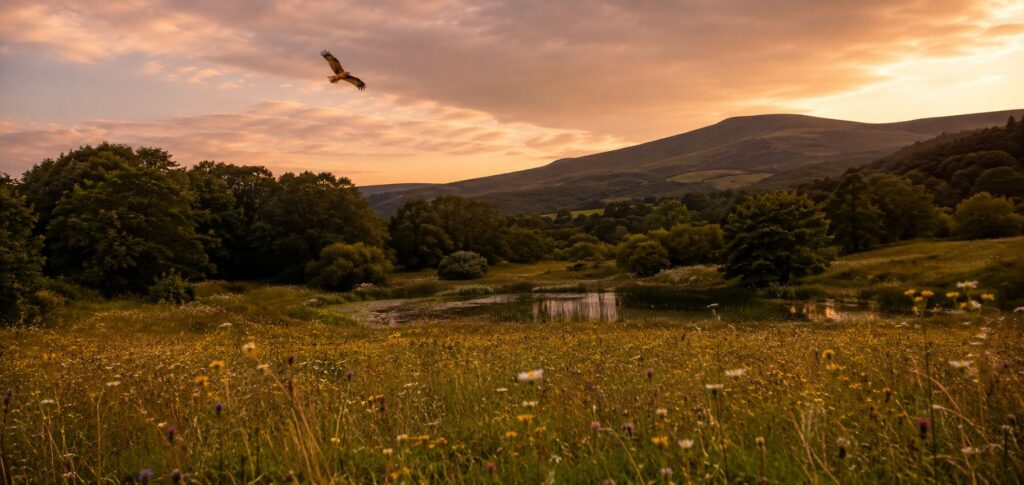
You don’t need to drive anywhere to start your list. Graig Fawr sits on a 40-acre conservation farm with pasture, wildflower meadow, mature woodland and a central wildlife pond, and the farm adjoins open common land.
From the raised patio, red kites and buzzards are regular sights over the pasture. In spring, Canada geese nest on the pond alongside moorhens and wild ducks, and cuckoos can be heard across the land. Summer brings swallows and house martins, with tawny owls calling after dark. From early October, redwings and fieldfares arrive from Scandinavia and Iceland to work the hedgerows, and overwintering waterfowl use the pond through the colder months.
For a closer look at the farm’s own birds, read Red Kites, Cuckoos and Wild Ponds.
What to see in each season
The best time for a birdwatching holiday depends on what you want to see. Spring is the obvious choice for woodland migrants, but winter has its own rewards and far fewer people.
| Season | What to look for | Where to try |
|---|---|---|
| Spring | Pied flycatcher, redstart, wood warbler, tree pipit, wheatear, cuckoo | Carngafallt, Gilfach, Cors y Llyn, Dinas |
| Summer | Common sandpiper, whinchat, curlew, spotted flycatcher, ospreys, hobby (occasional) | Elan Valley, Gilfach, Dyfi Wildlife Centre, Cors y Llyn |
| Autumn | Ring ouzel on passage, merlin, redwing, fieldfare | Elan Valley rowans and uplands, the farm’s hedgerows |
| Winter | Hen harrier, short-eared owl, goldeneye, common scoter, goosander, snipe, woodcock | Elan Valley, Cors Caron, Llanbwchllyn, Cors y Llyn |
| All year | Red kite, dipper, grey wagtail, goosander, buzzard | Almost everywhere; rivers for the dipper |
Spring is when the oakwoods come alive. The dawn chorus at Carngafallt is the reason many birders come, and a short break of two or three nights in May can be enough to see all three woodland specialities. Our guide to spring in the Cambrian Mountains covers the season more widely.
Summer is quieter in song but good for upland birds and river birds, and long evenings give you bats and owls after a day out.
Autumn is the season for movement. Ring ouzels pass through the Elan Valley, where they feed on rowan berries, and thrushes pour in from the north. See autumn in the Cambrian Mountains for more.
Winter suits patient birders. The trees are bare, the raptors are easier to pick out over open ground, and you may have a reserve to yourself. Our November wildlife diary gives a feel for the start of the season on the farm.
Where to go birdwatching near Builth Wells
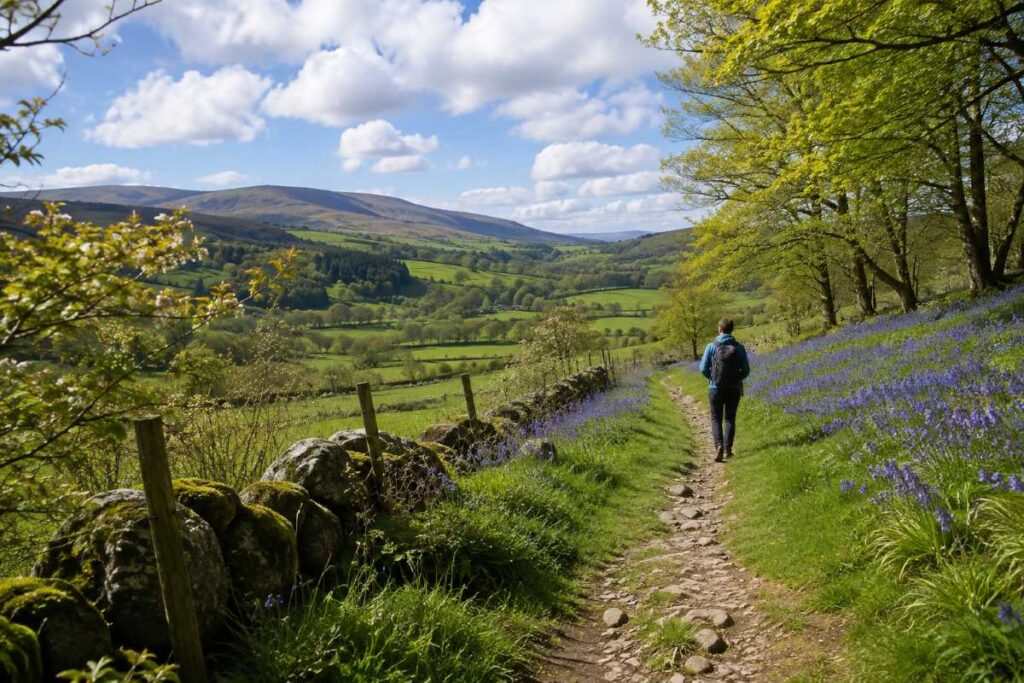
These four sites are close enough to combine with an easy day. Check each site’s page before you travel, as access and facilities change.
Cors y Llyn National Nature Reserve
About three and a half miles north-west of Builth Wells, this small Natural Resources Wales reserve has a 0.7-mile accessible route on boardwalk and mesh paths around a bog with stunted Scots pines. In summer, look for pied flycatchers, redstarts and wood warblers, and for the occasional hobby hunting insects. In winter it holds woodcock and snipe. There are no staff on site, and the postcode covers a wide area, so use the directions on the Natural Resources Wales page rather than relying on a sat nav. Waterproof footwear helps from autumn to early spring.
Llanbwchllyn Lake
South-east of Builth Wells, this Radnorshire Wildlife Trust reserve is the place for a winter wildfowl session. Goosander, teal, tufted duck, pochard and goldeneye overwinter on the lake, while great crested grebe and reed warbler breed in the reedbeds and water rail use the reeds all year. A wooded path of around 200 metres leads to a bird hide. Parking is roadside only and access is limited, and dogs are not permitted, so leave them at home for this one.
Gilfach Nature Reserve
In the Marteg Valley off the A470 north of Rhayader, Gilfach covers 166 hectares of river, oakwood and upland pasture. Over 70 bird species have been recorded, and more than two-thirds of them breed here. It is known for pied flycatchers, dippers and redstarts, with whinchat, redpoll, spotted flycatcher, linnet, yellowhammer and cuckoo also on the list. Dogs must be on a lead, and cattle with calves can mean some fields and paths are closed. Entry is by donation.
The Elan Valley
The Elan Valley Estate is big enough for several days, and our Elan Valley guide covers the reservoirs and trails. For birders, start with RSPB Carngafallt. It has no car park of its own, so park at the Elan Valley Visitor Centre, where there is a small charge, and walk in. The oakwood here is the best-known local site for pied flycatcher, redstart and wood warbler.
Then head for the water and the high ground. The Elan Valley Trust’s bird list names Dol y Mynach, in the Claerwen Valley, for wintering common scoter and goldeneye. Mandarin ducks breed on the reservoirs, common sandpipers use the shores in summer, and goosanders fish the Claerwen and Elan rivers. Higher up, look for wheatear from late March, whinchat from April, and merlin in summer and autumn. Hen harrier and short-eared owl are winter birds of the wet upland bog, and need time and luck.
Book direct and save
Book directly with the hosts — send a brief enquiry with your dates and they will come back to you with them confirmed. Direct rates start at £130 a night for a short break, or £105 a night for a week or more, and there are no booking fees. Prefer to see a live calendar first? Graig Fawr is on Airbnb too.
Worth a longer day out
These sites sit further away and suit a week-long holiday better than a weekend. Allow for slow roads and check the reserve’s own page on the day.
RSPB Gwenffrwd-Dinas
Beyond Llyn Brianne, near Rhandirmwyn, this is a classic Welsh oakwood reserve. The 2.5-mile circular trail begins on a boardwalk and takes about two hours, though parts of it by the River Tywi are rocky, uneven and slippery when wet. Expect pied flycatcher, redstart, common sandpiper, dipper and grey wagtail in summer, with bluebells in May.
Cors Caron National Nature Reserve
North of Tregaron, this great raised bog is one of the better winter options. Natural Resources Wales lists red kite, hen harrier, curlew and skylark, and its 1.6-mile accessible walk takes you along a boardwalk to a large hide. It is a good choice in rough weather, since the hide gives you shelter and a wide view.
Ynys-hir and the Dyfi
A full day’s outing to the coast takes in the Dyfi estuary. RSPB Ynys-hir has oakwood, reedbed, pools and saltmarsh, with hides and a visitor centre, and it is known for wintering wigeon, teal, lapwing and barnacle geese. Ospreys are the summer draw on the far side of the estuary, at the Dyfi Wildlife Centre run by Montgomeryshire Wildlife Trust. They are typically present from April to September, and the centre’s opening varies by season, so check before you set out.
How long should a birdwatching holiday be?
A short break of two or three nights suits one clear aim, such as a spring visit for the oakwood birds or a winter weekend looking for wildfowl. Pick one or two nearby sites and spend the rest of your time on the farm.
A week gives you room for the weather. Mid Wales can be wet, and birds don’t keep to a timetable, so spare days are useful. With seven nights you can cover the Elan Valley properly, add Gilfach and Cors y Llyn, and still have a day for Gwenffrwd-Dinas, Cors Caron or the Dyfi. Direct nightly rates also fall on longer bookings.
Practical planning for birdwatchers
A few things make a real difference on a birdwatching holiday here.
- Bring your own optics. Binoculars are the one essential. A scope helps at reservoirs and on estuaries, but is more than you need in the woods.
- Learn a few songs first. Wood warbler and redstart are often heard before they’re seen. Spring listening practice pays off.
- Go early for song, later for raptors. The dawn chorus peaks at first light, while kites and buzzards tend to appear as the day warms.
- Plan on a car. There’s no public transport worth relying on, and the good sites are spread out.
- Dress for the hills. The weather changes fast above the reservoirs, and mobile signal can be patchy on higher ground. Download maps before you leave the wifi.
- Keep to the paths. Ground-nesting birds are easily disturbed in spring and early summer, and the most threatened species are the ones that suffer most.
If you bring a dog, check each reserve’s rules. On open access land in Wales, dogs must be on a short lead from 1 March to 31 July, and around livestock at any time of year. RSPB Carngafallt asks for leads on its main trails, Gilfach requires them, and Llanbwchllyn doesn’t allow dogs. Owners of nervous dogs may find our guide to reactive dogs at Graig Fawr useful.
Why Graig Fawr suits a birdwatching holiday
Graig Fawr is a stone barn holiday cottage for two on a 40-acre conservation farm near Beulah, in the parish of Llanafanfawr. It suits birders for a simple reason: the birds start at the door.
The raised patio looks over the wildlife pond and pasture, so a morning coffee can double as a first hour of watching. Mown trails cross the farm to the meadow and woodland, and the common land beyond is open to walk on. The Elan Valley is around 10 to 15 miles north, and Gigrin Farm is about 10.8 miles away.
At the end of a long day the barn is warm, with underfloor heating throughout, run from the farm’s two air source heat pumps and solar panels. Indoor wifi is reliable, which helps when you want to check a call against a recording or look up a sighting. There’s no hot tub and no pool, and we doubt you’ll miss them.
Up to two dogs are welcome at no extra charge, though some fields hold sheep and others adjoin sheep fields, so keep a close eye on them. As a holiday let, it takes bookings from two nights up to 28, so you can come for a short break or take a fortnight over the whole of May. Paul and Kirstie look after the holiday cottage and manage the farm for conservation.
Plan your birdwatching holiday at Graig Fawr
Bring your binoculars and start your holiday on the patio. Check availability for Graig Fawr on Airbnb, or book direct with Paul and Kirstie, with no booking fees. Direct rates start from £130 a night for a short break and from £105 a night for seven nights or more, varying by season. There’s a two-night minimum, rising to three nights in July and August. Any questions about the farm’s birds or the best time to come? Email hello@wildahome.co.uk.