

Wildflower Meadows in Derbyshire: A County Guide to Landscape, Ecology, and Restoration
Derbyshire is one of the best counties in England to understand what a wildflower meadow should look like — and one of the few where enough still survive to prove the point. The wildflower meadows in Derbyshire range from the flower-rich limestone dales of the White Peak to the broad river floodplains of the Trent and Dove in the south. Between those extremes lies a county of extraordinary botanical variety, shaped by geology, altitude, and a long history of traditional land management.
Nationally, it’s a different story. The UK has lost around 97% of its species-rich grassland since the 1930s — roughly 3 million hectares replaced by improved pasture, arable cultivation, or development. What remains is fragmented, often in poor condition, and under continued pressure. Derbyshire has fared better than most, largely because the rugged terrain of the Peak District resisted the ploughing campaigns that transformed more tractable lowland counties. But ‘better than most’ is not the same as secure, and those working in restoration here know there is still much to do.
This guide covers the county from the ground up: the geology that drives the botany, the flagship sites worth knowing about, the reasons meadows declined, and what it looks like to restore them well.
The geology behind wildflower meadows in Derbyshire
You can’t understand Derbyshire’s meadow landscape without understanding its rocks. The county splits into three distinct zones, each producing a different soil chemistry, drainage pattern, and botanical outcome.
The White Peak: limestone and low-nutrient alkaline soils
The White Peak occupies the central plateau of the Peak District, underlain by Carboniferous limestone laid down in a tropical sea around 340 million years ago. This bedrock weathers into thin, well-drained, nutrient-poor alkaline soils — conditions that most agricultural grasses find difficult, but which wildflowers exploit brilliantly. The biological logic is straightforward: where nutrients are scarce, competitive grasses can’t dominate, and slower-growing, lower-statured forbs get a foothold.
It is precisely this “stressed” environment that allows a single square metre of White Peak grassland to support more than 40 plant species — a density of diversity that fertile improved pasture cannot approach.
The Dark Peak: gritstone, shale, and acidic upland pastures
Encircling the limestone core, the Dark Peak is formed from Millstone Grit — the product of ancient river deltas that buried the tropical limestone sea. These harder, silica-rich rocks produce thin, acidic, and often peaty soils. The plant communities here are distinct from the White Peak: acid grassland, heath, and rough pasture rather than species-rich calcareous sward. Ecologically important in their own right, these upland areas provide critical breeding habitat for ground-nesting birds including curlew, lapwing, and golden plover.
Lowland river valleys: neutral alluvial meadows
In the south and east of the county, the Trent, Dove, and Derwent rivers have deposited deep layers of alluvium, creating neutral, moderately fertile soils. These are the traditional English floodplain meadows — managed for hay production over centuries, flooded each winter, and cut once in late summer. At their best, they support Great Burnet (Sanguisorba officinalis), Meadowsweet (Filipendula ulmaria), and Cuckooflower (Cardamine pratensis), alongside a suite of grasses and sedges that tolerate periodic inundation.
Key wildflower meadow sites in Derbyshire
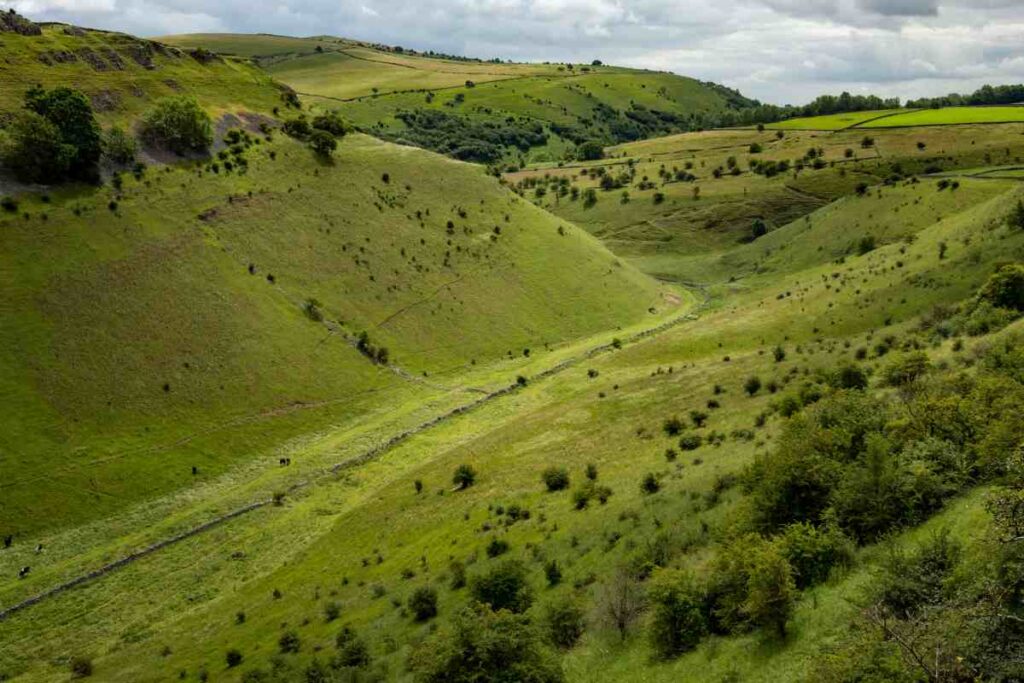
The county’s best surviving meadows are concentrated in the White Peak dales, where topography made intensive agriculture impractical and legal designations have provided some protection. These are not just pretty valleys — they are reference points for what restoration should aim to achieve.
Lathkill Dale
One of the finest limestone valleys in Britain, Lathkill Dale southwest of Bakewell is managed as a National Nature Reserve. Its seasonal flowering sequence is a reliable guide to the ecology: Primrose (Primula vulgaris) and Wood Anemone (Anemone nemorosa) in early Spring, Early Purple Orchid (Orchis mascula) and Cowslip (Primula veris) through May, and Common Rock-rose (Helianthemum nummularium) dominating the open dalesides from June into July. The Rock-rose is not merely decorative — it is the larval food plant of the Brown Argus butterfly and the Cistus Forester moth, two species whose presence depends entirely on it being here.
The hydrology adds further complexity. The River Lathkill periodically vanishes into old lead mining shafts during dry periods — a feature of the karst landscape that creates a mosaic of wet and dry microclimates within the valley floor, each supporting a slightly different community of plants and invertebrates.
Cressbrook Dale
Cressbrook Dale, sometimes called Ravensdale, is a dry limestone gorge with a winterbourne stream — the Cress Brook — that flows significantly only in wetter months. This intermittent hydrology creates a degree of environmental stress that further concentrates botanical diversity. The Dale holds the northern limit of Dwarf Thistle (Cirsium acaule) on its sun-warmed south-facing slopes, and its meadow areas to the north of Cressbrook village carry a history shaped directly by the lead-ore washing operations that once used the valley’s water supply.
Miller’s Dale Quarry
Miller’s Dale is a reminder that some of Derbyshire’s best wildflower habitats exist on former industrial ground rather than despite it. The disused quarry floor, nutrient-poor and largely undisturbed, supports Fragrant Orchid (Gymnadenia conopsea), Cowslip, Harebell (Campanula rotundifolia), and Lady’s Bedstraw (Galium verum) — species that would be rapidly outcompeted if the ground were enriched or disturbed. The quarry face crevices provide nesting sites for kestrel and jackdaw; the wildflower sward below supports day-flying Six-spot Burnet moths and Common Blue butterflies.
Rose End Meadows
Rose End Meadows near Cromford is Derbyshire’s “Coronation Meadow” — its most significant surviving example of traditionally managed limestone pasture. The reserve consists of 16 small fields that have never received artificial fertiliser, making them a living record of pre-intensification Derbyshire. Pyramidal and Bee Orchids grow here alongside Betony (Betonica officinalis) and Common Knapweed (Centaurea nigra). The site is linked to nearby Gang Mine SSSI, creating a connected corridor through which species can move — the kind of landscape-scale connectivity that isolated fragments cannot provide on their own.
Lowland reserves: Derwent Meadows and Willington Wetlands
In the lowlands, Derwent Meadows near Derby supports a mosaic of wet and dry grassland, including Sneezewort (Achillea ptarmica), Knapweed, and Bird ‘s-foot Trefoil (Lotus corniculatus), despite its proximity to industrial land. Willington Wetlands, a former gravel pit restoration on the Trent, demonstrates what is possible further south — a beaver-managed wetland complex now incorporating wet meadow habitat that supports Orange-tip butterflies whose larvae feed on the Cuckooflower that has colonised the margins.
Why Derbyshire's wildflower meadows declined — and what changed
The narrative of decline is the same across Britain, but the detail matters. In Derbyshire, the post-war shift from traditional hay meadow management to silage production removed the conditions that had sustained these communities for centuries.
The traditional hay cycle gave wildflowers time to grow. Meadows were closed up in Spring, flowers set seed through Summer, and a single cut was taken in late August when nutritional value peaked for winter fodder. This benign regime allowed more than 100 species to coexist in a single field. Silage changed the arithmetic entirely: cut three or four times a year from May onwards, heavily fertilised to maximise grass yield, and the wildflowers could not complete their cycle. Add to that the replacement of horse-drawn mowers with high-speed machinery, and the ecological space available to meadow species contracted sharply within a generation.
The measurable consequence in Derbyshire, as elsewhere, is that species like Linnet, Goldfinch, and Brown Hare — all dependent on the botanical richness of unimproved grassland — became increasingly confined to the surviving fragments. The fragments themselves became more isolated as the agricultural matrix around them was simplified.
Restoring wildflower meadows in Derbyshire: what actually works
Derbyshire’s restoration work has generated some clear principles, applied across projects from the large-scale Meadow Makers programme — which aims to create 100 hectares of species-rich grassland on verges and field margins — down to individual farm-scale restoration under Countryside Stewardship.
The first step is almost always reducing soil fertility. Wildflowers evolved in low-nutrient conditions. Any restoration site that has been in improved grass for decades will need years of management — repeated hay cuts with arisings removed, or light grazing — before nutrient levels drop enough to allow establishment. Adding seed too early, to a sward still fertile enough to support vigorous Ryegrass, produces predictable results: the Ryegrass wins.
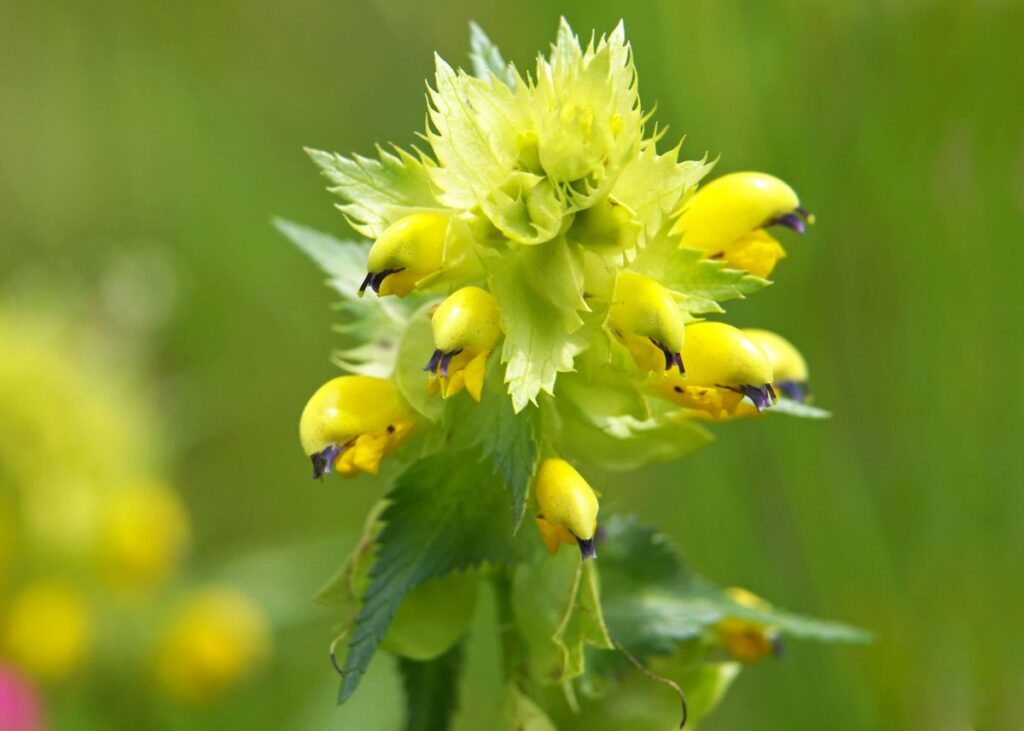
Where soil nutrient reduction alone is too slow, Yellow Rattle (Rhinanthus minor) is the intervention of choice. This annual hemiparasite attaches to the roots of grasses and directly reduces their vigour, creating space for wildflowers to establish.
It must be sown in autumn—the seed requires a cold stratification period to germinate the following spring—and the meadow should be cut and cleared in late summer to allow Yellow Rattle seed to fall to the ground before the cycle repeats.
Yellow Rattle Seed
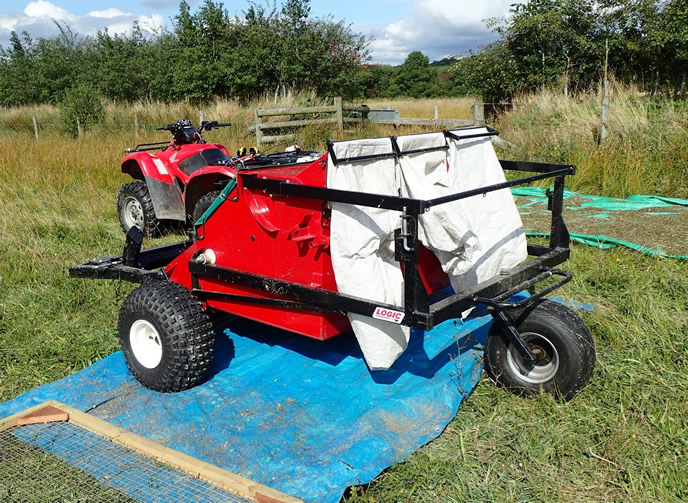
For sites where the aim is to recreate a locally appropriate sward rather than simply establishing a generic wildflower mix, green haying offers a more faithful result. Fresh hay cut from a donor meadow — ideally a local one matching the NCA (National Character Area) of the restoration site — is spread directly onto prepared ground while seed is still attached. The genetic diversity transferred this way is far greater than any bagged seed mix can provide, and the resulting meadow reflects the regional provenance of its source.
Locally sourced wildflower seeds for Derbyshire projects
For restoration projects across Derbyshire — whether on limestone grassland in the White Peak, neutral alluvial ground in the Dove Valley, or a garden paddock in the Derwent catchment — seed provenance is not a minor detail. It is the difference between a meadow that integrates with the local ecology and one that merely resembles it.
Wildahome supplies wildflower seed harvested from donor sites within specific National Character Areas, matched to the soil type and landscape context of your project.
Whether you need a limestone-grassland mix suited to the White Peak’s alkaline soils, a flood-meadow mix for lowland Derbyshire, or Yellow Rattle for a new establishment, we can advise on what is appropriate for your site and sowing window.
Ready to plan your Derbyshire meadow?
Browse our locally sourced seed mixes for the East Midlands and the Peak District, or get in touch to discuss your site and the right approach for your ground. Wildahome supplies seeds matched to your landscape—not just your county.
Frequently Asked Questions
What are the best wildflower meadows in Derbyshire to visit?
Lathkill Dale, Cressbrook Dale, and Rose End Meadows near Cromford are among the finest surviving examples. Miller’s Dale Quarry and Hartington Meadows are also worth visiting. The White Peak dales are the most species-rich, with peak flowering from May to July, depending on the site. Derwent Meadows near Derby is a good, accessible example of lowland restoration.
Which wildflower seeds are best suited to Derbyshire’s limestone soils?
On the alkaline, free-draining soils of the White Peak, look for species that have evolved in low-nutrient limestone grassland: Cowslip (Primula veris), Common Rock-rose (Helianthemum nummularium), Salad Burnet (Sanguisorba minor), Wild Thyme (Thymus polytrichus), Small Scabious (Scabiosa columbaria), and Kidney Vetch (Anthyllis vulneraria). Yellow Rattle is essential if you’re working on ex-improved ground.
Can I create a wildflower meadow on clay soil in Derbyshire?
Yes — the lowland parts of the county, particularly around the Trent Valley and the Erewash, sit on heavier clay. These soils suit a different species palette: Ragged Robin (Silene flos-cuculi), Meadow Cranesbill (Geranium pratense), Betony (Betonica officinalis), and Common Knapweed. Site preparation is more demanding on clay — drainage, surface scarification, and nutrient reduction are all critical to establishment.
When is the best time to sow wildflower seeds in Derbyshire?
Late Summer to early Autumn (August to October) is the preferred sowing window for most native wildflower species, including Yellow Rattle which requires autumn sowing to stratify over Winter. A Spring sowing window (March to May) also works for many species but will not include Yellow Rattle. Avoid sowing in a dry Summer or frozen ground in mid-Winter.
How long does it take to establish a wildflower meadow in Derbyshire?
Allow three years for a newly sown meadow to develop meaningful diversity, and five or more to begin approaching the richness of an established site. Annual species like Cornflower may flower in year one; perennial forbs typically establish more slowly. Consistent management — cutting and removing arisings — is as important as the initial sowing, particularly in the first three years.
Does local provenance matter when buying wildflower seeds for Derbyshire?
It matters more than most people realise. Wildflower ecotypes are adapted to local soils, rainfall patterns, and pollinator communities over many generations. Seed sourced from a different region may establish initially but often performs less well over time and can introduce genetic diversity that is inappropriate for the local landscape. For restoration projects with conservation or BNG objectives, local provenance is increasingly required by ecologists and planning conditions.
What is Yellow Rattle and why is it important in Derbyshire meadow restoration?
Yellow Rattle (Rhinanthus minor) is a native annual that parasitises the roots of grasses, reducing their vigour and creating gaps in the sward where wildflowers can establish. In Derbyshire, where competitive grasses still dominate much ex-improved grassland, it is often the most effective single intervention available. It must be sown in Autumn on bare soil or a very short sward, and the meadow should be cut in late Summer to allow the seed to set before the cycle repeats.