

Bee & Butterfly Wildflower Seed Mixes
Two versions of one pollinator-focused mix: British native wildflowers selected for a long run of nectar and pollen from spring to autumn. The 100% version is flowers only — no grasses, no cultivars — for over-sowing existing grass, borders and flower strips, sown at 3 g/m². The 80/20 version adds 80% fine native meadow grasses so you can create a complete pollinator meadow from bare ground, sown at 5 g/m². Both suit a range of soil types; choose by whether your site already has grass, and by how you intend to cut and manage it afterwards.
Choose this if…
- You want a pollinator-first planting rather than a habitat-specific meadow.
- Bee & Butterfly 100% — you already have grass, or want a flower-only strip.
- Bee & Butterfly 80/20 — you are sowing a new meadow from bare ground. For other soils and settings, see all 80/20 mixes and 100% mixes.
-
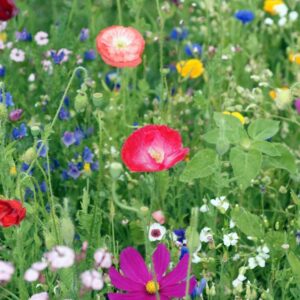 80/20 Wildflower Meadow Seed Mixes
Bee & Butterfly 80/20 Meadow Mix
£19.80 – £2,592.00Price range: £19.80 through £2,592.00 inc VAT Select options This product has multiple variants. The options may be chosen on the product page -
100% Wildflower Seed Mixes (No Grass)
Bee & Butterfly Wildflower Meadow Mix
£34.80 – £6,960.00Price range: £34.80 through £6,960.00 inc VAT Select options This product has multiple variants. The options may be chosen on the product page
More help choosing
Flower-only or grass-and-flower?
The wildflower selection is the same in both products; the difference is the grass. The 100% mix is the one to use where a sward already exists — a lawn, paddock, orchard or school field — or where you want a dense flower strip along a fence, drive or margin. The 80/20 mix is a complete meadow mixture for bare ground: the fine grasses knit the sward together in year one and give you something that can be cut once a year and walked on, while the flowers build from year two.
Site and management
Both mixes are listed for a range of soil types and flower from spring to October (the 100% mix from May). They still need what every wildflower sowing needs: low fertility, an exposed seedbed, and a cut-and-remove regime once a year in late summer after seed has set. On very specific ground — thin chalk, heavy wet clay, acid heath, dense shade — a habitat-matched mix will usually establish more reliably than a general pollinator mix; pair it with Bee & Butterfly 100% if you want to boost the flower content.
What to expect
A good pollinator mix provides a succession of flowers rather than a single flush, so insects find food across the season. That is what this selection is built for. It is not a guarantee of any particular species turning up, and the value comes from managing the area well year after year, not from the sowing alone.
Sowing and packs
Spring (March–May) or early autumn (August–September). Packs run from 20 m² (100%) or 10 m² (80/20) up to field scale, and both are available as Seed & Mulch Mats for banks and small plots.
Frequently asked questions
What is the difference between the Bee & Butterfly 100% and 80/20 mixes?
The same wildflower selection; the 80/20 version adds 80% fine native grasses to create a complete meadow on bare ground. The 100% version is flowers only.
Which should I choose?
100% if the area already has grass or you want a flower strip; 80/20 if you are starting from bare, cultivated ground.
Does the mix suit my soil?
Both are listed for a range of soil types. For extreme conditions (chalk, heavy clay, wet, acid, shade), consider the matching habitat mix instead, or alongside.
When should I sow?
Spring (March–May) or early autumn (August–September), onto a low-nutrient, exposed seedbed.
How much seed do I need?
100%: 3 g per square metre. 80/20: 5 g per square metre. Choose the pack size by area on the product page.
Related guides and categories
- All 80/20 meadow mixes
- All 100% wildflower mixes
- Bee and butterfly seed mats
- How to Establish a Wildflower Meadow
Sowing for a school, community garden or campsite? We can advise on the pack size and the simplest cutting routine for the site.