

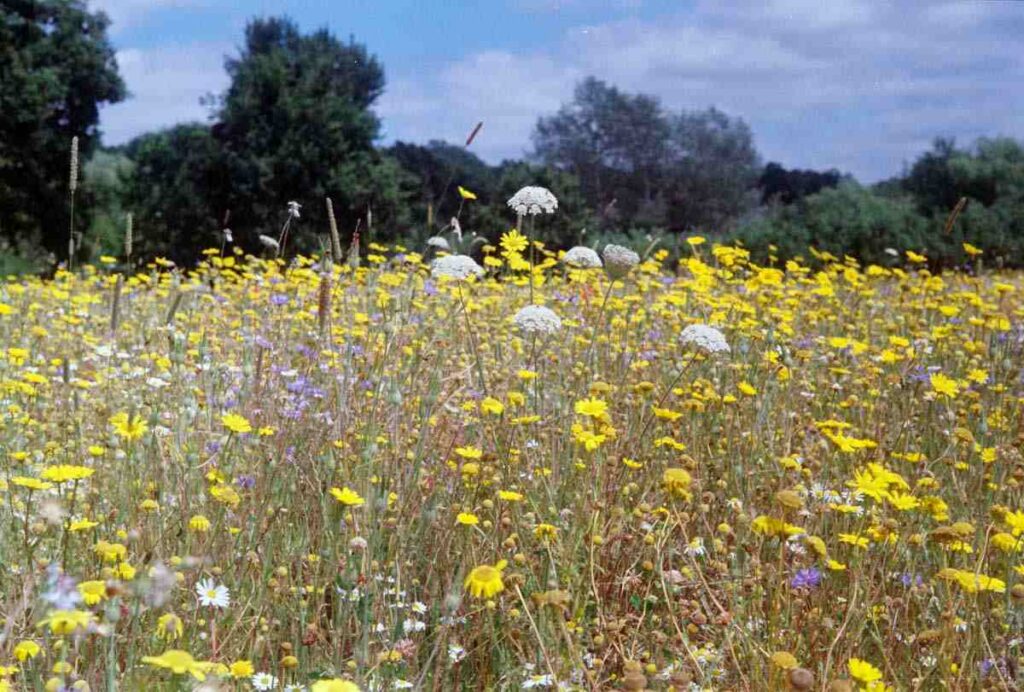
How to Establish a Wildflower Meadow: The Complete Guide
Wildflower meadows don’t happen by accident. Behind every drift of Ox-eye Daisy and Common Knapweed swaying in a July breeze sits a season or two of unglamorous groundwork: getting the fertility down, clearing the competition, timing the sow and, above all, cutting at the right moments afterwards. Learning how to establish a wildflower meadow properly is what separates a meadow that is still flowering in ten years from one that has quietly gone back to coarse grass by year three.
This guide covers the whole method, in the order you will meet it: understanding what a meadow actually is, reading your site, dealing with fertile ground, choosing and measuring your seed, preparing the ground, sowing, the first year, and the annual cycle that keeps a meadow rich for decades. The principles hold whether you are sowing a garden border or a twenty-acre field. If you are starting small, our companion guide on how to start a wildflower meadow in a garden is a gentler way in.
Establishment at a glance
- Fertility first. Wildflowers win on poor ground. Never add manure, compost or fertiliser.
- Bare soil. Seed needs contact with soil. On bare ground, prepare a fine, firm seedbed. Into existing grass, scarify until at least half the surface is bare.
- The right rate. 3 g/m² for a 100% wildflower mix, 5 g/m² for an 80/20 meadow mix. Add up to 30% on slopes, exposed sites and when over-sowing.
- The right time. Mid-August to late October is best. Late March to May works. Avoid November to February.
- On the surface. Mix seed with dry sand, sow in two halves at right angles, then roll or tread it in. Never bury it deeper than about 5 mm.
- Cut in year one. Cut back to 50–60 mm whenever growth reaches 100–150 mm, and take every cutting away.
- Hay cut every year after. Leave it to flower from March, cut in late July or August, and take the hay off.
What you are actually making
A wildflower meadow is grassland, not a flower bed. In a traditional hay meadow, fine grasses and wildflowers grow together in a low-fertility sward that is left to flower and set seed in summer, cut for hay, then grazed or mown short through autumn and winter. Every part of that cycle matters. The cut and removal takes nutrients off the land each year; the short winter sward lets light reach low rosettes; and the summer rest lets flowers seed back into the gaps.
That is why a meadow is a management system as much as a seed mix. Sowing is a single afternoon. The cutting regime is what turns that afternoon into a meadow.
It also explains the two kinds of mix we sell. An 80/20 wildflower meadow mix is 80% fine native grasses and 20% wildflowers, which is what a natural meadow looks like. A 100% wildflower mix has no grass, and is the right choice for over-sowing into existing grassland, for borders, and where you want the most flower for your money. Our 80/20 vs 100% guide sets out the trade-offs in detail.
Know your site
Before you buy any seed, spend half an hour looking at the ground. Four things decide which mix will thrive and how much preparation you need.
- Soil type. Dig a spade-depth hole. Sticky, grey or orange clay that holds water suits a heavy clay mix. Thin, pale, stony soil over chalk or limestone suits our chalk and limestone mix. Sandy or peaty ground with bracken, heather or gorse nearby points to the acidic soils mix. Deep, dark river-valley soil suits the loam and alluvial mix.
- Wetness. Ground that floods in winter or stays soft into May needs species that tolerate wet feet, such as those in the wetland and pond mix.
- Light. Most meadow flowers need full sun for at least half the day. Under trees or against a north wall, choose the woodland and heavy shade mix.
- What is growing now. The existing plants are the best soil test you have. They tell you about fertility, which matters more than anything else on this list.
Where you are in the country matters too. Seed grown from local populations is adapted to your climate and soils, which is why we publish wildflower seed guides for each county and explain why locally sourced seed matters.
Is your ground too fertile?
This is the question that decides most meadows, and the one most guides skip. Wildflowers are not fussy about soil type, but they are very sensitive to fertility. On rich ground, vigorous grasses, docks and nettles grow so fast that slower wildflowers are shaded out within a season. The usual culprit is phosphorus, built up by years of fertiliser, manure or grass clippings left to rot. Unlike nitrogen, phosphorus stays put in the soil for decades.
Signs your ground is too fertile:
- Lush, dark green grass that needs cutting every week in summer
- Nettles, docks, creeping thistle, cleavers or chickweed growing strongly
- Ryegrass and white clover dominating a former lawn or improved pasture
- A history of manure, slurry, fertiliser or garden compost
What to do about it, from quickest to slowest:
- Strip the topsoil. Removing the top 100–200 mm takes most of the nutrients with it and exposes the poorer subsoil wildflowers prefer. It is the fastest fix and the best one for small areas. Use the stripped soil elsewhere, for example in raised vegetable beds.
- Deep inversion. On larger sites, a deep plough that turns the soil over to 0.6–1.0 m buries the fertile layer beneath poorer soil. It needs a contractor with the right kit.
- Cut and remove. Cutting regularly and taking every cutting away draws fertility down slowly. It works, but expect several years on very rich ground.
- Use yellow rattle. On moderately fertile grassland, yellow rattle weakens the grasses enough to give wildflowers a foothold. More on this below.
Avoid this: adding manure, compost, topsoil or fertiliser to “help the seed along”. It does the opposite.
Create, restore or enhance?
Your starting point decides your method. There are three routes.
- Create from bare ground. Former arable, a building plot, a stripped lawn or a new bank. Prepare a seedbed and sow a full meadow mix. This gives the most control and the quickest results.
- Restore existing grassland. A lawn, paddock or field you want to keep growing. Weaken the grass, open up bare patches, and over-sow with a 100% wildflower mix and yellow rattle.
- Enhance a sward that already has some flowers. Old pasture with a few knapweeds and buttercups. Often the right move is to change the management first, with a later hay cut and no fertiliser, then add seed or green hay to the gaps.
If you can’t decide, look at what is growing. A sward already showing Bird’s-foot Trefoil, Selfheal, knapweed or buttercups is worth keeping and enhancing. A sward of ryegrass, docks and nettles is usually better stripped and started again.
Choosing your seed
Match the mix to the ground, not the picture on the packet. The site checks above will point you to a soil or habitat mix. If you are unsure, our traditional wildflower meadow mix and general purpose mix suit the widest range of ordinary soils. For pollinators specifically, browse our bee and butterfly mixes and our guide to the best wildflower seeds for pollinators.
Three further choices make a big difference:
- Add yellow rattle to almost any meadow sown in autumn, and to every over-sowing into existing grass.
- Add a cornfield annual nurse crop if you want colour in the first summer. See the section on nurse crops below.
- Consider single species to strengthen a mix or fill a particular gap. Our single-species seed range covers the main meadow plants.
For bigger or unusual sites, we put together bespoke wildflower seed mixes to suit the soil, the end use and the budget.
How much seed do you need?
Sowing too thickly is one of the commonest mistakes. Wildflower seed is small and expensive, and extra seed simply produces crowded seedlings that compete with each other.
| Mix | Rate | Per hectare | A 100 g pack covers |
|---|---|---|---|
| 100% wildflower | 3 g/m² | 30 kg | about 33 m² |
| 80/20 meadow mix | 5 g/m² | 50 kg | about 20 m² |
Add up to 30% to these rates on slopes, on exposed or windy sites, and when over-sowing into existing grass. Our seed coverage calculator works out the quantity and nearest pack size for your area in square metres, acres or hectares.
Preparing bare ground
On bare ground, the aim is a fine, firm, weed-free seedbed. Good preparation saves you years of weeding later.
- Clear existing growth. Remove turf, weeds and debris. Lift turf rather than digging it in, which only feeds the soil.
- Cultivate lightly. Dig, rotavate or harrow to around 100 mm. Going deeper brings up more buried weed seed.
- Make a stale seedbed. Leave the cultivated ground for 2–4 weeks so dormant weed seeds germinate.
- Kill the flush shallowly. Hoe or harrow off the seedlings, working no deeper than about 20 mm so you don’t bring up the next layer of seed. On weedy ground, repeat the stale seedbed two or three times.
- Finish fine and firm. Rake to a fine crumb, then firm by treading or rolling so a footprint barely shows. Seed on a loose, fluffy surface sinks too deep or dries out.
On heavy ground, work only when the soil is dry enough to crumble. Our article on sowing wildflowers on heavy clay covers the extra care clay needs.
Sowing into existing grass
Over-sowing a lawn or field is cheaper and less disruptive than stripping it, but it is harder. The existing grass is already established and will out-compete seedlings unless you weaken it first.
- Cut short. In late summer, mow or graze to about 25 mm and remove every cutting.
- Open up the sward. Scarify hard, harrow or rake until at least 50% of the surface is bare soil. 70% is better. A powered scarifier or a chain harrow saves a lot of effort on bigger areas.
- Sow a 100% wildflower mix with yellow rattle at the upper end of the rate, then roll.
- Keep the grass short through autumn so seedlings get light.
Be realistic. Over-sowing typically establishes roughly a fifth to a third of the seed you sow. That is normal, and the yellow rattle will steadily open up more space in the following years.
When to sow
- Mid-August to late October: best. The soil is warm and moist, and many native species need a winter’s cold before they germinate. Autumn sowing gives the most even establishment.
- Late March to May: workable. Good on heavy, waterlogged soils that are unworkable in autumn. Some species will wait until the following spring to appear, and dry spells are a risk.
- November to February: avoid. Cold, wet soil, slugs and birds take a heavy toll on seed lying on the surface.
Yellow rattle is the exception that needs planning. It must be sown in autumn, before the end of November, from current-season seed. More on timing in our autumn sowing guide and our piece on the best times to sow.
How to sow
Wildflower seed is tiny and many species need light to germinate, so sowing is about getting it evenly onto the surface and keeping it there.
- Bulk it up. Mix the seed with dry silver sand or kiln-dried sand, at three to four parts sand to one part seed. The pale sand shows you where you have sown.
- Sow in two halves. Divide the seed in two. Broadcast one half walking up and down, the other walking across at right angles. Stir the bucket as you go, because small seeds sink to the bottom.
- Settle it in, don’t bury it. The aim is to press seed into the soil surface, not cover it. Nothing should end up deeper than about 5 mm.
Rolling gives the best take-up. A roller presses seed into the damp layer just below the surface so moisture wicks straight into it. It holds seed in place against wind and heavy rain during the fortnight when most losses happen, slows the surface drying out, and cannot bury the seed however heavy-handed you are. On anything above a few square metres it is worth hiring or borrowing one. On garden-scale patches, treading the area or a light raking with a spring-tine or leaf rake both work.
What kills a sowing: raking the seed in as you would grass seed, rotavating or power-harrowing after sowing, drilling at normal depth, or top-dressing with soil or compost. All of these bury the seed below the depth it can germinate from.
After sowing, water only if the weather turns very dry. Autumn rain usually does the job.
Sowing with a wildflower seed mat
A wildflower seed mat is a biodegradable mat with seed built in. It gives even coverage and protects the seed while it germinates, which is useful on small areas, gentle slopes, and anywhere birds or wind are a problem. Prepare the ground exactly as for direct sowing, then:
- Dampen the prepared soil.
- Lay the mat directly onto the surface.
- Dampen the mat.
- Spread the supplied soil improver evenly over the mat.
- Cover with 25–35 mm of fine soil.
- Soak the whole area thoroughly, and keep it moist for the first three weeks.
Seed mats help bind the surface on gentle slopes, but they are not heavy-duty erosion control. On steep cut faces, lay jute or hessian mesh first, then a seed mat or direct sowing. Read more in why seed mats are a game changer and choosing seed mats for hedgerows and steep banks.
What year one really looks like
This is the point where most people lose heart, so it is worth knowing what to expect. A new meadow in its first summer usually looks like a weedy patch of bare soil and grass, not a sea of flowers.
- Weeds come first. Fat hen, redshank, chickweed and other annual weeds germinate fast from seed already in the soil.
- Perennials go underground. Most meadow perennials spend their first year building roots and a low rosette of leaves. Many will not flower until year two or three.
- Annuals give the colour. If you sowed cornfield annuals, they will flower in the first summer, then fade as the perennials take over.
None of this means the sowing failed. Get down on your knees in early summer and look between the weeds: you should see small wildflower seedlings in their hundreds.
The first-year cut
The single most important job in year one is cutting. It feels wrong to mow a new meadow, but it is what lets the slow perennials through.
- Whenever growth reaches 100–150 mm, cut back to 50–60 mm (100 mm on stony ground, to protect the blades).
- Expect three to five cuts between May and September, depending on the season.
- Remove every cutting. Clippings left lying smother seedlings and feed the soil.
- Give a final cut in September or October so the sward goes into winter short.
This regular cutting stops tall annual weeds shading out the seedlings beneath and prevents them setting seed. It also encourages wildflower rosettes to spread.
Cornfield annuals as a nurse crop
Cornflower, Corn Poppy, Corn Marigold and Corncockle give a burst of colour in the first summer while the perennials establish. They need disturbed soil, so they fade naturally once the meadow closes over.
- Sow at around 1 g/m² on top of your perennial mix, or use our cornfield annuals mix.
- Instead of the regular first-year cuts, let the annuals flower, then clear the whole area to 50–100 mm when they start to flop over. That is usually late July for an autumn sowing and early August for a spring sowing.
- Remove all the cut material, then cut again as needed into autumn.
Use a nurse crop on garden and public sites where people expect to see flowers in year one. On larger restoration sites it is optional.
The meadow year: management from year two
From the second year, your meadow moves onto the annual cycle it will follow for the rest of its life.
| When | What to do |
|---|---|
| March to June | Shut the meadow up. No cutting, no grazing, no walking through it if you can help it. Let it grow and flower. |
| Late July to August | The hay cut. Wait until most flowers have set seed and the yellow rattle seed heads rattle when you shake them. Cut to 50–75 mm. |
| A few days after cutting | Leave the hay lying for a few days and turn it once, so seed drops out. Then take every bit of it off. |
| September to December | Aftermath grazing, or regular mowing with the cuttings removed, to keep regrowth short and trample in seed. |
| January to February | Keep the sward short going into spring, then shut it up again in March. |
Grazing is the traditional way to manage aftermath growth. Cattle and sheep both work; horses are fine at low stocking rates. Take the animals off by early spring so the flowers can come through. Our note on how we manage the land at Tyn-y-Clyn shows how this works on our own meadows.
Meadows without machinery
You don’t need a tractor. A garden meadow can be managed with a strimmer or a scythe and a rake.
- A scythe is quiet, cuts cleanly and is surprisingly quick once you get the hang of it.
- A strimmer with a brush-cutter blade handles tough stems better than a nylon line.
- Rake the cuttings into heaps, let them dry for a day or two, then remove them. They make good habitat piles at a field edge, as we explain in our piece on log piles and grass cuttings.
- A lawnmower set high, with the box on, works for the autumn and winter cuts.
For more on garden-scale care, see how to create and care for a wildflower garden.
Yellow rattle: the meadow maker
Yellow rattle (Rhinanthus minor) is a native annual that taps into the roots of grasses and draws off their water and nutrients. Where it grows well, it can cut grass growth by around half, which opens up the sward and gives wildflowers room to establish. It is the most useful single plant in meadow creation.
- Sow it in autumn only. The seed needs about four months below roughly 5 °C before it will germinate, so it must be on the ground by the end of November.
- Use fresh seed. Yellow rattle seed stays viable for only about 12–18 months. Buy current-season seed.
- Cut late enough. As an annual, it must set seed every year to persist. Wait until the seed heads rattle before the hay cut.
For the step-by-step method, see how to sow yellow rattle. Read more in why yellow rattle is essential for wildflower meadows, or buy yellow rattle seed.
Problem plants
A few vigorous plants can take over a young meadow. Deal with them early, by hand, rather than with weedkiller.
- Docks. Dig them out with a spade or dock fork, taking the root at least 150 mm below the crown, or they regrow.
- Creeping thistle. Cut or pull the stems when the flower heads are at tight bud. Repeated over two or three seasons, this exhausts the roots.
- Ragwort. Pull it when the ground is damp, taking the whole crown, and remove it from the site. It is poisonous to livestock, especially once dried in hay.
- Nettles. A sign of high fertility. Cut them repeatedly and remove the cuttings; they weaken as fertility falls.
Also expect some species to dominate for a year or two. Ribwort Plantain or Ox-eye Daisy often take over in year two before settling down. That is normal succession and not a reason to resow.
What arrives and when
A meadow fills in over years, not months. A rough timeline for a well-managed sowing:
- Years 1–2: yellow rattle, buttercups, selfheal, and annuals if you sowed them.
- Years 3–4: Ox-eye Daisy, knapweed, cowslip and scabious come into their own.
- Years 5–7: on suitable ground, orchids such as Common Spotted and Bee Orchid may appear.
- Years 7–10: the rarest, slowest species, if they are present in the seed or nearby.
Most meadows take three to five years to settle into a stable mix.
Extending the display with wildflower bulbs
Native bulbs add colour before a meadow grows up in spring. Snowdrops, wild daffodils and fritillaries flower in late winter and early spring, while bluebells suit shady edges. All have finished and died back before the hay cut.
Plant dormant bulbs in autumn, at two to three times the bulb’s depth, nose-up, about twice their own width apart. Bulbs planted in the green go in at the same depth they were growing before, firmed in and watered well. Plant in informal clusters of six to ten rather than rows, and be patient: like the wildflowers around them, bulbs take a season or two to settle. See our full range of wildflower bulbs for autumn planting.
For depths, spacing and which bulbs suit which ground, see our full guide to planting wildflower bulbs.
Going further: larger sites and projects
The method above scales up, but larger sites bring extra options and obligations.
- Green hay and harvested seed. Fresh hay cut from a nearby species-rich meadow can be spread straight onto prepared ground to transfer local seed. It is an excellent way to restore land near a good donor site.
- Developers and BNG. If you are creating grassland to meet Biodiversity Net Gain, see our wildflower seeds for BNG page and our housing and development advice.
- Farmers. Wildflower mixes can deliver farm scheme actions. See our guides to SFI pollen and nectar mixes and flower-rich margins.
- Councils and public land. Verges, parks and amenity grassland are covered in our council guide and on our civic page.
- Big areas. For acres rather than square metres, see large-scale wildflower projects.
For a real example, our Dunsdon Farm case study describes restoring species-rich grassland with Devon Wildlife Trust.
Common mistakes
- Adding compost, manure or topsoil to “improve” the ground.
- Sowing onto existing grass without opening it up first.
- Sowing too thickly, or too deep.
- Raking the seed in like grass seed.
- Not cutting in year one, so weeds smother the seedlings.
- Leaving cuttings on the meadow.
- Cutting the hay too early, before the flowers and yellow rattle have seeded.
- Giving up in year one, or resowing in year two because one species dominates.
- Expecting a finished meadow in one summer. Plan for three to five years.
As summers get hotter and drier, it also pays to choose deep-rooted, drought-tolerant species. See building a climate-resilient wildflower meadow.
Ready to establish your meadow?
Autumn is the best time to sow, so get the ground prepared now and sow between mid-August and late October. Browse our wildflower seeds to find the mix that suits your soil. If you would like help matching a mix to your site, ask us and we’ll recommend the right seed and quantity.
Establishing a meadow properly takes patience. Get the fertility, the sowing and the cutting right, and you will have a diverse, resilient meadow that gets better every year.
Frequently Asked Questions
How long does it take to establish a wildflower meadow?
Most meadows take three to five years to settle. Expect weeds and leafy rosettes in year one, the first good flowering in year two, and the full mix of species by years three to five. Slower plants such as orchids can take seven years or more.
When is the best time to sow wildflower seeds in the UK?
Mid-August to late October is best, because the soil is warm and moist and many native species need winter cold to germinate. Late March to May also works, especially on heavy soils. Avoid sowing between November and February.
How much wildflower seed do I need per square metre?
Sow a 100% wildflower mix at 3 g/m² and an 80/20 meadow mix at 5 g/m². Add up to 30% on slopes, exposed sites and when over-sowing into existing grass. A 100 g pack of 100% mix covers about 33 m².
Should I add compost or fertiliser before sowing wildflowers?
No. Wildflowers do best on poor soil. Compost, manure and fertiliser feed vigorous grasses and weeds, which then smother the wildflowers. On fertile ground, remove topsoil or cut and remove the growth to lower fertility instead.
Can I sow wildflower seeds onto an existing lawn?
Yes, but only after opening it up. Mow to about 25 mm, remove the cuttings, then scarify until at least half the surface is bare soil. Sow a 100% wildflower mix with yellow rattle in autumn and roll it in. Expect a fifth to a third of the seed to establish.
Should I rake wildflower seed in after sowing?
Settle it in rather than rake it in. Rolling gives the best results because it presses seed into damp soil without burying it. On small areas, treading or a light pass with a spring-tine rake is fine. Never bury seed deeper than about 5 mm.
Do I need to cut a wildflower meadow in the first year?
Yes. Whenever growth reaches 100–150 mm, cut back to 50–60 mm and remove the cuttings, usually three to five times between May and September. This stops annual weeds shading out the slower wildflower seedlings.
When should I cut a wildflower meadow?
From year two, leave the meadow uncut from March to June, then take a hay cut in late July or August once most flowers have set seed. Leave the hay to dry for a few days, then remove it. Keep regrowth short through autumn and winter.
Why is my wildflower meadow just grass and weeds in the first year?
That is normal. Most meadow perennials spend year one building roots and flower from year two. Annual weeds germinate first from seed already in the soil. Keep cutting and removing the growth, and the wildflowers will come through.
What is yellow rattle and why is it used in meadows?
Yellow rattle is a native annual that feeds on grass roots and can cut grass growth by around half. That opens up space for wildflowers. It must be sown in autumn from fresh seed, because it needs a cold winter to germinate.
What is the difference between an 80/20 mix and a 100% wildflower mix?
An 80/20 mix is 80% fine native grasses and 20% wildflowers, which recreates a natural meadow on bare ground. A 100% mix contains wildflowers only and suits over-sowing into existing grass, borders and sites where you want maximum flowers.
Can I establish a wildflower meadow on clay soil?
Yes. Many meadow plants thrive on clay. Choose a heavy clay mix, cultivate only when the soil is dry enough to crumble, and consider sowing in spring if the ground is waterlogged in autumn. Clay holds nutrients, so keep removing cuttings.
Do I need a roller to sow wildflower seeds?
Not on a small patch, where treading works. On anything above a few square metres, a roller is worth hiring or borrowing. It gives the best seed-to-soil contact, holds seed against wind and rain, and cannot bury it too deep.
How do I get rid of docks and thistles in a new meadow?
Dig out docks with at least 150 mm of root below the crown. Cut or pull creeping thistle when the flower heads are at tight bud, and repeat for two or three seasons. Avoid weedkillers, which also kill wildflowers.
Ready to get started?
Shop: Traditional Wildflower Meadow Mix →