

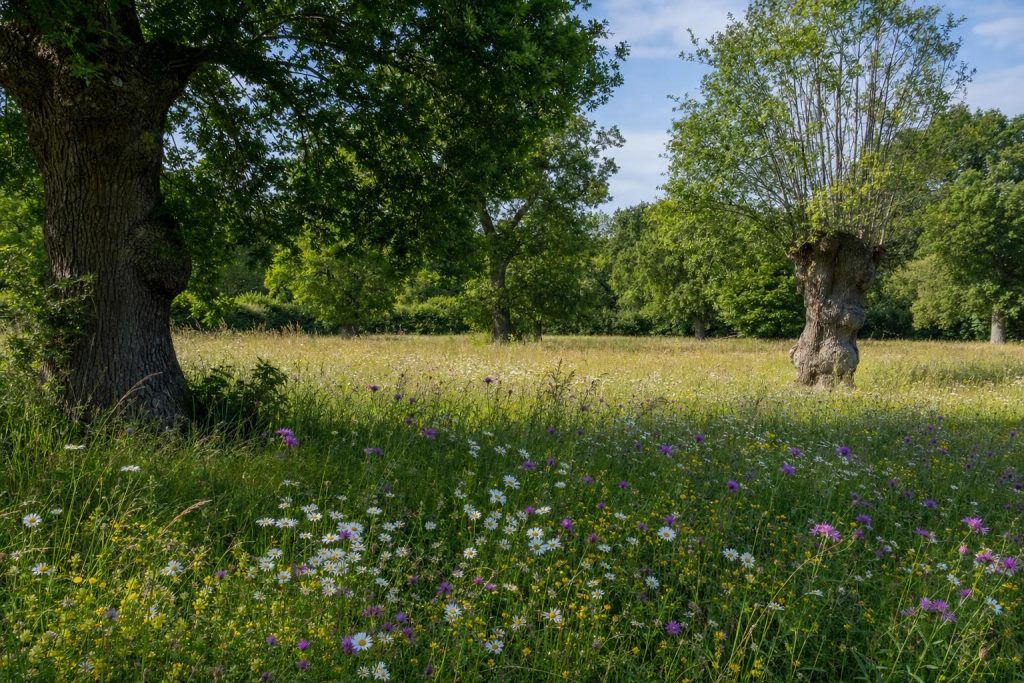
Wood Meadows: History, Management and Wildlife of Britain’s Forgotten Habitat
For most of the last century, Britain sorted its countryside into boxes: woods for timber, fields for grazing and crops, nature reserves for wildlife. Wood meadows never fitted any of them, so they were largely forgotten. Yet a hay meadow running beneath scattered trees, pollards and orchard fruit was once an ordinary part of farming life, and it turns out to be one of the richest wildlife habitats temperate Europe has ever produced.
This guide looks at wood meadows from the ground up: what they are, how they came about, how they were managed for centuries, where they stand today, and why they are being rediscovered as a practical way to bring back wildflowers, pollinators and woodland wildlife together. It is written for landowners, estate managers, community groups and anyone with trees and grass on the same piece of ground.
Quick answer: a wood meadow is a hay meadow managed among scattered trees, pollards, coppice or fruit trees. The grass is left to flower and seed, cut for hay in summer and the hay removed, which keeps soil fertility low and wildflower diversity high. Common across Britain for centuries, wood meadows almost disappeared in the twentieth century, but they are now being recreated for their value to pollinators, woodland-edge wildlife and veteran trees.
Wood meadows at a glance:
- Management: livestock off from early spring, hay cut in late July or August, hay removed, light autumn grazing, trees coppiced or pollarded in winter.
- Richest example: Laelatu wooded meadow in Estonia, with 76 plant species recorded in one square metre.
- UK revival: Three Hagges Woodmeadow, created from a barley field in 2012, had recorded 1,113 invertebrate species by 2021.
- Status: not a formal UK habitat type, but made up of three priority habitats: lowland meadow, traditional orchard, and wood pasture and parkland.
In this guide:
- What is a wood meadow?
- Where wood meadows came from
- How wood meadows were managed
- The decline of wood meadows
- Where wood meadows stand today
- Why wood meadows matter for wildlife
- The modern revival of wood meadows
- Future prospects for wood meadows
- How to create a wood meadow
- Wood meadows and our own land
- Plan your wood meadow
- Frequently asked questions
What is a wood meadow?
A wood meadow is grassland and trees managed together, with the grass cut for hay rather than grazed through the growing season. The trees might be standards grown for timber, pollards cut above the reach of livestock, coppice stools along the edges, or fruit and nut trees. The grassland between them is shut up in spring, left to flower and set seed, then mown in summer and the hay taken away.
The woodland ecologist George Peterken brought the idea back into British conservation after visiting the wooded meadows of Estonia, where hay meadows under scattered trees were still worked well into the twentieth century. His article Recognising wood-meadows in Britain? in British Wildlife (2017) argued that we had lost sight of a habitat that once existed here in several forms: coppice-with-meadow, pollards-with-meadow and fruit-trees-with-meadow. You will see it written as wood meadow, wood-meadow, wooded meadow or woodmeadow. They all describe the same thing.
Wood meadow or wood pasture?
Wood meadows are often confused with wood pasture, which is better known and is a recognised priority habitat in the UK. Both mix trees and grass. The difference is in how the grass is used.
- Wood pasture is grazed for much or all of the year by cattle, sheep, ponies, deer or pigs. The sward is uneven and tussocky, dung adds nutrients in patches, and trees are often ancient pollards. Royal forests, deer parks and wooded commons are the classic examples.
- A wood meadow is kept free of stock from spring until after the hay cut, then grazed only lightly, if at all, in late summer and autumn. The whole sward flowers and seeds before it is cut, and taking the hay off year after year keeps fertility low. That is why wood meadows carry far more wildflowers than most grazed wood pasture.
Where wood meadows came from
The wildwood debate
How “natural” a wood meadow is depends on what you think Britain looked like before farming. The long-held view, associated with the landscape historian Oliver Rackham, is that after the Ice Age lowland Britain became largely closed woodland, and open grassland was mostly created by people.
The Dutch ecologist Frans Vera challenged that in 2000. He argued that large wild grazers such as aurochs, red deer and wild horses kept much of the land as a shifting mosaic of grassland, thorny scrub and groves of trees. Oak and hazel, he pointed out, need light to regenerate and struggle under a closed canopy, but they grow well when protected by thorn scrub in open ground. The debate is not settled, but it matters here. If Vera is even partly right, wood meadows are not a quirk of farming. They are a human-managed echo of the half-open landscape many of our woodland-edge plants and insects evolved in.
From leaf fodder to the scythe
Early farmers fed livestock through winter partly on “leaf hay”, branches of elm, ash, lime and holly cut in summer and dried. Cutting grass for hay on any scale needed good metal blades, and haymaking became established in Britain by the Iron Age and Roman period. Cutting trees above the browse line, pollarding, gave a repeated crop of leafy branches and poles while leaving the ground beneath free to grow grass.
Anglo-Saxon and medieval meadows
By the Anglo-Saxon period, meadow was a distinct and valuable land use. It was recorded separately from pasture in charters, and the Domesday Book of 1086 valued meadow carefully alongside ploughland and wood. Hay was what kept animals alive through winter, so good meadow was some of the most valuable land a village had.
Medieval woods were intensively worked, largely as coppice, and many landscapes combined wood and meadow in the same holding:
- Coppice-with-meadow: hazel, ash, willow or alder cut in rotation for poles, hurdles and charcoal, with the glades and margins mown for hay.
- Pollards-with-meadow: trees cut above head height for poles and leaf fodder, with hay grown beneath. Repeated pollarding also lengthens a tree’s life, producing the hollow veteran trees that are now so valuable for wildlife.
- Fruit-trees-with-meadow: apple, pear, plum and walnut grown over a hay crop. Traditional orchards are the most familiar survivor of this tradition.
How wood meadows were managed
The traditional working year of a wood meadow shaped its wildlife as much as soil or climate did.
- Late winter: coppicing, pollarding and hedge laying while trees were dormant, giving firewood, poles, fencing and fodder.
- Early spring: stock taken off and the meadow “shut up” for hay. Spring woodland flowers such as wood anemone, primrose and bluebell flowered under the bare trees.
- May and June: grasses and wildflowers left to grow, flower and set seed.
- Late June to August: hay cut, by hand with scythes for most of history, so the cut moved slowly across the field over days or weeks. Insects, spiders and young birds could move ahead of the blades into uncut grass.
- Late summer and autumn: the hay dried, turned and carried off, then light “aftermath” grazing on the regrowth.
Two things made this system so good for wildflowers. First, the hay was always removed. Year after year, that took nutrients off the land, keeping the soil poor enough that vigorous grasses could not crowd out slower-growing flowers. Second, the hay cut came late enough for most plants to have shed seed. Semi-parasitic yellow rattle, which feeds on grass roots and weakens the sward, thrived under this pattern, opening up space for other species.
The decline of wood meadows
Wood meadows declined for the same reasons as the rest of our flower-rich grassland, with the added problem that they fell between categories. As farming mechanised and artificial fertiliser arrived, hay meadows were ploughed, reseeded with rye-grass or turned to silage. Small, awkward fields with trees in them were the hardest to work with machinery, so they were either cleared for efficiency or abandoned to scrub.
The scale of loss is stark. The Wildlife Trusts estimate that 97% of lowland meadows in England and Wales have been lost since 1935. Coppicing largely stopped in the twentieth century, pollarding with it, and many traditional orchards were grubbed out. Where a wood meadow was simply left alone, bramble, thorn and young trees closed it over within a few decades. That loss is easy to miss, because it looks like nature reclaiming land.
Where wood meadows stand today
Wood meadow is not a formal habitat category in the UK. Lowland meadows, traditional orchards and wood pasture and parkland are all recognised priority habitats, but a wood meadow straddles them, so surviving examples tend to be recorded as one or the other, or not at all.
Fragments and echoes survive in many places once you start looking:
- wide, grassy rides and glades in woods that are still cut late each year;
- churchyards managed for wildflowers among old yews, limes and oaks;
- traditional orchards with hay or late-cut grass beneath the trees;
- field edges and hedge-bank meadows beneath hedgerow trees;
- parkland where the grass under old trees is cut for hay rather than grazed.
The best surviving examples are in the Baltic and Scandinavia. At Laelatu in western Estonia, a wooded meadow still cut for hay, botanists recorded 76 species of plant in a single square metre, one of the highest counts recorded anywhere. Several other western Estonian wooded meadows exceed 60 species per square metre. Many Estonian wooded meadows have also disappeared under trees once hay-making stopped, which shows how much these habitats depend on being worked.
Why wood meadows matter for wildlife
The strength of a wood meadow is its edges. Where open grassland meets trees, species from both habitats overlap, and edge specialists thrive that are rare in either. Light, shade, shelter and warmth change over a few metres, so one field can hold a remarkable range of living conditions.
Wildflowers
A wood meadow carries a long flowering season. Spring flowers bloom under the bare canopy before leaves close over: wood anemone, native bluebell, primrose, wild daffodil and, on damp ground, wild garlic. In the part-shaded zone around the trees come red campion, wood avens, foxglove and bugle. In the open glades, the summer meadow flora takes over: betony, ox-eye daisy, self-heal, lady’s bedstraw, agrimony, wild marjoram on lighter ground, and knapweeds and scabious later in the season. You can add individual species to an existing sward from our single-species wildflower seeds.
Pollinators
Because something is in flower from early spring blossom to late-summer knapweed, wood meadows give bees, hoverflies, butterflies and moths food across the whole season. Trees add early pollen and nectar from sallow, blackthorn, hawthorn and fruit blossom, when little is flowering in open fields. Our guide to the best wildflower seeds for pollinators covers the species that matter most, and our bee and butterfly 80/20 meadow mix is designed around them.
Deadwood and veteran trees
Pollards and old orchard trees develop hollows, rot holes and dead limbs. These are home to saproxylic invertebrates, the beetles, flies and other insects that depend on dead and decaying wood. Buglife estimates that around 13% of all UK plant and animal species depend directly on deadwood habitats. Many of the rarest, including the noble chafer associated with old orchards, prefer deadwood in sunny, open positions rather than in shaded woodland, and their adults feed on flowers nearby. A wood meadow provides both in one place. Our guide to log piles and deadwood around wildflower meadows explains how to add this habitat.
Fungi
Old, unfertilised grassland that has not been ploughed supports waxcaps, earthtongues, fairy clubs and pinkgills, fungi that take decades to establish and disappear quickly with fertiliser or cultivation. Trees bring their own fungal partners. In a long-established wood meadow, grassland and woodland fungi share the same soil, which adds another layer of diversity below ground.
Birds and mammals
Open ground beneath scattered trees suits birds that hunt insects from a perch, such as the spotted flycatcher and redstart, and those that nest at the woodland edge, like the tree pipit. Bats hunt along the sheltered edges, and small mammals use the cover of trees and scrub while feeding in the grass, which in turn supports owls and kestrels.
The modern revival of wood meadows
Wood meadows are now being created deliberately, and the early results are striking.
Three Hagges Woodmeadow, North Yorkshire
The best-known example is Three Hagges Woodmeadow at Escrick, near York, run by the Woodmeadow Trust. Planting began in 2012 on 25 acres of former barley field, with native trees and shrubs, orchard trees, ponds and species-rich meadow sown between them. By early 2021, surveys had recorded 1,113 invertebrate species on the site, including 34 species of bee, 26 butterflies and 43 hoverflies. They included the dingy skipper, a butterfly more usually found on chalky ground. The Trust’s stated ambition is a woodmeadow in every parish in the country.
Nymans, West Sussex
The National Trust’s woodmeadow project at Nymans in the High Weald covers 114 hectares of former farmland, mixing new woodland, copses, orchards, ponds, restored hedgerows and wildflower meadows, with some seed harvested locally in the High Weald. In its first season of establishment, plant diversity in the fields rose from two or three species per square metre to as many as twelve.
Both projects show that a wood meadow can be built on ordinary, previously farmed land, and that wildlife arrives faster than many expected, provided fertility is brought down and the meadow is managed as hay.
Future prospects for wood meadows
The outlook is mixed: strong interest and good evidence, but patchy support.
Policy and funding
In England, the reformed Sustainable Farming Incentive (SFI26) no longer includes the action that paid for managing, restoring or creating species-rich grassland. That support, along with agroforestry and woodland improvement, now sits in Countryside Stewardship Higher Tier, which is largely by invitation. A further SFI round is planned for 2027. Biodiversity Net Gain gives developers a reason to create well-managed meadow and tree habitats, but the habitat categories used to measure it do not include wood meadow as such, so it is usually recorded as its component habitats. Our guide to wildflower seeds for Biodiversity Net Gain and our housing and development page explain how meadow habitats fit into a net gain plan.
In Wales, the Sustainable Farming Scheme began in January 2026. It requires at least 10% of each farm to be managed as habitat, counts hay meadow, semi-natural grassland and wood pasture as habitat, asks farms to keep or establish hedgerow trees, and includes optional support for woodland and agroforestry creation. That combination fits wood meadow principles well, although none of the schemes funds wood meadows by name.
Pressures
- Nutrient enrichment: nitrogen deposited from the air acts as a slow fertiliser, favouring coarse grasses. Cutting and removing hay every year is the main counter.
- Abandonment: without regular cutting, scrub closes in quickly. Wood meadows need a manager, not just protection.
- Tree disease: ash dieback is taking many old ash pollards and hedgerow trees, so new trees need to be planted and pollards started now to follow on.
- Gaps in the age of trees: many sites have very old trees and very young ones, with little in between. Planting and pollarding a “middle generation” keeps deadwood habitats continuous.
Why the timing is right
Wood meadows answer several modern questions at once. They create habitat for pollinators and woodland-edge wildlife on the same ground, store carbon in both trees and permanent grassland roots, slow surface run-off, and give shade and shelter for stock and people. They also suit the scale of most landholdings: a single field, a paddock, an orchard or a churchyard can be managed this way. Our page for churches, schools and civic sites covers smaller community projects, and our guide to building a climate-resilient wildflower meadow looks at resilience in more detail.
How to create a wood meadow
You do not need a large estate. A field, paddock, orchard or the edge of an existing wood can become a wood meadow.
- Start with what you have. Existing hedgerow trees, an old orchard or the sunny edge of a wood are often the best starting points, because the trees are already established.
- Keep it open. Plant trees widely spaced, in loose groups or scattered singly, so most of the ground stays in sun. Aim for a mosaic, not a new wood. Native trees and fruit trees both work.
- Bring fertility down. On improved grassland or former arable land, cut and remove hay for several years, strip topsoil, or grow a crop without fertiliser before sowing. Never add compost, manure or fertiliser.
- Sow the open ground as meadow. Use a mix matched to your soil (see all our 80/20 meadow mixes), such as our traditional 80/20 meadow mix on neutral ground or the heavy clay soils 80/20 mix on clay. Sow from mid-August to late October, and use our seed coverage calculator to work out quantities. Our step-by-step guide to establishing a wildflower meadow covers preparation and sowing.
- Use a shade mix near the trees. Under canopies and along woodland edges, our woodland and heavy shade 80/20 wildflower mix suits the lower light. Our guide to wildflower seeds for shady areas explains which species cope with which levels of shade. Along hedges, the hedgerow and banks mix is the right choice.
- Plant bulbs under the trees. Spring bulbs flower before the canopy closes. Our guides on planting wildflower bulbs, native bluebells, wild garlic and snowdrops cover planting under trees, and the deluxe woodland bulb collection brings several species together. Browse all our spring bulbs and check timings in our native bulb planting calendar.
- Add yellow rattle. In existing grass, sow yellow rattle seed in autumn, by the end of November, to weaken the grasses. See how to sow yellow rattle.
- Manage it as hay. Shut the meadow up from early spring, cut in late July or August once seed has set, remove the hay, and graze or mow the regrowth lightly in autumn. Coppice or pollard trees in winter on a rotation. Our guide to the wildflower meadow in winter covers the quieter months.
- Leave some deadwood. Keep standing dead limbs where safe, and stack cut wood in sunny spots.
Use seed from British wild populations, sourced as close to your site as practical; our guide on why locally sourced wildflower seeds really matter explains why. To find the right mix for your area, see our wildflower seeds by county guides.
Wood meadows and our own land
At Dunsdon Farm in North Devon, we worked with Devon Wildlife Trust to restore culm grassland, recreate wildflower meadows and plant native woodland side by side. You can read about that work in our Dunsdon Farm case study and our article on culm grassland. Seeing meadow and woodland develop together is one of the best arguments we know for treating them as one system rather than two.
Plan your wood meadow
If you have trees and grass on the same ground, you may already have the beginnings of a wood meadow. Start by bringing fertility down and changing the cutting regime, then add the right meadow, shade and bulb species. For farms, estates, schools, churchyards and community sites, our bespoke wildflower seed mixes can be matched to the light and soil across your site, and our bulk and trade seed service supplies larger areas. Ask us and we will help you plan species, quantities and management.
Frequently Asked Questions
What is a wood meadow?
A wood meadow is grassland and trees managed together, with the grass cut for hay instead of being grazed through spring and summer. The trees may be standards, pollards, coppice or fruit trees. Cutting late and removing the hay keeps soil fertility low, which allows a very wide range of wildflowers to grow among the trees.
What is the difference between a wood meadow and wood pasture?
Both mix trees and grassland. Wood pasture is grazed for much or all of the year, giving an uneven, tussocky sward. A wood meadow is kept free of livestock from spring until after the summer hay cut, then grazed only lightly. Wood meadows usually hold more wildflowers because the whole sward flowers and seeds before it is cut.
Why are wood meadows so good for wildlife?
Wood meadows combine meadow, woodland and woodland edge in one place. Species from all three overlap, and the changes in light, shade and shelter over short distances create many different niches. Flowers from spring to late summer feed pollinators, while old trees and deadwood support beetles, fungi, birds and bats.
How do you manage a wood meadow?
Keep livestock off from early spring, cut the grass for hay in late July or August once seed has set, and remove the hay. Graze or mow the regrowth lightly in autumn. Coppice or pollard trees in winter on a rotation, and leave some deadwood. Never add fertiliser, which favours coarse grasses over wildflowers.
Can I create a wood meadow on farmland?
Yes. Three Hagges Woodmeadow in North Yorkshire was created from a barley field in 2012 and has since recorded over a thousand invertebrate species. Reduce fertility first, plant trees widely spaced, sow the open ground with a meadow mix matched to your soil, and use a shade-tolerant mix and bulbs near the trees.
Which wildflowers grow best in a wood meadow?
Under the trees, wood anemone, native bluebell, primrose and wild garlic flower in spring. In part shade, red campion, wood avens, foxglove and bugle do well. In the open, sow meadow species such as betony, ox-eye daisy, self-heal, lady’s bedstraw, knapweed and yellow rattle, matched to your soil.
Are wood meadows a protected habitat in the UK?
Wood meadow is not a separate priority habitat in the UK. Its parts, lowland meadow, traditional orchard and wood pasture and parkland, are all recognised priority habitats. Surviving wood meadows are usually recorded under one of those headings, and many sites may be designated as Local Wildlife Sites for their grassland or trees.
Sources and further reading
- Peterken, G. (2017) Recognising wood-meadows in Britain? British Wildlife 28.3
- Estonian Seminatural Community Conservation Association: wooded meadow vegetation
- National Biodiversity Network: invertebrate life at Three Hagges Woodmeadow
- National Trust: Nymans woodmeadow project
- The Wildlife Trusts: lowland meadow and pasture
- Welsh Government: Sustainable Farming Scheme 2026
- Defra: SFI26 update
Ready to get started?
Shop: Traditional Wildflower Meadow Mix →