

Wildflower Seeds for Carmarthenshire: Native Mixes for Rhos Pasture, Valleys and Coast
Carmarthenshire, Sir Gâr, is a county of green valleys, wet pasture and mild Atlantic weather. The Tywi winds through a broad floodplain past Llandeilo and Carmarthen, the Black Mountain rises along the eastern border, rolling farmland of shale and mudstone covers the middle, and the coast runs from the Burry Inlet past Pembrey and Laugharne to Pendine. With high rainfall and heavy, often wet soils, it is a county where wildflower meadows succeed when the species suit the conditions and struggle when they do not. Choosing wildflower seeds for Carmarthenshire is mostly a question of wetness, acidity and fertility.
This guide works through the county’s soils and habitats, the native seed mixes that suit each, and the sowing and management that work in a wet western climate. It is aimed at farmers, landowners, estates, developers, councils and community groups, as well as gardeners.
Carmarthenshire also holds some of Wales’s most important grassland: rhos pasture, the purple moor-grass and rush pasture that supports the marsh fritillary butterfly, and traditional hay meadows on valley farms. Those habitats shape how we approach seed here. For other parts of Wales, see our guide to wildflower seeds for Wales, and for the rest of the UK our wildflower seeds by county guides.
Understanding Carmarthenshire’s soils and climate
Rainfall is the first thing to factor in. Most of the county is wet through Autumn and Winter, and many soils drain slowly. Then check pH and fertility.
- Central farmland: heavy, slowly draining soils over Ordovician and Silurian shales and mudstones, mostly acidic to neutral and often waterlogged in Winter.
- The Tywi, Cothi and Taf valleys: deep, fertile alluvial soils on the floodplains, much of it improved for dairy grazing.
- The Black Mountain and eastern uplands: acidic upland soils over sandstone, with a band of limestone along the northern edge of the Black Mountain giving local lime-rich ground.
- The coast: sand dunes, saltmarsh and coastal grassland around Pembrey, the Burry Inlet, Laugharne and Pendine, with light, free-draining sands.
On much of the county’s lowland, decades of dairying mean fertility is high. Reducing it is often the deciding factor in whether a new meadow becomes flower-rich or reverts to rye-grass.
Choosing the right wildflower seeds for Carmarthenshire’s habitats
Rhos pasture and wet grassland
Rhos pasture, the purple moor-grass and rush pasture of west Wales, is one of Carmarthenshire’s defining habitats. It supports devil’s-bit scabious, meadow thistle, sneezewort, lesser skullcap, tormentil, carnation sedge and whorled caraway, a speciality of west Wales. Devil’s-bit scabious is the food plant of the marsh fritillary caterpillar, and Carmarthenshire is one of the butterfly’s strongholds in Wales.
Existing rhos pasture should be managed, not sown over: light cattle grazing is usually the key. Our guide to restoring purple moor-grass and rush pastures covers management and restoration. To create new wet grassland on damp fields, ditch edges and pond margins, use our wetland and pond 80/20 wildflower mix, and see our guide to wildflower seeds for wetland and pond areas.
Hay meadows on valley and upland-fringe farms
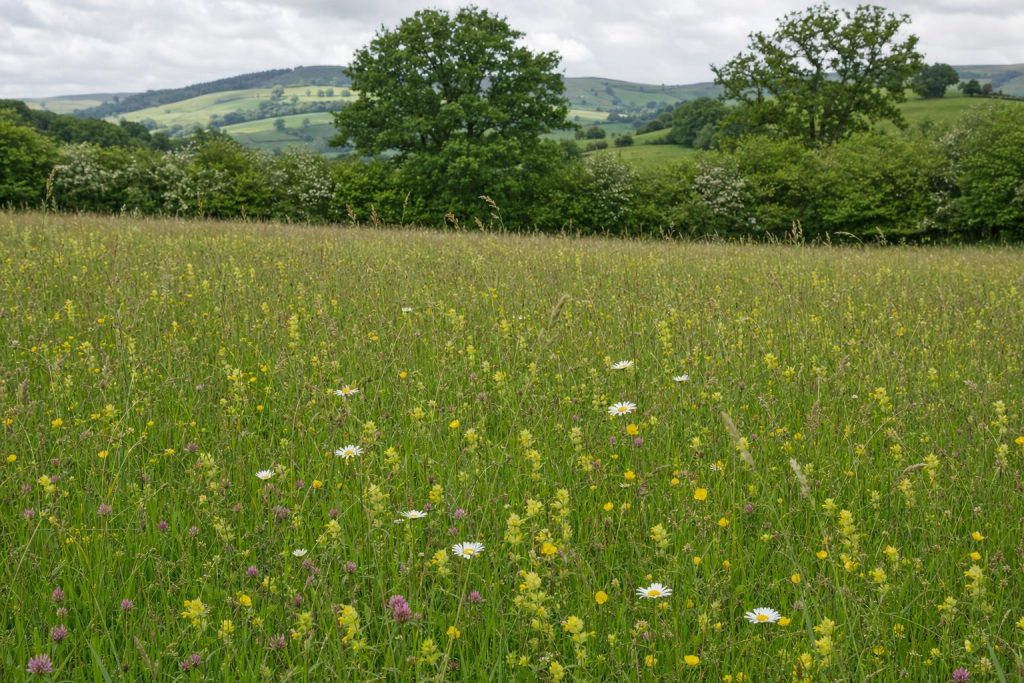
Traditional hay meadows survive on some valley and hill-fringe farms, with yellow rattle, common knapweed, betony, eyebright, bird’s-foot trefoil and greater bird’s-foot trefoil in damper spots. The National Botanic Garden of Wales near Llanarthne manages its farmland for this kind of species-rich grassland; our article on the National Botanic Garden of Wales describes a visit.
On neutral to slightly acidic, moderately drained ground, our traditional 80/20 meadow mix recreates this character. On heavier, wetter fields, the heavy clay soils 80/20 meadow mix copes better with waterlogging; see our guide to wildflower seeds for heavy clay soil.
Acid grassland and the Black Mountain
On the hills and on thin, acidic soils elsewhere, acid grassland with tormentil, heath bedstraw, sheep’s sorrel, harebell and heath speedwell is the natural community. Use our acidic soils 80/20 meadow mix, and see our guide to the wildflowers of the UK’s acid soils.
Where the limestone band along the Black Mountain brings lime to the surface, small areas of calcareous grassland occur. On genuinely alkaline ground, our chalk and limestone 80/20 meadow mix suits; check pH first, as it is the exception in this county.
The Tywi floodplain
The broad Tywi floodplain floods regularly and has fertile silty soils. Floodplain meadow species such as meadowsweet, great burnet, meadow buttercup and ragged robin suit damp alluvial ground. Our loam and alluvial 80/20 meadow mix is designed for these soils, but reduce fertility first on improved grazing. Our guide to wildflower seeds for loam and alluvial soils has more detail.
The coast
Carmarthenshire’s coast includes the extensive dunes at Pembrey and Cefn Sidan, the saltmarsh of the Burry Inlet and coastal slopes around Laugharne and Pendine. Saltmarsh and dunes are protected habitats and should not be sown. For coastal gardens, caravan and holiday sites, verges and grassland near the sea, our coastal 80/20 meadow mix uses salt and wind-tolerant species such as bird’s-foot trefoil, kidney vetch, sea campion and thrift.
Hedgebanks and woodland edges
Carmarthenshire’s earth-banked hedges, the traditional cloddiau, and its oak woodlands in the valleys link its grassland habitats. For hedge banks, use our hedgerow and banks 80/20 wildflower mix, and for shaded woodland edges the woodland and heavy shade 80/20 mix.
80/20 or 100% wildflowers?
An 80/20 mix creates a complete native grass and wildflower sward and suits most new meadows. A 100% wildflower mix adds flowers to an existing sward or a small area. Our guide to 80/20 vs 100% wildflower seed mixes explains the choice.
Sowing wildflower seeds in Carmarthenshire: timing and preparation
When to sow
The best time to sow wildflower seeds in Carmarthenshire is mid-August to late September, slightly earlier than in drier eastern counties, so seedlings establish before the wettest Autumn weather. Sowing can continue into October on free-draining ground. On the wettest heavy soils, where autumn sowings can sit waterlogged, late March to May is often more reliable. Avoid November to February.
Getting fertility down
Improved dairy grassland is the main obstacle to new meadows in Carmarthenshire. Rye-grass and clover on fertile soil will outcompete sown wildflowers. Reduce fertility first by stripping turf and topsoil, taking repeated hay or silage cuts without fertiliser for several years, or growing an unfertilised crop. Never add compost, manure, topsoil or fertiliser, and do not lime acidic ground unless there is a specific reason.
Preparing the seedbed
Create bare, weed-free soil with a fine, firm surface. On heavy, wet ground, wait for a dry spell before any cultivation and avoid working soil that smears. Avoid deep cultivation, which brings up nutrients and buried weed seed. Never cultivate rhos pasture or other semi-natural grassland.
Sowing
Sow 3 g/m² for a 100% wildflower mix or 5 g/m² for an 80/20 mix, adding up to 30% on slopes and exposed ground. Bulk seed with dry sand, sow half in one direction and half at right angles, then roll or tread it in. Never rake it in or bury it: most wildflower seed needs light to germinate. Our step-by-step meadow establishment guide covers each stage, and the seed coverage calculator works out quantities. On steep valley banks, a wildflower seed mat stops heavy rain washing seed away.
Adding Yellow Rattle
Yellow Rattle weakens vigorous grasses and opens space for wildflowers in existing swards, which makes it particularly useful on Carmarthenshire’s productive grassland. Sow it in autumn, by the end of November, as it needs winter cold to germinate. See our guide on how to sow Yellow Rattle.
Managing your Carmarthenshire wildflower meadow long-term
- Year one: expect grass and weeds first. Cut back to 50–60mm whenever growth reaches 100–150mm, removing cuttings. Most perennials flower in year two or three.
- Hay meadows: keep stock off from Spring, take a hay cut in late July or August once seed has set, remove the hay, then graze the aftermath lightly into Autumn.
- Rhos pasture and wet grassland: light summer grazing, ideally by cattle, keeps purple moor-grass and rushes from dominating. Avoid heavy grazing and avoid drainage.
- Wet ground: in wet summers, a late cut is better than no cut. Wait for a dry window and remove the material.
Always remove cuttings, as they feed the grasses and smother seedlings. Our guide to the wildflower meadow in winter covers the dormant months.
Wildflower seeds for larger projects in Carmarthenshire
The statutory 10% Biodiversity Net Gain regime applies in England, not Wales. In Wales, Planning Policy Wales requires development to deliver a net benefit for biodiversity, following a step-wise approach that avoids harm first. Species-rich grassland, matched to the soil and secured with long-term management, is one of the most practical ways to show that benefit on schemes around Carmarthen, Llanelli, Ammanford and the coastal towns. Our guide to wildflower seeds for biodiversity net gain covers the principles, which apply equally to Welsh net benefit.
For farmers, Natural Resources Wales and Farming Connect provide advice on habitat creation and management, and habitat work can fit with Wales’s Sustainable Farming Scheme. Check with them before sowing on land that may hold existing habitat, as semi-natural grassland is usually better restored than replaced. Our housing and development and civic and institutional pages explain how we support larger sites, and our bulk and trade wildflower seed service supplies larger quantities.
Locally sourced wildflower seeds for Carmarthenshire
Seed from British wild populations, collected as close as practical to your site, establishes better in a wet western climate and suits local wildlife. Our guide on why locally sourced wildflower seeds really matter explains why provenance matters.
Carmarthenshire shares much of its landscape with its neighbours: Pembrokeshire to the west, Cardiganshire to the north, Powys to the east and Glamorgan to the south-east. For a site that needs something specific, such as a rhos pasture margin or a valley hay meadow, we can put together bespoke wildflower seed mixes.
Ready to choose the right mix?
Start with how wet your ground is, then its pH and fertility. Choose the matching mix from our wildflower seed shop and plan to sow from mid-August, or in Spring on the wettest ground. If you are working on a farm, estate, development or community site in Carmarthenshire, ask us and we will help you match seed, quantities and management to your land.
Frequently Asked Questions
What is the best wildflower seed mix for Carmarthenshire?
Most of Carmarthenshire is wet and acidic to neutral. On damp fields and pond edges, use a wetland and pond mix; on heavy, wet farmland, a heavy clay mix; on drier neutral ground, a traditional mix; and on hill or thin acid soils, an acidic soils mix. Coastal sites suit a coastal mix.
When should I sow wildflower seeds in Carmarthenshire?
Sow wildflower seeds in Carmarthenshire from mid-August to late September, continuing into October on free-draining ground. On the wettest heavy soils, late March to May is often more reliable. Avoid November to February. Yellow Rattle must be sown in autumn, by the end of November, as it needs winter cold to germinate.
What is rhos pasture?
Rhos pasture is the purple moor-grass and rush pasture of west Wales: wet, unimproved grassland on acidic soils with devil’s-bit scabious, meadow thistle, whorled caraway and sedges. Carmarthenshire holds important areas of it, and it supports the marsh fritillary butterfly. Existing rhos pasture should be managed with light grazing rather than resown.
Can I create a wildflower meadow on improved dairy grassland?
Yes, but fertility must come down first. Strip turf and topsoil, take several years of hay or silage cuts without fertiliser, or grow an unfertilised crop. Then sow a mix matched to your soil and add Yellow Rattle to weaken remaining grasses. Expect the process to take several years.
Does Biodiversity Net Gain apply in Carmarthenshire?
The statutory 10% Biodiversity Net Gain regime applies in England only. In Wales, Planning Policy Wales requires development to deliver a net benefit for biodiversity. Well-established, species-rich grassland with secured long-term management is a practical way to demonstrate that benefit on Welsh development sites.
Can I sow wildflowers on the Carmarthenshire coast?
Do not sow on sand dunes or saltmarsh, which are protected habitats with their own specialised plants. For coastal gardens, holiday and caravan sites, verges and grassland near the sea, a coastal mix with salt and wind-tolerant species such as kidney vetch, sea campion and thrift establishes well.
Who can advise on habitat creation for Carmarthenshire farms?
Natural Resources Wales and Farming Connect both provide advice on habitat creation and management for Welsh farms, including how it fits with Wales’s Sustainable Farming Scheme. Check with them before sowing on land that may already hold semi-natural grassland, which is usually better restored than replaced.
Ready to get started?
Shop: Traditional Wildflower Meadow Mix →Frequently asked questions
What is the best wildflower seed mix for Carmarthenshire?
Most of Carmarthenshire is wet and acidic to neutral. On damp fields and pond edges, use a wetland and pond mix; on heavy, wet farmland, a heavy clay mix; on drier neutral ground, a traditional mix; and on hill or thin acid soils, an acidic soils mix. Coastal sites suit a coastal mix.
When should I sow wildflower seeds in Carmarthenshire?
Sow wildflower seeds in Carmarthenshire from mid-August to late September, continuing into October on free-draining ground. On the wettest heavy soils, late March to May is often more reliable. Avoid November to February. Yellow Rattle must be sown in autumn, by the end of November, as it needs winter cold to germinate.
What is rhos pasture?
Rhos pasture is the purple moor-grass and rush pasture of west Wales: wet, unimproved grassland on acidic soils with devil's-bit scabious, meadow thistle, whorled caraway and sedges. Carmarthenshire holds important areas of it, and it supports the marsh fritillary butterfly. Existing rhos pasture should be managed with light grazing rather than resown.
Can I create a wildflower meadow on improved dairy grassland?
Yes, but fertility must come down first. Strip turf and topsoil, take several years of hay or silage cuts without fertiliser, or grow an unfertilised crop. Then sow a mix matched to your soil and add Yellow Rattle to weaken remaining grasses. Expect the process to take several years.
Does Biodiversity Net Gain apply in Carmarthenshire?
The statutory 10% Biodiversity Net Gain regime applies in England only. In Wales, Planning Policy Wales requires development to deliver a net benefit for biodiversity. Well-established, species-rich grassland with secured long-term management is a practical way to demonstrate that benefit on Welsh development sites.
Can I sow wildflowers on the Carmarthenshire coast?
Do not sow on sand dunes or saltmarsh, which are protected habitats with their own specialised plants. For coastal gardens, holiday and caravan sites, verges and grassland near the sea, a coastal mix with salt and wind-tolerant species such as kidney vetch, sea campion and thrift establishes well.
Who can advise on habitat creation for Carmarthenshire farms?
Natural Resources Wales and Farming Connect both provide advice on habitat creation and management for Welsh farms, including how it fits with Wales's Sustainable Farming Scheme. Check with them before sowing on land that may already hold semi-natural grassland, which is usually better restored than replaced.
More county guides
Find the right native wildflower mix for your county, or browse our full list by region.