

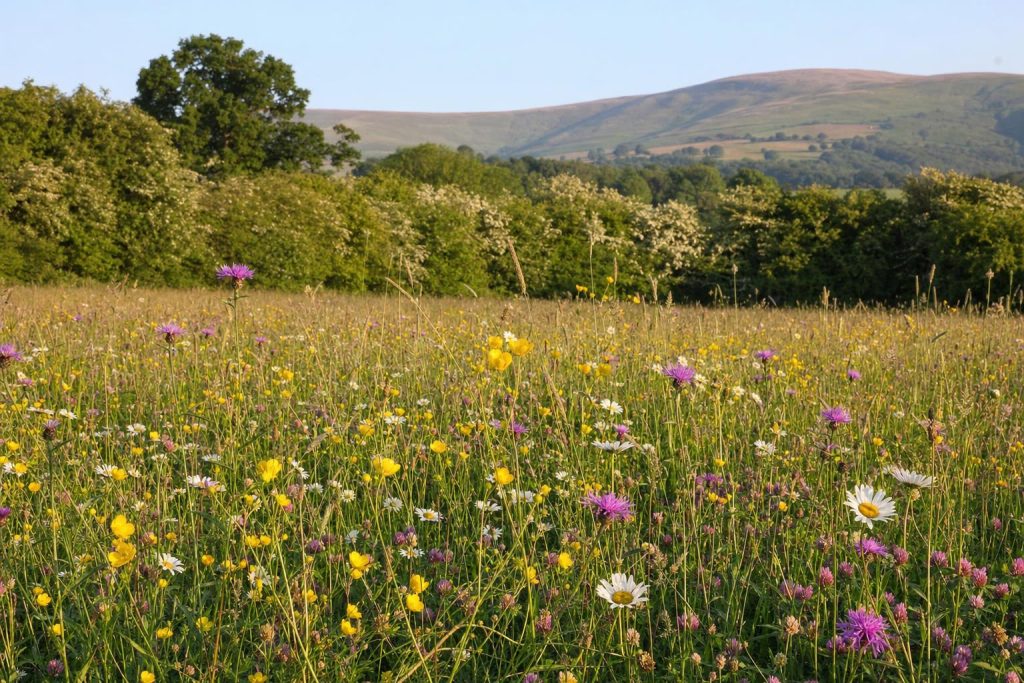
Wildflower Seeds for Shropshire: Native Mixes for the Hills, the Plain and the Meres
Shropshire is England’s largest landlocked county, and one of its most varied. In the south, the Shropshire Hills rise from ancient rocks: the heather-covered plateau of the Long Mynd, the quartzite tors of the Stiperstones and the limestone scarp of Wenlock Edge. Across the north, a broad plain of glacial clays and sands holds the meres and mosses around Ellesmere and Whixall. Through the middle runs the Severn, from Welsh border country past Shrewsbury to the Ironbridge Gorge. Choosing wildflower seeds for Shropshire starts with working out which of those landscapes your ground belongs to.
This guide covers Shropshire’s soils and habitats, the native seed mixes that suit each, and the sowing and management that give meadows the best chance in the county’s conditions. It is aimed at farmers, landowners, estates, developers and community groups, as well as gardeners with space to sow.
Shropshire’s border position matters too. The west of the county shares its hill country and climate with mid Wales, the north with Cheshire’s plain, and the south with the Herefordshire lowlands. For neighbouring areas and the rest of the country, see our wildflower seeds by county guides.
Understanding Shropshire’s soils before you sow
A soil pH test and a spade’s depth of digging will tell you most of what you need to know.
- The Shropshire Hills uplands: thin, acidic, often peaty soils over hard ancient rocks on the Long Mynd, Stiperstones, Clee Hills and Clun Forest, with high rainfall.
- Wenlock Edge and limestone outcrops: thin, free-draining alkaline soils over Silurian limestone, with lime-loving grassland where it has not been improved.
- The north Shropshire plain: a patchwork of glacial boulder clay, sands and gravels, from heavy, wet clay to light, hungry sand, with peat in the mosses.
- River valleys: fertile alluvial silts along the Severn, Teme, Clun, Onny and Tern, wet in winter and prone to flooding.
Soil type decides which species suit your ground. Fertility decides whether they can compete. On the dairy and arable land of the north plain and the valleys, fertility is often the bigger obstacle.
Choosing the right wildflower seeds for Shropshire’s habitats
The Shropshire Hills: acid grassland and upland hay meadows
The open hills carry acid grassland, heath and bracken, with tormentil, heath bedstraw, sheep’s sorrel, harebell, heath speedwell and bilberry. Lower slopes and valley fields in the south-west, especially around Clun, still hold traditional hay meadows with betony, great burnet in damper spots, yellow rattle, knapweed and eyebright, closer in character to mid Welsh hay meadows than to lowland England.
On acidic, free-draining ground, use our acidic soils 80/20 meadow mix. Our guide to the wildflowers of the UK’s acid soils explains the species and what to expect. For damp, rushy fields on the upland fringe, our guide to restoring purple moor-grass and rush pastures covers this distinctive wet grassland.
Wenlock Edge and limestone grassland
The wooded scarp of Wenlock Edge and nearby limestone outcrops support small areas of lime-rich grassland with cowslip, salad burnet, common rock-rose, quaking grass, wild thyme and, in places, orchids. These are among the most species-rich grasslands in the county.
Our chalk and limestone 80/20 meadow mix suits thin, alkaline soils, and our guide to wildflower seeds for chalk and limestone soils goes into the species.
The north Shropshire plain: clay and sand
Much of the north is farmed, but old meadows, field corners and road verges still hold knapweed, bird’s-foot trefoil, meadow vetchling, ox-eye daisy and meadow buttercup on clay, and lady’s bedstraw, harebell and common cat’s-ear on the sandier ground.
- On heavy boulder clay, use our heavy clay soils 80/20 meadow mix, and see our guide to wildflower seeds for heavy clay soil.
- On neutral loams, the traditional 80/20 meadow mix is a reliable all-rounder.
- On light, acidic sands, the acidic soils mix is usually the better choice.
Meres, mosses and wet ground
The meres and mosses of north Shropshire, including the raised bog of Whixall Moss on the Welsh border, are internationally important habitats, and peat bog itself should never be sown. Around their margins, and on wet fields, ditch banks and pond edges elsewhere in the county, a wet grassland flora of meadowsweet, ragged robin, marsh bird’s-foot trefoil, purple loosestrife and water mint is the target. Our wetland and pond 80/20 wildflower mix suits ground that stays wet for long periods; see our guide to wildflower seeds for wetland and pond areas.
The Severn and other river valleys
On fertile alluvial soils along the Severn, Teme and Tern, our loam and alluvial 80/20 meadow mix recreates the floodplain hay meadow character of great burnet, meadow foxtail, meadowsweet and meadow buttercup. Our guide to wildflower seeds for loam and alluvial soils covers these sites.
Hedges, banks and woodland edges
Shropshire’s dense network of hedges and sunken lanes links its meadows and woods. For hedge bottoms and banks, use our hedgerow and banks 80/20 wildflower mix, and for shaded rides and woodland edges, such as those along Wenlock Edge, the woodland and heavy shade 80/20 mix.
80/20 or 100% wildflowers?
An 80/20 mix of fine native grasses and wildflowers creates a complete sward and suits most new meadows. A 100% wildflower mix is for adding flowers to existing grassland or small, high-impact areas. Our explainer on 80/20 vs 100% wildflower seed mixes sets out the differences.
Sowing wildflower seeds in Shropshire: timing and preparation
When to sow
The best time to sow wildflower seeds in Shropshire is mid-August to late October, while the soil is still warm and autumn rain arrives. Many meadow species need winter cold to germinate. In the hills, aim for the earlier end of that window, as the growing season shortens with altitude. Late March to May also works, especially on wet clay or floodplain ground. Avoid November to February.
Getting fertility down
Fertile soil favours vigorous grasses that smother wildflowers. On improved grassland and former arable land, reduce fertility first by stripping turf and topsoil, cutting and removing hay for several years, or growing an unfertilised cereal crop. Never add compost, manure, topsoil or fertiliser.
Preparing the seedbed
Create bare, weed-free soil with a fine, firm surface. On clay, cultivate shallowly in a dry spell. On thin hill and limestone soils, a light scarify and roll is often enough.
Sowing
Sow 3 g/m² for a 100% wildflower mix or 5 g/m² for an 80/20 mix, adding up to 30% on slopes and exposed ground. Bulk the seed with dry sand, sow half in one direction and half at right angles, then roll or tread it in. Never rake it in or bury it; most wildflower seed needs light to germinate. Our meadow establishment guide walks through each stage, and the seed coverage calculator works out how much you need.
On steep hill banks and sunken lanes where rain can wash seed away, a wildflower seed mat holds it in place while it establishes.
Adding Yellow Rattle
To bring wildflowers into existing grassland, sow Yellow Rattle first. It is semi-parasitic on grass roots and weakens the sward, making room for other species. It needs winter cold to germinate, so sow it in autumn by the end of November. See our guide on how to sow Yellow Rattle.
Managing your Shropshire wildflower meadow long-term
- Year one: expect grass and weeds first. Cut back to 50–60mm whenever growth reaches 100–150mm, and remove the cuttings. Most perennials flower in year two or three.
- Every year after: let the meadow grow from Spring, take a hay cut in late July or August once seed has set, remove the hay, then graze or mow the regrowth short into Autumn.
- Upland hay meadows: keep stock off from Spring until the hay cut, which may be later in the hills, and graze the aftermath lightly. Avoid fertiliser and lime unless advised.
- Limestone and acid grassland: light grazing keeps bracken, scrub and coarse grasses in check. Cut or crush bracken where it spreads.
Always remove cuttings; left on the ground, they feed the grasses and smother seedlings. Our guide to the wildflower meadow in winter covers the dormant season.
Wildflower seeds for larger projects and Biodiversity Net Gain in Shropshire
New housing and employment land around Shrewsbury, Telford, Oswestry and the market towns means many Shropshire developers now need to deliver Biodiversity Net Gain. Most developments in England must achieve at least 10% net gain under the statutory biodiversity metric, usually secured for 30 years. Species-rich grassland, matched to the soil and properly managed, is one of the most achievable habitats to create on site.
Our guide to wildflower seeds for Biodiversity Net Gain explains how mix choice and management affect habitat condition, and our housing and development and civic and institutional pages set out how we support larger projects. For farmers, flower-rich plots can fit Sustainable Farming Incentive actions; see our guide to SFI action CAHL1. Larger quantities are available through our bulk and trade wildflower seed service.
Locally sourced wildflower seeds for Shropshire
Seed from British wild populations, collected as close as practical to your site, establishes better and suits local wildlife. Our guide on why locally sourced wildflower seeds really matter explains the reasons.
Shropshire’s landscapes run across its borders: the Welsh hills into Montgomeryshire and wider Powys, the northern plain into Cheshire, and the south into Herefordshire and the Welsh Marches.
For a site that needs something specific, such as an upland hay meadow restoration or a mix matched to a particular soil, we can supply bespoke wildflower seed mixes.
Where to see wildflower grassland in Shropshire
Llanymynech Rocks, on the Welsh border, is an old limestone quarry managed jointly by Shropshire Wildlife Trust and Montgomeryshire Wildlife Trust. Its lime-rich grassland holds a dozen species of orchid along with rock-rose, wild thyme and marjoram, and more than 30 species of butterfly. For acid grassland and heath, the National Trust’s Long Mynd and the Stiperstones National Nature Reserve show the upland side of the county, with harebell, tormentil and bilberry. Both are good places to see what a low-nutrient sward looks like.
Ready to choose the right mix?
Identify your soil first: acid hill ground, limestone, clay, sand, wet ground or river silt. Then choose the matching mix from our wildflower seed shop and plan to sow between mid-August and late October. If you are working across several soil types, or on a farm, estate or development site, ask us and we will help you plan seed, quantities and management for your Shropshire ground.
Frequently Asked Questions
What is the best wildflower seed mix for Shropshire?
It depends on your soil. In the Shropshire Hills and on light sands, use an acidic soils mix. On Wenlock Edge limestone, use a chalk and limestone mix. On north Shropshire boulder clay, use a heavy clay mix, and on river silts a loam and alluvial mix. A pH test will confirm which suits your ground.
When should I sow wildflower seeds in Shropshire?
Sow wildflower seeds in Shropshire between mid-August and late October. In the hills, aim for August or September because the growing season is shorter. Late March to May also works on wet clay or floodplain ground. Avoid November to February, and sow Yellow Rattle in autumn by the end of November.
Can I create a hay meadow in the Shropshire Hills?
Yes, on suitable ground. Lower slopes and valley fields, especially in the south-west, can support upland-style hay meadows with betony, yellow rattle and knapweed. Keep fertility low, use an acidic or traditional mix depending on soil pH, keep stock off until the hay cut, and remove the hay each year.
Which wildflowers grow on Wenlock Edge limestone?
Thin limestone soils on and around Wenlock Edge support cowslip, salad burnet, common rock-rose, quaking grass, wild thyme and, in places, orchids. A chalk and limestone mix matched to these soils, with light grazing or a late-Summer cut, gives the best chance of recreating that grassland.
Can I sow wildflowers on wet ground near the meres and mosses?
Never sow on peat bog itself, which is a protected and fragile habitat. On wet fields, ditch banks and pond edges elsewhere, a wetland and pond mix suits ground that stays wet, supporting species such as meadowsweet, ragged robin and purple loosestrife. Seek advice before working near designated sites.
How long does a wildflower meadow take to establish in Shropshire?
Expect grass and weeds in year one, controlled by regular cutting. Most perennial wildflowers flower in year two or three, and a meadow usually takes three to five years to become a stable, species-rich sward. In the hills, establishment can be a little slower because of the shorter growing season.
Can wildflower meadows count towards Biodiversity Net Gain in Shropshire?
Yes. Species-rich grassland can contribute to the 10% statutory net gain required for most developments in England, provided the mix suits the soil and management is secured for the long term, usually 30 years. The condition achieved depends on establishment and ongoing hay-meadow management.
Ready to get started?
Shop: Traditional Wildflower Meadow Mix →Frequently asked questions
What is the best wildflower seed mix for Shropshire?
It depends on your soil. In the Shropshire Hills and on light sands, use an acidic soils mix. On Wenlock Edge limestone, use a chalk and limestone mix. On north Shropshire boulder clay, use a heavy clay mix, and on river silts a loam and alluvial mix. A pH test will confirm which suits your ground.
When should I sow wildflower seeds in Shropshire?
Sow wildflower seeds in Shropshire between mid-August and late October. In the hills, aim for August or September because the growing season is shorter. Late March to May also works on wet clay or floodplain ground. Avoid November to February, and sow Yellow Rattle in autumn by the end of November.
Can I create a hay meadow in the Shropshire Hills?
Yes, on suitable ground. Lower slopes and valley fields, especially in the south-west, can support upland-style hay meadows with betony, yellow rattle and knapweed. Keep fertility low, use an acidic or traditional mix depending on soil pH, keep stock off until the hay cut, and remove the hay each year.
Which wildflowers grow on Wenlock Edge limestone?
Thin limestone soils on and around Wenlock Edge support cowslip, salad burnet, common rock-rose, quaking grass, wild thyme and, in places, orchids. A chalk and limestone mix matched to these soils, with light grazing or a late-Summer cut, gives the best chance of recreating that grassland.
Can I sow wildflowers on wet ground near the meres and mosses?
Never sow on peat bog itself, which is a protected and fragile habitat. On wet fields, ditch banks and pond edges elsewhere, a wetland and pond mix suits ground that stays wet, supporting species such as meadowsweet, ragged robin and purple loosestrife. Seek advice before working near designated sites.
How long does a wildflower meadow take to establish in Shropshire?
Expect grass and weeds in year one, controlled by regular cutting. Most perennial wildflowers flower in year two or three, and a meadow usually takes three to five years to become a stable, species-rich sward. In the hills, establishment can be a little slower because of the shorter growing season.
Can wildflower meadows count towards Biodiversity Net Gain in Shropshire?
Yes. Species-rich grassland can contribute to the 10% statutory net gain required for most developments in England, provided the mix suits the soil and management is secured for the long term, usually 30 years. The condition achieved depends on establishment and ongoing hay-meadow management.
More county guides
Find the right native wildflower mix for your county, or browse our full list by region.