Wildflower Seeds for Herefordshire: Native Mixes for the Welsh Marches
Herefordshire sits in the heart of the Welsh Marches — a county of rolling red sandstone hills, wooded river valleys, and traditional farming landscapes that have changed less than most of England over the past century. It is one of the least densely populated counties in the country, and that relative quietness has helped preserve some genuinely important wildflower habitats. Old orchards, ancient hay meadows along the Wye and Lugg, and the wet pastures of the Golden Valley are among the most significant surviving examples of traditional farmland ecology anywhere in Britain.
For anyone looking for wildflower seeds in Herefordshire, the county’s character points clearly towards a traditional meadow and hedgerow-based approach. The Old Red Sandstone geology produces moderately acidic, free-draining soils across much of the county — ideal for meadow wildflowers. The river valley alluvium introduces wet meadow conditions. And the western fringe, rising towards the Black Mountains and Radnor Forest, brings more acidic upland conditions into play. Reading the site before choosing a mix is, as always, the essential first step.
Herefordshire’s soils and habitats: the landscape in detail
The Old Red Sandstone that underlies most of Herefordshire produces reddish-brown, free-draining, moderately acidic soils — typically pH 5.5 to 6.5. These are good wildflower soils. They’re naturally low in fertility compared to the clays further east, and they support a traditional meadow flora that includes Meadow Cranesbill (Geranium pratense), Knapweed (Centaurea nigra), Betony (Betonica officinalis), Devil’s Bit Scabious (Succisa pratensis), and Yellow Rattle (Rhinanthus minor). Where these old meadows survive unimproved, they’re among the most species-rich in the Marches.
The Wye Valley and its tributaries — the Lugg, Arrow, Frome, and Monnow — carry alluvial soils that range from freely draining gravel terraces to seasonally waterlogged flood meadows. The best surviving wet meadows along these rivers hold Green-winged Orchid (Anacamptis morio), Cuckooflower (Cardamine pratensis), Marsh Marigold (Caltha palustris), and Meadow Saxifrage (Saxifraga granulata). These are the reference communities for wetland and traditional meadow establishment in the county.
The Black Mountains fringe and the upland pastures of the western border — towards Hay-on-Wye and the Radnor area — carry more acidic, peaty, and poorly drained soils. These higher ground habitats are closer in character to the Welsh uplands than to the lowland Herefordshire farmland. Acidic soils mixes are more appropriate on the high ground than standard meadow mixes.
Herefordshire’s traditional orchards are a nationally significant habitat. Unimproved orchard grassland — particularly on the red sandstone soils around Ledbury, Ross-on-Wye, and the Bromyard Downs — supports a distinctive flora combining meadow species with shade-tolerant plants suited to the dappled light under old fruit trees. This is one of the best habitats in the county for wildflower establishment.
Choosing the right wildflower seeds for Herefordshire
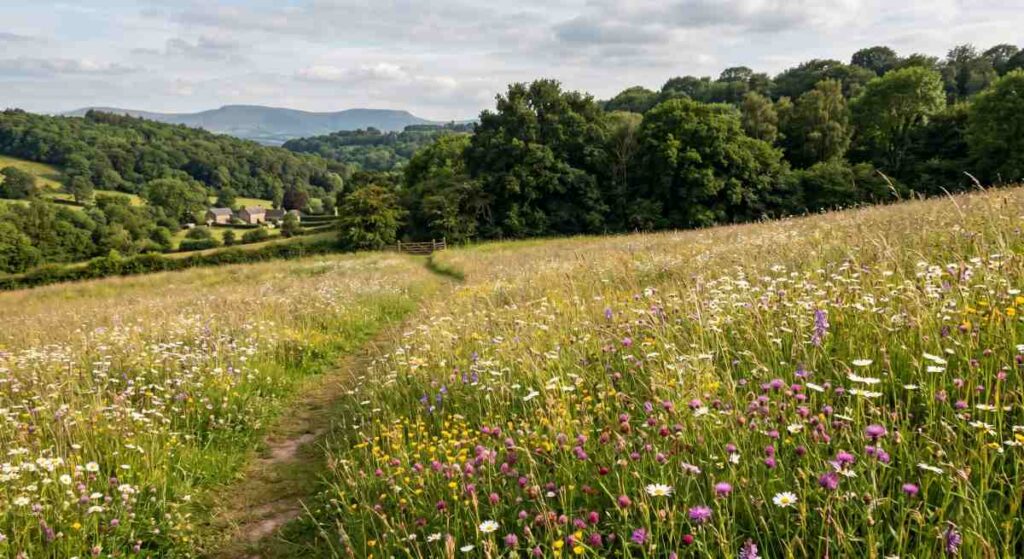
Traditional Meadow Mix — the core choice for most of Herefordshire’s lowland farmland, the lower river valley terraces, and orchard grassland on the red sandstone soils. Knapweed, Meadow Cranesbill, Ox-eye Daisy (Leucanthemum vulgare), Betony, Yellow Rattle, Bird’s-foot Trefoil (Lotus corniculatus), and Wild Carrot (Daucus carota) are all characteristic of the Herefordshire meadow flora and establish reliably on well-prepared red sandstone soils.
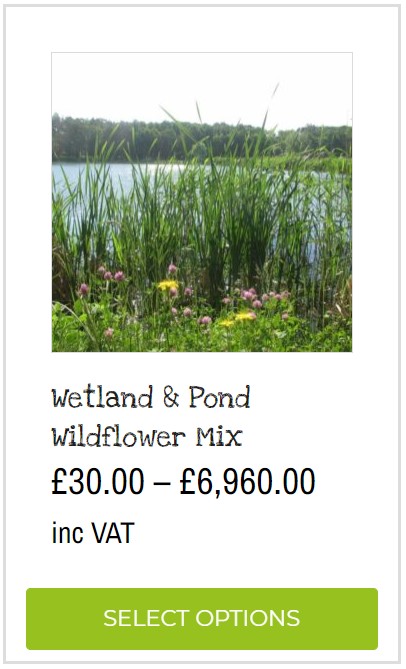
Wetland and Pond Mix — for the flood meadows and wet pastures of the Wye, Lugg, Arrow, and Monnow valleys, and any Herefordshire site that holds water seasonally. Yellow Flag Iris (Iris pseudacorus), Ragged Robin (Lychnis flos-cuculi), Meadowsweet (Filipendula ulmaria), Purple Loosestrife (Lythrum salicaria), and Marsh Marigold are key components. Sow in Autumn into exposed wet or moist soil during a drawdown period or after poaching.
Hedgerow and Banks Mix — Herefordshire has one of the densest ancient hedgerow networks in England, and the county’s sunken lanes and hedgerow banks are outstanding habitats in their own right. Red Campion (Silene dioica), Foxglove (Digitalis purpurea), Primrose (Primula vulgaris), Herb Robert (Geranium robertianum), Wild Garlic (Allium ursinum), and Lesser Celandine (Ficaria verna) are all part of the native Herefordshire hedgerow flora. Sow into loosened bank material in Autumn.
Acidic Soils Mix — for the western upland fringe, the higher pastures towards the Black Mountains and Radnor Forest, and any Herefordshire site with a pH below 5.5. Heath Bedstraw (Galium saxatile), Tormentil (Potentilla erecta), Harebell (Campanula rotundifolia), and Devil’s Bit Scabious are appropriate species. Do not use this mix on the lower red sandstone farmland — the pH is too high for most acidic soils specialists to establish reliably.
Sowing wildflower seeds in Herefordshire: timing and ground preparation
Herefordshire’s Atlantic-influenced climate — relatively mild, wet winters and warm summers — gives two reliable sowing windows: late August to October for Autumn sowing, and March to May for Spring sowing. Autumn sowing is strongly preferred for perennial-dominated mixes. The county’s mild winters allow some root development before the coldest months, and seeds that require cold stratification complete the process naturally.
Yellow Rattle is the essential Autumn-only species for Herefordshire meadow projects. It must be sown in September — fresh seed into existing turf or into a newly prepared seedbed. On the county’s red sandstone soils, grass competition is real but not as extreme as on the fertile clays further east. Even so, Yellow Rattle is the most cost-effective insurance against grass reasserting dominance in years two and three.
Ground preparation on Herefordshire’s red sandstone soils is typically more straightforward than on clay. Scarification to expose 50 to 70 percent bare soil is usually sufficient on old grassland. On more improved sites where fertiliser has been applied within the last five years, rotovation or topsoil stripping may be needed. In orchard grassland, hard raking under the canopy followed by broadcasting into the disturbed turf works well for introducing species into an established sward.
Managing Herefordshire wildflower habitats for the long term
The traditional Herefordshire hay meadow management — cut for hay in late July or August, remove cuttings, and allow aftermath grazing by cattle through Autumn — is the model that produced the surviving species-rich grassland the county is known for. Cut late, take the hay off, graze afterwards if stock are available, and do not fertilise.
In orchard habitats, management is shaped by the trees. Grass growth under old fruit trees can be managed by a combination of late cutting and grazing — cattle and traditional breeds of pony are well suited to orchard grassland. Avoid cutting so low that you remove the tussocky structure that invertebrates depend on. A light touch in Autumn, leaving some rougher areas, is more valuable than a uniformly close cut.
On the river valley wet meadow sites, cutting management needs to work with the water table. Where winter flooding is a feature, cutting in late Summer and then allowing the flood to do its work is part of the natural cycle. Do not attempt to drain these sites for wildflower establishment — work with the hydrology, not against it.
Locally sourced wildflower seeds for Herefordshire
Wildahome sources seed from UK meadows and partner farms, with provenance matched to regional habitats wherever possible. For Herefordshire projects, the Traditional Meadow, Wetland and Pond, Hedgerow and Banks, and Acidic Soils mixes all contain species native to the Marches landscape. The county’s moderate-fertility sandstone soils make it one of the more forgiving places in England to establish wildflowers — the conditions work in your favour on most sites.
Herefordshire’s traditional farming landscape is one of the best-preserved in England. The hay meadows, orchards, and hedgerow banks that remain are a living reference for what wildflower establishment here can look like at its best. Browse our seed mixes or contact us to discuss your site.