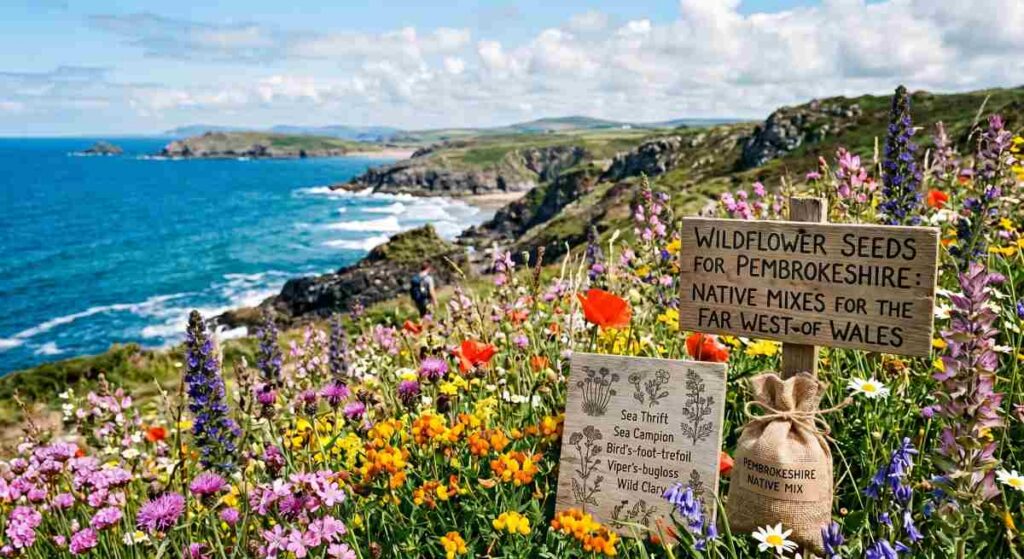
Wildflower Seeds for Pembrokeshire: Native Mixes for the Far West of Wales
Pembrokeshire is the most westerly county in Wales and one of the most ecologically distinctive in Britain. Its position at the tip of a peninsula jutting into the Atlantic gives it a climate unlike any other Welsh county — mild, wet, and relentlessly wind-exposed on the coast, but sheltered and fertile in the deep-cut estuarine valleys and wooded cwms of the interior. The Pembrokeshire Coast National Park contains some of the finest coastal grassland and maritime heath in the UK. The Preseli Hills in the north carry ancient upland moorland. And the patchwork of old meadows, ancient hedgebanks, and flower-rich road verges in between represent a traditional farming landscape relatively insulated from agricultural intensification.
For anyone looking for wildflower seeds in Pembrokeshire, the county’s Atlantic character sets the context. High rainfall and mild winters mean that well-prepared sites can establish quickly — but the same conditions drive vigorous grass growth that can overwhelm poorly prepared ones. The soils are predominantly acidic Old Red Sandstone and Ordovician geology, with localised limestone along the south Pembrokeshire coast. Reading your site before choosing a mix is the essential first step.
Pembrokeshire’s soils and habitats: the Atlantic fringe
The coastal grasslands of the Pembrokeshire Coast National Park — the cliff tops from St David’s Head south to Stackpole and around the Marloes peninsula — are among the most species-rich maritime grasslands in Wales. Thin, wind-scoured, salt-influenced soils carry Spring Squill (Scilla verna), Sea Campion (Silene uniflora), Thrift (Armeria maritima), and Kidney Vetch (Anthyllis vulneraria). These are habitats for management, not seed introduction — the existing communities are fragile and disturbance is more likely to harm than help.
The Preseli Hills in north Pembrokeshire sit on Ordovician igneous and sedimentary rocks, producing thin, acidic, peaty soils across the plateau. Heather (Calluna vulgaris), Bell Heather (Erica cinerea), Western Gorse (Ulex gallii), Purple Moor-grass (Molinia caerulea), and Tormentil (Potentilla erecta) are characteristic. As on other intact Welsh moorland, management of existing vegetation is the priority — seed introduction supplements rather than replaces habitat management.
South Pembrokeshire carries a belt of Carboniferous limestone along the coast from Tenby to Castlemartin. The Castlemartin peninsula and the coastal slopes around Tenby carry calcareous grassland with Small Scabious (Scabiosa columbaria), Common Rock-rose (Helianthemum nummularium), Carline Thistle (Carlina vulgaris), and Horseshoe Vetch (Hippocrepis comosa). A chalk and limestone mix is appropriate for open grassland restoration on these limestone soils.
The deep estuarine valleys of the Western Cleddau, Eastern Cleddau, and the Daugleddau estuary carry sheltered, fertile, seasonally wet habitats. These are the most productive sites for wildflower seed establishment in the county — sheltered from Atlantic exposure, with soils that respond well to management.
Choosing the right wildflower seeds for Pembrokeshire
Acidic Soils Mix — for the Preseli Hills fringe, Old Red Sandstone upland pastures, and any Pembrokeshire site with a pH below 6.0. Heath Bedstraw (Galium saxatile), Tormentil, Harebell (Campanula rotundifolia), Devil’s Bit Scabious (Succisa pratensis), and Heath Spotted Orchid (Dactylorhiza maculata) precursors are the target species. Sow in Autumn at low rates into scarified, low-nutrient soil.
Traditional Meadow Mix — the most widely applicable mix across Pembrokeshire’s sheltered interior farmland, the enclosed fields of the Cleddau valleys, and any lowland site with moderate-fertility, reasonably free-draining soil. Knapweed (Centaurea nigra), Ox-eye Daisy (Leucanthemum vulgare), Meadow Cranesbill (Geranium pratense), Yellow Rattle (Rhinanthus minor), Ragged Robin (Lychnis flos-cuculi), and Bird’s-foot Trefoil (Lotus corniculatus) establish reliably. Yellow Rattle is essential on all sites with existing grass.
Chalk and Limestone Mix — for the Carboniferous limestone belt of south Pembrokeshire, the coastal slopes around Tenby and Manorbier, and any site with a pH above 6.5 and thin, free-draining alkaline soil. Small Scabious, Common Rock-rose, Horseshoe Vetch, Kidney Vetch, Salad Burnet (Sanguisorba minor), and Marjoram (Origanum vulgare) are the characteristic species. Sow in Autumn into scarified limestone soil.
Wetland and Pond Mix — for the Cleddau estuary margins, riverside strips along the Western and Eastern Cleddau, and any Pembrokeshire site with seasonally wet or waterlogged ground. Ragged Robin, Yellow Flag Iris (Iris pseudacorus), Meadowsweet (Filipendula ulmaria), Purple Loosestrife (Lythrum salicaria), and Marsh Marigold (Caltha palustris) suit the mildly acidic, wet conditions of Pembrokeshire’s valley bottoms. Sow in Autumn into exposed moist or wet soil.
Sowing wildflower seeds in Pembrokeshire: timing and ground preparation
Pembrokeshire’s Atlantic climate gives a generous sowing window. Late August to October suits Autumn sowing on most sites. Spring sowing (March to May) is a viable secondary option, though the mild, wet spring means grass competition gets going quickly — ground preparation needs to be thorough before Spring seed goes in. Autumn sowing remains the strongly preferred approach for perennial mixes.
Yellow Rattle must be sown in September — it is non-negotiable on any Pembrokeshire site where existing grass is present. The county’s high rainfall and mild growing season means grasses recover quickly after any disturbance. Without Yellow Rattle suppressing grass roots, the established sward will reassert itself within two to three seasons.
Ground preparation is critical. The county’s high rainfall means soils recover grass cover quickly after disturbance — aim for 50 to 70 percent bare soil and sow promptly after preparation. On limestone sites, scarification of thin turf is sufficient. On fertile estuary valley soils, rotovation or topsoil stripping is the realistic option. Never sow wildflower seed into unbroken turf in Pembrokeshire — the grass will win every time.
Managing Pembrokeshire wildflower habitats for the long term
Pembrokeshire’s traditional farming landscape — small fields, ancient hedgebanks, late-cut meadows — produced species-rich grassland communities for centuries. Cut once in late Summer (August to September), remove all cuttings, do not fertilise. On the wetter, more productive lowland sites, aftermath cattle grazing in Autumn is particularly valuable for consolidating the sward.
Pembrokeshire’s ancient hedgebanks are among the finest hedgerow habitats in Wales. On most intact examples, management is the priority — sympathetic rotational trimming that allows hedgerow flowers to set seed. Where banks have been scraped or damaged, introduction of a Hedgerow and Banks mix in Autumn into loosened bank material can reinstate the native flora. Key species include Red Campion, Foxglove, Primrose, Herb Robert, and Wild Garlic.
Natural Resources Wales agri-environment schemes may provide financial support for wildflower meadow restoration and traditional grassland management on eligible Pembrokeshire farmland. Check with NRW or Farming Connect for current scheme eligibility before committing to a restoration project.
Locally sourced wildflower seeds for Pembrokeshire
Wildahome sources seed from UK meadows and partner farms across Wales and the border counties, with provenance matched to regional habitats wherever possible. For Pembrokeshire projects, the Acidic Soils, Traditional Meadow, Chalk and Limestone, and Wetland and Pond mixes all contain species native to the west Wales landscape. The county’s coastal and Atlantic character makes it one of the most rewarding places in Wales to establish wildflowers — given the right mix, preparation, and consistent management.
Pembrokeshire’s wildflower heritage is exceptional — from the maritime cliff-top communities of the National Park to the flower-rich hedgebanks of the interior. Browse our seed mixes or contact us to talk through your site before ordering.