Wildflower Seeds for Cambridgeshire: Native Mixes for Fen, Chalk, and Clay
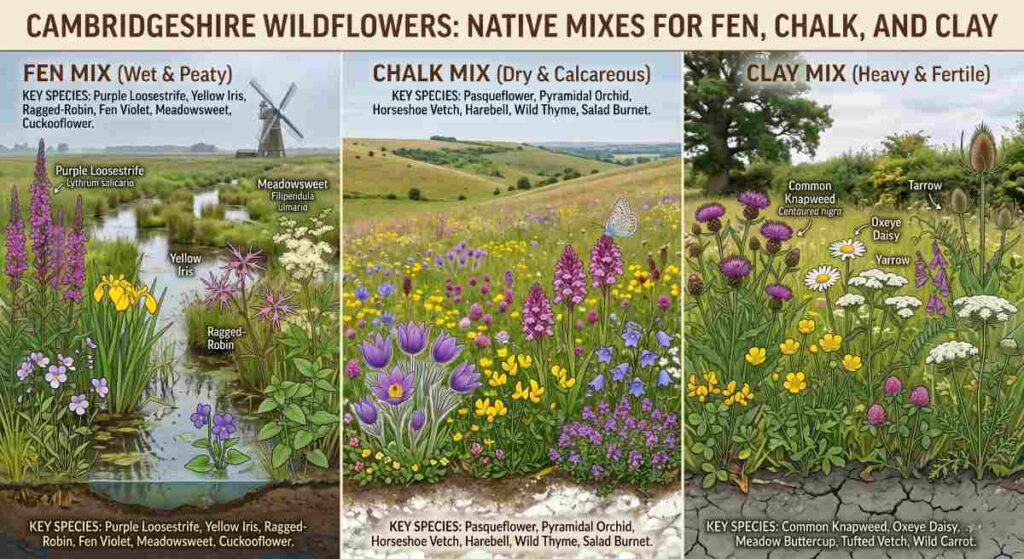
Cambridgeshire presents one of the most dramatic contrasts in English wildflower ecology. The chalk ridge running south-west from Newmarket through Royston carries some of the finest calcareous grassland remaining in eastern England — thin, alkaline, flower-rich habitats where Pasque Flower (Pulsatilla vulgaris) and Chalk Milkwort (Polygala calcarea) still survive in their last refuges. Barely twenty miles north and east, the drained Fenland of the Bedford Levels and the Isle of Ely presents an entirely different world: deep peat and alluvial soils, some below sea level, managed by drainage rather than grazing.
Between these extremes lies the boulder clay plateau of south Cambridgeshire and the river meadows of the Cam, Great Ouse, and their tributaries. For anyone looking for wildflower seeds in Cambridgeshire, these three zones — chalk, fen, and clay — demand quite different approaches. Getting the right mix for your specific ground is the essential starting point, and the county’s low rainfall makes Autumn sowing the strongly preferred approach across all soil types.
Cambridgeshire’s soils and habitats: chalk, fen, and clay
The Cambridgeshire chalk — the Gog Magog Hills south-east of Cambridge, the chalk escarpment around Newmarket, and the ridge running through Royston and Melbourn — carries some of the best-preserved calcareous grassland in the region. The surviving unimproved chalk grassland holds Pasque Flower (one of Britain’s rarest native wildflowers), Meadow Clary (Salvia pratensis), Chalk Milkwort, Horseshoe Vetch (Hippocrepis comosa), and Squinancywort (Asperula cynanchica). These sites are nationally important; on degraded chalk margins, a chalk and limestone mix is the appropriate restoration tool.
The Fenland of north Cambridgeshire — the vast flat basin drained since the seventeenth century, stretching north to the Wash — has been almost entirely converted to intensive arable. The deep, black peat and alluvial soils are among the most fertile in Britain. Where undrained fen habitat persists — in nature reserves such as Wicken Fen, Woodwalton Fen, and Holme Fen — it represents one of the last fragments of the original Great Fen. On the agricultural fen margins, riverside dyke banks, and any seasonally wet ground, a Wetland and Pond mix supports habitat creation.
The boulder clay plateau of south Cambridgeshire — from Saffron Walden and Haverhill north through Linton, Balsham, and Fulbourn to Cambridge — carries moderately fertile, reasonably well-drained clay soils with a surviving network of hedgerows, green lanes, and field margins that hold traditional meadow flora wherever they have escaped improvement.
The river meadows of the Cam, Great Ouse, Nene, and their tributaries carry alluvial grassland habitats ranging from well-drained terrace grassland to seasonally flooded wet meadow. The meadows along the upper Cam and around Grantchester are among the closest surviving examples of traditional hay meadow management to Cambridge itself.
Choosing the right wildflower seeds for Cambridgeshire
Chalk and Limestone Mix — for the Cambridgeshire chalk escarpment, the Gog Magog Hills, the Newmarket chalk, and any site with thin, alkaline, free-draining chalk-derived soil and a pH above 6.5. Horseshoe Vetch, Common Rock-rose (Helianthemum nummularium), Small Scabious (Scabiosa columbaria), Clustered Bellflower (Campanula glomerata), Salad Burnet (Sanguisorba minor), and Kidney Vetch (Anthyllis vulneraria) are the core species. Do not introduce seed onto intact Pasque Flower or Meadow Clary sites without specialist ecological input.
Traditional Meadow Mix — the core choice for the boulder clay plateau of south Cambridgeshire, river valley terraces, and any moderately fertile, reasonably well-drained site. Knapweed (Centaurea nigra), Ox-eye Daisy (Leucanthemum vulgare), Meadow Cranesbill (Geranium pratense), Yellow Rattle (Rhinanthus minor), Wild Carrot (Daucus carota), Musk Mallow (Malva moschata), and Greater Knapweed (Centaurea scabiosa) establish reliably on well-prepared Cambridgeshire clay and loam soils. Yellow Rattle is essential on any site with established grass.
Wetland and Pond Mix — for the Fenland dyke banks, river margins along the Cam, Great Ouse, and Nene, and any site with seasonally waterlogged conditions. Ragged Robin (Lychnis flos-cuculi), Yellow Flag Iris (Iris pseudacorus), Meadowsweet (Filipendula ulmaria), Purple Loosestrife (Lythrum salicaria), Water Mint (Mentha aquatica), and Great Willowherb (Epilobium hirsutum) are core components. For any work near Wicken Fen, Woodwalton Fen, or other designated fen reserves, consult the relevant conservation body before sowing. Sow in Autumn into exposed wet or moist soil.
Sowing wildflower seeds in Cambridgeshire: timing and ground preparation
Cambridgeshire is one of the driest counties in England — annual rainfall typically 550 to 600mm. Autumn sowing (late August to October) is the strongly preferred approach across all soil types, catching the autumn and winter moisture before the dry Cambridgeshire spring and summer. Spring sowing is viable but carries more drought risk, particularly on the free-draining chalk soils.
Yellow Rattle must be sown in September on any site with existing grass. On the moderately fertile clay plateau of south Cambridgeshire, it is the most important insurance against grass competition in years two and three. On the naturally low-fertility chalk sites, it is less critical but still a valuable component. Always include it in the Autumn sowing or broadcast it separately into existing turf.
Ground preparation on the Cambridgeshire chalk is relatively straightforward — scarification to expose 40 to 60 percent bare chalk is usually sufficient. On the boulder clay soils, rotovation or topsoil stripping targets 50 to 70 percent bare soil. On the Fenland margins and dyke banks, sowing into exposed moist soil during a drawdown period produces the best results for wetland species.
Managing Cambridgeshire wildflower habitats for the long term
On the Cambridgeshire chalk, light sheep grazing through the growing season with stock off in summer, or a July to August cut with all cuttings removed, is the management model. Scrub encroachment — hawthorn, dogwood, and clematis on the chalk — requires ongoing control. The chalk grassland communities of the Gog Magog Hills are among the most valuable in the county; any restoration work near intact sites should be undertaken with awareness of the existing rare flora.
For the clay plateau meadow sites and river valley habitats, the standard rule applies: cut once in late Summer (August to September), remove all cuttings, do not fertilise. Aftermath cattle grazing in Autumn consolidates the sward on clay sites. On Fenland dyke banks and wet margins, cutting management combined with water level maintenance produces the best results.
As with other dry East Anglian counties, summer browning on lighter soils during establishment is normal. Perennial wildflowers will recover when autumn moisture returns. Establishment takes two to three years on clay; chalk and light loam sites can show strong results in year two.
Locally sourced wildflower seeds for Cambridgeshire
Wildahome sources seed from UK meadows and partner farms, with provenance matched to regional habitats wherever possible. For Cambridgeshire projects, the Chalk and Limestone, Traditional Meadow, and Wetland and Pond mixes all contain species appropriate to the county’s main habitat types. Cambridgeshire’s chalk flora includes some of the rarest wildflowers in England — always take specialist advice before working on or near nationally important chalk grassland sites.
From the Pasque Flower chalk of the Gog Magog Hills to the fen margins of the Great Ouse and the meadows of the upper Cam, Cambridgeshire holds wildflower habitats of national significance. Browse our seed mixes or contact us to discuss your project.