

Wildflower Seeds for Lincolnshire: Native Mixes Across England’s Largest County
Wildflower Seeds for Lincolnshire: Native Mixes Across England’s Largest County
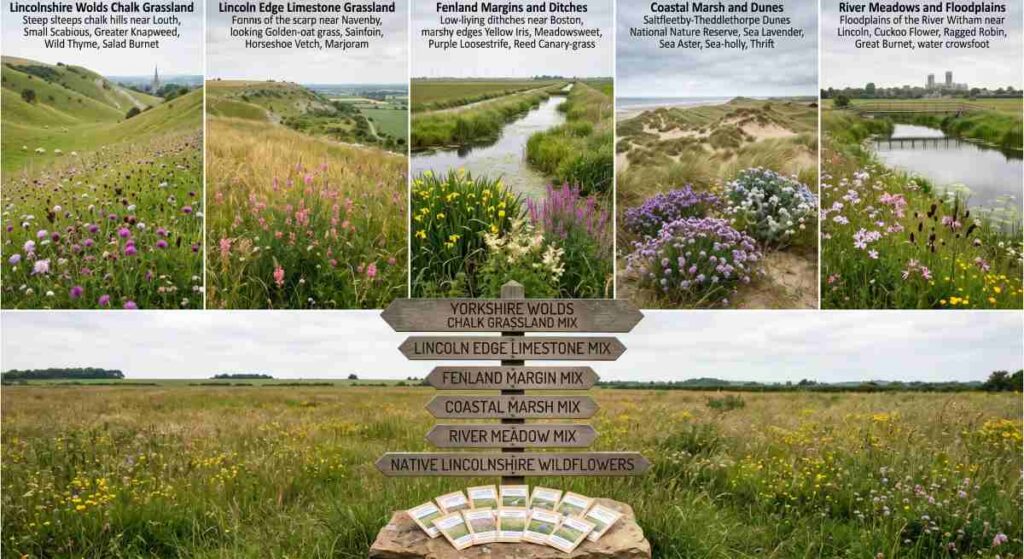
Lincolnshire is the second largest county in England, and its sheer scale produces a landscape of real ecological diversity. The chalk Wolds running north from the Humber through Louth to Caistor carry calcareous grassland of genuine conservation importance. The Lincoln Edge — the limestone ridge running the length of the county from north to south — holds ancient heath grassland communities. The vast Fens in the south and east mirror Cambridgeshire’s drained peat landscape. The coastal marshes, dunes, and saltings from Cleethorpes to Gibraltar Point form one of the most significant migratory bird coastlines in Britain. And the river valleys of the Witham, Welland, Nene, and Ancholme carry alluvial meadow habitats throughout.
For anyone looking for wildflower seeds in Lincolnshire, the county’s diversity demands a site-first approach. The chalk of the Wolds, the limestone of the Edge, the peat of the Fens, and the alluvial clays of the river valleys all require different mixes and different preparation. Lincolnshire also shares the low rainfall characteristic of the broader East Midlands region — Autumn sowing is the strongly preferred approach across all soil types.
Lincolnshire’s soils and habitats: wolds, edge, fen, and coast
The Lincolnshire Wolds — the chalk hills running from the Humber estuary south through Caistor, Louth, and Horncastle — carry thin, alkaline, free-draining chalk soils. The surviving unimproved chalk grassland holds Clustered Bellflower (Campanula glomerata), Common Rock-rose (Helianthemum nummularium), Small Scabious (Scabiosa columbaria), and Horseshoe Vetch (Hippocrepis comosa). On degraded Wolds margins and disturbed chalk slopes, a chalk and limestone mix is the appropriate restoration tool.
The Lincoln Edge — the Jurassic limestone escarpment running from the Humber near Barnetby south through Lincoln and Sleaford — carries a different calcareous grassland community on its oolitic limestone soils. Wild Thyme (Thymus polytrichus), Salad Burnet (Sanguisorba minor), Kidney Vetch (Anthyllis vulneraria), and Dropwort (Filipendula vulgaris) are among the best surviving limestone heath species in the East Midlands.
The Lincolnshire Fens — the flat, drained peat and alluvial basin south and east of Lincoln, around Boston, Spalding, and the Wash — mirror the Cambridgeshire Fenland. On remaining dyke banks, riverside margins, and wet field corners, a Wetland and Pond mix supports habitat creation. For any work near the Wash National Nature Reserve or Lincolnshire Wildlife Trust fen reserves, consult the relevant conservation body.
The coastal marshes, dunes, and grazing marsh of the Lincolnshire coast carry nationally important coastal grassland and wetland communities. Management rather than seed introduction is usually the right approach on the best sites. On degraded coastal grassland margins and disturbed dune edges, low-rate traditional meadow or acidic soils mixes support restoration.
Choosing the right wildflower seeds for Lincolnshire
Chalk and Limestone Mix — for the Wolds chalk grassland, the Lincoln Edge limestone heath, and any site with thin, alkaline, free-draining calcareous soil with a pH above 6.5. Horseshoe Vetch, Common Rock-rose, Small Scabious, Clustered Bellflower, Wild Thyme, Salad Burnet, Kidney Vetch, and Dropwort are all target species. Sow in Autumn into scarified chalk or limestone soil, exposing 40 to 60 percent bare ground.
Traditional Meadow Mix — for the river valley terraces and lowland enclosed farmland, particularly the Witham, Welland, and Ancholme valleys, and any moderately fertile, reasonably well-drained site. Knapweed (Centaurea nigra), Ox-eye Daisy (Leucanthemum vulgare), Meadow Cranesbill (Geranium pratense), Yellow Rattle (Rhinanthus minor), Wild Carrot (Daucus carota), and Musk Mallow (Malva moschata) establish reliably. Yellow Rattle is essential on any site with established grass.
Wetland and Pond Mix — for the Fenland dyke banks, river margins along the Witham, Welland, Nene, and Ancholme, and any site with seasonally waterlogged conditions. Ragged Robin (Lychnis flos-cuculi), Yellow Flag Iris (Iris pseudacorus), Meadowsweet (Filipendula ulmaria), Purple Loosestrife (Lythrum salicaria), Water Mint (Mentha aquatica), and Marsh Marigold (Caltha palustris) are the core species. Sow in Autumn into exposed wet or moist soil.
Sowing wildflower seeds in Lincolnshire: timing and ground preparation
Lincolnshire’s annual rainfall is moderate to low — typically 550 to 650mm — making Autumn sowing (late August to October) the strongly preferred approach across all soil types. Spring sowing (March to May) is viable as a secondary option but carries drought risk, particularly on the free-draining chalk Wolds and limestone Edge soils.
Yellow Rattle must be sown in September on any lowland site with existing grass. On the naturally low-fertility chalk and limestone grasslands it is less critical — but on the more fertile river valley and Fen-edge soils, it is the most important component of any meadow mix. Include it in the Autumn sowing or broadcast it separately into existing turf in September.
On the Wolds chalk and Edge limestone, scarification to expose 40 to 60 percent bare calcareous soil is usually sufficient. On the river valley clays and loam soils, rotovation or topsoil stripping to achieve 50 to 70 percent bare soil is needed before sowing. On Fenland dyke banks, sowing into exposed moist soil during a drawdown period is most productive for wetland species.
Managing Lincolnshire wildflower habitats for the long term
On the Wolds chalk and Edge limestone grassland, light sheep grazing through the growing season with stock off in summer, or a July to August cut with all cuttings removed. Scrub encroachment — hawthorn, bramble, and elder on the limestone — needs ongoing control.
For the river valley meadow sites and lowland farmland, cut once in late Summer (August to September), remove all cuttings, do not fertilise. Aftermath cattle grazing in Autumn is beneficial on the richer alluvial valley soils. On Fenland dyke banks, cutting management combined with water level maintenance produces the best results for wetland flora.
As with Suffolk and Norfolk, dry summers can cause browning on chalk and limestone soils during establishment years — this is normal. The perennial wildflowers are building root systems and will recover strongly when autumn moisture returns. Establishment takes two to three years on clay and loam; chalk and limestone sites often show strong results in year two.
Locally sourced wildflower seeds for Lincolnshire
Wildahome sources seed from UK meadows and partner farms, with provenance matched to regional habitats wherever possible. For Lincolnshire projects, the Chalk and Limestone, Traditional Meadow, and Wetland and Pond mixes all contain species appropriate to the county’s main habitat types. Lincolnshire’s size and ecological variety mean that identifying the right mix for your specific site is always worthwhile — contact us to discuss before ordering.
From the chalk Wolds to the limestone Edge, the Fenland dykes to the Wash coastal marshes, Lincolnshire holds some of the finest and most varied wildflower habitats in eastern England. Browse our seed mixes or get in touch to discuss your project.
Ready to get started?
Shop: Traditional Wildflower Meadow Mix →Frequently asked questions
When's the best time to sow a wildflower mix?
Late summer to early autumn (August to September) is the best sowing window for most of the UK -- seed goes into warm, moist soil ahead of winter and gets the cold, damp period many native wildflower seeds need to break dormancy. A second window opens in spring (March to April) once the ground has warmed, though autumn sowing usually establishes faster with fewer weed problems.
Why does local seed provenance matter?
Seed grown from populations adapted to similar soil, rainfall and temperature conditions germinates more reliably and settles into a stronger, longer-lived meadow than seed sourced from a very different climate. That's why we match seed to comparable growing conditions rather than supplying one generic UK-wide mix.
Do I need to prepare the ground before sowing?
Yes, and it's the single biggest factor in whether a meadow succeeds. Existing vegetation and topsoil fertility need to be reduced, since most UK soils are too nutrient-rich for wildflowers and favour competitive grasses and weeds instead. In practice that usually means clearing down to bare soil, raking to a fine tilth, and sometimes sowing yellow rattle alongside the mix to suppress grass vigour.
How long before it looks like a proper meadow?
Most sites show flowers in year one, but a settled, species-rich meadow typically takes two to three growing seasons to establish as slower perennials build up and the balance between grasses and wildflowers matures. Very fertile ground can take longer, since excess nutrients need to be drawn down through repeated cutting and removal of cuttings.
What ongoing management does a wildflower meadow need?
An annual cut in late summer, after flowering and seed-set, with the cuttings removed rather than left to rot down, is the core of long-term management. This keeps fertility low and stops coarse grasses and scrub taking over. Spring topping and occasional scarification help in the early years, and light grazing can replace cutting on some sites.
More county guides
Find the right native wildflower mix for your county, or browse our full list by region.