

Wildflower Seeds for Heavy Clay Soil: Species, Preparation, and Long-Term Success
Wildflower Seeds for Heavy Clay Soil: Species, Preparation, and Long-Term Success
Heavy clay is one of the most challenging substrates for wildflower establishment — but it is far from impossible. Some of Britain’s richest ancient meadows sit on clay, and with the right approach, species selection, and honest expectations, clay ground can support a genuinely diverse and long-lasting wildflower sward.
This guide covers which native British species are suited to clay conditions, how to prepare the ground without undermining your chances, and what long-term management looks like. The principles here apply whether you’re working a garden-scale plot or a field-sized restoration.
Why clay soil is challenging — and why that’s not the whole story
Clay soils are structurally dense, slow to drain, and prone to compaction. These properties make them inhospitable to many plants — particularly those adapted to free-draining, low-fertility ground. A thick clay site with poor drainage and grass competition is among the harder starting points for wildflower establishment.
But clay also holds moisture through dry summers, which suits a number of native perennials that struggle on thin chalky or sandy soils. The key is working with the soil rather than trying to fundamentally alter it. Adding organic matter or compost to clay before sowing wildflowers is counterproductive — it raises nutrient levels and encourages competitive grass and weed growth, which will outcompete wildflowers. Wildflowers need low fertility to establish and persist. On clay, that means exposing mineral soil, not enriching it.
Ground preparation for wildflower seeds on heavy clay soil
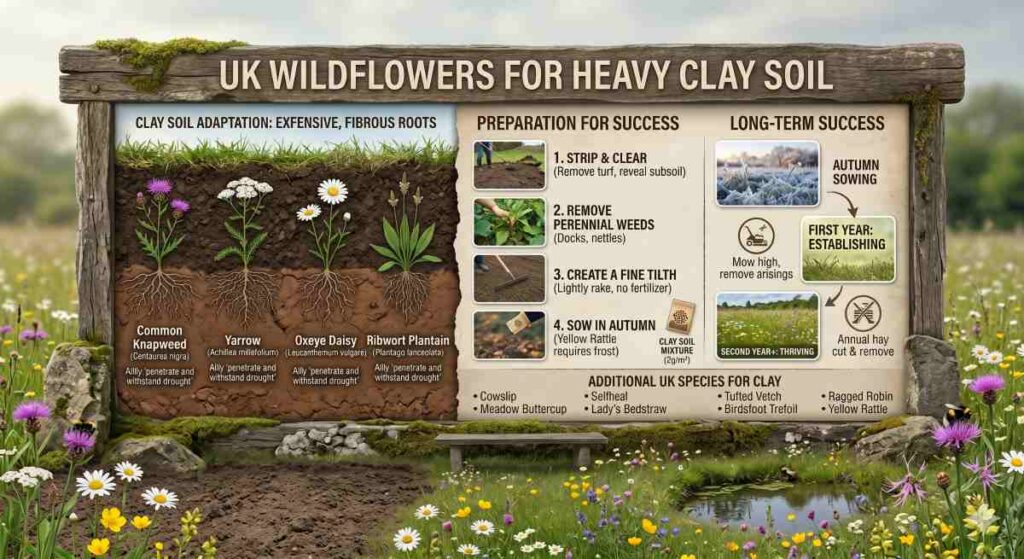
Surface preparation matters more than soil amendment. The goal is to create a fine, firm seedbed on mineral clay with minimal weed seed load. Do not add compost, manure, or any organic material before sowing.
Strip existing vegetation — either by cultivating and allowing a flush of weeds to germinate and die (stale seedbed method), by repeated close mowing, or by cutting and removing all existing plant material.
Scarify and firm the surface — rough up the top 5–10mm of clay to create seed-to-soil contact, then firm down with a roller or boot. Clay should be moist but not waterlogged at sowing time.
Drainage: only tackle it where it’s critical — very waterlogged clay that holds standing water for weeks at a time will need drainage work before sowing. For moderately heavy clay with seasonal moisture retention, drainage work is usually unnecessary and the right species selection will compensate.
Sow into exposed mineral clay — not into green vegetation, not into recently composted soil. Bare, firm, and low-nutrient is the target.
Native wildflower species that thrive on heavy clay soil
The following species are native to Britain and reliably establish on clay-based substrates. All are available in Wildahome mixes selected for heavier ground conditions. These are not American prairie species — they are the plants that historically occurred in the clay vales, hedgerow banks, and lowland meadows of Britain.
Meadow cranesbill (Geranium pratense)
A tall, robust perennial with violet-blue flowers from June to August. Excellent for clay — tolerates seasonal moisture and establishes well where grass competition is reduced. Long-lived once established.
Red campion (Silene dioica)
One of the most reliable colonisers of heavy clay. Flowers May to September, supports bumblebees, and spreads readily by seed. Works well in partial shade or on hedgerow banks, not just open meadows.
Oxeye daisy (Leucanthemum vulgare)
A classic meadow perennial that tolerates a wide range of conditions including moderately heavy clay. Flowers June to August, highly attractive to pollinators. Establishes in year one if sown in the right window and spreads steadily thereafter.
Common knapweed (Centaurea nigra)
One of the most valuable late-season species for pollinators, flowering July to September. Knapweed tolerates heavy, moist soils well and is a key component of any traditional meadow mix aimed at clay ground. Highly persistent once established.
Ragged robin (Lychnis flos-cuculi)
Suited to the wetter end of clay soils — particularly low-lying areas or seasonally flooded ground. The bright pink, fringed flowers appear May to June and are important for long-tongued bumblebees. Not suited to freely draining sites.
Devil’s bit scabious (Succisa pratensis)
A key species for late-season pollinators, particularly for the declining Marsh Fritillary butterfly. Flowers August to October on heavy, moist soils — one of the few wildflowers to peak into early Autumn. Slow to establish but very persistent.
Meadow buttercup (Ranunculus acris)
Tolerates heavy soils well and persists in moist, grassy conditions. Flowers May to July. Provides early nectar and fits naturally into a mixed perennial sward.
Yellow Rattle (Rhinanthus minor)
An essential component of any long-term clay meadow where grass competition is strong. Yellow Rattle is a hemiparasitic annual that attaches to grass roots and reduces their vigour, opening space for wildflowers to establish and persist. It must be sown fresh in Autumn (August to October) — it will not germinate from spring-sown seed.
Sowing windows for clay soil
Timing matters more on clay than on free-draining ground. The best results come from Autumn sowing into a prepared seedbed, between late August and the end of October.
Clay warms and dries slowly in Spring, which delays germination and extends the window in which weeds can establish first. Autumn sowing allows seeds to cold-stratify naturally over Winter and germinate as conditions become optimal in Spring. This is particularly important for Yellow Rattle, which requires a cold period to break dormancy.
Spring sowing (March to April) is possible but produces slower establishment results on clay. If you sow in Spring, prepare the seedbed in Autumn to allow winter weather to break down the clay surface — this creates a finer tilth for sowing.
Which Wildahome seed mix to choose for heavy clay
For most clay sites, the 80/20 Traditional Wildflower Meadow Mix is the recommended starting point. The 80% grass component provides structure and ground cover while the 33 native wildflower species establish. Including Yellow Rattle in the mix is strongly advisable where existing grass is competitive.
For wetter clay ground with seasonal flooding, the Wetland & Pond mix is more appropriate — it includes Ragged Robin, Purple Loosestrife, and Water Avens, which are suited to saturated conditions that the Traditional mix would struggle in.
If your clay site is dry in Summer despite winter moisture, and you’re in the south or midlands, consider the Chalk & Limestone mix — some species in that mix, including Wild Marjoram and Kidney Vetch, tolerate more clay-influenced soils in warmer regions than their name suggests. Contact us for site-specific advice before committing.
Long-term management of clay wildflower meadows
Establishment on clay is typically slower than on well-drained ground. Year one will often show a mix of annual species and early-establishing perennials. The real meadow character — knapweed, scabious, cranesbill — builds from year two onwards, and improves significantly in years three and four.
Annual management is simple: cut the entire meadow once in late Summer or early Autumn (typically August to October depending on what’s still in flower), remove all cuttings, and leave it until the following Spring. Removing the cuttings keeps nutrient levels low — essential for long-term wildflower persistence on clay.
Do not fertilise. Do not add organic matter after establishment. Both encourage grass and rank weed growth that will suppress wildflowers. The soil nutrient level you start with is the one that determines your meadow’s long-term character — keep it low.
Managing expectations
Clay sites take longer, and that honesty is part of working with British native wildflowers. Year one often disappoints. By year three, a well-prepared clay meadow with good species selection can be exceptional — knapweed, cranesbill, and scabious together make for one of the best summer displays in the British landscape.
If establishment is patchy in year one, resist the urge to intervene heavily. Allow seed to ripen and disperse naturally. Many species that fail to emerge in year one will germinate successfully in year two from seed already in the ground.
Ready to start your clay wildflower meadow?
Wildahome supply native British wildflower seed mixes formulated for heavy clay conditions, sourced from our own meadows in Devon and Powys and partner farms across the UK. If you’re unsure which mix is right for your site, call us on 0333 242 0602 or contact Paul directly — we’re happy to talk through the specifics of your ground before you commit to a mix.
Ready to get started?
Shop: Heavy Clay Wildflower Meadow Mix →About the Author
Paul Stenning, Wildahome
Paul Stenning is the co-founder of Wildahome, a family-run British wildflower seed business growing and supplying native seed from their own meadows in Devon and Powys, Wales. With hands-on experience establishing wildflower habitats across the UK, Paul advises individuals, land managers, ecologists, and developers on species selection, ground preparation, and long-term meadow management. For site-specific advice, call 0333 242 0602 or email paul@wildahome.co.uk.