

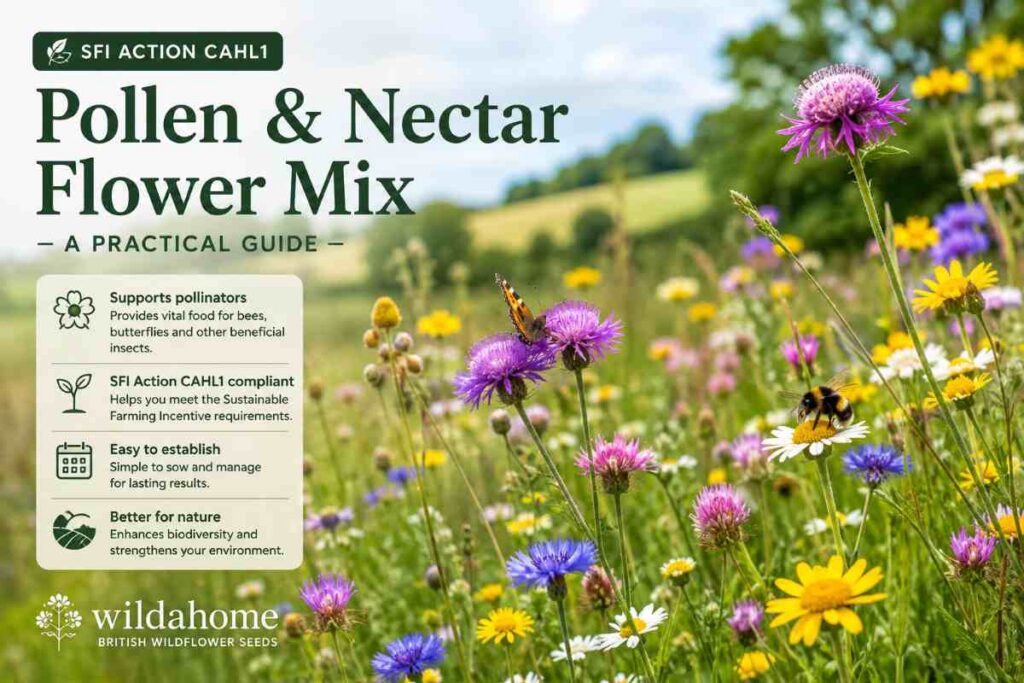
SFI Action CAHL1: Pollen and Nectar Flower Mix — A Practical Guide
SFI Action CAHL1: Pollen and Nectar Flower Mix — A Practical Guide
With SFI26 Window 1 opening on 30 June 2026, farmers across England are making decisions right now about which actions to include in their agreements. CAHL1 — the Pollen and Nectar Flower Mix — is one of the most widely chosen, and for good reason. It delivers visible results, supports a wide range of beneficial insects, and fits into most arable and mixed farming rotations with relatively little disruption.
This guide covers what CAHL1 actually requires, how to choose and establish a compliant seed mix, and what long-term management looks like to keep the strips or blocks performing well year after year.
What Is SFI Action CAHL1?
CAHL1 requires you to establish a pollen and nectar flower mix that produces areas of flowering plants from late Spring and throughout Summer. The aim is to provide food and habitat for beneficial pollinators — bumblebees, solitary bees, hoverflies, and butterflies — as well as natural predators of crop pests such as parasitic wasps and ground beetles.
It is a rotational or static action, meaning you can either keep it in the same location each year or move it around the farm between agreement years. The minimum seed mix specification requires:
- A minimum of 6 flowering species
- No grasses in the mix
- No single species exceeding 50% of the mix by weight
CAHL1 is subject to the 25% area cap in SFI26 — this limits the combined area of certain high-value actions (including CAHL1, CIPM2, CAHL2, and CAHL3) to no more than 25% of the farmed area across all SFI agreements attached to the holding.
Choosing the Right CAHL1 Seed Mix
The Defra specification sets a floor, not a ceiling. Any mix with 6 or more flowering species and no grasses will be technically compliant — but a well-designed mix with higher species diversity will deliver substantially more ecological value and, critically, will flower across a longer season.
The best CAHL1 mixes typically combine:
- Short-lived annual and biennial species for quick establishment and early-season colour — Phacelia (Phacelia tanacetifolia), Borage (Borago officinalis), Cornflower (Centaurea cyanus)
- Longer-lived perennial species for sustained value — Common Knapweed (Centaurea nigra), Oxeye Daisy (Leucanthemum vulgare), Wild Marjoram (Origanum vulgare)
- Legumes for nitrogen fixation and bumblebee value — Red Clover (Trifolium pratense), Birdsfoot Trefoil (Lotus corniculatus), Vetch (Vicia sativa)
Avoid mixes dominated by a single species such as Phacelia or Vetch. These provide a narrow flowering window and limited diet diversity for specialist pollinators. A mix that flowers from May through to October will deliver significantly more value across a full SFI agreement year.
Where possible, choose seed from British-grown or locally sourced stock. Locally provenance-matched seed establishes more reliably on UK soils and supports the native ecotype populations that regional pollinators have co-evolved with.
Ground Preparation — Getting the Seedbed Right
CAHL1 strips and blocks are often sown on land that has previously carried arable crops, which means fertility can be relatively high. This is worth addressing before sowing — flowering forbs, particularly the more delicate native species, establish far better in low-nutrient conditions where aggressive grass weeds are less competitive.
Before Sowing
- Cultivate to a fine, firm, weed-free seedbed — aim for a surface similar to a prepared vegetable plot
- If the field has a history of perennial weed problems (creeping thistle, couch grass), address these before sowing — wildflower mixes cannot outcompete established perennials
- Avoid applying any fertiliser or manure to the designated area
- On fertile soils, a false seedbed (cultivate, allow weed flush, shallow cultivate again) can reduce early weed competition significantly
Sowing Windows and Rates for CAHL1
CAHL1 mixes can be sown in Spring or early Autumn, each with different advantages.
Spring Sowing (March–May)
Spring sowing suits annual-dominant mixes and will typically deliver flowering in the same year, from early Summer onwards. Soil temperatures need to be reliably above 7°C. Spring sowing on heavier soils can be more difficult if the ground remains wet into April.
Autumn Sowing (August–October)
Autumn sowing suits mixes with a stronger perennial component. Many native forbs require a period of cold stratification to germinate, so autumn-sown seed will establish through Winter and flower more strongly in the following year. This approach often produces a more resilient, longer-lived stand.
Sowing Rate
Typical sowing rates for a 100% flower mix (no grasses) are 2–4g per m², or 20–40kg per hectare. Broadcasting by hand or with a fertiliser spreader works well for larger areas. Mixing the seed with dry sand (roughly 1:4 seed to sand by volume) helps achieve an even spread, particularly with lighter seed.
After sowing, roll if conditions allow — good seed-to-soil contact is essential for reliable germination.
Establishment — What to Expect in Year One
A CAHL1 block or strip sown in Spring will typically show germination within 2–3 weeks in warm, moist conditions. Annuals like Phacelia and Cornflower will establish quickly and may be in flower within 8–10 weeks of sowing.
Perennial species are slower — many will not flower until their second year. Do not judge a Spring-sown mix purely on Year 1 performance. A block that looks sparse and weedy in its first Summer may develop into a diverse, productive stand by Year 2 once the perennial forbs have established root systems.
Weed management in Year 1 is the critical variable. If aggressive annuals such as Fat Hen (Chenopodium album) or Redshank (Persicaria maculosa) are dominating early on, a careful cut to 15–20cm before they set seed will suppress them without damaging the slower-establishing wildflowers below. Do not cut lower than this or you risk cutting off developing rosettes.
Long-Term Management of CAHL1 Areas
- Cut in late Autumn (October–November) once flowering has finished and seed has been shed. Remove or box off the cuttings — leaving a thick mulch layer suppresses wildflower regeneration.
- For rotational delivery, move the location of the block or strip between agreement years to prevent a build-up of rank grass and perennial weeds in a single spot.
- For static delivery, consider scarifying or harrowing every 2–3 years to break up any thatch and expose bare soil for self-seeding annual species.
- Do not apply herbicides, fungicides, or insecticides to CAHL1 areas. Spot treatment of injurious weeds (such as Ragwort and Creeping Thistle) using a weed wiper is permitted.
Wildahome Seed Mixes for CAHL1
Our 100% Wildflower mixes — including the Traditional Meadow Mix and Chalk & Limestone Mix — can be used to create a CAHL1-compliant pollen and nectar strip or block that goes well beyond the minimum specification. All are grown from British-sourced seed at our farms in Devon and Powys, and are sown at 1–3g per m² on prepared, low-nutrient ground.
If you have a specific soil type — sandy, clay, chalk, or acidic — we can match your mix to the conditions on the ground, giving you a better stand and a longer-lasting block that genuinely earns its place in your SFI agreement.
Ready to get started?
Shop: Traditional Wildflower Meadow Mix →