

Yellow Rattle in Woodland Creation and Wood Pasture Projects
Most new woodland in Britain is planted on old farmland, and the first thing every young tree meets is grass. Ryegrass, Yorkshire fog and false oat-grass have spent decades being fed and favoured, and they take water and nutrients from a sapling’s roots long before the tree can compete. This guide explains how yellow rattle in woodland creation can weaken that grass, what the science says about why it works, where its limits lie, and how to use it in wood pasture, glades, rides and woodland meadows.
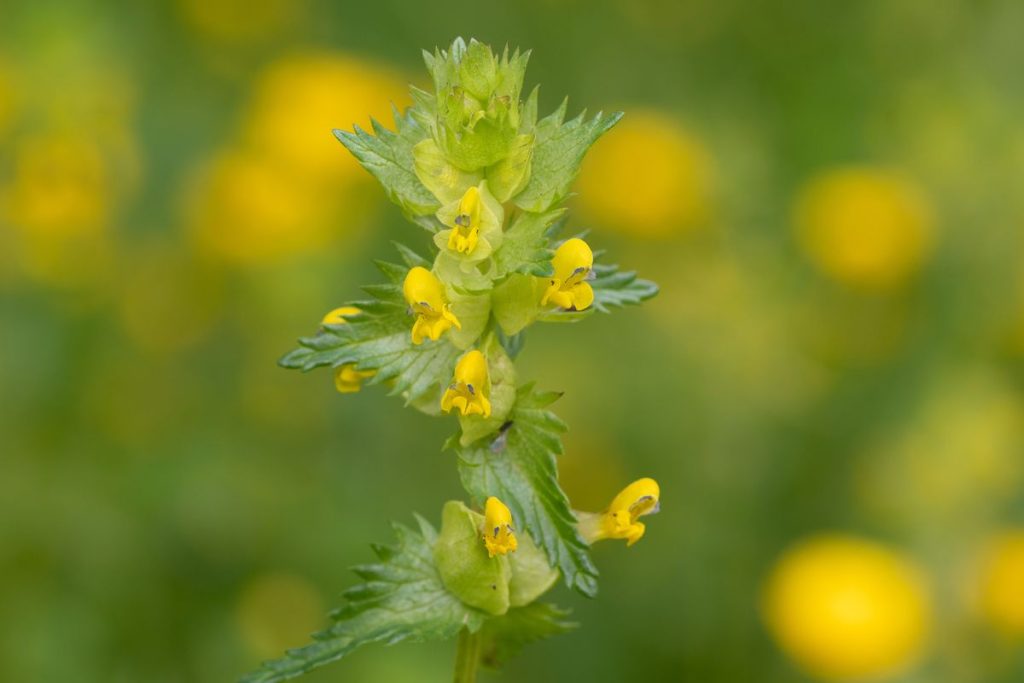
Yellow Rattle (Rhinanthus minor) is best known as the meadow-maker, the semi-parasitic annual that opens up a sward for wildflowers. The same habit makes it useful in the open stages of a new wood. It feeds on grass roots, it needs light, and it has no long-lived seedbank, so it does its work while the site is open and then fades out as the canopy closes.
Woodland creation is moving quickly. England has a legal target to raise tree canopy and woodland cover to at least 16.5% of land by the end of 2050, and Wales and Scotland have their own planting programmes. Much of that land will be improved pasture or ex-arable ground, and on those sites grass control decides whether the first planting thrives or is replaced. A low-cost, low-chemical tool that suits the open ground between trees deserves a place in the plan.
Why grass competition holds back woodland creation
Tree whips planted into a vigorous grass sward have three problems at once. The grass roots intercept rain and take up nitrogen in the top few centimetres of soil, exactly where a newly planted whip is trying to root. A dense sward also keeps the soil surface cool and damp, which suits slugs and fungal problems. And long, tussocky grass is ideal cover for field voles, which strip bark from the base of young broadleaves in winter.
Forestry practice has usually dealt with this in one of two ways. The first is herbicide: a metre-wide spot or strip kept bare around each tree for the first three to five years. The second is mechanical: mowing, strimming or mulch mats. Both work, but both cost money every year, strimmers damage bark, and repeated spraying sits uneasily with projects whose purpose is nature recovery.
Neither approach does anything for the open ground between the trees, and that ground matters. In wood pasture, along rides and in glades, it is meant to stay open as species-rich grassland for decades. That is where yellow rattle earns its keep.
How yellow rattle works: the science in brief
Yellow Rattle is a hemiparasite. It has green leaves and makes some of its own sugars, but it takes most of its water and minerals from other plants. Its roots respond to chemical signals from nearby host roots and form small attachment organs called haustoria. Each haustorium pushes a peg of tissue through the host root’s outer layers and connects directly to its water-conducting vessels, the xylem.
Once connected, Yellow Rattle behaves like a pump. Its leaf pores stay open almost constantly, including at night, so it transpires hard and pulls sap out of the host. That sap carries nitrogen, phosphorus, potassium and other minerals, and research shows the parasite also takes a significant share of its carbon from the host. For the grass, the effect resembles drought and starvation together: root growth slows, tillering drops and the sward thins.
Grasses, legumes and forbs respond differently
The selectivity is what makes the plant so useful. Laboratory work on haustoria has shown that grasses put up almost no defence at the point of attack, while many broad-leaved wildflowers (forbs) wall the parasite off.
| Plant group | Examples | Response at the root | Effect of Yellow Rattle |
|---|---|---|---|
| Grasses | Perennial ryegrass, crested dog's-tail, Yorkshire fog | No effective defence; parasite reaches the xylem easily | Strong suppression of growth and seed set |
| Legumes | Tufted vetch, clovers, bird's-foot trefoil | Little defence, but nitrogen-fixing keeps them vigorous | Tolerant; often act as good hosts without collapsing |
| Forbs | Ox-eye daisy, ribwort plantain | Active defence: cell death and thick lignified walls block the parasite | Little or no damage |
In UK grassland restoration trials, sowing Yellow Rattle reduced total plant biomass by roughly a fifth to almost a half in most studies, and increased the number of wildflower species. Farmers have long known the effect: older accounts put hay losses on rattle-heavy fields at up to 50%, which is why it was once treated as a weed.
The fertility threshold
Yellow Rattle does not work everywhere. On highly fertile ground the grass grows so fast in early spring that it shades out rattle seedlings before they can attach to a host. The key measure is phosphorus. Natural England guidance on habitat creation advises a low soil phosphorus status, Index 0 or 1 (roughly 15 mg/l Olsen P or less), where botanical diversity is the goal. Phosphorus binds tightly to soil and can persist for decades after fertiliser stops.
That makes a soil test the first job on any former farmland. On a site at Index 2 or 3, expect Yellow Rattle to struggle unless the topsoil fertility is dealt with first. Deep ploughing to bury the enriched topsoil, or removing it altogether, are the quick options. Repeated cutting and removing the arisings works too, but it lowers phosphorus very slowly. Our guide to why low-nutrient soil matters for meadow establishment covers this in more depth.
What yellow rattle can and cannot do for young trees
It is worth being clear about the evidence. The grass-suppressing effect of Yellow Rattle is well established in grassland research. Its use in new woodland is growing. Forestry England, for example, included a Yellow Rattle area in the meadow plans for its new 51-hectare Wing Wood in Buckinghamshire. But there are few published trials measuring tree growth with and without rattle. The case rests on sound ecology rather than long-term forestry data.
What we can say with confidence:
- Less grass means less root competition. Weed control trials consistently show that young broadleaves grow faster and survive better when the surrounding grass is suppressed. Yellow Rattle weakens the sward in the open ground between trees, though it will not create the bare spot a whip needs in its first years.
- A thinner sward gives voles less cover. Voles favour dense, tussocky grass and a deep layer of thatch, and forestry advice has long noted that removing that cover reduces bark damage. A rattle-thinned sward should be less attractive to voles, but it is not a substitute for guards in a vole-plague year.
- It works with soil life, not against it. Rattle suppression is biological and local. Unlike repeated herbicide use, it does not put chemicals into the rooting zone that young trees and their mycorrhizal fungi depend on.
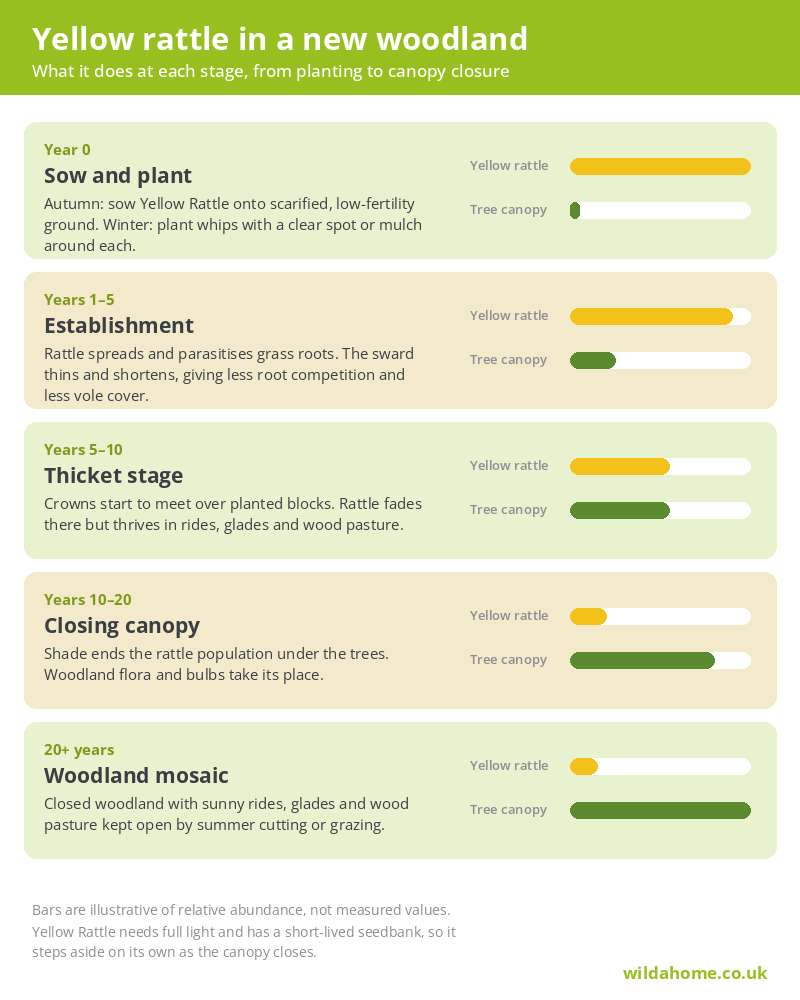
- It steps aside on its own. Yellow Rattle needs full light, and its seed survives in the soil for only a year or two. As the canopy closes over planted blocks, it dies out there naturally, leaving the ground for shade-tolerant woodland flora.
In practice, treat Yellow Rattle as a landscape-scale partner to good establishment, not a replacement for it. Keep a weed-free spot or biodegradable mulch around each whip for the first few years, protect trees where browsing or voles are a known problem, and let the rattle do its work on the grass across the wider site.
A brief history of woodland meadows and wood pasture
Trees and grazing animals have shared British landscapes for thousands of years. Ecologists still debate how open the prehistoric wildwood was, but from the Neolithic onwards people kept livestock among trees, and wood pasture became one of the commonest wooded landscapes in the country.
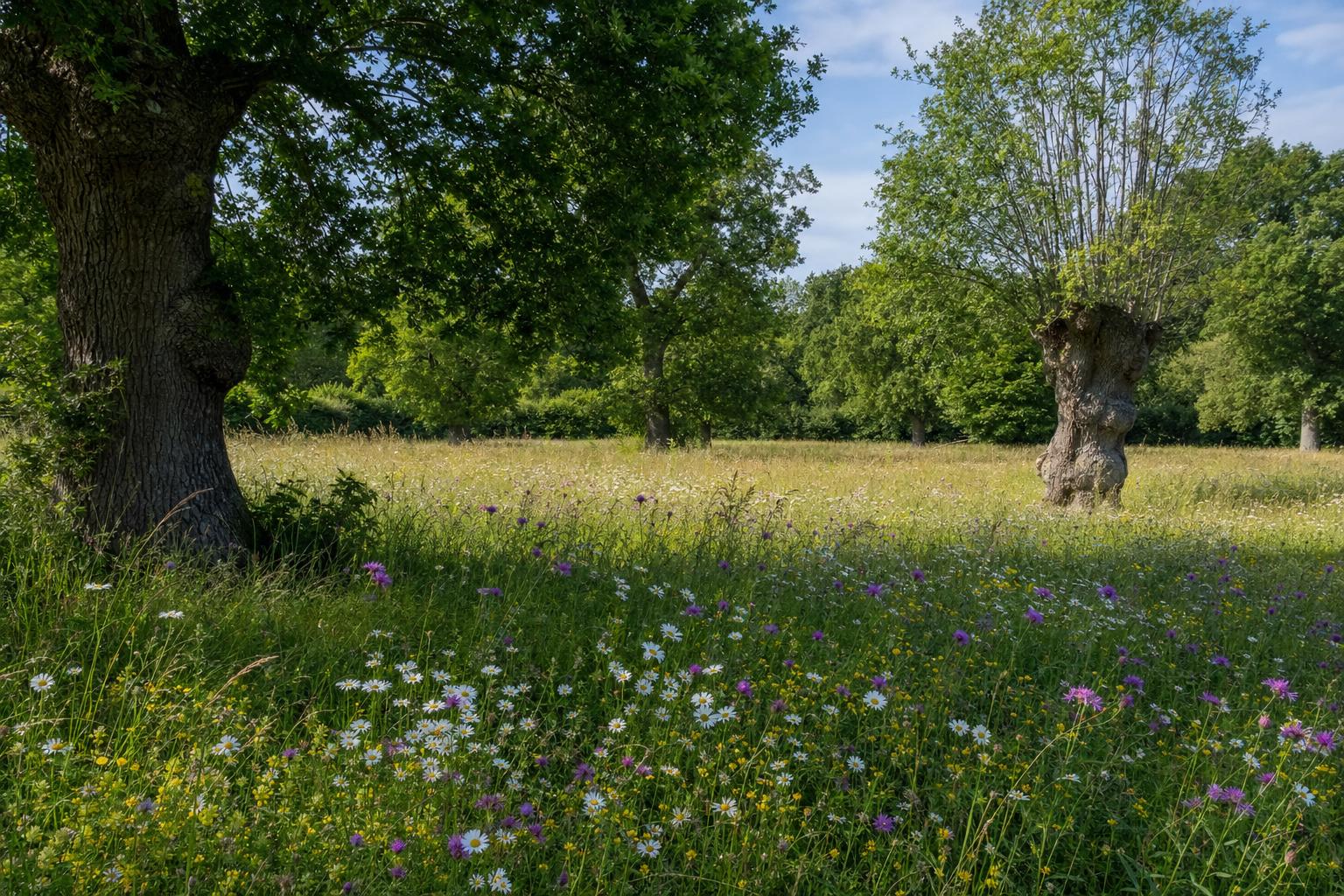
By the medieval period, wood pasture took several forms. Royal Forests such as the New Forest, Sherwood and Savernake were legal hunting areas where commoners also grazed animals and cut wood. Deer parks were enclosed by landowners for venison and status. Wooded commons gave villagers grazing, firewood and timber. Trees were often pollarded, cut above the reach of browsing animals, so they could keep producing poles and leafy fodder while livestock grazed below. Many of our oldest living trees are ancient pollards from these systems.
Wood meadows were the hay-making version: open stands of trees with species-rich grassland beneath, cut for hay in summer and grazed afterwards. Our article on wood meadows and their history looks at them in detail.
Most of these habitats were lost through enclosure, agricultural improvement and conversion to dense plantations. Wood pasture and parkland is now a UK Biodiversity Action Plan priority habitat, and there is growing interest in recreating it on farms, estates and in new community woodland.
The benefits of woodland meadows, rides and wood pasture
Open ground within and around woodland is some of the most valuable habitat in the British landscape. A well-designed woodland creation scheme keeps some of it on purpose.
- Wildlife at the edge. Woodland edges, rides and glades combine sun, shelter and a mix of plants. Almost all woodland butterflies breed in sunny rides and glades rather than under the canopy, and many birds, bats and reptiles feed along the edges.
- Veteran trees of the future. Open-grown trees develop broad crowns, hollows and deadwood far earlier than trees in a crowded plantation. Those features support specialist beetles, fungi, lichens and bats.
- Pollinators. Flower-rich grassland under and between trees feeds bees, hoverflies and moths through the season.
- Productive land. Wood pasture can still be grazed, which makes it attractive on working farms where some income from the land matters. Across England, farm planning increasingly counts trees outside woodland, including shelter belts and wood pasture, towards tree cover goals.
- Resilience. A mosaic of grassland, scrub and trees offers more niches and more room for species to shift as the climate changes than a single closed wood.
For developers and estates working towards Biodiversity Net Gain, a woodland creation scheme with species-rich rides and glades can deliver both woodland and grassland habitat units on the same site.
How to use yellow rattle in woodland creation, step by step
1. Test the soil and decide on your open space
Send soil samples for a standard analysis that includes Olsen P before you buy any seed. Map which parts of the site will close to woodland, and which will stay open as rides, glades, a woodland edge or wood pasture. Rides and glades need to be at least one and a half times as wide as the height of the surrounding trees to stay sunny, so plan them generously from the start.
For wood pasture, trees are usually planted as widely spaced single standards or in small clusters of five to seven whips, with the strongest one kept and the rest thinned later. Each tree or cluster will need its own guard against livestock.
2. Prepare the sward in late summer
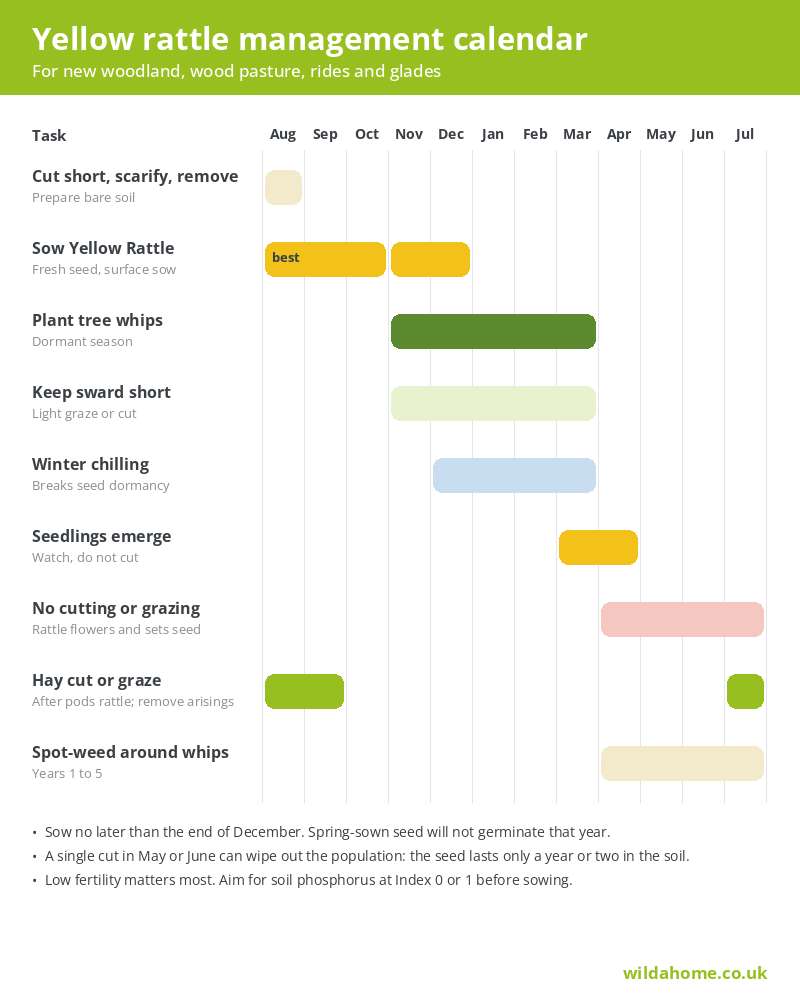
On an existing grass sward, cut or graze it as short as possible in late summer, then scarify or chain-harrow hard enough to expose bare soil in at least half the surface. Yellow Rattle seed needs direct contact with soil. On cultivated or inverted ground, prepare a firm, fine seedbed. Do not add compost, manure or topsoil.
3. Sow yellow rattle in autumn
Sow from mid-August to late October, and no later than the end of December. Yellow Rattle seed must go through a winter of cold before it will germinate, so seed sown in spring will not come up that year. Buy seed harvested that summer, because viability falls quickly in storage.
Mix the seed with kiln-dried sand for an even spread, sow on the surface and roll or tread it in. Do not rake it in. Our Yellow Rattle seed is sold in pack sizes calculated at 3g/m². On a large wood pasture or ride network, sow full-rate patches and strips rather than spreading thinly across the whole area; the rattle will spread out from them over the following summers.
4. Plant trees in the dormant season
Plant whips between November and March, once the ground is workable. Sowing Yellow Rattle in autumn and planting the same winter puts both on the same timeline. Keep a clear spot around each whip using a biodegradable mulch or careful hand weeding for the first three to five years.
5. Manage the cut and grazing calendar
This is where most rattle introductions fail. Keep the sward short through winter so the light-hungry seedlings are not smothered in spring. Stop cutting and grazing by late March, then leave the open ground alone through April, May, June and into July while the rattle flowers and sets seed. Cut or graze from late July or August once the seed pods have dried and rattle, and remove the cuttings.
A single cut in May or June can wipe out a population, because the seed does not survive in the soil for long. Our guide to managing a meadow through winter covers the cutting and grazing pattern in more detail.
Do this / avoid this
Do this:
- Test for phosphorus before you start
- Sow fresh, current-season seed in autumn onto bare, scarified soil
- Keep weed-free spots around whips for the first years
- Cut and remove arisings after the seed has shed
Avoid this:
- Sowing in spring or into a thick, uncut sward
- Cutting or topping between April and mid-July
- Fertilising rides and glades, or leaving cuttings to rot down
- Relying on rattle alone where voles or deer are a known problem
Species for woodland meadows, rides and wood pasture
Yellow Rattle prepares the ground; the wildflowers that follow give the habitat its value. Match species to light levels across the site rather than sowing one mix everywhere.
Open wood pasture, glades and wide rides (full sun)
These areas behave like hay meadow. Alongside Yellow Rattle, sow a meadow mix matched to your soil, such as the Traditional 80/20 Meadow Mix on neutral loams. Robust single species that suit grazed or cut open ground include Greater Knapweed, Ox-eye Daisy, Self-heal, Lady’s Bedstraw and Tufted Vetch. Tufted Vetch is a good host for rattle and copes well with being parasitised.
Woodland edge and narrow rides (partial shade)
The edge is a gradient from sun to shade, and it suits species of hedge banks and woodland margins. The Hedgerow & Banks 80/20 Wildflower Mix works well here, with Betony, Agrimony, Red Campion and Wood Avens. Yellow Rattle will still grow along sunnier edges but thins out where shade lasts most of the day. For more on mixed light, see our guide to wildflower seed mixes for partial shade on loam soil.
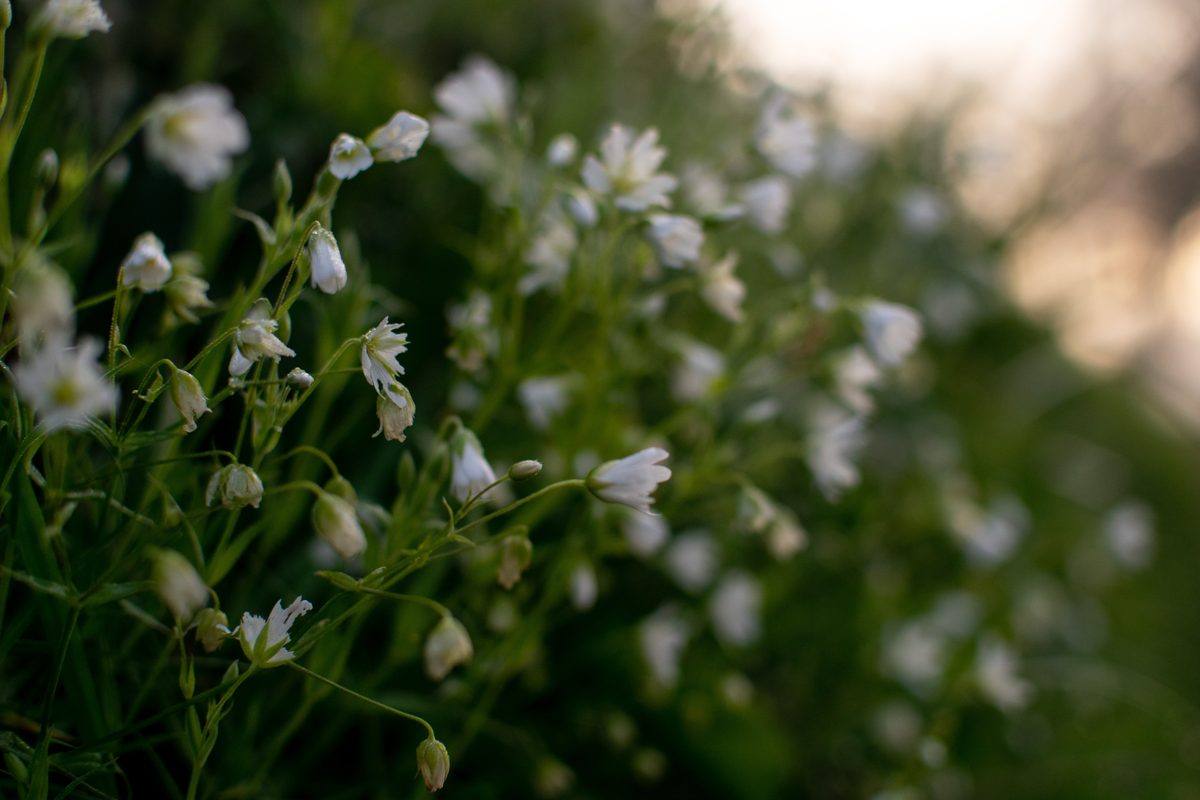
Under the developing canopy (shade)
Under closing canopy, Yellow Rattle drops out and woodland flora takes over. Many true woodland plants colonise new woods very slowly, so introducing them helps. Once shade has developed, sow the Woodland & Heavy Shade Wildflower Mix, which has no grasses, and add Wild Foxglove for clearings and coupes.
Native bulbs establish woodland character faster than seed. Bluebell bulbs, Wood Anemone, Wild Garlic and Wild Daffodil suit the shade of a young wood. The Deluxe Woodland Wildflower Bulb Collection brings several together. Our article on buying and planting native bluebell bulbs explains how to plant them. Always use cultivated stock, never bulbs dug from the wild.

What success looks like over time
New woodland changes from year to year, and so does the job Yellow Rattle does. A realistic timeline:
- Year 1: Rattle seedlings appear in March and April and flower in June. Patchy cover is normal. Grass is still strong around the whips, so keep up spot weeding.
- Years 2 to 5: Where management is right, rattle spreads and the sward visibly thins and shortens. Wildflowers in the mix gain ground. Trees put on height once their roots are established.
- Years 5 to 10: Planted blocks reach thicket stage. Rattle fades under them but persists in rides, glades and wood pasture.
- Years 10 to 20 and beyond: The canopy closes over planted areas and rattle disappears there. Shade-tolerant ground flora and introduced bulbs take its place. Open areas continue as species-rich grassland with regular summer cutting or grazing.
Expect year-to-year variation. A wet spring, a late cut or a vole peak can set things back for a season. Annual cutting, grazing and removal of arisings are what keep the open ground in good condition over the long term.
Wildahome’s Yellow Rattle and woodland range
Our Yellow Rattle is fresh, current-season seed collected from our own and partner UK meadows, cleaned and tested for germination, and sold in packs from 20m² up to 650m². For a larger woodland creation scheme, we can add Yellow Rattle to a bespoke wildflower seed mix matched to your soils and to the different light zones across the site, from open wood pasture to the woodland edge.
Browse our single species wildflower seeds, the 80/20 grass and wildflower mixes for rides and glades, and our native spring bulbs for the woodland floor.
Plan your woodland meadow
If you are planning a new woodland, wood pasture or woodland meadow, start with the soil test and a map of where the open ground will be. Then get in touch. Tell us your soil results, the size of the site and how it will be managed, and we will suggest a sowing plan and quantities for each zone. Our advice service covers larger projects for estates, councils and developers, or you can contact us directly with a question. Autumn is the sowing window, so the earlier you plan, the better.
Frequently Asked Questions
Does yellow rattle help woodland creation?
Yes, in the open parts of a new woodland. Yellow Rattle parasitises grass roots and can reduce grass growth substantially, which eases competition and vole cover across the open ground between trees. It works best on low-fertility soils and should sit alongside, not replace, weed-free spots around each young tree for the first few years.
Will yellow rattle harm young trees?
There is no published evidence that it harms planted trees. Yellow Rattle does its damage to grasses, which put up almost no defence against it, and it is a small annual working in the top layer of soil. As the woodland canopy closes, the rattle dies out because it cannot survive in shade.
When should I sow yellow rattle in a woodland creation scheme?
Sow from mid-August to late October, and no later than the end of December. The seed needs a winter of cold to germinate the following spring. Sowing in autumn and planting trees the same winter keeps both on the same timeline.
Does yellow rattle grow in shade?
Not well. Yellow Rattle needs full or near-full sun. It thrives in wood pasture, wide rides and glades, and along sunny edges, but dies out under a closed canopy. For shaded ground, use a woodland and shade mix with no grasses, and native bulbs such as bluebell and wood anemone.
What is the difference between wood pasture and a woodland meadow?
Wood pasture is grazed land with scattered trees, often large pollards or open-grown veterans. A woodland meadow, or wood meadow, is managed mainly for hay, with a summer cut and grazing afterwards. Both combine trees with species-rich grassland, and both benefit from Yellow Rattle where the ground is open.
How much yellow rattle seed do I need per hectare?
Our packs are calculated at 3g/m², which is 30kg per hectare if sown across the whole area. On large sites, a cost-effective approach is to sow full-rate patches or strips rather than a thin layer everywhere, and let the rattle spread out from them over the following summers.
Can I graze wood pasture that has been sown with yellow rattle?
Yes, with timing. Graze or cut the sward short through winter, take stock off by late March, and let the rattle flower and seed through to late July. Grazing can resume from August. Protect young trees with suitable guards, as livestock will browse them.
Sources and further reading
- Defra, Tree canopy and woodland cover Environment Act target delivery plan (2025)
- Natural England, Technical Information Note TIN060: The use of yellow rattle to facilitate grassland diversification
- Natural England, Technical Information Note TIN036: Soil and agri-environment schemes: interpretation of soil analysis
- Bullock and Pywell (2005), Rhinanthus: a tool for restoring diverse grassland? Folia Geobotanica 40
- Westbury and others (2006), Seeds of change: the value of using Rhinanthus minor in grassland restoration. Journal of Vegetation Science 17
- Cameron and others (2006), Differential resistance among host and non-host species underlies the variable success of the hemi-parasitic plant Rhinanthus minor. Annals of Botany 98
- Forestry England, Wing Wood community woodland
- Woodland Trust and People’s Trust for Endangered Species, guidance on wood pasture and parkland
Ready to get started?
Shop: Woodland & Heavy Shade Wildflower Mix →