

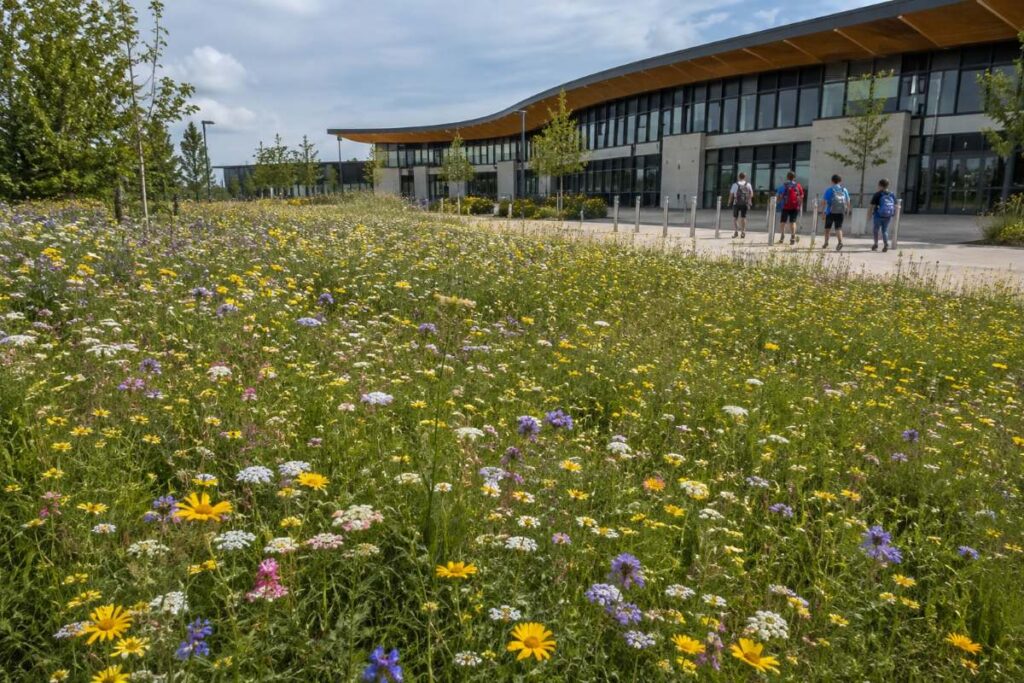
Large-Scale Wildflower Projects: From First Survey to Year Thirty
Large-scale wildflower projects rarely fail at sowing. They fail in year three—when the mix that germinated beautifully has been shaded out by ryegrass, and the contractor who cut it in July has moved on to another framework. Nobody in the organisation is entirely sure who owns the field now.
Britain has lost around 97% of its species-rich grassland since the 1930s: more than three million hectares. The national response has been serious. The Coronation Meadows project has created or restored more than 101 meadows using county-matched donor seed, contributing to nearly 5,000 hectares of flower-rich habitat across allied schemes. Buglife's B-Lines network maps 3 km-wide pollinator corridors across all four nations, targeting 150,000 hectares. Plantlife's Meadow Makers restored 395–400 hectares across 100 sites in a single operational season.
Most restoration, though, happens well below that altitude. It happens on a developer's four hectares of public open space, on forty kilometres of council verge, on a farm's twelve-acre bottom field, on an estate's parkland, on a school field. Same ecology. Very different constraints — budget, governance, planning conditions, and the awkward question of who will still be cutting the grass in 2036.
This guide sets out how landscape-scale meadow restoration actually gets delivered at that level: what changes when you scale up, why locally sourced wildflower seed matters more rather than less, how the four main sectors differ, and where outside advice earns its fee.
What changes when a wildflower project gets big
The ecology does not change with area. A knapweed on four hectares wants what a knapweed on four square metres wants: low fertility, light, and a cut at the right time. What changes is the way the project can fail.
Four shifts matter most.
Logistics compress the sowing window
On a garden scale, the sowing window is a weekend. On a large site it is a fortnight of workable ground in September shared with a contractor, a forecast, and whatever else the build programme needs doing. Machinery is booked before the ground is ready, which means committing on a guess. Build in a fallback: if Autumn slips, most free-draining soils will take a Spring sowing in late March or April, though clay rarely will.
Seed supply stops being off-the-shelf
Twenty kilograms of genuinely regional seed is a phone call. Eight hundred kilograms is a harvest somebody planned a year in advance. At scale you are buying from last Summer's harvest, and the mixes with the strongest provenance are the ones that run out first. Order in Winter for the following Autumn.
Somebody has to own the management
This is the failure that costs the most. On a housing scheme, the meadow passes to a management company; on council land, it passes to a grounds maintenance framework; on a farm, it passes to whoever is free in August. Unless the cutting regime is written into a contract, specified with the right machinery, and priced, it will revert to a monthly amenity cut within three seasons.
Sites stop being homogeneous
One field has one soil. Forty hectares has six — a wet corner, a thin calcareous bank, a compacted haul road, an old muck heap that is still running at a phosphorus index of 4. The instinct to buy a single mix for the whole site is the most common and most expensive mistake in large-scale wildflower projects. Map the variation first, then split the specification. Two or three mixes across a large site cost marginally more and establish far better.
The four questions every large-scale wildflower project has to answer
Before ordering a single kilogram of seed, a project should be able to answer these four questions in writing. If it cannot, it is not ready to buy seed.
- Where does the seed come from, and can you prove it? Provenance in the UK wildflower seed trade is unregulated. Ask for the harvest location, the harvest year, and a species list with percentages by weight. A supplier who can answer all three is working to a standard; one who cannot is selling you an unknown.
- What is the soil's nutrient status? Species diversity is inversely proportional to soil fertility. High phosphorus and nitrogen favour fast, aggressive grasses — perennial ryegrass (Lolium perenne), cock's-foot (Dactylis glomerata) — which shade out slower broadleaf herbs. A soil test costing very little at the start will tell you whether the site needs topsoil stripping, a nutrient-stripping cropping year, or nothing at all.
- Who cuts it, with what, in year seven? Name the party. Specify the machine. Cut-and-collect, not flail-and-leave. Arisings removed from site, not mulched back in.
- What does success look like, who measures it, and when? A restored lowland meadow benchmark sits around 12 to 17 vascular plant species per square metre—the standard that Coronation Meadows recipient sites have reached under donor-matching protocols. Agree on the metric, the quadrat locations and the survey years at the outset, not when a funder asks.
Why locally sourced seed matters more on large-scale projects
On a garden bed, provenance is a preference. At landscape scale it becomes a risk control — because a hectare of non-local genetic stock sitting inside a regional pollinator network does not stay put. It flowers, it crosses with remnant local populations in nearby verges and field margins, and it can shift a local population's flowering timing away from the emergence window of the insects that depend on it. Marsh Fritillary (Euphydryas aurinia) relies almost exclusively on Devil's-bit Scabious (Succisa pratensis) as a larval host plant. Getting the plant right and the timing wrong helps nobody.
Local provenance also buys establishment reliability. Seed harvested from a donor site on the same soil type, at the same altitude, in the same rainfall band is already adapted to what your site will do to it. That shows in years two and three, when imported stock has thinned, and local stock has not.
Three routes to seed at scale
| Method | How it works | Best for | Provenance control |
|---|---|---|---|
| Green hay transfer | Donor meadow cut at seed ripeness; hay moved and spread within hours onto scarified ground. | Large restoration where a suitable donor site is within reach | Excellent — direct transfer, no cleaning stage |
| Brush harvesting | Mechanical brushes flick ripe seed from standing plants into a hopper; seed is dried, cleaned and tested. | Large sites, phased sowing, targeted species recovery | Very good — site-specific and traceable |
| Field-cropped local provenance | Seed of known local origin bulked up as a crop, then blended to a specified mix. | Projects needing volume, consistency and a defined species list | Good — depends entirely on supplier records |
Green hay is the strongest option where the geography allows it. A rough working ratio is one hectare of a diverse donor meadow to three to five hectares of recipient ground. The hay must move fast—within hours—because a heating heap degrades seed. Spread it thinly on scarified, largely bare ground, turn it at least once so the seed drops through, then bed it in with a light roller or livestock trampling. The drying straw doubles as a protective mulch.
Check the donor site for injurious weeds before you commit. Broad-leaved dock (Rumex obtusifolius) and spear thistle (Cirsium vulgare) travel in green hay as readily as anything you want.
Commercial and development sites: meadows under Biodiversity Net Gain
For developers, wildflower meadows are usually the most efficient habitat on the BNG board. They score well on distinctiveness, they carry a manageable maintenance cost across the 30-year obligation compared with woodland, and they look like an amenity rather than a compliance measure. That combination is why they appear on so many schemes.
The policy position has moved during 2026, so build your case on current guidance rather than a two-year-old briefing note. As of August 2026, the headline requirement remains a minimum 10% measurable uplift, secured for 30 years, evidenced through a Habitat Management and Monitoring Plan. Changes that took effect on 6 August 2026 exempt developments below 0.2 hectares unless on-site priority habitat is affected, exempt temporary developments reinstated within five years, allow minor developments to go straight to off-site delivery, and remove the previous self-build exemption. Applications submitted before that date run under the earlier rules.
Two practical points make a real difference to the numbers.
- Align with your Local Nature Recovery Strategy. England has 48 LNRSs, each mapping priority zones for grassland and corridor creation. Delivering habitat inside a mapped priority area engages the strategic significance multiplier in the statutory metric — the same physical meadow, worth more units.
- Be honest about achievable condition. Creating a habitat you cannot get to target condition is a 30-year liability, not an asset. On a nutrient-rich former arable margin, specifying "lowland meadow" and delivering "other neutral grassland in poor condition" is a failure you will be re-surveying in year 5, year 10 and year 30.
Brownfield and made ground: use the poverty
Urban and post-industrial sites often look like the worst place to establish wildflowers and are frequently the best. The National Wildflower Centre and Scouse Flowerhouse built their Liverpool programme on exactly this: sowing native seed directly into crushed brick, recycled demolition aggregate, subsoils and biochar. Low phosphorus, low nitrogen, sharp drainage, no seed bank of agricultural grasses. Their 26 Liverpool sites ranged from 87 m² to 24,702 m², averaging 3,587 m².
On a development site, the equivalent move is to resist importing topsoil onto habitat areas. Strip it, sell it or use it elsewhere on the scheme, and sow into the subsoil. It feels wrong to a landscape contractor, and it is right for the meadow.
Sequencing with the build programme
Sow after the last heavy plant movement, not before. A meadow sown in Autumn and then driven across in February to finish a drainage run is a re-sow. Where areas hand over in phases, or where slopes and awkward corners make broadcast sowing impractical, seed mats give a controlled, even sowing rate with no wind drift and no operative judgement involved.
Civic and council land: verges, parks and the B-Lines network
Local authorities hold something no other sector has: continuous linear land at national scale. Verges, cycleway margins, park edges, roundabouts and housing amenity grass together form the skeleton of a functioning pollinator network.
The B-Lines initiative gives that skeleton a plan. B-Lines are 3 km-wide corridors mapped across England, Wales, Scotland and Northern Ireland, designed so that a pollinating insect never has to travel more than 500 metres to reach a suitable floral or nesting site. Restoring roughly 10% of the land inside those corridors delivers the national 150,000-hectare target. Regional delivery — Get Cumbria Buzzing with National Highways, Shropshire B-Lines with the county Wildlife Trust, Northumberland's mapping of calaminarian grassland and whin sill habitats — shows the pattern: the mapping tells you which parcels to do first.
The real bottleneck is machinery, not seed
Councils rarely fail on species selection. They fail because the maintenance contract specifies a flail and the meadow needs a cut-and-collect. Flailing leaves the arisings in place, the nutrients return to the soil, fertility climbs, and within four seasons the sward is coarse grass with a few survivors. Before committing to a hectare figure, confirm the authority has access to cut-and-collect equipment and somewhere to take the arisings. That single line item determines whether the programme survives.
Managed messiness reads as care
Public objection to long grass is rarely about the grass. It is about whether the site looks abandoned. A mown margin along the footway, mown desire lines through the middle, clear sightlines at junctions and a small sign explaining the cutting regime will resolve most complaints. Evaluations of the Liverpool urban sites found measurable gains in public engagement and nature connectedness in socio-economically deprived wards—presentation is part of the outcome, not decoration.
- Do this: start with a written grassland strategy that ranks sites, sets cutting regimes and names the equipment. Cheshire West and Chester's wildflower and grassland strategy is a workable model.
- Avoid this: annual pictorial mixes of non-native cornfield-style annuals on permanent verges. They are vivid in year one, gone in year two, and they need re-sowing and cultivating indefinitely. They build no habitat, and they teach the public that meadows are short-lived.
Farm-scale meadow restoration and the 2026 funding picture
Farms hold the largest opportunity and the most direct route to good seed. If there is a species-rich meadow within your county on comparable soil, a green hay arrangement with that neighbour will give you better material than anything you can buy — and it usually costs the price of the cut, the haulage and a bottle of something.
The three levers on farm ground
- Yellow Rattle (Rhinanthus minor). A hemiparasitic annual that attaches to the roots of adjacent grasses and draws off water and nitrogen, suppressing grass vigour by 20% to 50%. It opens the canopy gaps that let slower forbs germinate. Sow fresh seed in Autumn onto genuinely bare, scarified ground — it needs a cold period, and it will not establish into a thick, uncut sward.
- The hay cut. Leave the sward uncut through Spring and early Summer so plants flower and set seed. Cut in late Summer, typically late July into August. Remove every scrap of cut material from the field. Leaving it is the fastest way to undo three years of work.
- Aftermath grazing. Bring livestock onto the regrowth after the cut—hardy native breeds do this best. The hoof action creates small patches of bare soil, which are precisely the germination niches that Autumn-dropping seed needs. Save Our Magnificent Meadows used conservation fencing to reintroduce managed cattle grazing on marshy grassland in Fermanagh and South Tyrone specifically to conserve Marsh Fritillary; the Scottish Wildlife Trust's Shetland cattle 'Flying Flock' did the same job on urban-fringe grassland in Edinburgh.
Funding as it stands in 2026 — check before you build a business case
The agri-environment picture has moved twice in eighteen months. Treat any payment rate quoted from an old table with caution.
The Sustainable Farming Incentive 2026 (SFI26) opened Window 1 on 30 June 2026 for small farms and holdings without an existing Environmental Land Management agreement, with Window 2 following in September 2026 for everyone else. Importantly for meadow work, the SFI action for managing species-rich grassland — GRH6, previously paying £646 per hectare — was not carried into SFI26.
Species-rich grassland now sits within Countryside Stewardship Higher Tier. CSHT has historically been invitation-only, and Defra has confirmed it is removing that requirement and rolling out single-focus agreements, beginning with managing species-rich grassland (CGS22), with wet grassland and traditional orchard actions following. Expression of interest routes opened during Summer 2026, with at least £50 million available for new agreements in the year.
None of this changes the practical advice: design the restoration you actually want, then find the funding that fits it. Meadows designed around an option code stop being managed the day the agreement ends.
Start with the awkward ground
Do not restore your most productive ley first. Start with the wet bottom that never yields, the steep bank the machinery dislikes, the corner behind the buildings. Those fields are usually lower in nutrients; they cost you least in lost production, and they teach you how your soils behave before you commit a larger area.
Estates, large gardens and domestic projects that behave like big ones
A three-acre paddock behind a house is a small project by area and a large one by every other measure. It has the same soil variation, the same establishment timescale and the same long-term management requirement as a farm field — with no contractor, no funding stream and a much shorter patience horizon.
Two adjustments make these projects work. Phase it: do one field, or a third of one, in the first Autumn. You will learn more about your own soil in two seasons than any amount of planning will tell you, and you will still have the rest of the ground to apply it to.
And mow the frame, not the picture. A generously mown path through the middle and a mown border around the edge converts "the field has been left" into "the field is being managed". It costs an hour a fortnight and removes almost every objection a neighbour will raise.
Plug plants earn their place at this scale
Seed is the efficient route to a new sward from bare ground. Plugs are the efficient route to adding slow, hard-to-establish species into an existing sward — Devil's-bit Scabious, Betony, Greater Knapweed, Cowslip. Meadow Makers combined the two on 40 hectares across 14 sites in the Forest of Bowland, planting over 11,000 plug plants alongside 450 kilograms of harvested native seed. Plant plugs into slots cut through the turf in Autumn, water them once, and mark them so they are not cut in year one.
Orchard understorey: two habitats for one management regime
If the site includes fruit trees, the meadow beneath them is doing double duty. Traditional orchards are a Priority Habitat because they stack woodland, pasture and meadow structure in one place. That value comes from longevity, which comes from rootstock choice — full-standard apple on M25, pear on Kirchensaler, plum on Brompton — because trees on those roots live long enough to develop the heart-rot, hollow trunks and deadwood rare saproxylic invertebrates need. Noble Chafer (Gnorimus nobilis) larvae feed exclusively on decaying wood inside mature hollow fruit trees, with strongholds in Worcestershire, Herefordshire and Gloucestershire. A meadow understorey cut late in Summer with no pesticide input serves both layers under one regime.
What wildflower consultancy and advice actually buys you
Consultancy on a wildflower project is not a report. It is a set of decisions made in the right order, before you commit money to the wrong ones. The sequence matters more than the document.
- Baseline walkover and soil sampling. Before any mix is discussed: soil texture, pH, and phosphorus and potassium indices, sampled by management zone rather than as one composite across the site. Existing vegetation recorded — what is already there tells you more than the soil report does.
- A realistic target community. What habitat this site can actually reach, given its nutrient status, hydrology and management capacity. Aspirational targets written into a planning condition become a liability the moment they are surveyed.
- Mix specification with the reasoning attached. Why 80/20 grasses to forbs on this field and 100% forb on that one? Why this rate? Which species establish quickly, which are for year five, and which are there because a specific invertebrate needs them?
- An establishment plan tied to dates. Cultivation method, seedbed standard, sowing window with a fallback, sowing rate, rolling, and the first-year cutting regime. Over-sowing wastes money and produces competition, not diversity.
- A contractor briefing. The highest-value single page in the whole project. Most large-scale wildflower projects that disappoint were sown correctly and cut wrongly. Write down the cut dates, the cut height, the machine, and the instruction to remove arisings — and put it in the maintenance contract, not the appendix.
- Monitoring with fixed quadrats and named years. Year 1, 3 and 5 as a minimum, in the same locations, at the same time of year, with photographs. This is what tells you whether to intervene while intervention is still cheap.
- A remedial route. What to do if year two comes back thin, if docks colonise the scarified ground, if the Yellow Rattle fails to take. Every experienced adviser has a plan for these, because they happen on good projects.
What honest advice sounds like
Nobody can promise a species count in year one. A well-established meadow is a three- to five-year conversation, and the interesting parts of the sward often do not appear until year three. An adviser who says the site will look like the photograph next Summer is selling seed, not restoration.
Some sites are not worth sowing until something else changes. Ground running at a high phosphorus index needs a nutrient-stripping cropping year, topsoil removal, or a different target habitat altogether. Being told that before the seed budget is spent is the most valuable advice available.
A realistic timeline: year 0 to year 10
| Stage | What happens | What it should look like |
|---|---|---|
| Year 0 — Spring/Summer | Survey, soil sampling, target habitat agreed, mix specified, seed ordered, donor site arranged if using green hay | Paperwork, not planting. This is where the project is won. |
| Year 0 — Aug to Oct | Seedbed preparation and sowing. Spring sowing (Mar–Apr) as a fallback on lighter soils | Fine, firm, largely bare seedbed. Roll after sowing |
| Year 1 | Germination, annual weed flush, 2–3 cuts to 5–7 cm with arisings removed | Patchy, green, unimpressive. This is normal and correct. |
| Year 2 | Yellow Rattle visible and working; first meaningful flowering; move to a single late Summer cut | Recognisable meadow structure beginning; grass visibly thinner. |
| Year 3 | Perennial forbs assert themselves; species count becomes worth measuring | The year most people decide the project worked |
| Years 4–5 | Sward composition stabilises; consider plug planting to add slow species | 12–17 species per m² is a strong result on a good site |
| Years 6–10 | Management is the whole job: hay cut, aftermath grazing, scrub control, monitoring. | Resilient and self-sustaining, provided the cutting regime holds |
Two habits keep long projects on track. Photograph the same three points every July. And re-read the management specification with whoever is holding the contract every second year, because staff change and institutional memory is short.
Where large-scale wildflower projects go wrong
- One mix across a varied site. Split the specification by soil and moisture zone.
- Topsoil imported onto habitat areas. Low fertility is the asset. Protect it.
- Flail cutting with arisings left in place. This alone will undo a good establishment within four seasons.
- Cutting in June because the site looks untidy. That removes the year's seed set.
- Non-native annual mixes specified for permanent habitat. Bright in year one, absent in year two.
- Seed ordered in July for an August sowing. The regional mixes will already be committed.
- No named party responsible for management after handover. The most common cause of a 30-year obligation quietly failing.
- Yellow Rattle sown into an uncut, thatchy sward. It needs bare ground, fresh seed and Autumn cold.
Matching seed to the site: how Wildahome mixes are put together
Wildahome supplies locally sourced, regionally provenance-matched native seed for projects at every scale, which is why the range is built around site conditions rather than a single house mix.
The 80/20 mixes — 80% native meadow grasses to 20% forbs — are the working default for creating a new meadow from bare ground on farm, civic and development sites. The grass fraction gives the sward structure, holds the soil and suppresses weeds while the slower forbs establish. The 100% wildflower mixes are for over-sowing into an existing grass sward, or for sites where structure is already present and only floral diversity is missing. Single species are there for the specifics — Yellow Rattle to open a tight sward, or a particular larval host plant a local invertebrate needs.
Soil-specific mixes cover chalk and limestone, heavy clay, acidic, loam and alluvial, wetland and pond margins, hedgerow and bank, and woodland or heavy shade — which is what allows a large site to be split into two or three specifications rather than compromised into one. Seed mats give an even, controlled sowing rate on slopes, awkward corners and phased handovers, and native bulbs bridge the early-season nectar gap while a perennial meadow is establishing.
Talk to us before you specify the mix
If you are scoping a site — a BNG delivery area, a verge programme, a farm restoration or an estate paddock — the most useful conversation happens before the seed is chosen. Send us the site area, soil type, current vegetation, and any planning or funding conditions you are working to, and we will tell you what is realistic, what mix logic fits, and what the management will ask of you in year seven. If your specification is already settled and you need volume, we can quote directly for bulk seed and seed mats, with provenance details supplied. Either route starts the same way: get in touch with the site details, and we will work from there.
Frequently Asked Questions
What counts as a large-scale wildflower project?
There is no formal threshold, but projects behave differently above roughly one hectare, or wherever the work passes through a contractor rather than the person who commissioned it. At that point, seed volumes need to be ordered in advance, sites contain more than one soil type, and management has to be written into a contract. Those three conditions—not area alone—are what make a project large-scale in practice.
How much does a large-scale wildflower project cost?
Costs split into three parts: seed, establishment and thirty years of management. Seed is usually the smallest. Ground preparation, machinery hire and the annual cut-and-collect over the obligation period dominate the total. Get a realistic management cost into the budget at the start — projects that underfund year 5 onwards are the ones that quietly revert.
Why use locally sourced wildflower seed instead of a standard mix?
Local provenance seed is adapted to your soils, rainfall and season length, and its flowering timing matches the emergence of local pollinators. At scale, non-local stock can also cross with remnant wild populations nearby and shift their genetics. Locally sourced seed establishes more reliably and carries far less ecological risk across a large area.
Can wildflower meadows deliver Biodiversity Net Gain?
Yes, and they are often the most efficient option. Species-rich grassland scores well for distinctiveness and has lower long-term management costs than most alternatives over the 30-year obligation. The requirement is a minimum 10% uplift, secured for 30 years with a Habitat Management and Monitoring Plan. Delivering inside a Local Nature Recovery Strategy priority area increases the units the same habitat generates.
When is the best time to sow a large-scale wildflower project?
Late Summer to mid-Autumn — roughly August to October — is the strongest window. Soil is warm, moisture is returning, and species needing a cold period, including Yellow Rattle, get one. Spring sowing in late March or April works on lighter, free-draining soils but is less reliable on clay. Build a fallback window into the programme.
How long before a large-scale meadow looks established?
Year one looks patchy and unimpressive—that is normal. Yellow Rattle and the first real flowering appear in year two. Perennial forbs assert themselves in year three, which is when most people judge the project a success. A mature, resilient sward reaching 12 to 17 species per square metre typically takes four to five years on a good site.
Do you provide consultancy and advice for large-scale wildflower projects?
Yes. That covers site assessment and soil interpretation, target habitat selection, mix specification with the reasoning set out, establishment planning, contractor briefing notes and long-term management schedules, including work aligned to Biodiversity Net Gain obligations and agri-environment agreements. The most useful point to involve us is before the mix is chosen, not after the seed arrives.
Ready to get started?
Shop: Traditional Wildflower Meadow Mix →