

Building a Climate-Resilient Wildflower Meadow
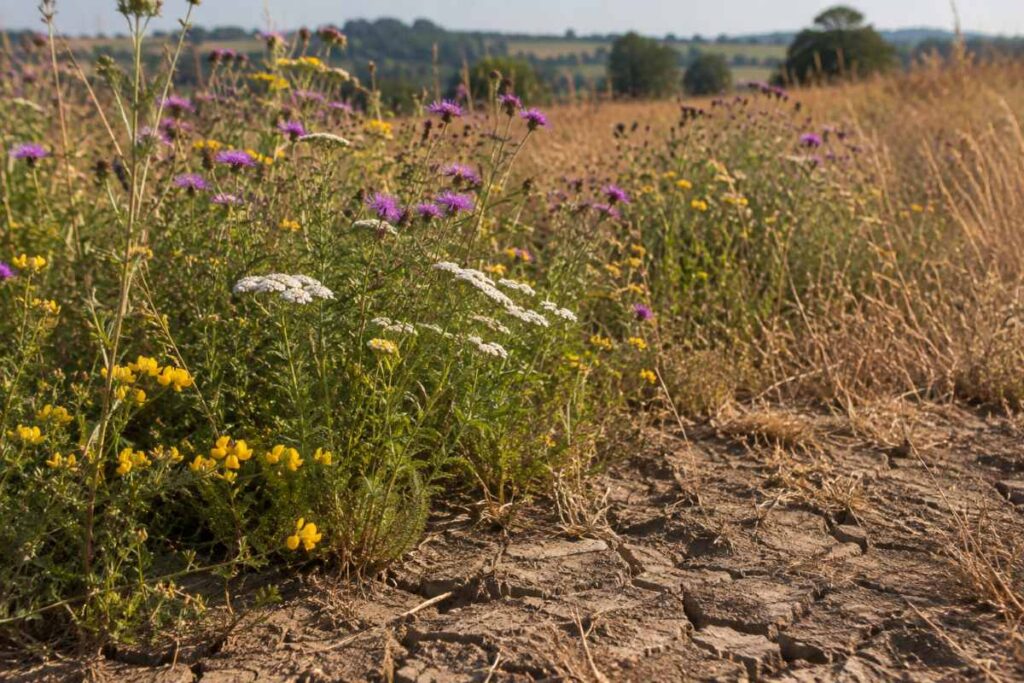
UK summers are no longer what they were when most meadow establishment guides were written. Prolonged soil moisture deficits, heatwave spikes, and tinder-dry grassland are now a recurring feature of the British growing season, and a species-poor sward has little defence against any of it. A climate-resilient wildflower meadow is built differently from the start — deeper roots, more varied phenology, lower fuel load — so that it holds its structure through a dry August rather than collapsing into scorched thatch. This matters whether you’re restoring a paddock, a country estate parkland, or a community green space: the difference between a meadow that limps through a drought and one that thrives in it comes down to species selection, ground preparation, and how it’s managed in the years after sowing.
This article sets out what climate resilience actually means for a UK meadow, which native species carry the functional traits to cope with heat and drought, and how to prepare, sow, and manage a meadow so it becomes more resilient with every passing year rather than less.
Why UK meadows need to be built for a changing climate
Britain has lost roughly 97% of its species-rich wildflower meadows since the 1930s, down from over 7.5 million acres to barely 200,000 fragmented acres today. Post-war agricultural intensification, drainage, fertiliser use, and selective herbicides did most of the damage, replacing complex, multi-species swards with high-input grass monocultures dominated by species such as Perennial Ryegrass (Lolium perenne).
That historic loss is now compounding with a genuinely different climate. Shallow-rooted agricultural grass and unmanaged, species-poor turf have limited resistance to extended dry spells. Under sustained soil moisture deficit, these swards scorch, senesce early, and collapse structurally — and as the dead material accumulates as thatch, it stops being a carbon sink and starts being fuel. During heatwaves, dried-out grassland can ignite from a discarded cigarette, glass, or arson and carry a fast-moving surface fire across urban-fringe, lowland, and upland sites alike. more on the state of UK grassland habitat
Species-rich meadow restoration is one of the few genuinely proven, nature-based responses to both problems at once. A diverse sward with varied root depths, staggered flowering times, and established fungal partnerships holds moisture, holds soil, and simply doesn’t burn the way a rank grass monoculture does. But that resilience has to be designed in — not assumed. A meadow sown on the old assumptions of a wetter, milder Britain is still vulnerable to the summers we’re getting now.
What actually makes a meadow climate-resilient
Resilience in a meadow isn’t one trait — it’s a combination of root architecture, phenology, and below-ground biology working together.
Root depth and diversity. A mix of deep taprooted forbs, rhizomatous perennials, and slow-growing fine grasses can access subsoil moisture long after shallow-rooted agricultural grass has given up. That keeps green cover through a drought instead of dead, flammable thatch.
Staggered flowering and growth cycles. Where a monoculture grass sward does one thing at one time, a diverse meadow has species actively growing, flowering, or setting seed across different weeks of the season. That spreads out water demand and keeps some part of the sward photosynthesising even when others are dormant.
Mycorrhizal partnerships. Older, established grasslands build extensive underground fungal networks that trade soil moisture and minerals with plant roots in exchange for sugars. These networks measurably increase drought tolerance and help stabilise soil structure — one reason a meadow gets more resilient, not less, as it matures.
Lower fuel load. A structurally diverse, well-managed meadow simply carries less fine, dry, easily ignitable material than a neglected grass sward. Suppressing coarse grass dominance directly reduces both the spread rate and intensity of any fire that does start.
Choosing drought-hardy native species for a climate-resilient wildflower meadow
Species selection is where climate resilience is actually built. The aim is a mix weighted toward native species with the root architecture, life history, or leaf adaptations to cope with heat and dry soil — not simply the most decorative or widely available seed.
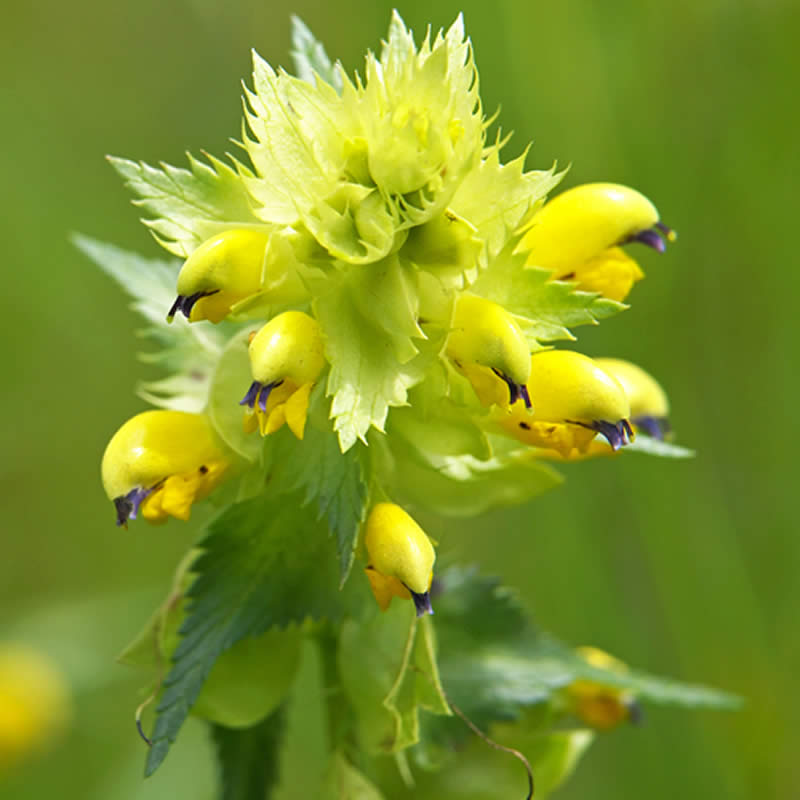
Yellow Rattle (Rhinanthus minor) — the ecological engineer. This native annual hemiparasite attaches to the roots of competitive grasses such as Ryegrass, Yorkshire Fog (Holcus lanatus), and Cock’s-foot (Dactylis glomerata), drawing off water, nutrients, and carbohydrates. By suppressing grass vigour, it opens bare soil gaps for slower-establishing wildflowers and — critically for resilience — reduces the fine grass fuel load that drives grassland fire spread. Few single species do as much structural work in a young meadow. our Yellow Rattle seed
Deep-rooted legumes. Bird’s-foot Trefoil (Lotus corniculatus) and Red Clover (Trifolium pratense) fix nitrogen and reach subsoil moisture, keeping forage green and nectar flowing when shallower plants have gone dormant.
Taprooted and rhizomatous forbs. Rough Hawkbit (Leontodon hispidus), Yarrow (Achillea millefolium), Common Knapweed (Centaurea nigra), and Viper’s Bugloss (Echium vulgare) all carry deep taproots or extensive rhizomatous networks that withstand severe soil drying while maintaining vegetative cover through the worst of a heatwave.
Baseline commercial mixes vs. green hay. Standard commercial mixtures — combinations of slow-growing, non-competitive grasses such as Red Fescue (Festuca rubra), Crested Dog’s-tail (Cynosurus cristatus), and Common Bent (Agrostis capillaris) alongside a native wildflower component — give a reliable, well-tested baseline. Where a good-quality donor meadow exists nearby, green hay harvesting (cutting a donor site as seed is maturing and spreading the fresh material within hours) transfers locally adapted provenance, native mycorrhizal fungi, and soil micro-organisms that a bagged mix simply can’t replicate — and tends to produce a meadow more resilient to local climate extremes as a result. This is the same logic behind sourcing seed regionally rather than from a generic national mix: plants grown from a local donor population are already adapted to your rainfall pattern, your soil, and your local pollinators. our county-by-county wildflower seed guides
Preparing low-nutrient ground for resilient establishment
The single biggest reason UK meadow creation fails isn’t drought — it’s soil fertility. Semi-natural wildflower grassland needs low available phosphate. High nitrogen and phosphorus favour fast, competitive grass and aggressive ruderal weeds such as Creeping Thistle (Cirsium arvense), Broad-leaved Dock (Rumex obtusifolius), and Common Nettle (Urtica dioica), all of which will outcompete young wildflowers before they’ve had a chance to root.
Where a site carries decades of fertiliser history, physical soil amelioration has to happen before sowing:
- Topsoil stripping — scraping away the nutrient-rich upper layer to expose low-nutrient subsoil. Machinery-intensive, but it removes the competitive arable seed bank in one pass.
- Deep soil inversion — ploughing that buries high-nutrient topsoil beneath low-nutrient subsoil, burying weed seed while bringing a better substrate to the surface.
- Mechanical scarification — for sites with low to moderate existing fertility, heavy harrowing to strip back dense grass and open bare ground for seed-to-soil contact, without full turf removal.
Weed control has to happen alongside this, not after it. Bare, disturbed ground is exactly what Creeping Thistle, Dock, Nettle, and Bramble exploit to spread fast and shade out seedlings. Hand-pull small infestations, cut repeatedly before seed set, or spot-treat heavy infestations with a targeted herbicide before you sow. Skipping this step is the most common reason a promising site turns into a weed patch by its second summer.
Sowing windows that work with, not against, UK climate extremes
Autumn (late August to October) is the reliable window for UK meadow creation, and it matters more than ever as droughts intensify. Autumn sowing uses residual soil warmth alongside returning rain to establish roots before winter. It also delivers the winter cold period (vernalisation) that species such as Yellow Rattle and native orchids need to break dormancy and germinate the following spring. Wildflowers sown in autumn build deep root systems over winter, which is exactly what makes them resilient to soil drying the following summer. Sow too late (after November) and birds or rain erosion take a toll on seed; sow too early into an active late-summer heatwave and germination can fail outright.
Spring (March–April) sowing works for general mixes and cornfield annuals such as Cornflower (Centaurea cyanus) and Poppy (Papaver rhoeas), but it carries real risk under current climate trends. Species that need cold stratification simply won’t germinate in year one — they sit dormant and vulnerable to rot. And shallow-rooted spring seedlings are exposed if an early summer drought arrives before their roots reach deeper moisture. Without landscape-scale irrigation, which is rarely practical, spring sowings fail more often than autumn ones.
Sowing technique matters as much as timing. Wildflower seed is tiny and needs light to germinate — never bury it in drill lines. Mix small seed with an inert carrier such as clean, moist horticultural sand (roughly 1 part seed to 4 parts sand) for even broadcast coverage. After broadcasting onto a fine, firm tilth, roll or tread the area to press seed into firm contact with the soil. Never rake seed under topsoil or harrow it deep — light exclusion is one of the most common reasons native wildflower seed fails to break dormancy. For smaller or awkward sites, a biodegradable wildflower seed mulch mat is a reliable alternative to broadcasting: laid onto prepared soil and covered with seed and compost, it suppresses competing weeds and encourages even germination, without the guesswork of hand-sowing.
Long-term management: cutting, grazing, and fuel load control
Establishing a meadow is only the start. Species-rich grassland needs three to five years of structured management to stabilise — without it, natural succession pushes any UK grassland back toward rank grass, scrub, and eventually woodland.
Year one. Sown perennials put their energy into roots, not flowers, so the site will look weedy and grass-dominated through its first summer. Top the sward to around 10cm every four to six weeks through spring and summer to stop annual weeds and coarse grass smothering the wildflower rosettes below. Rake and remove all cuttings — leaving them behind smothers seedlings and puts nutrients straight back into the soil you worked to strip out. our meadow management how-to guides
From year two — the traditional hay cycle:
- Spring (March–April): a light cut or graze to keep the sward open so Yellow Rattle seedlings get full light.
- Late spring to early summer: leave the sward undisturbed so wildflowers can bloom, feed pollinators, and set seed.
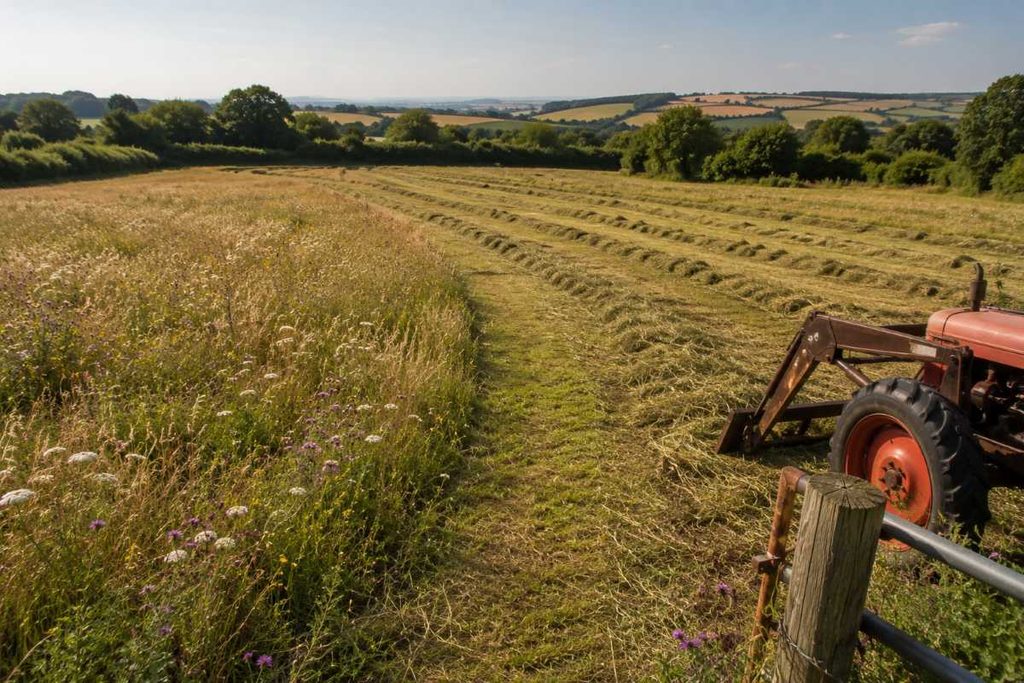
- The hay cut (August–September): delay mowing until after mid-July, ideally into August or September once most plants have shed seed. Cut to around 5–10cm.
- Tedding: leave cut material lying for one to seven days so seed drops back into the sward before removal.
- Complete arisings removal: bale or rake off all dried hay. This is what strips nitrogen and phosphorus out of the system year after year and keeps the meadow low-nutrient long-term.
- Autumn aftermath grazing: traditional breeds grazing late-season regrowth create small bare “trampling gaps” with their hooves, pressing shed seed into the soil ahead of spring.
Fuel load and wildfire mitigation are part of ongoing management, not an afterthought. Maintain mown firebreaks (kept short) along boundaries near housing, footpaths, and fencing. During extreme heatwaves, bringing a hay cut forward on urban-fringe sites reduces standing fuel near people and property while preserving habitat further from the edge. Where a meadow sits within a wider landscape, integrating it with native broadleaf woodland and wetland creates a natural mosaic — damp, shaded ground simply doesn’t carry fire the way dry open grass does.
From the Wildahome range
Every Wildahome seed mix is built around the same logic set out above: regionally sourced provenance, a meaningful proportion of Yellow Rattle to manage grass competition, and species selected for the soil and conditions of your specific site rather than a generic national blend. For sites with a known drought or wildfire exposure, we weight mixes toward deep-rooted forbs and legumes — Bird’s-foot Trefoil, Yarrow, Knapweed, Rough Hawkbit — alongside the slow-growing native grasses that hold a sward together without becoming fuel. Smaller or awkward areas — verges, banks, garden corners — establish reliably with our biodegradable wildflower seed mulch mat: lay it over prepared ground, cover with seed and compost, and it suppresses weeds while helping seed germinate evenly, without the risk of wind-loss or patchy broadcasting. browse our wildflower seed mixes
Start with your site, not just your seed
If you’re planning a meadow that needs to hold up through drier summers and hotter years, start with your soil and your site’s local conditions before you start with seed. Get in touch with the Wildahome team for guidance on species selection, ground preparation, or a regionally provenanced mix suited to your county and soil type — we’ll help you build something that gets more resilient with every year it’s left to establish, not less.
Ready to get started?
Shop: Traditional Wildflower Meadow Mix →