

Wildflower Seeds for Nottinghamshire: Native Mixes for Sherwood Sandstone and the Trent Valley
Wildflower Seeds for Nottinghamshire: Native Mixes for Sherwood Sandstone and the Trent Valley
Nottinghamshire’s soils tell the story of Sherwood Forest before you even reach a single tree. Across the west and centre of the county, light, acidic sand weathered from the Sherwood Sandstone Group gave rise to the heathland and oak woodland that made Sherwood famous — and that same sand is exactly the kind of low-nutrient ground wildflower seed establishes best in. Further east, the picture changes completely: the Trent Valley’s fertile alluvium and the heavier Mercia Mudstone clay of the Vale of Belvoir call for a different approach altogether.
Choosing wildflower seeds for Nottinghamshire starts with knowing which of these zones you’re working with. Sow a mix built for acid sand onto Trent floodplain clay, or the reverse, and you’ll spend years fighting the ground instead of working with it. Get the match right, and Nottinghamshire’s sandy west in particular is some of the most forgiving wildflower-establishment ground in the East Midlands.
Understanding Nottinghamshire’s soils before you sow
Nottinghamshire’s geology runs in broad bands, and each one points toward a different wildflower seed mix.
The Sherwood Sandstone belt
Covering Mansfield, Ashfield, and much of Newark and Sherwood’s western half, including the Sherwood Forest heathland mosaic around Edwinstowe and Ollerton, this Triassic sandstone weathers to light, free-draining, acidic, low-nutrient soil — historically heathland and oak-birch woodland. An acidic soils mix is the natural fit, and this ground is naturally forgiving of the low-nutrient establishment approach wildflowers need.
The Trent Valley
Running through Nottingham, Beeston, Colwick, Radcliffe-on-Trent, Newark and down to Besthorpe and Collingham, the Trent’s alluvium is fertile, fine and seasonally wet. A loam and alluvial mix suits this damp, nutrient-moderate floodplain ground.
The Mercia Mudstone clay vale
The Vale of Belvoir and much of Rushcliffe borough — Bingham, Cotgrave, and the rural land toward the Leicestershire border — sit on heavier Keuper Marl clay. This calls for a heavy clay mix, with sowing timed around the ground’s slower drainage.
Coal Measures and restored ground
Former colliery land around Mansfield, Sutton and Worksop sits on Carboniferous Coal Measures, much of it now restored to country park or amenity grassland. Low-nutrient ex-industrial ground often establishes wildflowers unusually well, using our restoration mix as a starting point for brownfield and former-industrial sites.
Choosing the right wildflower seeds for Nottinghamshire’s habitats
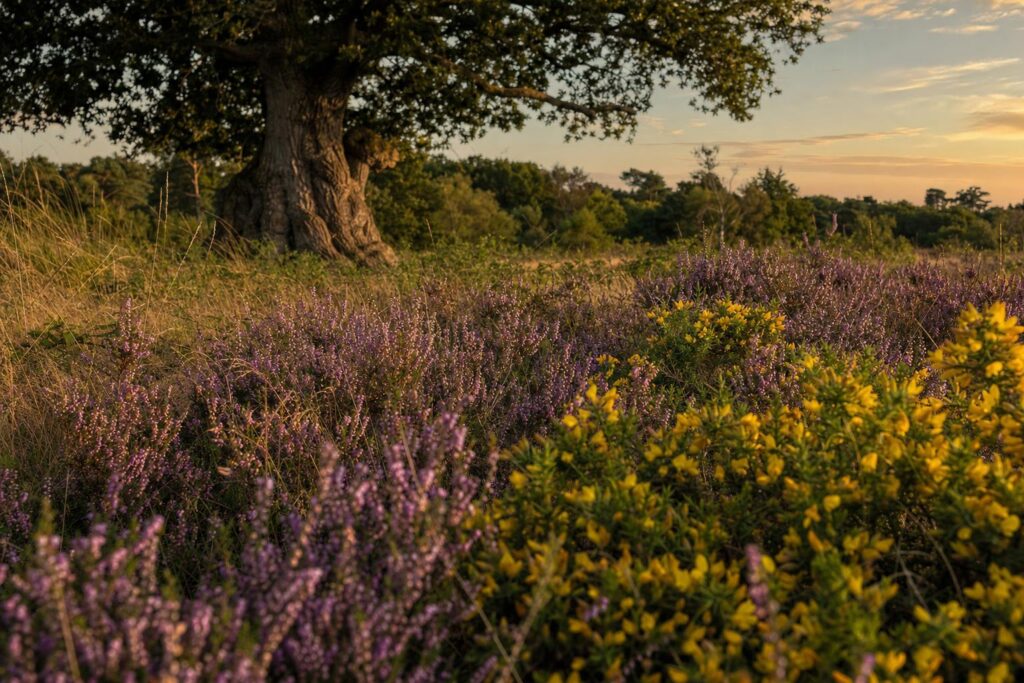
Nottinghamshire’s nature reserves make the case for each zone. Sherwood Forest National Nature Reserve, incorporating the Birklands and Bilhaugh SSSI near Edwinstowe, protects ancient oak woodland and lowland heath on the sandstone belt — a landscape of heather, bell heather, gorse and wavy hair-grass that shows what the acidic, low-nutrient soils of west Nottinghamshire can support when managed sympathetically.
On the Trent floodplain, Attenborough Nature Reserve near Beeston, Nottinghamshire Wildlife Trust’s flagship site, is a former sand and gravel working now restored to wetland, lake and reedbed — a strong example of quarry-to-habitat restoration on alluvial ground, echoed further downstream at Besthorpe near Newark and at Idle Valley near Retford, where former gravel workings now support a mosaic of wet grassland and heathland close to the sandstone belt. Colwick Country Park, on the Trent east of Nottingham city, is a more everyday example: wildflower grassland areas within an accessible, well-used green space rather than a nationally designated reserve — a useful reminder that meaningful habitat doesn’t need SSSI status to matter.
The classic floodplain-meadow plant community typical of Trent-type alluvial grassland includes great burnet, meadow foxtail, meadowsweet and pepper-saxifrage — species worth considering for any Trent Valley wildflower project, alongside the sandstone belt’s heathland palette for anyone working further west.
There is also a narrow, fragmented strip of Magnesian Limestone along Nottinghamshire’s western edge, touching parts of Bassetlaw and the Mansfield Woodhouse and Worksop fringe. It’s a minor zone compared with the same limestone belt further north in Yorkshire and Durham, but where it survives, it produces shallower, calcareous soils that support species typical of magnesian limestone grassland elsewhere — common rock-rose, salad burnet, quaking grass, small scabious and cowslip. If you’re unsure whether your land falls within this strip, a soil test is worth doing before choosing between a chalk and limestone mix and one of the county’s more common blends.
Sowing wildflower seeds in Nottinghamshire: timing and ground preparation
Autumn sowing, from late August through October, gives the most reliable results across Nottinghamshire, allowing seed to experience the winter chill that species like Yellow Rattle (Rhinanthus minor) need to germinate — see our guide to why Yellow Rattle is essential for wildflower meadows. Spring sowing (March–April) works well on the free-draining Sherwood Sandstone belt, where the ground rarely stays wet for long, but is a harder call on the Vale of Belvoir’s heavier clay.
On the sandy west of the county, ground preparation is often more straightforward than elsewhere — low native fertility means less competition from vigorous grass. On the Trent floodplain and the clay vale, strip existing vegetation without deep cultivation and avoid any added fertiliser. Our guide to establishing a wildflower meadow and our note on the best times to sow wildflower seeds cover the full sequence.
Managing your Nottinghamshire wildflower meadow long-term
Budget three years for full establishment wherever you are in Nottinghamshire: leaf and root growth dominates year one, a partial display appears in year two, and a proper meadow sward develops by year three. An annual late-summer cut, with arisings removed rather than left to rot down and re-fertilise the soil, is the single most important management task — it keeps nutrient levels low, which favours wildflowers over coarse grass.
On the sandstone belt, the main long-term risk is scrub and birch encroachment on acid grassland and heath, so periodic clearance matters as much as cutting. On the Trent floodplain and clay vale, Yellow Rattle earns its keep by weakening grass roots, giving slower-establishing wildflowers room to compete — particularly valuable on the heavier Mercia Mudstone ground of the Vale of Belvoir.
Wildflower seeds for larger-scale projects and Biodiversity Net Gain in Nottinghamshire
Nottinghamshire has taken a notably joined-up approach to biodiversity net gain. Nottinghamshire County Council, Nottingham City Council and all seven districts — Ashfield, Bassetlaw, Broxtowe, Gedling, Mansfield, Newark and Sherwood, and Rushcliffe — worked together on a shared Biodiversity Net Gain Framework for Nottinghamshire and Nottingham, published in October 2024, giving landowners and developers a common evidence base rather than seven different local approaches. Nottinghamshire County Council has also run its own BNG Supplementary Planning Document through consultation, and Bassetlaw District Council published its own BNG SPD in November 2025.
Newark and Sherwood District Council has been particularly active on habitat banking, approving council-led sites at South Clifton, Blidworth, Wellow and Normanton in September 2025 — a genuine, named example of BNG habitat creation happening in the county right now. Nottinghamshire’s Local Nature Recovery Strategy, covering the county jointly with Nottingham City and led by Nottinghamshire County Council as the responsible authority, was reported as published in November 2025 following a 2025 consultation period; it’s worth checking the current county LNRS page before relying on a specific date, since this is an area local authorities continue to update. No Nottinghamshire authority has been confirmed as a Defra-designated responsible body for conservation covenants, so treat council habitat-bank activity as distinct from that formal designation unless you’ve checked separately.
Development around the former Ratcliffe-on-Soar power station — now being redeveloped as a low-carbon energy and technology campus following the plant’s closure in 2024 — is a significant brownfield-to-development BNG driver in Rushcliffe borough, alongside longer-standing growth strategy work around the HS2 East Midlands hub at Toton, whose current status is worth confirming given well-publicised changes to HS2’s eastern leg in recent years. For sourcing seed at scale, our guide to wildflower seeds for biodiversity net gain beyond the baseline and our housing and development page cover the practical detail.
Nottinghamshire’s mix of clay-vale, Trent Valley and sandy-fringe farmland is broadly well suited to Sustainable Farming Incentive wildflower and habitat actions — our practical guides to SFI action CAHL1 (pollen and nectar flower mix) and SFI action CIPM2 (flower-rich grass margins) are a good starting point, though it’s worth checking current action codes on GOV.UK, since these have changed between scheme years.
Locally sourced wildflower seeds for Nottinghamshire
Wildahome’s seed is harvested from donor meadows in Devon and Powys, chosen for genetic compatibility with lowland and midland British grassland rather than proximity to Nottinghamshire itself. What matters is that the seed suits the county’s climate and its real range of soil conditions, from acidic Sherwood sand to Trent Valley alluvium to Vale of Belvoir clay, rather than being a generic mix with no connection to actual British growing conditions. Read more about why locally sourced wildflower seeds really matter.
For larger or mixed-soil Nottinghamshire sites — a farm spanning both sandstone and clay vale, or a BNG habitat bank with several habitat targets — our bespoke wildflower seed mixes service builds a blend around your actual site survey rather than a single off-the-shelf product.
Ready to choose the right mix?
Whether you’re restoring heathland-fringe grassland near Sherwood Forest, establishing a meadow on Trent floodplain, or planning a habitat bank for a Nottinghamshire development, matching the mix to your soil from the outset saves years of disappointing results. Browse our full range of wildflower seed mixes, explore our advice section, or get in touch if your site needs a bespoke approach.
Frequently Asked Questions
What are the best wildflower seeds for Nottinghamshire?
It depends on which part of the county you’re in. The Sherwood Sandstone belt around Mansfield and Sherwood Forest suits an acidic soils mix; the Trent Valley around Nottingham and Newark needs a loam and alluvial mix; and the Vale of Belvoir’s heavier clay does better with a heavy clay mix. There’s no single mix that fits every Nottinghamshire site.
When should I sow wildflower seeds in Nottinghamshire?
Autumn, ideally late August to October, gives the most reliable results across the county — it lets seed go through a proper winter chill before germinating, which species like Yellow Rattle need. A spring window between March and April works well on the free-draining Sherwood Sandstone belt, but is a harder call on the Vale of Belvoir’s heavier clay.
Can wildflowers grow well on Nottinghamshire’s sandy soils?
Yes — the acidic, low-nutrient sand of the Sherwood Sandstone belt around Mansfield and Sherwood Forest is naturally forgiving ground for wildflower establishment, since it lacks the fertility that lets coarse grass outcompete slower-growing wildflowers. This is some of the more straightforward wildflower ground in the county, provided you use an acidic soils mix suited to it.
What is Nottinghamshire’s biodiversity net gain requirement?
Nottinghamshire’s county council, Nottingham City Council and all seven districts apply the England-wide mandatory 10% biodiversity net gain on qualifying developments, and worked together on a shared Biodiversity Net Gain Framework for Nottinghamshire and Nottingham, published October 2024. Individual councils, including Nottinghamshire County Council and Bassetlaw District Council, have also published their own BNG supplementary planning documents.
Are there registered BNG habitat banks in Nottinghamshire?
Yes. Newark and Sherwood District Council approved council-led habitat banks at South Clifton, Blidworth, Wellow and Normanton in September 2025. It’s worth checking current availability and status directly with the district council, since habitat bank capacity changes over time.
Is Nottinghamshire seed the same as seed from other counties?
Not exactly, but it’s closely matched. Wildahome’s seed is harvested from donor meadows in Devon and Powys, then selected specifically as wildflower seeds for Nottinghamshire’s sand-to-clay soil range and the East Midlands climate, rather than sold as one generic UK mix. For most gardens, paddocks and BNG sites, that regional matching gives noticeably better establishment than seed with no connection to the county’s conditions at all.
How long does it take to establish a wildflower meadow in Nottinghamshire?
Budget three years for a proper result, whichever part of Nottinghamshire you’re in: mostly leaf and root growth in year one, a partial flowering display in year two, and a full meadow from year three onward. Vale of Belvoir clay in particular tests patience — don’t judge a new meadow’s success by its first summer alone.
Ready to get started?
Shop: Traditional Wildflower Meadow Mix →Frequently asked questions
What are the best wildflower seeds for Nottinghamshire?
It depends on which part of the county you're in. The Sherwood Sandstone belt around Mansfield and Sherwood Forest suits an acidic soils mix; the Trent Valley around Nottingham and Newark needs a loam and alluvial mix; and the Vale of Belvoir's heavier clay does better with a heavy clay mix. There's no single mix that fits every Nottinghamshire site.
When should I sow wildflower seeds in Nottinghamshire?
Autumn, ideally late August to October, gives the most reliable results across the county — it lets seed go through a proper winter chill before germinating, which species like Yellow Rattle need. A spring window between March and April works well on the free-draining Sherwood Sandstone belt, but is a harder call on the Vale of Belvoir's heavier clay.
Can wildflowers grow well on Nottinghamshire's sandy soils?
Yes — the acidic, low-nutrient sand of the Sherwood Sandstone belt around Mansfield and Sherwood Forest is naturally forgiving ground for wildflower establishment, since it lacks the fertility that lets coarse grass outcompete slower-growing wildflowers. This is some of the more straightforward wildflower ground in the county, provided you use an acidic soils mix suited to it.
What is Nottinghamshire's biodiversity net gain requirement?
Nottinghamshire's county council, Nottingham City Council and all seven districts apply the England-wide mandatory 10% biodiversity net gain on qualifying developments, and worked together on a shared Biodiversity Net Gain Framework for Nottinghamshire and Nottingham, published October 2024. Individual councils, including Nottinghamshire County Council and Bassetlaw District Council, have also published their own BNG supplementary planning documents.
Are there registered BNG habitat banks in Nottinghamshire?
Yes. Newark and Sherwood District Council approved council-led habitat banks at South Clifton, Blidworth, Wellow and Normanton in September 2025. It's worth checking current availability and status directly with the district council, since habitat bank capacity changes over time.
Is Nottinghamshire seed the same as seed from other counties?
Not exactly, but it's closely matched. Wildahome's seed is harvested from donor meadows in Devon and Powys, then selected specifically as wildflower seeds for Nottinghamshire's sand-to-clay soil range and the East Midlands climate, rather than sold as one generic UK mix. For most gardens, paddocks and BNG sites, that regional matching gives noticeably better establishment than seed with no connection to the county's conditions at all.
How long does it take to establish a wildflower meadow in Nottinghamshire?
Budget three years for a proper result, whichever part of Nottinghamshire you're in: mostly leaf and root growth in year one, a partial flowering display in year two, and a full meadow from year three onward. Vale of Belvoir clay in particular tests patience — don't judge a new meadow's success by its first summer alone.
More county guides
Find the right native wildflower mix for your county, or browse our full list by region.