

Wildflower Seeds for Leicestershire: Native Mixes for Charnwood Forest and the Clay Vales
Wildflower Seeds for Leicestershire: Native Mixes for Charnwood Forest and the Clay Vales
Leicestershire’s geology divides sharply between the ancient volcanic rock of Charnwood Forest, in the county’s centre, and the heavy glacial clay vales that surround it. Charnwood — around Loughborough, Coalville, Shepshed and Markfield — sits on some of the oldest rock in England, weathering to thin, poor, acid soil that historically resisted farming. Everywhere else, deep boulder clay laid down by glaciers dominates, cut through by the Soar, Sence and Welland valleys. Choosing wildflower seeds for Leicestershire starts with knowing which of these two very different grounds you’re working with.
Much of north and central Leicestershire also sits within the National Forest, a 200-square-mile initiative that has tripled woodland cover across the area since the 1990s and increasingly funds meadow and wetland creation alongside tree planting. That’s a genuinely useful route into funded habitat work for landowners here, alongside the more familiar national schemes.
Understanding Leicestershire’s soils before you sow
Leicestershire’s ground falls into a few clear zones, each needing a different approach.
Charnwood Forest
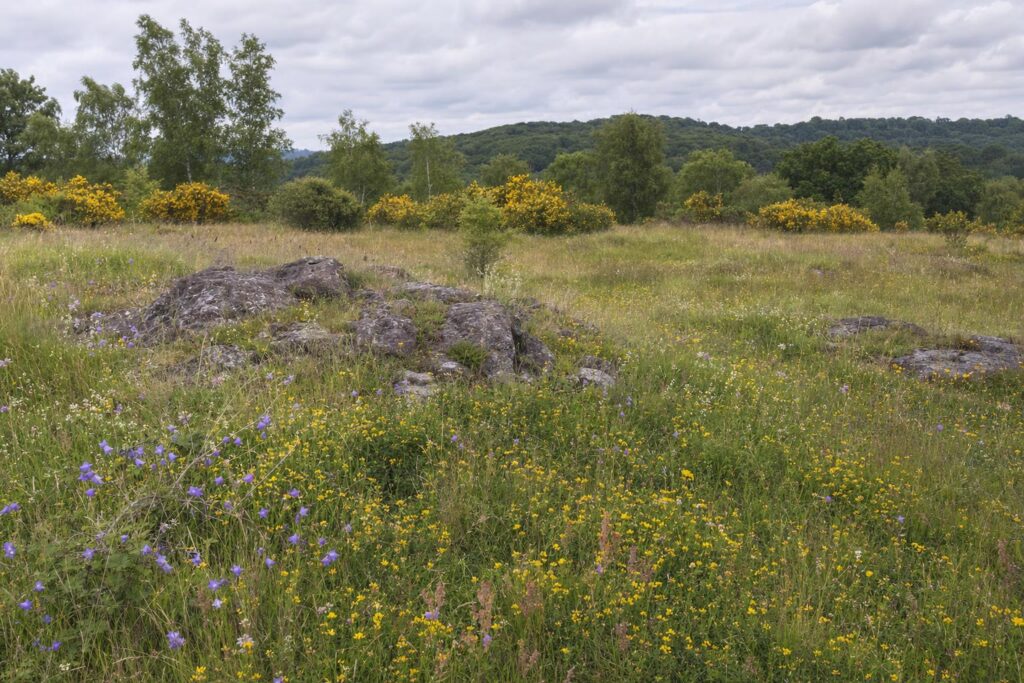
Precambrian volcanic rock, among the oldest exposed in England, underlies the country around Loughborough, Coalville, Shepshed and Markfield, weathering to thin, acid, low-nutrient soil. An acidic soils mix is the natural choice on this ground, which historically supported heathland and acid grassland precisely because it was too poor for productive farming.
The Leicestershire Vales
South and west of Charnwood — Leicester, Market Harborough, Lutterworth, Hinckley — sits on glacial boulder clay over Mercia Mudstone and Jurassic Lias clay, low-lying and cut by the Soar, Sence, Swift and Welland valleys. A heavy clay mix suits this ground.
High Leicestershire and the Wolds
East of Charnwood — towards Uppingham and the Vale of Belvoir around Melton Mowbray — boulder clay sits over Jurassic limestone and ironstone, giving rolling, more mixed ground. Depending on the specific site, either a heavy clay mix or, on the thinner limestone-influenced ground, a chalk and limestone mix can be the better fit.
The Soar and Wreake valleys
Running north through Leicester to Loughborough and beyond, the Soar and Wreake valleys carry alluvial, seasonally wet floodplain soils, well suited to a wetland and pond mix where ground stays genuinely damp.
Choosing the right wildflower seeds for Leicestershire’s habitats
Charnwood’s unimproved neutral grassland and heath-grassland mosaic is rated the most ecologically valuable habitat in the Forest — 144 vascular plant species have been recorded at a single site, Herbert’s Meadow, and over 1,480 insect species across Charnwood as a whole. Leicestershire’s classic ridge-and-furrow meadows, medieval cultivation ridges still visible in pasture across the county, support green-winged orchid, cowslip, lady’s bedstraw and pepper saxifrage — Muston Meadows, an 8.8-hectare SSSI in the north-east, is a good local example of what patient hay-cut and winter-grazed management can preserve.
The clearest large-scale example of what’s being achieved right now is the Oakley Solar Farm at Hathern, a 50MW scheme approved by Charnwood Borough Council in February 2024 delivering 62% biodiversity net gain — far beyond the statutory 10% minimum. The scheme has created 61 acres of wildflower meadow and 166 acres of species-rich grassland, alongside 2,800 new trees, 605 metres of new hedgerow and four wildlife ponds. It’s a concrete demonstration that solar development in Leicestershire is now driving genuinely significant wildflower and grassland creation, not just token planting.
A second, community-flavoured example: a three-year River Soar catchment project led by Trent Rivers Trust with Leicestershire County Council has converted fields to species-rich grassland and wildflower habitat at Broughton Astley and Watermead Country Park, including 4.7 hectares at Watermead alone, with ponds, paths and conservation grazing forming pollinator corridors along the river.
Muston Meadows, an 8.8-hectare SSSI and National Nature Reserve in the northeast of the county, is a good benchmark for what patient management on clay-derived soil can achieve — hay-cut then winter-grazed, its ridge-and-furrow ground carries green-winged orchid, lady’s bedstraw, yellow rattle and pepper saxifrage. It’s a useful reminder that Leicestershire’s heavy clay isn’t a barrier to a genuinely species-rich meadow, just a slower and more deliberate one to establish than lighter ground.
Sowing wildflower seeds in Leicestershire: timing and ground preparation
Autumn sowing, ideally August to September, is recommended for Leicestershire’s clay-dominated ground, allowing winter stratification before spring germination — important for species like Yellow Rattle (Rhinanthus minor). Our guide to why Yellow Rattle is essential for wildflower meadows explains why.
On the Vales and Wolds, ground preparation needs a thoroughly scarified, fine seedbed on clay that’s genuinely workable, not waterlogged or compacted — sow too early or too late and establishment suffers. On Charnwood’s thinner, acid ground, far less soil intervention is needed; the naturally low fertility works in the grower’s favour. For existing grassland conversions on clay, adding a Yellow Rattle booster to open the sward first gives noticeably better results. Our guide to establishing a wildflower meadow and note on the best times to sow cover the general sequence in more depth.
Managing your Leicestershire wildflower meadow long-term
Budget three years for a Leicestershire meadow to reach its full potential: modest establishment in year one, a partial flowering display in year two, and a clear improvement in sward quality from year three onward, particularly on clay. An annual late-summer cut with arisings removed is the backbone of long-term management everywhere in the county, keeping fertility low.
On the Vales and Wolds clay, ongoing attention to drainage and grass competition matters more than on lighter ground. On Charnwood’s acid grassland and heath-fringe sites, the main long-term task is controlling scrub and bracken encroachment before it shades out open ground — a pattern seen repeatedly at the Forest’s better-managed reserves.
Wildflower seeds for larger-scale projects and Biodiversity Net Gain in Leicestershire
The mandatory England-wide 10% Biodiversity Net Gain requirement applies across Leicestershire’s district and borough councils, calculated against the statutory biodiversity metric and secured for a minimum of 30 years. Leicestershire County Council’s Ecology Team acts as statutory ecological consultant across most districts, recommending pre-development habitat baseline data and evidence of engagement with off-site credit providers well ahead of the statutory minimum. Some districts, including Melton, currently have no confirmed operating habitat bank and are actively inviting landowners to propose sites — a genuine opportunity for Leicestershire landowners with suitable ground.
The Leicestershire, Leicester and Rutland Local Nature Recovery Strategy was published in August 2025, identifying species-rich grassland creation and protection as one of eight priority habitat types alongside woodland, freshwater and green corridors. For farmers, the current Countryside Stewardship rates for species-rich grassland have risen sharply — management and restoration payments both increased to £646 per hectare, and floodplain meadow restoration to £1,070 per hectare, directly relevant to Leicestershire’s Soar and Wreake floodplain meadows and ridge-and-furrow pasture. Within the National Forest boundary, which covers much of north and central Leicestershire, grants can fund up to 100% of habitat creation costs, explicitly including meadows, wetlands and ponds alongside tree planting — a genuinely useful funding route for Leicestershire landowners. Our guide to wildflower seeds for Biodiversity Net Gain beyond the baseline and our housing and development page cover sourcing seed for projects at this scale.
Locally sourced wildflower seeds for Leicestershire
Wildahome’s seed is harvested from donor meadows in Devon and Powys, then selected specifically as wildflower seeds for Leicestershire’s clay-to-Charnwood soil range and the East Midlands’ climate, rather than sold as one generic UK mix. For most gardens, paddocks and BNG sites, that regional matching gives noticeably better establishment than seed with no connection to the county’s conditions at all. Read more about why locally sourced wildflower seeds really matter.
For larger or mixed-soil Leicestershire sites — land spanning Charnwood’s acid ground and the surrounding clay vales, or a habitat project responding to Biodiversity Net Gain requirements — our bespoke wildflower seed mixes service builds a blend around your actual site survey.
Ready to choose the right mix?
Whether you’re restoring acid grassland on Charnwood Forest, converting clay pasture in the Vales, or planning habitat enhancement for a Leicestershire development, matching the mix to your ground is the decision everything else depends on. Browse our full range of wildflower seed mixes, explore our advice section, or get in touch if your site needs a bespoke approach.
Frequently Asked Questions
What are the best wildflower seeds for Leicestershire?
It depends on which part of the county you’re in. Charnwood Forest’s thin, acid ground suits an acidic soils mix; the surrounding clay vales and Wolds need a heavy clay mix; and the Soar and Wreake valley floodplains do better with a wetland and pond mix where ground stays genuinely damp. There’s no single mix that fits every Leicestershire site.
When should I sow wildflower seeds in Leicestershire?
Autumn, ideally August to September, is the recommended window across most of Leicestershire’s clay-dominated ground — it allows winter stratification before spring germination, which species like Yellow Rattle need. Ground must be genuinely workable, not waterlogged, when you sow.
Can wildflowers grow on Leicestershire’s heavy clay soil?
Yes, though it needs a different approach from Charnwood’s thin acid ground. Clay establishment depends on a thoroughly scarified, fine seedbed, avoiding waterlogged or compacted conditions at sowing, and using Yellow Rattle to weaken competitive grass. Expect modest year-one growth with clear improvement from year two onward.
What is Leicestershire’s biodiversity net gain requirement?
Leicestershire’s district and borough councils apply the England-wide mandatory 10% biodiversity net gain on qualifying developments, calculated against the statutory biodiversity metric and secured for at least 30 years. Leicestershire County Council’s Ecology Team advises across most districts on assessment and delivery.
How do I set up a BNG habitat bank in Leicestershire?
Some Leicestershire districts, including Melton, currently have no confirmed operating habitat bank and are actively inviting landowners to propose sites, working with the county’s Ecology Team. It’s worth approaching your district council directly if you have suitable land, since the local market for off-site biodiversity units is still developing.
Is Leicestershire seed the same as seed from other counties?
Not exactly, but it’s closely matched. Wildahome’s seed is harvested from donor meadows in Devon and Powys, then selected specifically as wildflower seeds for Leicestershire’s clay-to-Charnwood soil range and the East Midlands’ climate, rather than sold as one generic UK mix. For most gardens, paddocks and BNG sites, that regional matching gives noticeably better establishment than seed with no connection to the county’s conditions at all.
How long does it take to establish a wildflower meadow in Leicestershire?
Budget three years for a proper result, whichever part of Leicestershire you’re in: modest growth in year one, a partial flowering display in year two, and a clear improvement in sward quality from year three onward. Heavy clay ground in the Vales and Wolds in particular tests patience — don’t judge a new meadow’s success by its first summer alone.
Ready to get started?
Shop: Traditional Wildflower Meadow Mix →Frequently asked questions
What are the best wildflower seeds for Leicestershire?
It depends on which part of the county you're in. Charnwood Forest's thin, acid ground suits an acidic soils mix; the surrounding clay vales and Wolds need a heavy clay mix; and the Soar and Wreake valley floodplains do better with a wetland and pond mix where ground stays genuinely damp. There's no single mix that fits every Leicestershire site.
When should I sow wildflower seeds in Leicestershire?
Autumn, ideally August to September, is the recommended window across most of Leicestershire's clay-dominated ground — it allows winter stratification before spring germination, which species like Yellow Rattle need. Ground must be genuinely workable, not waterlogged, when you sow.
Can wildflowers grow on Leicestershire's heavy clay soil?
Yes, though it needs a different approach from Charnwood's thin acid ground. Clay establishment depends on a thoroughly scarified, fine seedbed, avoiding waterlogged or compacted conditions at sowing, and using Yellow Rattle to weaken competitive grass. Expect modest year-one growth with clear improvement from year two onward.
What is Leicestershire's biodiversity net gain requirement?
Leicestershire's district and borough councils apply the England-wide mandatory 10% biodiversity net gain on qualifying developments, calculated against the statutory biodiversity metric and secured for at least 30 years. Leicestershire County Council's Ecology Team advises across most districts on assessment and delivery.
How do I set up a BNG habitat bank in Leicestershire?
Some Leicestershire districts, including Melton, currently have no confirmed operating habitat bank and are actively inviting landowners to propose sites, working with the county's Ecology Team. It's worth approaching your district council directly if you have suitable land, since the local market for off-site biodiversity units is still developing.
Is Leicestershire seed the same as seed from other counties?
Not exactly, but it's closely matched. Wildahome's seed is harvested from donor meadows in Devon and Powys, then selected specifically as wildflower seeds for Leicestershire's clay-to-Charnwood soil range and the East Midlands' climate, rather than sold as one generic UK mix. For most gardens, paddocks and BNG sites, that regional matching gives noticeably better establishment than seed with no connection to the county's conditions at all.
How long does it take to establish a wildflower meadow in Leicestershire?
Budget three years for a proper result, whichever part of Leicestershire you're in: modest growth in year one, a partial flowering display in year two, and a clear improvement in sward quality from year three onward. Heavy clay ground in the Vales and Wolds in particular tests patience — don't judge a new meadow's success by its first summer alone.
More county guides
Find the right native wildflower mix for your county, or browse our full list by region.