

Wildflower Seeds for Biodiversity Net Gain: Beyond the Baseline
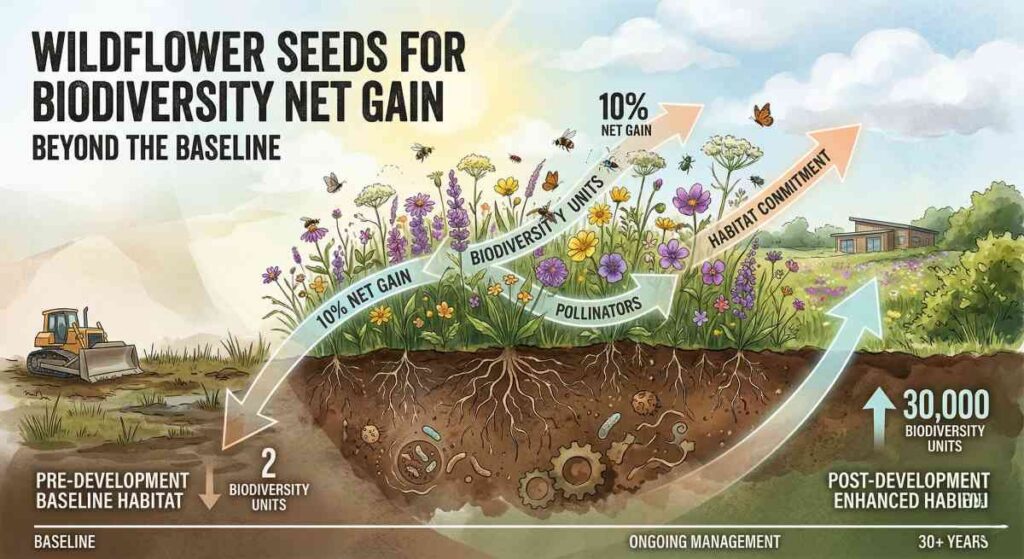
Since February 2024, Biodiversity Net Gain has been mandatory for most major planning applications in England. Developers must demonstrate a minimum 10% uplift in biodiversity units — measured, monitored, and maintained for at least 30 years. For many sites, wildflower meadow creation is one of the most effective ways to meet that requirement.
But there’s more to this than compliance. Wildflower seeds for biodiversity net gain, when matched carefully to local soils and sown with the right preparation, can create habitats of genuine ecological value — habitats that support native pollinators, invertebrates, and small mammals over the long term. Done properly, a meadow established for BNG doesn’t just satisfy a planning condition. It becomes a functioning piece of countryside.
This article sets out why wildflowers work so well within the BNG framework, what the practical requirements are, and how to approach establishment and management in a way that stands up to monitoring and delivers real ecological gain.
Why wildflower meadows score well under the BNG metric
The UK Habitat Biodiversity Accounting Tool — commonly called the biodiversity metric — assigns unit values to different habitat types based on their distinctiveness, condition, and size. Wildflower-rich grassland consistently scores higher than amenity grass, scrub, or bare ground.
A well-established species-rich meadow, particularly one that includes native grasses and a diverse range of flowering forbs, can generate significantly more biodiversity units per hectare than a maintained grass sward. The difference matters when you’re calculating net gain on a constrained site.
The key variables the metric considers are habitat type, condition, and the location’s strategic significance. By targeting the right mix for your soil type and managing it correctly from year one, you can push the condition score upward over time — improving the unit value of the habitat as it matures.
Matching wildflower seeds to site conditions — the foundation of BNG success
The most common reason BNG wildflower schemes underperform is a mismatch between the seed mix and the site. A Traditional Meadow mix sown into acidic, waterlogged ground will fail to establish properly. A chalk-grassland mix on heavy clay soil will give you years of frustration and poor condition scores.
Getting this right starts with understanding your site:
- Soil pH — acidic, neutral, or calcareous? This is the single most important variable.
- Drainage — is the site seasonally wet, free-draining, or somewhere in between?
- Nutrient status — former agricultural land is often too fertile; wildflowers need low-nutrient conditions to thrive.
- Existing vegetation — is there an established grass sward to deal with, or bare or disturbed ground?
For most lowland sites with neutral soils, a Traditional Meadow mix provides the broadest range of native forbs and grasses. Chalk and limestone sites benefit from a specialist calcareous mix with species such as Cowslip (Primula veris), Kidney Vetch (Anthyllis vulneraria) and Yellow Oat-grass (Trisetum flavescens). Wetter ground calls for a Wetland & Pond mix. Acidic, healthy ground — including many upland fringes and post-industrial sites — responds best to an Acidic Soils mix with species like Heath Bedstraw (Galium saxatile) and Devil ‘s-bit Scabious (Succisa pratensis).
Provenance matters too. Seeds sourced from UK-grown, locally harvested stock establish more reliably and support local invertebrate communities more effectively than imported or cultivated varieties. For BNG schemes intended to hold their condition score over 30 years, provenance is not a minor detail.
Ground preparation: the step most BNG schemes get wrong
Wildflowers are not competitive plants. They evolved in low-fertility conditions where grasses are kept in check by thin soils, grazing, or cutting. Put them into fertile ground — or directly into an existing grass sward — and the grasses will outcompete them within a season or two.
Effective ground preparation for a wildflower BNG scheme typically involves:
- Cutting and removing any existing vegetation — removing the clippings takes nutrient capital off the site.
- Scarifying or harrowing to expose bare soil across at least 50–70% of the sowing area.
- On highly fertile sites, stripping the topsoil to expose the subsoil is the most reliable option.
- Avoid chemical treatments unless necessary—they disrupt soil biology and can affect seed germination.
Sowing into bare, low-nutrient soil is the closest you can get to replicating the conditions in which native wildflowers actually evolved. Skip this step, and your species richness — and your condition score — will suffer.
Sowing windows and what to expect in year one
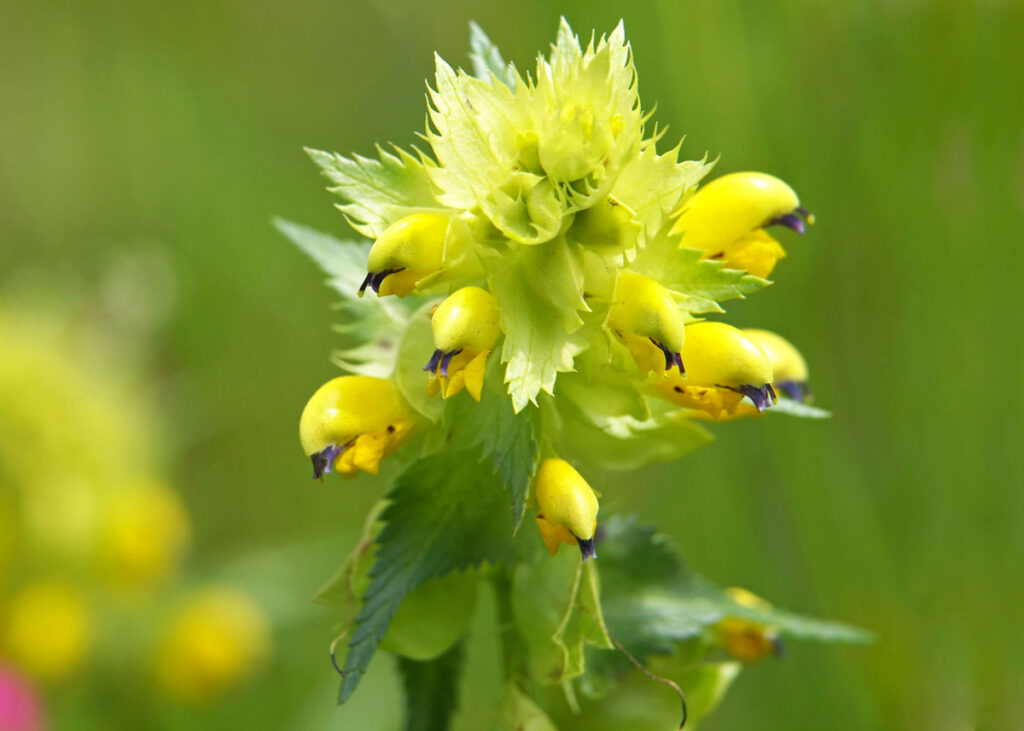
Wildflower seeds for biodiversity net gain can be sown in two windows: Spring (March to May) or early Autumn (August to October). Autumn sowing is generally preferred for perennial-heavy mixes because many native species require a cold period — known as cold stratification — to break dormancy and germinate reliably. Yellow Rattle (Rhinanthus minor) in particular must be sown in Autumn; it will not germinate from a Spring sowing.
In year one, manage expectations. A new meadow sown from seed will look sparse and weedy. Annual species such as Cornfield Poppies (Papaver rhoeas) and Corn Marigold (Glebionis segetum) will often flower in the first season, providing colour and early invertebrate value. The perennial backbone — Oxeye Daisy (Leucanthemum vulgare), Knapweed (Centaurea nigra), Wild Carrot (Daucus carota) — takes longer to establish root systems and typically flowers from year two or three onwards.
A good rule of thumb: allow three growing seasons before assessing the true species composition of a newly sown meadow. Monitor and record from year one, but build this expectation into the BNG monitoring plan so that early-stage data is interpreted correctly.
Long-term management: the 30-year commitment
BNG requires habitat to be maintained in good condition for a minimum of 30 years. For wildflower meadows, that means a consistent management regime — and one that actually suppresses grass dominance rather than encouraging it.
The standard management approach for a species-rich meadow is a single annual cut in late Summer (typically August or September), with all cuttings removed from the site. This mimics traditional hay meadow management. Removing the clippings is essential: leaving them to rot returns nutrients to the soil and progressively enriches the conditions that favour grasses over wildflowers.
On sites where grass dominance becomes an issue, introducing Yellow Rattle is the most ecologically sound intervention. As a root hemiparasite of grasses, it weakens grass growth, creating space for wildflowers to establish. It must be sown fresh in Autumn and allowed to self-seed annually to persist.
Periodic light disturbance — scarifying small patches of bare soil in Autumn — helps maintain establishment opportunities for annual and short-lived perennial species. Scrub encroachment should be managed by cutting or pulling, depending on scale.
For BNG schemes with formal monitoring obligations, keep detailed records of management activities and photograph fixed points in the meadow at the same time each year. This documentation supports condition assessments and provides evidence for the 30-year management agreement.
Choosing the right wildflower seed mix for a BNG scheme
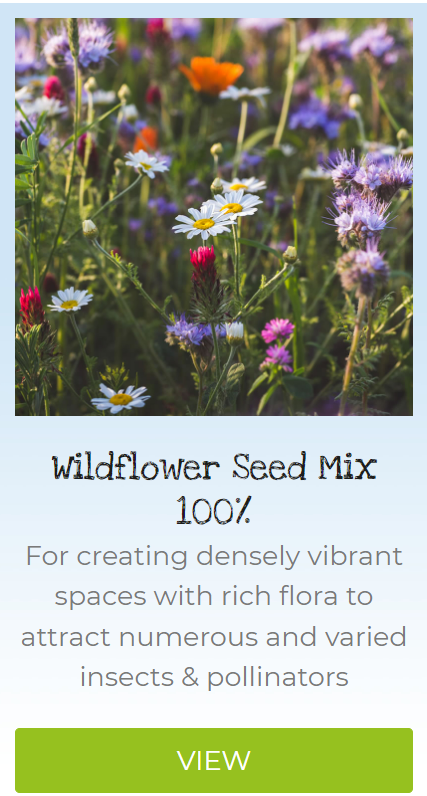
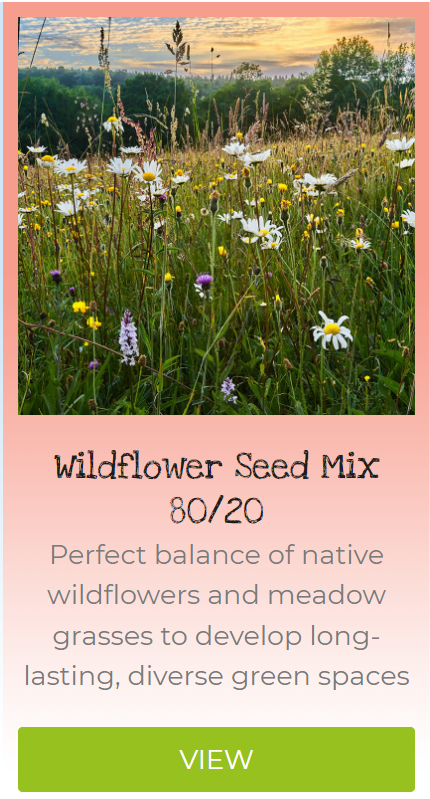
Wildahome supplies a range of 100% wildflower mixes and 80/20 grass-wildflower mixes suited to the full spectrum of UK soil types and drainage conditions. All seed is sourced from UK-grown, locally provenance-matched stock — an important quality marker for BNG schemes where long-term habitat resilience and ecological authenticity matter.
For BNG applications, 100% wildflower mixes tend to generate higher species richness and support denser pollinator communities than 80/20 mixes, which are better suited to erosion-prone or amenity contexts where grass cover is needed for stability. If your site has specific soil characteristics or is part of a wider habitat network, we’d recommend contacting us to discuss the right mix before ordering.
Talk to us about your BNG project
Every BNG site is different — soil type, previous land use, drainage, and surrounding habitat all affect which approach will work and what you can realistically achieve. If you’re working on a scheme and want practical guidance on mix selection, sowing rates, ground preparation, or long-term management, get in touch with the Wildahome team. We work with developers, ecologists, and land managers at all stages of the planning and establishment process.
Contact us directly at hello@wildahome.co.uk or call 0333 242 0602.
Frequently Asked Questions
What are wildflower seeds for biodiversity net gain, and how do they work?
Wildflower seeds for biodiversity net gain are native seed mixes sown to create species-rich grassland habitat that scores measurable biodiversity units under the UK Habitat Biodiversity Accounting Tool. The more diverse and well-managed the meadow, the higher the condition score — and the more biodiversity units it generates to offset development impacts.
Which wildflower seed mix is best for a BNG scheme?
It depends on your soil type and drainage. Neutral lowland soils suit a Traditional Meadow mix; chalk or limestone sites need a specialist calcareous mix; acidic or wet ground requires dedicated mixes for those conditions. Getting this right from the outset is critical — a mismatched mix will underperform ecologically and score poorly in condition assessments.
How long does a wildflower meadow take to establish for BNG purposes?
Allow at least three growing seasons before the full species composition is apparent. Annual species flower in year one; perennial forbs typically flower from year two or three. BNG monitoring plans should reflect this timeline and not judge condition solely on first-year appearance.
Does ground preparation really matter for wildflower seeds for biodiversity net gain?
Yes—it’s the most important practical step. Sowing into fertile soil or an established grass sward almost always fails. Expose bare, low-nutrient soil before sowing, remove all vegetation clippings, and on fertile sites, consider topsoil stripping. Skipping ground prep is the single biggest cause of BNG meadow failure.
Can wildflower meadows be used on smaller development sites for BNG?
Yes. Even modest areas of species-rich grassland generate biodiversity units, and on constrained sites they often represent the highest-scoring habitat type available. Wildflower seed mats can be useful on very small areas or in locations where conventional sowing is difficult, such as slopes or narrow strips.
What management does a wildflower meadow require over the 30-year BNG period?
A single late-Summer cut each year, with all clippings removed from the site. This mimics traditional hay meadow management, keeps grass dominance in check, and maintains the low-nutrient conditions that wildflowers need. Yellow Rattle can be introduced where grasses become dominant. Detailed records of all management activity should be kept for monitoring purposes.
Is local provenance important for wildflower seeds used in BNG schemes?
It matters significantly for long-term ecological performance. UK-grown, locally provenance-matched seed establishes more reliably and supports local invertebrate communities more effectively than imported or cultivated stock. For schemes with a 30-year monitoring obligation, provenance is a quality marker worth specifying from the outset.
Ready to get started?
Shop: Wildflower Seeds for BNG →About the Author
Paul Stenning, Wildahome
Paul Stenning is the co-founder of Wildahome, a family-run British wildflower seed business growing and supplying native seed from their own meadows in Devon and Powys, Wales. With hands-on experience establishing wildflower habitats across the UK, Paul advises individuals, land managers, ecologists, and developers on species selection, ground preparation, and long-term meadow management. For site-specific advice, call 0333 242 0602 or email paul@wildahome.co.uk.