

Why Locally Sourced Wildflower Seeds Really Matter
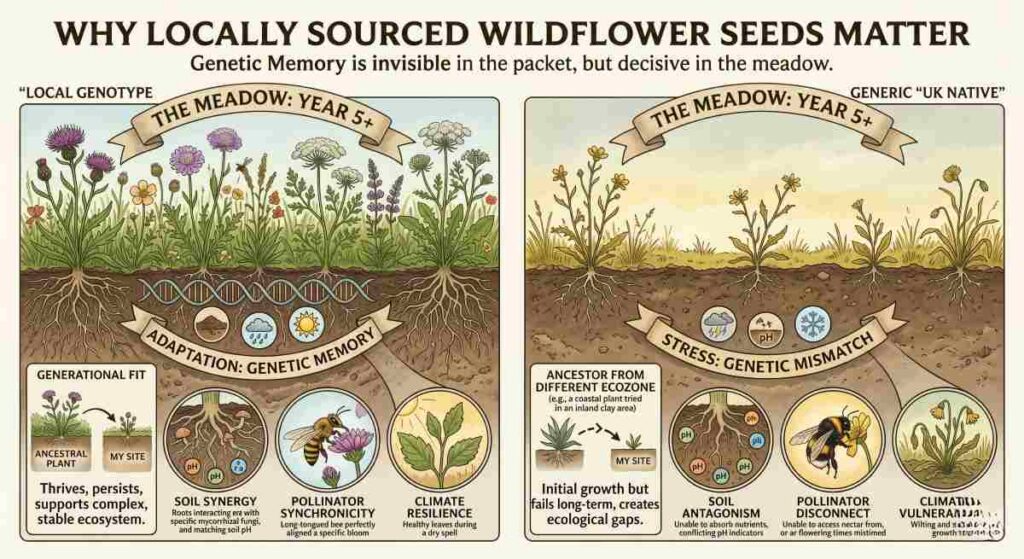
There is a meaningful difference between a seed labelled UK native and one that was harvested a few miles from where you are sowing it. Both might grow. But only one is likely to thrive, persist, and support the ecology of your particular place over the long term.
Locally sourced wildflower seeds carry something that commercial mixes cannot replicate from a catalogue: genetic memory. The plants those seeds came from have spent generations adapting to your region’s soils, rainfall patterns, frost windows, and pollinators. That adaptation is not visible in the packet. But it is very visible in the meadow, especially in years two, three, and beyond.
This article explains what provenance actually means, why soil chemistry is a decisive factor in establishment success, and how to think about seed sourcing if you are serious about long-term habitat.
What local provenance actually means
Native means a species that colonised the British Isles naturally after the last ice age, without human introduction. Most wildflower seeds sold in the UK are native in this sense. But native covers an enormous range. A population of Oxeye Daisy (Leucanthemum vulgare) growing on chalk downland in Kent is genetically distinct from a population on acid grassland in mid-Wales. They are the same species, but they are not interchangeable.
Local provenance refers to seed harvested from wild populations close to your sowing site, ideally within the same National Character Area (NCA), or at minimum from broadly similar soil and climate conditions. These locally adapted ecotypes have evolved specific traits: flowering timing, root architecture, drought tolerance, cold hardiness. Traits shaped by exactly the conditions you are asking them to grow in.
Standard commercial mixes, even those labelled British native, are commonly grown in agricultural conditions on soils far removed from their intended destination. The seed may be pure and viable. But the genetics may not suit your site, your season, or your local insect community.
The genetic case for locally sourced wildflower seeds
When non-local genotypes are introduced at scale, they can cross with surrounding wild populations and alter their genetic composition. Research on species such as Oxeye Daisy and Burnet-saxifrage (Pimpinella saxifraga) has shown that non-local seed introductions leave a detectable genetic footprint in regional gene pools for years after sowing. Buying the wrong seed can affect the wildflowers growing in the hedgerows and field margins around you, not just in your meadow.
The reverse problem also exists. Seed collected from very small, isolated populations carries risk of inbreeding depression: reduced germination rates, poor seedling survival, and weak growth. This is increasingly common as the UK wildflower-rich habitats fragment. For restoration to be ecologically sound, seed should ideally come from a reasonably large, genetically diverse donor population.
A useful rule of thumb: seed from populations 3 to 10 km away tends to perform well, close enough to share your soil and climate conditions, far enough to bring some healthy genetic variety. Very short-distance crosses and very long-distance crosses both carry risk, for different reasons.
Why soil chemistry often matters more than distance
One of the most common and avoidable causes of meadow establishment failure is sowing seed into the wrong soil type. Not wrong in a vague sense, but wrong at the chemistry level.
Devil’s-bit Scabious (Succisa pratensis) is a good example. Populations from calcareous soils are physiologically adapted to alkaline pH and the nutrient profile of those conditions. Populations from wet acidic soils carry different adaptations entirely, including tolerance of low pH and aluminium toxicity. Transfer seed from the wrong donor site and you are asking a plant to survive in chemistry it did not evolve for.
- Calcareous grassland species will typically fail on acid soils, regardless of how carefully you prepare the seedbed
- Wetland species sown on free-draining ground will struggle through summer drought even if they germinate
- Agricultural cultivars of common species such as Red Clover, Common Vetch, and Sainfoin are bred for high-nutrient conditions and will outcompete smaller native wildflowers on improved ground
Locally sourced seeds and the soil microbiome
Soil is not just a growing medium. A healthy soil contains billions of microbial organisms, including Arbuscular Mycorrhizal Fungi (AMF), which form symbiotic relationships with up to 90% of land plants. These fungal networks extend root surface area dramatically and supply phosphorus, nitrogen, and water in exchange for carbon from the plant.
This relationship is species-specific and locally evolved. Native wildflowers grown from local-provenance seed are better matched to the specific fungal communities present in your soil. Non-local cultivars or non-native ecotypes may not form effective partnerships with local AMF communities, which reduces their establishment rate and long-term resilience.
Sites that have been farmed intensively, or that carry invasive species like Himalayan Balsam (Impatiens glandulifera), often have depleted mycorrhizal networks. On these sites, ground preparation is not just about seedbed tilth. You may need to support the soil biology as well as reduce competition.
Yellow Rattle: the key to meadow establishment
No article on wildflower seed sourcing is complete without Yellow Rattle (Rhinanthus minor). This annual hemi-parasite attaches to grass roots via haustoria, extracting water and nitrogen and weakening the competitive grass sward. The thinning that results allows light to reach the soil surface, creating the conditions that slower-growing perennial wildflowers need to establish.
Yellow Rattle has specific requirements that many landowners underestimate:
- Seed viability is very short. Sow within a year of harvest, ideally from fresh seed
- Cold stratification is essential: sow in Autumn (August to November) so seed overwinters naturally before germinating in Spring
- The seedbed must have exposed soil. Cut the sward short and scarify to expose at least 50% bare ground before sowing
- Do not cut in Spring while seedlings are establishing. Delay the first cut until late July or August, after seed capsules have rattled and shed
- Never sow onto completely bare, grass-free ground. Yellow Rattle requires host roots to survive
The source of your Yellow Rattle seed matters just as much as the source of your other species. Locally harvested seed is more likely to be in genuine dormancy, correctly stored, and matched to your local seasonal cues.
Sowing rates and practical preparation
Getting the seed rate right depends partly on what you are sowing:
- 100% pure wildflower seed: sow at 1 to 3 g per m2
- 80/20 grass and wildflower mixes: sow at 5 g per m2
- Seed with high chaff content from regionally harvested material: increase rate to account for the non-seed fraction
In all cases, mix seed with dry sharp sand at approximately 4 parts sand to 1 part seed by weight. This gives you a visible carrier, which helps you sow evenly and avoid missing patches or double-sowing.
Ground preparation is non-negotiable. Existing grass competition is the single biggest cause of wildflower establishment failure. You cannot successfully direct-sow into an established grass sward without first cutting it short, scarifying to expose bare soil, and removing arisings. On improved or fertile ground, additional steps to reduce nutrient levels may be needed before sowing.
Sowing windows are Autumn (August to October, preferred) or early Spring (February to April). Autumn sowing allows seeds to cold-stratify naturally over winter and germinate with the first warmth of Spring. Spring sowing can work, but germination is often more erratic and establishment slower in the first year.
Wildahome seed mixes: provenance built in
Wildahome’s seed mixes are harvested from our own meadows in Devon and Powys, and from partner farms across the UK. Every mix is matched to soil type and regional conditions, not manufactured to a generic spec. If you are looking at a calcareous site, a wetland edge, an acidic moorland bank, or a heavy clay field margin, there is a mix formulated for those conditions, with seed sourced from the appropriate donor habitat.
We offer both 100% wildflower mixes and 80/20 grass-wildflower mixes across the main habitat types. For sites requiring Yellow Rattle establishment, this can be added as a standalone product and sown separately in Autumn.
Ready to source with confidence?
Provenance is not a premium feature. It is the baseline for meadow establishment that actually works. If you have a project in mind, or you are not sure which mix suits your soil and region, get in touch. We will help you match seed source to site before you commit to anything.
Ready to get started?
Shop: Traditional Wildflower Meadow Mix →