

Wildflower Seeds for Northamptonshire: Native Mixes for Ironstone, Limestone and Clay Vale
Wildflower Seeds for Northamptonshire: Native Mixes for Ironstone, Limestone and Clay Vale
Northamptonshire sits on Jurassic bedrock that gives the county three genuinely different growing grounds. Ironstone uplands run through the northwest around Daventry and Kettering’s fringes, giving local buildings their distinctive orange-brown colour. Limestone dominates the Rockingham Forest country in the northeast, between the Nene and Welland, with old ironstone quarry cuttings — locally called gullets — still visible across the landscape. And heavy boulder clay covers much of the rest of the county, particularly the wooded ridge in the south around Towcester and Brackley. Choosing wildflower seeds for Northamptonshire means matching your mix to whichever of these three grounds you’re working with.
Northamptonshire is also at the sharp end of England’s logistics and warehousing boom — the county sits at the heart of the so-called Golden Logistics Triangle — and one of the largest solar developments currently working through the UK planning system, Green Hill Solar Farm near Wellingborough, sits right in the county. Both are reshaping what habitat creation looks like here.
Understanding Northamptonshire’s soils before you sow
Northamptonshire’s bedrock splits into clear zones running roughly northwest to southeast.
The ironstone uplands
Northwest Northamptonshire, around Daventry and towards Kettering, sits on Jurassic limestone and Lias clay capped with ironstone — the Northampton Sand Formation that gives local stone its orange colour. Depending on the specific site, either a chalk and limestone mix or a heavy clay mix suits this ground, since boulder clay caps much of the higher ground.
Rockingham Forest and the limestone north
Between the Nene and Welland, Jurassic Great Oolite limestone forms a scarp running through Kings Cliffe, Oundle and towards Stamford, with historic ironstone-mining gullets around Corby and Wellingborough. A chalk and limestone mix is the natural fit on this thin, free-draining ground.
The boulder clay vale and wooded ridge
South of the ironstone belt, around Towcester and Brackley, a limestone plateau is capped with heavy, variable glacial clay that historically limited farming and preserved ancient woodland — Whittlewood, Salcey and Yardley Chase. A heavy clay mix is needed here.
The Nene and Welland valleys
Running through Daventry, Northampton, Wellingborough and Thrapston, the Nene’s floodplain carries alluvial soils and extensive former gravel workings, many now wetland nature reserves. A wetland and pond mix suits genuinely damp floodplain ground.
Choosing the right wildflower seeds for Northamptonshire’s habitats
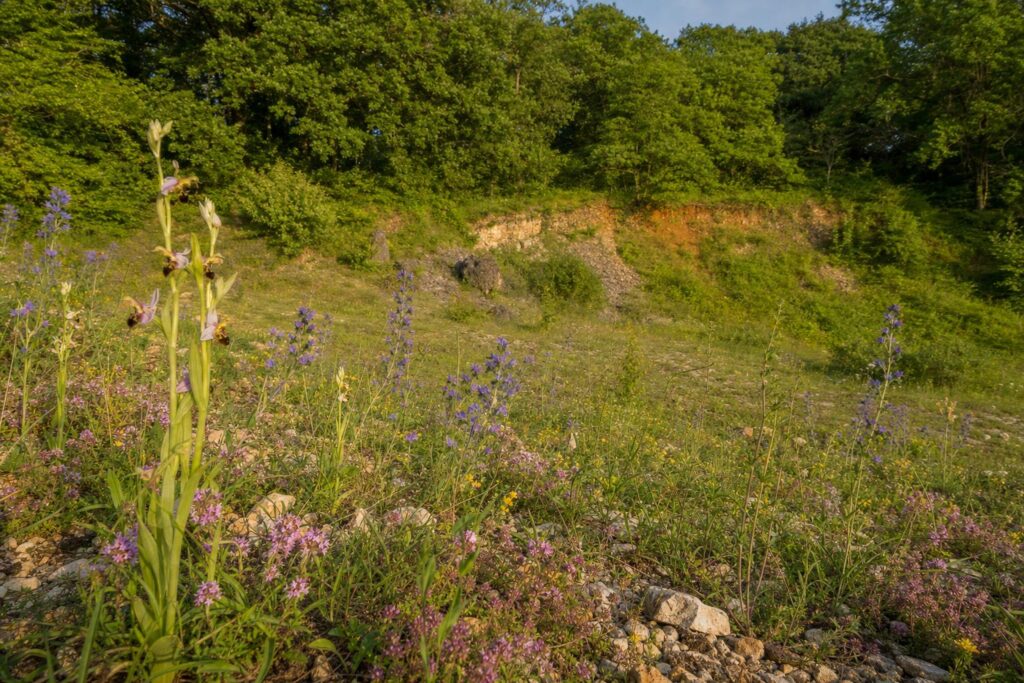
Northamptonshire’s most striking wildflower habitats are often old quarries. Twywell Hills and Dales, a 54.6-hectare reserve near Kettering managed by the Woodland Trust and Rockingham Forest Trust, is a former ironstone quarry where the cutting slopes now carry species-rich limestone grassland alongside ponds and scrub, notable for rare ground-nesting bees and wasps. Barnack Hills and Holes, a former medieval limestone quarry, and Old Sulehay, an 85-hectare remnant of ancient Rockingham Forest grazed by rare-breed sheep and cattle, tell a similar story — Northamptonshire’s thinnest, poorest ground often turns out to be its richest for wildflowers.
Kingsthorpe North Meadows in Northampton is the county’s official Coronation Meadows site — community-purchased land where annual hay-cutting has revealed medieval ridge-and-furrow and a growing list of species including bird’s-foot trefoil, meadow vetchling and great burnet, a genuinely replicable model for smaller sites.
At real scale, Green Hill Solar Farm — a 500MW scheme south of Wellingborough, one of the largest under consideration in the UK, with a decision expected in October 2026 — has earmarked around 190 hectares of its roughly 1,200-hectare site specifically for environmental mitigation and enhancement, including retained woodland, hedgerows and field margin buffers benefiting bats, farmland birds, brown hare and hedgehog. Whatever the outcome, it’s a clear sign of the scale at which habitat creation is now being planned in the county.
Between 2012 and 2015, the Nene Valley Nature Improvement Area — one of only 12 such areas designated nationally following the government’s Natural Environment White Paper — coordinated planning, river restoration and land management work with farmers along the Nene from Daventry to Peterborough. Its legacy lives on in reserves like Summer Leys and Titchmarsh, part of the 1,382-hectare Upper Nene Valley Gravel Pits SSSI, nationally important for breeding and wintering waterbirds — a strong indication of what the Nene corridor can support when habitat creation and river management work together.
Sowing wildflower seeds in Northamptonshire: timing and ground preparation
Autumn sowing, ideally August to October, is the standard optimal window, and it matters more than usual on Northamptonshire’s heavy boulder clay — get ahead of the wet season rather than trying to work sodden ground. Our guide to why Yellow Rattle is essential for wildflower meadows explains its role in suppressing competitive grass on this kind of ground.
On the county’s ex-arable clay and ironstone soils, which tend to carry more residual fertility than downland counties further south, stripping topsoil or several seasons of cropping-off without fertiliser before sowing makes a real difference to establishment. On the limestone and old quarry ground of Rockingham Forest, by contrast, the naturally thin, low-nutrient substrate needs very little preparation — a genuine local advantage for anyone restoring old ironstone-spoil or quarry ground. Our guide to establishing a wildflower meadow and note on the best times to sow cover the general sequence in more depth.
Managing your Northamptonshire wildflower meadow long-term
Budget three years for a Northamptonshire meadow to reach its full potential: modest growth in year one, a partial flowering display in year two, and a proper sward from year three onward. An annual late-summer cut with arisings removed, following the Kingsthorpe North Meadows model, is the backbone of long-term management across the clay vale and limestone north alike.
On floodplain sites along the Nene and Welland, seasonal flooding affects both timing and species choice — build management around the water rather than fighting it. On former quarry and ironstone ground, the main long-term task is usually controlling scrub encroachment on ungrazed cutting slopes rather than fighting fertility, since these sites are naturally poor.
Wildflower seeds for larger-scale projects and Biodiversity Net Gain in Northamptonshire
Northamptonshire has two unitary planning authorities since 2021, North Northamptonshire Council and West Northamptonshire Council, both applying the mandatory England-wide 10% Biodiversity Net Gain requirement to qualifying developments, calculated against the statutory biodiversity metric and secured for a minimum of 30 years. North Northamptonshire has gone further, adopting a formal Habitat Banks framework in April 2025 that lets developers buy biodiversity units within the district rather than losing that investment to habitat banks elsewhere — a concrete opportunity for North Northamptonshire landowners with suitable land.
North Northamptonshire published its Local Nature Recovery Strategy in March 2025, with an interactive mapping portal for landowners and developers; West Northamptonshire’s strategy was expected to follow in late September 2026. Northamptonshire’s growth pressure is unusually visible: the county sits at the centre of the Golden Logistics Triangle, with warehouse and distribution development running at some of the highest rates in the UK, and the Green Hill Solar Farm near Wellingborough — one of the largest solar schemes in the country, with roughly 190 hectares earmarked for habitat enhancement — illustrates the scale at which BNG-driven habitat creation is now being planned locally. Our guide to wildflower seeds for Biodiversity Net Gain beyond the baseline and our housing and development page cover sourcing seed for projects at this scale.
Locally sourced wildflower seeds for Northamptonshire
Wildahome’s seed is harvested from donor meadows in Devon and Powys, then selected specifically as wildflower seeds for Northamptonshire’s ironstone-to-clay soil range and the East Midlands’ climate, rather than sold as one generic UK mix. For most gardens, paddocks and BNG sites, that regional matching gives noticeably better establishment than seed with no connection to the county’s conditions at all. Read more about why locally sourced wildflower seeds really matter.
For larger or mixed-soil Northamptonshire sites — land spanning limestone and clay, or a habitat project responding to Biodiversity Net Gain requirements — our bespoke wildflower seed mixes service builds a blend around your actual site survey.
Ready to choose the right mix?
Whether you’re restoring limestone grassland on old quarry ground, converting boulder clay in the south of the county, or planning habitat enhancement for a Northamptonshire development, matching the mix to your ground is the decision everything else depends on. Browse our full range of wildflower seed mixes, explore our advice section, or get in touch if your site needs a bespoke approach.
Frequently Asked Questions
What are the best wildflower seeds for Northamptonshire?
It depends on which part of the county you’re in. The ironstone uplands and Rockingham Forest’s limestone country in the north suit a chalk and limestone mix; the boulder clay vale in the south, around Towcester and Brackley, needs a heavy clay mix; and the Nene and Welland valley floodplains do better with a wetland and pond mix. There’s no single mix that fits every Northamptonshire site.
When should I sow wildflower seeds in Northamptonshire?
Autumn, ideally August to October, is the standard window, and it matters more than usual on Northamptonshire’s heavy boulder clay — sow before the ground gets too wet to work rather than fighting waterlogged clay later in the season.
Can wildflowers grow on old ironstone quarry ground?
Yes, often better than on farmed land. Northamptonshire’s former ironstone and limestone quarries — Twywell Hills and Dales is a good example — tend to have thin, naturally low-nutrient substrate that needs very little preparation before sowing, giving genuinely good results with minimal intervention.
What is Northamptonshire’s biodiversity net gain requirement?
Both North Northamptonshire Council and West Northamptonshire Council apply the England-wide mandatory 10% biodiversity net gain on qualifying developments, calculated against the statutory biodiversity metric and secured for at least 30 years. North Northamptonshire has adopted a formal Habitat Banks framework to keep BNG investment and long-term oversight within the district.
How do I set up a BNG habitat bank in Northamptonshire?
North Northamptonshire Council adopted a Habitat Banks framework in April 2025 that lets developers buy biodiversity units from within the district, evaluated and approved by the council’s planning team under a 30-year monitoring period. It’s worth contacting the council’s ecology or planning policy team directly if you have suitable land in North Northamptonshire.
Is Northamptonshire seed the same as seed from other counties?
Not exactly, but it’s closely matched. Wildahome’s seed is harvested from donor meadows in Devon and Powys, then selected specifically as wildflower seeds for Northamptonshire’s ironstone-to-clay soil range and the East Midlands’ climate, rather than sold as one generic UK mix. For most gardens, paddocks and BNG sites, that regional matching gives noticeably better establishment than seed with no connection to the county’s conditions at all.
How long does it take to establish a wildflower meadow in Northamptonshire?
Budget three years for a proper result, whichever part of Northamptonshire you’re in: modest growth in year one, a partial flowering display in year two, and a proper sward from year three onward. Boulder clay ground in the south in particular tests patience — don’t judge a new meadow’s success by its first summer alone.
Ready to get started?
Shop: Traditional Wildflower Meadow Mix →Frequently asked questions
What are the best wildflower seeds for Northamptonshire?
It depends on which part of the county you're in. The ironstone uplands and Rockingham Forest's limestone country in the north suit a chalk and limestone mix; the boulder clay vale in the south, around Towcester and Brackley, needs a heavy clay mix; and the Nene and Welland valley floodplains do better with a wetland and pond mix. There's no single mix that fits every Northamptonshire site.
When should I sow wildflower seeds in Northamptonshire?
Autumn, ideally August to October, is the standard window, and it matters more than usual on Northamptonshire's heavy boulder clay — sow before the ground gets too wet to work rather than fighting waterlogged clay later in the season.
Can wildflowers grow on old ironstone quarry ground?
Yes, often better than on farmed land. Northamptonshire's former ironstone and limestone quarries — Twywell Hills and Dales is a good example — tend to have thin, naturally low-nutrient substrate that needs very little preparation before sowing, giving genuinely good results with minimal intervention.
What is Northamptonshire's biodiversity net gain requirement?
Both North Northamptonshire Council and West Northamptonshire Council apply the England-wide mandatory 10% biodiversity net gain on qualifying developments, calculated against the statutory biodiversity metric and secured for at least 30 years. North Northamptonshire has adopted a formal Habitat Banks framework to keep BNG investment and long-term oversight within the district.
How do I set up a BNG habitat bank in Northamptonshire?
North Northamptonshire Council adopted a Habitat Banks framework in April 2025 that lets developers buy biodiversity units from within the district, evaluated and approved by the council's planning team under a 30-year monitoring period. It's worth contacting the council's ecology or planning policy team directly if you have suitable land in North Northamptonshire.
Is Northamptonshire seed the same as seed from other counties?
Not exactly, but it's closely matched. Wildahome's seed is harvested from donor meadows in Devon and Powys, then selected specifically as wildflower seeds for Northamptonshire's ironstone-to-clay soil range and the East Midlands' climate, rather than sold as one generic UK mix. For most gardens, paddocks and BNG sites, that regional matching gives noticeably better establishment than seed with no connection to the county's conditions at all.
How long does it take to establish a wildflower meadow in Northamptonshire?
Budget three years for a proper result, whichever part of Northamptonshire you're in: modest growth in year one, a partial flowering display in year two, and a proper sward from year three onward. Boulder clay ground in the south in particular tests patience — don't judge a new meadow's success by its first summer alone.
More county guides
Find the right native wildflower mix for your county, or browse our full list by region.