

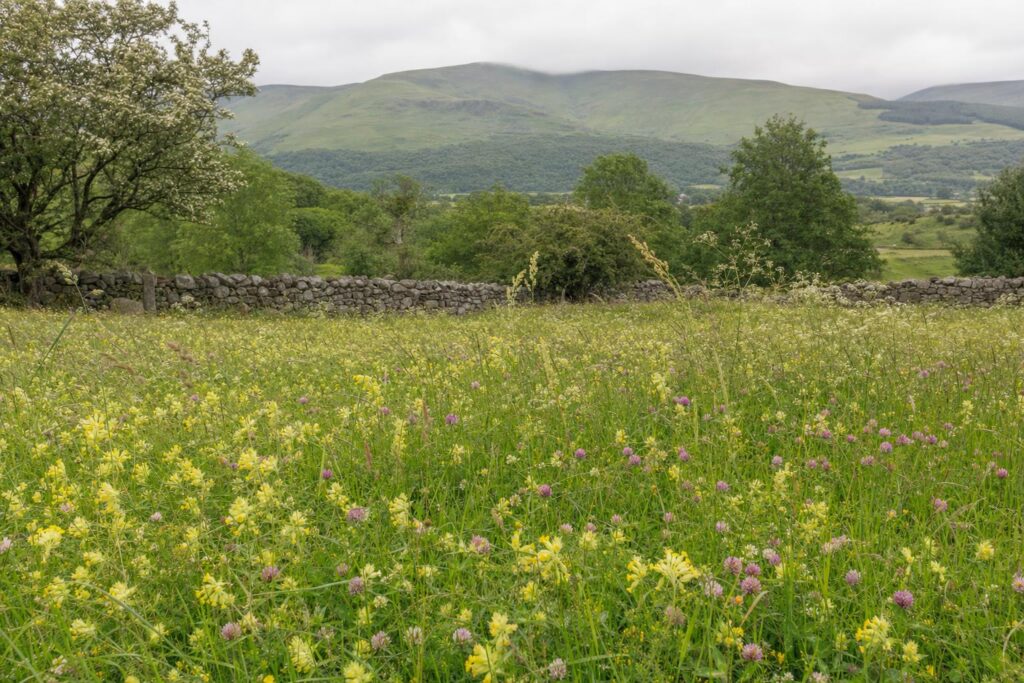
Wildflower Seeds for Montgomeryshire: Native Mixes for the Cambrian Uplands and Severn Valley
Wildflower Seeds for Montgomeryshire: Native Mixes for the Cambrian Uplands and Severn Valley
Montgomeryshire runs from the acid, peaty Cambrian uplands in the west — the source of the Severn, Wye and Rheidol — down through the broad Severn Valley around Welshpool and Newtown, with occasional pockets of base-rich ground on the Long Mountain and Breidden Hills near the English border. Choosing wildflower seeds for Montgomeryshire means recognising which of these very different landscapes your ground actually belongs to.
It’s also worth knowing, before you start, that Wales doesn’t regulate biodiversity the way England does. There’s no mandatory 10% metric here — Welsh planning policy takes a different, case-by-case approach, and it matters for anyone planning a larger habitat project. More on that below.
Understanding Montgomeryshire’s soils before you sow
Montgomeryshire’s bedrock falls into a few clear zones that map directly onto seed mix choice.
The Cambrian and Berwyn uplands
The western and northwestern part of the county — including Pumlumon and the Llanbrynmair Forest area — sits within the wider Cambrian Mountains massif, the source of the Severn, Wye and Rheidol rivers. Soils here are acid and often peaty over Ordovician and Silurian mudstones and shales; an acidic soils mix is the right starting point on this upland fringe.
The Severn Valley
The broad, glacially shaped valley around Welshpool and Newtown sits on Silurian slate, shale and mudstone, with seasonally wet, silty floodplain soils along the river itself — regularly flooded in winter, especially near Welshpool. A general-purpose neutral grassland mix suits the drier valley-side ground, while genuinely wet floodplain pockets do better with a wetland and pond mix.
Long Mountain, the Breidden Hills and calcareous pockets
Along the Welsh-English border, and scattered through the uplands above roughly 300 metres, small pockets of base-rich ground occur where limestone, certain sandstones and volcanic rock create locally calcareous soil amid otherwise acid uplands. Where you find this ground, a chalk and limestone mix is worth considering rather than defaulting to an acid mix across the whole holding.
Choosing the right wildflower seeds for Montgomeryshire’s habitats
Montgomeryshire’s lowland meadows have declined as sharply as everywhere else in Britain — species-rich floodplain meadow is down roughly 97% nationally since 1935, with only around 200 sites and 3,000 hectares surviving UK-wide. Where it does survive locally, expect cuckoo flower, meadow buttercup, oxeye daisy and great burnet on wetter ground, cowslip, red clover and lady’s bedstraw on drier sites, and meadow pipit and skylark overhead.
Roundton Hill, a 44-hectare National Nature Reserve near Churchstoke managed by Montgomeryshire Wildlife Trust, is a good local benchmark for what traditional hay-meadow management can preserve: a late cut followed by aftermath grazing with cattle and sheep has kept over 300 nationally and locally significant species on site, including carline thistle and rock stonecrop on old mine ground. Above around 650 metres in the uplands, rarer arctic-alpine species such as globeflower and roseroot survive on ungrazed rock ledges, alongside the scarce northern brown argus butterfly.
At landscape scale, Wilder Marches — launched in 2023 by four Wildlife Trusts spanning Montgomeryshire, Radnorshire, Shropshire and Herefordshire — covers around 100,000 hectares across the Welsh-English border, working to restore peatlands, native woodland and grassland, rehabilitate river floodplains, and support conservation grazing with native breeds across the Lugg, Teme and Clun headwaters. It builds on the longer-running Pumlumon Project, which Montgomeryshire Wildlife Trust has led since 2007 across 40,000 hectares of the Cambrian Mountains, working directly with more than 20 farm businesses on peatbog preservation and grassland improvement.
A recent example of habitat creation in the county: a new pond connected to the Montgomery Canal — itself a Special Area of Conservation protecting exceptionally rich aquatic plant communities — was completed at Wern, near Welshpool, in December 2024, built specifically to support the protected floating water-plantain. It’s a small-scale but telling sign of the kind of targeted, species-specific habitat work now happening across Montgomeryshire’s wetter valley ground, alongside the meadow and grassland restoration described above.
Sowing wildflower seeds in Montgomeryshire: timing and ground preparation
Autumn sowing, ideally August to October, is the standard optimal window across Montgomeryshire. Our guide to why Yellow Rattle is essential for wildflower meadows explains why species like Yellow Rattle (Rhinanthus minor) need a proper winter chill.
Most Montgomeryshire pasture, particularly improved lowland fields in the Severn Valley, will need fertility reduction before a wildflower mix stands a chance — cropping, turf removal, or several years of hay-cutting without fertiliser first. Yellow Rattle is essential on any existing grass sward for exactly this reason, opening ground for wildflowers by suppressing vigorous rye-grass. Our guide to establishing a wildflower meadow and note on the best times to sow cover the general sequence in more depth.
Managing your Montgomeryshire wildflower meadow long-term
As with most of Britain, budget three years for a Montgomeryshire meadow to reach its full potential: root and leaf growth in year one, a partial flowering display in year two, and a proper sward from year three onward. An annual late-summer cut with arisings removed, followed by aftermath grazing where you can manage it — the Roundton Hill model — is the backbone of long-term management across the county.
On upland acid grassland and moorland-fringe ground, the main long-term task is usually maintaining grazing pressure to stop the sward reverting to rush or scrub. In the Severn Valley, ongoing attention to drainage and fertility matters more, particularly on land that’s been intensively farmed in recent decades.
Wildflower seeds for larger-scale projects and biodiversity in Montgomeryshire
Wales handles biodiversity policy differently from England, and it’s worth understanding the distinction before planning a larger Montgomeryshire project. There is no mandatory 10% Biodiversity Net Gain metric here. Instead, Powys County Council states plainly that all planning approvals in Powys must deliver a Net Benefit for Biodiversity, under the Environment (Wales) Act 2016’s Section 6 duty and Planning Policy Wales. Rather than a fixed percentage uplift, applicants must avoid harm where possible, mitigate or compensate what can’t be avoided, and enhance the site — judged case by case rather than against a metric. For smaller applications, Powys publishes practical guidance on measures requiring no ecological expertise: native and pollinator planting, hedgerow and tree planting, pond creation and reduced-mowing regimes are all specifically named.
The Powys Nature Recovery Action Plan, developed with the Powys Nature Partnership, structures local conservation effort around seven habitat types including grassland specifically, while the Natural Resources Wales Mid Wales Area Statement — covering Powys and Ceredigion, including Montgomeryshire — identifies farming as central to the area’s character and biodiversity outcomes alike. For farmers, the Sustainable Farming Scheme, starting January 2026, requires at least 10% of each holding to be actively managed habitat, calculated across semi-natural habitat, woodland, hedgerows and temporary habitat combined — and critically, this can include newly created temporary habitat such as wildlife margins or mixed leys, making wildflower seed a direct, practical route to meeting the requirement on livestock and upland holdings that may be short of qualifying semi-natural habitat. Renewable energy development is the main growth pressure locally, with wind farm proposals including a resubmitted scheme at Llanbrynmair Forest creating planning-linked demand for habitat enhancement under Powys’s Net Benefit for Biodiversity policy. Our guide to wildflower seeds for Biodiversity Net Gain beyond the baseline and our civic institutions page may be useful for public-body projects responding to the Section 6 duty directly.
Locally sourced wildflower seeds for Montgomeryshire
Wildahome’s seed is harvested from donor meadows in Devon and Powys — Powys sits right at the heart of Montgomeryshire, giving genuinely close climatic and soil-chemistry compatibility with much of the county’s upland and valley ground. What matters most is that the seed suits Montgomeryshire’s actual range of conditions, from Cambrian upland acid ground to Severn Valley floodplain, rather than proximity alone. Read more about why locally sourced wildflower seeds really matter.
For larger or mixed-soil Montgomeryshire sites — land spanning upland and valley ground, or a habitat project responding to Net Benefit for Biodiversity requirements — our bespoke wildflower seed mixes service builds a blend around your actual site survey.
Ready to choose the right mix?
Whether you’re restoring upland grassland in the Cambrian Mountains, managing Severn Valley pasture, or planning habitat enhancement for a Montgomeryshire development, matching the mix to your ground is the decision everything else depends on. Browse our full range of wildflower seed mixes, explore our advice section, or get in touch if your site needs a bespoke approach.
Frequently Asked Questions
What are the best wildflower seeds for Montgomeryshire?
It depends on which part of the county you’re in. The Cambrian and Berwyn uplands in the west suit an acidic soils mix; the Severn Valley around Welshpool and Newtown suits a general neutral grassland mix on drier ground, or a wetland and pond mix on genuinely damp floodplain; and calcareous pockets on Long Mountain and the Breidden Hills suit a chalk and limestone mix. There’s no single mix that fits every Montgomeryshire site.
When should I sow wildflower seeds in Montgomeryshire?
Autumn, ideally August to October, is the standard optimal window — it lets seed go through a proper winter chill before germinating, which species like Yellow Rattle need across all of Montgomeryshire’s soil types.
Does Montgomeryshire have a mandatory Biodiversity Net Gain requirement like England?
No. Wales does not use England’s mandatory 10% Biodiversity Net Gain metric. Instead, Powys County Council requires all planning approvals to deliver a Net Benefit for Biodiversity, under Planning Policy Wales and the Environment (Wales) Act 2016’s Section 6 duty — a case-by-case approach based on avoiding, mitigating and compensating harm, rather than a fixed percentage uplift.
What is the Sustainable Farming Scheme and does it affect Montgomeryshire farmers?
The Sustainable Farming Scheme (SFS) is Wales’s successor to Glastir and the Basic Payment Scheme, starting January 2026. It requires at least 10% of a holding to be active habitat, calculated across semi-natural habitat, woodland, hedgerows and temporary habitat combined — a requirement that applies broadly across Montgomeryshire’s predominantly livestock and upland farms, and one that newly created wildflower habitat can help meet directly.
Can wildflowers grow on Montgomeryshire’s upland acid ground?
Yes, with the right mix. The Cambrian and Berwyn uplands are naturally acid and low-nutrient, which actually favours wildflower establishment over grass once a sward is opened up — an acidic soils mix, with Yellow Rattle to suppress competitive grass, is the right starting point rather than a general-purpose or chalk-suited blend.
Is Montgomeryshire seed the same as seed from other counties?
Not exactly, but it’s closely matched. Wildahome’s seed is harvested from donor meadows in Devon and Powys — Powys sits at the heart of Montgomeryshire — then selected specifically as wildflower seeds for the county’s upland-to-valley soil range, rather than sold as one generic UK mix. For most gardens, paddocks and habitat projects, that regional matching gives noticeably better establishment than seed with no connection to local conditions.
How long does it take to establish a wildflower meadow in Montgomeryshire?
Budget three years for a proper result across most of the county: mostly root and leaf growth in year one, a partial flowering display in year two, and a full meadow from year three onward. Improved lowland pasture in the Severn Valley, in particular, tests patience — don’t judge a new meadow’s success by its first summer alone.
Ready to get started?
Shop: Traditional Wildflower Meadow Mix →Frequently asked questions
What are the best wildflower seeds for Montgomeryshire?
It depends on which part of the county you're in. The Cambrian and Berwyn uplands in the west suit an acidic soils mix; the Severn Valley around Welshpool and Newtown suits a general neutral grassland mix on drier ground, or a wetland and pond mix on genuinely damp floodplain; and calcareous pockets on Long Mountain and the Breidden Hills suit a chalk and limestone mix. There's no single mix that fits every Montgomeryshire site.
When should I sow wildflower seeds in Montgomeryshire?
Autumn, ideally August to October, is the standard optimal window — it lets seed go through a proper winter chill before germinating, which species like Yellow Rattle need across all of Montgomeryshire's soil types.
Does Montgomeryshire have a mandatory Biodiversity Net Gain requirement like England?
No. Wales does not use England's mandatory 10% Biodiversity Net Gain metric. Instead, Powys County Council requires all planning approvals to deliver a Net Benefit for Biodiversity, under Planning Policy Wales and the Environment (Wales) Act 2016's Section 6 duty — a case-by-case approach based on avoiding, mitigating and compensating harm, rather than a fixed percentage uplift.
What is the Sustainable Farming Scheme and does it affect Montgomeryshire farmers?
The Sustainable Farming Scheme (SFS) is Wales's successor to Glastir and the Basic Payment Scheme, starting January 2026. It requires at least 10% of a holding to be active habitat, calculated across semi-natural habitat, woodland, hedgerows and temporary habitat combined — a requirement that applies broadly across Montgomeryshire's predominantly livestock and upland farms, and one that newly created wildflower habitat can help meet directly.
Can wildflowers grow on Montgomeryshire's upland acid ground?
Yes, with the right mix. The Cambrian and Berwyn uplands are naturally acid and low-nutrient, which actually favours wildflower establishment over grass once a sward is opened up — an acidic soils mix, with Yellow Rattle to suppress competitive grass, is the right starting point rather than a general-purpose or chalk-suited blend.
Is Montgomeryshire seed the same as seed from other counties?
Not exactly, but it's closely matched. Wildahome's seed is harvested from donor meadows in Devon and Powys — Powys sits at the heart of Montgomeryshire — then selected specifically as wildflower seeds for the county's upland-to-valley soil range, rather than sold as one generic UK mix. For most gardens, paddocks and habitat projects, that regional matching gives noticeably better establishment than seed with no connection to local conditions.
How long does it take to establish a wildflower meadow in Montgomeryshire?
Budget three years for a proper result across most of the county: mostly root and leaf growth in year one, a partial flowering display in year two, and a full meadow from year three onward. Improved lowland pasture in the Severn Valley, in particular, tests patience — don't judge a new meadow's success by its first summer alone.
More county guides
Find the right native wildflower mix for your county, or browse our full list by region.