

Wildflower Seeds for Rutland: Native Mixes for England’s Smallest County
Wildflower Seeds for Rutland: Native Mixes for England’s Smallest County
Rutland packs two genuinely different soil stories into just 382 square kilometres. Free-draining Jurassic limestone dominates the east of the county, around Ketton, Clipsham, Pickworth and Greetham, historically quarried for building stone and now expressed as some of the East Midlands’ best surviving calcareous grassland. The centre of the county, around Oakham, sits on the heavier clay of the Vale of Catmose. And at its heart, Rutland Water — England’s largest reservoir by surface area — anchors a wetland and grassland mosaic unlike anywhere else nearby. Choosing wildflower seeds for Rutland starts with knowing which of these grounds you’re working with.
Rutland’s own council has flagged a genuine local opportunity: no confirmed operating Biodiversity Net Gain habitat bank currently sits within the county, even as development pressure and a 215-acre solar farm on the county boundary drive real demand for habitat creation. For a landowner with suitable ground, that’s a gap worth knowing about.
Understanding Rutland’s soils before you sow
Rutland’s ground runs, broadly, from limestone in the east to clay in the centre, with the reservoir basin sitting between.
The Jurassic limestone belt
Buff-cream oolitic limestone outcrops around Ketton, Clipsham, Pickworth, Greetham, North Luffenham and Tolethorpe, historically quarried as Ketton stone and now home to species-rich calcareous grassland on old quarry ground and roadside verges. A chalk and limestone mix is the natural fit here.
The Vale of Catmose
Central Rutland, where Oakham sits, is the county’s clay lowland — heavier, wetter ground than the eastern limestone uplands. A heavy clay mix suits this ground, and needs more patience to establish.
Rutland Water and its margins
The reservoir sits over Lias clay overlain by oolite-group limestone, with grassland grazed by Hebridean sheep and Dexter cattle around its shores. Land near the reservoir margins and along the county’s floodplain meadows — Seaton Meadows, Empingham Marshy Meadows — suits a wetland and pond mix where ground stays genuinely damp.
Choosing the right wildflower seeds for Rutland’s habitats
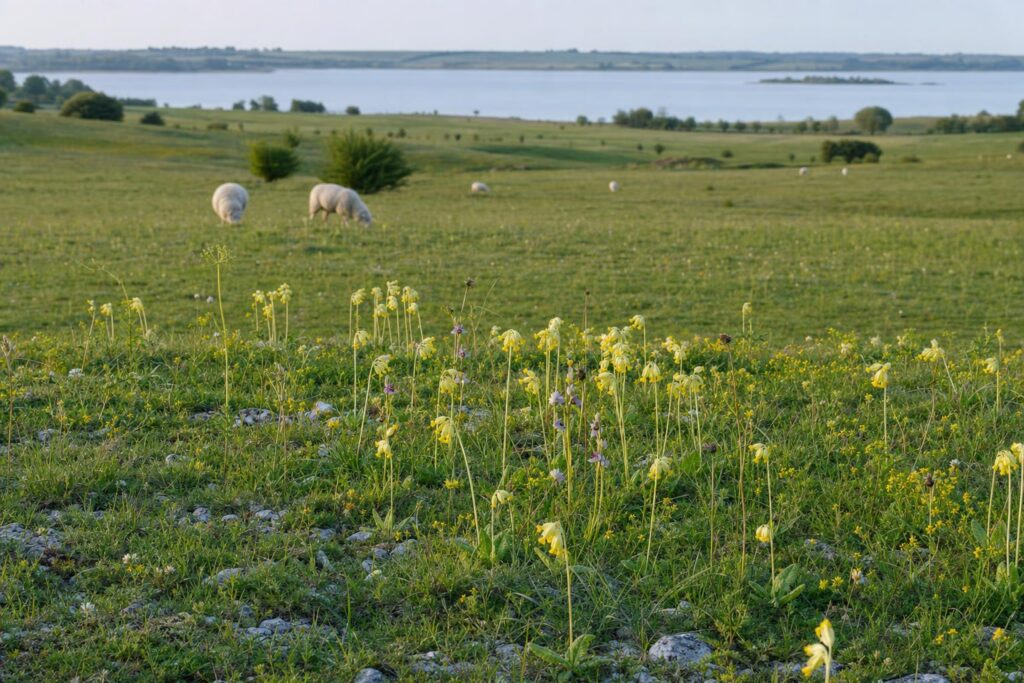
Rutland’s calcareous grassland survives mainly on old quarry ground and road verges, and it’s remarkably rich for its scale. Ketton Quarry, a 28-hectare Wildlife Trust reserve on former limestone workings, holds bee orchid, cowslip, yellow-wort, autumn gentian and the county’s only yellow bird’s-nest colony, alongside marbled white and grizzled skipper butterflies, managed with Herdwick and Hebridean sheep grazing. Greetham Meadows, a 12.4-hectare SSSI, preserves classic ridge-and-furrow hay meadow with frog orchid, crested dog’s-tail and upright brome — a good reference for what patient, low-input management on clay-influenced ground can achieve.
Rutland Water itself is internationally significant — a Ramsar site and Special Protection Area holding around 4% of the European population of gadwall and over 200 recorded bird species. The clearest large-scale restoration example in the county is the habitat creation scheme delivered by Anglian Water and the Leicestershire and Rutland Wildlife Trust, completed in 2011: 240 acres of reserve expansion, nine new shallow-water lagoons, islands and scrapes, with ongoing grazing management maintaining the grassland-wetland mosaic ever since. Island reprofiling work has continued into 2024 and 2025, underlining that this is a maintained landscape, not a one-off project.
One site worth knowing about directly: St George’s Barracks, a former MOD site near North Luffenham, holds around 38% of Rutland’s total calcareous grassland supply — a striking concentration of the county’s most valuable grassland resource on land whose future use has been debated for years.
Clipsham Old Quarry and Pickworth Great Wood, a 111-hectare SSSI near the Lincolnshire border, pairs limestone grassland with one of the county’s largest deciduous woods, recording over 150 moth species — a good illustration of how Rutland’s smaller limestone sites punch well above their size ecologically. Rutland Water’s own three priority landscapes, as set out in the council’s biodiversity duty report, map neatly onto this article’s soil zones: the reservoir wetland, the eastern Jurassic limestone, and Leighfield Forest’s 594 hectares of ancient woodland in the southwest.
Sowing wildflower seeds in Rutland: timing and ground preparation
Autumn sowing, ideally August to October, is the standard optimal window for Rutland, and it works well for a slightly different reason on each of the county’s soils. On the free-draining eastern limestone, which dries out fast in summer, autumn establishment reduces drought risk to seedlings. On the heavier Vale of Catmose clay, autumn sowing avoids trying to work wet ground in spring. Our guide to why Yellow Rattle is essential for wildflower meadows explains its role in suppressing competitive grass.
Rutland’s limestone ground is often naturally low-fertility already — a genuine advantage, needing minimal soil stripping before sowing. Clay vale ground and former arable land need more preparation: topsoil removal or several seasons of cropping off without fertiliser before wildflowers will compete successfully with grass. Our guide to establishing a wildflower meadow and note on the best times to sow cover the general sequence in more depth.
Managing your Rutland wildflower meadow long-term
Budget three years for a Rutland meadow to reach its full potential: modest growth in year one, a partial flowering display in year two, and a proper sward from year three onward. An annual late-summer cut with arisings removed is the backbone of long-term management on both soil types.
Rutland County Council’s own approach to its road verges is a useful real-world model: a three-cut annual regime that protects wildflower seeding, with earlier, more specialised cutting on SSSI verges agreed with Natural England, and ragwort managed on a risk basis rather than blanket eradication in recognition of its pollinator value. On floodplain and reservoir-margin sites, grazing with hardy breeds — as used around Rutland Water itself — keeps swards open and prevents scrub encroachment more effectively than cutting alone.
Wildflower seeds for larger-scale projects and Biodiversity Net Gain in Rutland
Rutland County Council applies the mandatory England-wide 10% Biodiversity Net Gain requirement to qualifying developments, calculated against the statutory biodiversity metric and secured for a minimum of 30 years. The county’s emerging Local Plan proposes going further, to 15%, on the basis that a county-wide study found a shortage of biodiverse-rich habitat locally and that higher net gain is realistically deliverable on Rutland sites. As of the council’s most recent biodiversity duty report, 35 BNG-applicable planning applications had been received and 9 approved with monitoring secured — but no dedicated, publicly listed habitat bank currently operates within Rutland itself, with the council actively working to develop in-county provision rather than see that investment go elsewhere.
The joint Leicestershire, Leicester and Rutland Local Nature Recovery Strategy was published in August 2025, translated locally into 81 integrated measures. Solar development is a live driver of demand here too: a 215-acre solar farm on Stygate Lane, straddling the Rutland-Leicestershire border, was approved by Rutland County Council in January 2026 with the developer committed to over 50% biodiversity net gain through the scheme’s design. For farmers, it’s worth knowing that species-rich grassland management has moved out of the standard Sustainable Farming Incentive and into Countryside Stewardship’s invitation-only Higher Tier — Rutland’s own council notes that most agricultural grant schemes have recently closed, so check current eligibility rather than assuming a route is open. Our guide to wildflower seeds for Biodiversity Net Gain beyond the baseline and our housing and development page cover sourcing seed for projects at this scale.
Locally sourced wildflower seeds for Rutland
Wildahome’s seed is harvested from donor meadows in Devon and Powys, then selected specifically as wildflower seeds for Rutland’s limestone-to-clay soil range and the East Midlands’ climate, rather than sold as one generic UK mix. For most gardens, paddocks and BNG sites, that regional matching gives noticeably better establishment than seed with no connection to the county’s conditions at all. Read more about why locally sourced wildflower seeds really matter.
For larger or mixed-soil Rutland sites — land spanning limestone and Vale of Catmose clay, or a habitat project responding to Biodiversity Net Gain requirements — our bespoke wildflower seed mixes service builds a blend around your actual site survey.
Ready to choose the right mix?
Whether you’re restoring calcareous grassland on Rutland’s eastern limestone, converting clay pasture in the Vale of Catmose, or planning habitat enhancement near Rutland Water, matching the mix to your ground is the decision everything else depends on. Browse our full range of wildflower seed mixes, explore our advice section, or get in touch if your site needs a bespoke approach.
Frequently Asked Questions
What are the best wildflower seeds for Rutland?
It depends on which part of the county you’re in. The Jurassic limestone belt in the east, around Ketton and Clipsham, suits a chalk and limestone mix; the Vale of Catmose clay around Oakham needs a heavy clay mix; and ground near Rutland Water’s margins or the county’s floodplain meadows does better with a wetland and pond mix. There’s no single mix that fits every Rutland site.
When should I sow wildflower seeds in Rutland?
Autumn, ideally August to October, is the standard window across the county — it reduces drought risk on the free-draining eastern limestone and avoids working wet clay in the Vale of Catmose. Ground should be genuinely workable, not waterlogged, when you sow.
Is there a BNG habitat bank in Rutland?
Not yet confirmed operating within the county, as of Rutland County Council’s most recent biodiversity duty report. The council is actively developing in-county provision to stop investment going to habitat banks elsewhere — which means a genuine, current opportunity for Rutland landowners with suitable land to establish one.
What is Rutland’s biodiversity net gain requirement?
Rutland County Council applies the England-wide mandatory 10% biodiversity net gain to qualifying developments, calculated against the statutory biodiversity metric and secured for at least 30 years. The county’s emerging Local Plan proposes going further, to 15%, based on a county-wide study finding a shortage of biodiverse-rich habitat locally.
Can I get funding to create a wildflower meadow in Rutland?
It’s worth checking current eligibility carefully. Species-rich grassland management has moved out of the standard Sustainable Farming Incentive and into Countryside Stewardship’s invitation-only Higher Tier, and Rutland’s own council notes that many agricultural grant schemes have recently closed. Biodiversity Net Gain-linked routes, where your land qualifies, are increasingly the more reliable funding path.
Is Rutland seed the same as seed from other counties?
Not exactly, but it’s closely matched. Wildahome’s seed is harvested from donor meadows in Devon and Powys, then selected specifically as wildflower seeds for Rutland’s limestone-to-clay soil range and the East Midlands’ climate, rather than sold as one generic UK mix. For most gardens, paddocks and BNG sites, that regional matching gives noticeably better establishment than seed with no connection to the county’s conditions at all.
How long does it take to establish a wildflower meadow in Rutland?
Budget three years for a proper result, whichever part of Rutland you’re in: modest growth in year one, a partial flowering display in year two, and a proper sward from year three onward. Vale of Catmose clay ground in particular tests patience — don’t judge a new meadow’s success by its first summer alone.
Ready to get started?
Shop: Traditional Wildflower Meadow Mix →Frequently asked questions
What are the best wildflower seeds for Rutland?
It depends on which part of the county you're in. The Jurassic limestone belt in the east, around Ketton and Clipsham, suits a chalk and limestone mix; the Vale of Catmose clay around Oakham needs a heavy clay mix; and ground near Rutland Water's margins or the county's floodplain meadows does better with a wetland and pond mix. There's no single mix that fits every Rutland site.
When should I sow wildflower seeds in Rutland?
Autumn, ideally August to October, is the standard window across the county — it reduces drought risk on the free-draining eastern limestone and avoids working wet clay in the Vale of Catmose. Ground should be genuinely workable, not waterlogged, when you sow.
Is there a BNG habitat bank in Rutland?
Not yet confirmed operating within the county, as of Rutland County Council's most recent biodiversity duty report. The council is actively developing in-county provision to stop investment going to habitat banks elsewhere — which means a genuine, current opportunity for Rutland landowners with suitable land to establish one.
What is Rutland's biodiversity net gain requirement?
Rutland County Council applies the England-wide mandatory 10% biodiversity net gain to qualifying developments, calculated against the statutory biodiversity metric and secured for at least 30 years. The county's emerging Local Plan proposes going further, to 15%, based on a county-wide study finding a shortage of biodiverse-rich habitat locally.
Can I get funding to create a wildflower meadow in Rutland?
It's worth checking current eligibility carefully. Species-rich grassland management has moved out of the standard Sustainable Farming Incentive and into Countryside Stewardship's invitation-only Higher Tier, and Rutland's own council notes that many agricultural grant schemes have recently closed. Biodiversity Net Gain-linked routes, where your land qualifies, are increasingly the more reliable funding path.
Is Rutland seed the same as seed from other counties?
Not exactly, but it's closely matched. Wildahome's seed is harvested from donor meadows in Devon and Powys, then selected specifically as wildflower seeds for Rutland's limestone-to-clay soil range and the East Midlands' climate, rather than sold as one generic UK mix. For most gardens, paddocks and BNG sites, that regional matching gives noticeably better establishment than seed with no connection to the county's conditions at all.
How long does it take to establish a wildflower meadow in Rutland?
Budget three years for a proper result, whichever part of Rutland you're in: modest growth in year one, a partial flowering display in year two, and a proper sward from year three onward. Vale of Catmose clay ground in particular tests patience — don't judge a new meadow's success by its first summer alone.
More county guides
Find the right native wildflower mix for your county, or browse our full list by region.