

Wildflower Seeds for Merseyside: Native Mixes for Sand Dunes, the Mersey Fringe and Urban Liverpool
Wildflower Seeds for Merseyside: Native Mixes for Sand Dunes, the Mersey Fringe and Urban Liverpool
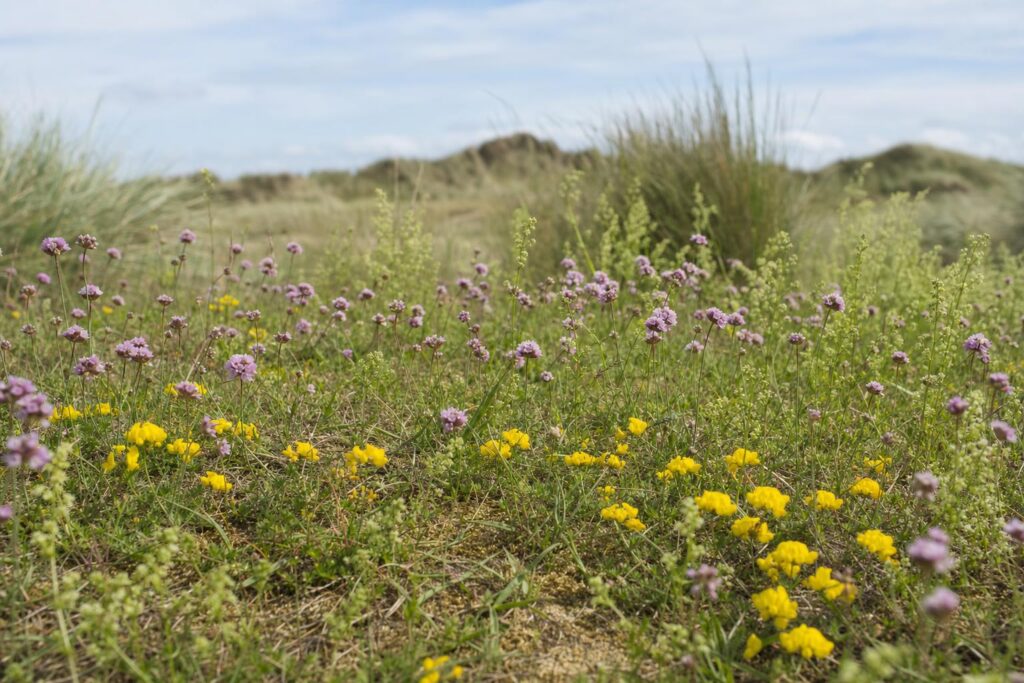
Merseyside’s defining habitat sits along its coast rather than inland. The Sefton coast, running roughly twenty kilometres between Liverpool and Southport, holds the largest sand dune system in England — a genuinely internationally important landscape. Inland, the county is largely urban, built on the Mersey estuary’s clay and, on the Wirral peninsula, a sandstone ridge that gives noticeably different ground to the low-lying city either side of it. Choosing wildflower seeds for Merseyside means recognising that most of the county’s land is built-up, and that its most ecologically valuable habitat needs a genuinely different approach from a standard meadow mix.
It’s worth being upfront: the Sefton coast’s dune grassland and dune slacks are internationally significant, supporting around 40% of Britain’s entire natterjack toad population alongside sand lizards and the northern dune tiger beetle. Active dune and dune-heath restoration there is specialist conservation work, led by Natural England and the National Trust, not something a standard wildflower mix replaces. What that does tell you is how well low-nutrient, free-draining sandy ground performs for wildflowers generally — a lesson worth applying to any Merseyside site with similar sandy soil, well away from the protected dune system itself.
Understanding Merseyside’s ground before you sow
Merseyside splits into three practical zones: sandy coastal ground, the Wirral sandstone ridge, and the urban Mersey basin.
Sandy coastal ground
Away from the protected core of the Sefton dune system, land with genuinely sandy, free-draining, low-nutrient soil — found in pockets along the wider Merseyside coast and on former sandy heath inland of the dunes — suits a general-purpose neutral grassland mix well, and often establishes faster than heavier ground precisely because it’s already low-fertility.
The Wirral sandstone ridge
Running down the spine of the Wirral peninsula, this gives lighter, better-drained ground than the surrounding clay lowland, generally suited to a standard neutral grassland mix rather than anything specialist.
Urban Liverpool and the Mersey basin
Most of Merseyside’s land, and most practical wildflower projects, sit in this zone: gardens, parks, verges and community green space on the clay and disturbed ground typical of a major estuary city. A heavy clay mix suits open ground with genuine clay soil, while a wildflower seed mat often works better on smaller or heavily disturbed urban plots.
Choosing the right wildflower seeds for Merseyside’s habitats
The Sefton coast’s Dynamic Dunescapes project is the clearest large-scale restoration story in the county, working across the Ainsdale Sand Dunes National Nature Reserve, managed by Natural England, and the National Trust’s Formby site. The project has rejuvenated over 23 hectares of bare sand habitat by clearing dense, stabilising vegetation that had encroached on the dune system, alongside more than half a hectare of dune slack wetland restoration and the removal of roughly 6 hectares of invasive Japanese rose. Dune heath — an exceptionally rare habitat that takes around 300 years of natural acidification from seashell lime to develop properly — is also being actively restored here, one of only a handful of sites in the country where this work is happening at all. The scale of what’s at stake is significant: this single stretch of coast supports around 40% of Britain’s natterjack toads, alongside sand lizards and the nationally scarce northern dune tiger beetle, and is recognised as one of the most important dune habitats in north-west Europe.
For anyone with sandy ground near the Merseyside coast but outside the protected dune system, that context is genuinely useful: it confirms that low-nutrient, free-draining sandy soil supports remarkably rich plant and invertebrate communities when it’s managed with a light touch rather than fertilised or intensively mown. A standard wildflower mix on comparable sandy ground inland of the protected dunes can build toward something in that spirit, even if it will never replicate the dune system’s specialist rarities.
Sowing wildflower seeds in Merseyside: timing and ground preparation
Autumn sowing, ideally August to October, is the standard optimal window across Merseyside, and the county’s coastal, maritime-influenced climate tends to give slightly milder autumns than inland Lancashire and Greater Manchester. On sandy coastal ground and the Wirral ridge, autumn sowing reduces the drought risk to seedlings from free-draining soil drying out in a warm spell. On heavier Mersey basin clay, it avoids working wet ground in spring. Our guide to why Yellow Rattle is essential for wildflower meadows explains its role in suppressing competitive grass, particularly useful on previously fertilised urban turf.
Sandy coastal and Wirral ridge ground is often naturally low-fertility already, needing minimal preparation before sowing. Urban Mersey basin ground usually needs more work: dealing with compaction, poor or imported topsoil and buried debris before sowing into open ground, or using a seed mat where full preparation isn’t practical. Our guide to establishing a wildflower meadow and note on the best times to sow cover the general sequence in more depth.
Managing your Merseyside wildflower meadow long-term
Budget three years for a proper result on any Merseyside site: modest establishment growth in year one, a partial flowering display in year two, and a full meadow from year three onward. An annual late-summer cut with arisings removed is the backbone of long-term management, whether that’s a garden meadow, a community green space or a managed verge.
Close to the coast, be mindful of the sensitivity of the dune system nearby — avoid introducing seed near the protected dune boundary itself, and be aware that sand lizards, natterjack toads and ground-nesting birds can use adjacent land seasonally. Elsewhere in the county, the standard rule applies everywhere: resist fertilising, and always remove what you cut rather than leaving it to rot down and re-enrich the soil.
Wildflower seeds for larger-scale projects and Biodiversity Net Gain in Merseyside
All Merseyside local authorities apply the mandatory England-wide 10% Biodiversity Net Gain requirement to qualifying developments, in force for major developments since February 2024 and small sites since April 2024, secured against the statutory biodiversity metric for a minimum of 30 years. The Liverpool City Region Combined Authority and the Merseyside Environmental Advisory Service both provide supporting guidance for developers working across the city region, helping keep BNG assessment consistent across borough boundaries in a way that matters for any project spanning more than one Merseyside authority.
Given how built-up much of Merseyside is, off-site BNG delivery is often the realistic route for developers, and land at the county’s rural edges — including sandy ground inland of the protected dune system and pasture on the Wirral ridge — is well placed to deliver it. Our guide to wildflower seeds for Biodiversity Net Gain beyond the baseline and our housing and development page cover sourcing seed for projects at this scale.
Locally sourced wildflower seeds for Merseyside
Wildahome’s seed is harvested from donor meadows in Devon and Powys, then selected specifically as wildflower seeds for Merseyside’s sandy-to-clay soil range and the North West’s coastal climate, rather than sold as one generic UK mix. For most gardens, community spaces and BNG sites, that regional matching gives noticeably better establishment than seed with no connection to local conditions at all. Read more about why locally sourced wildflower seeds really matter.
For larger or mixed-ground Merseyside sites — land near the coast, or a habitat scheme responding to Biodiversity Net Gain requirements — our bespoke wildflower seed mixes service builds a blend around your actual site survey.
Ready to choose the right mix?
Whether you’re sowing a small urban garden meadow in Liverpool, working with sandy coastal ground inland of the Sefton dunes, or establishing meadow on the Wirral ridge, matching the mix to your ground is the decision everything else depends on. Browse our full range of wildflower seed mixes, explore our advice section, or get in touch if your site needs a bespoke approach.
Frequently Asked Questions
What are the best wildflower seeds for Merseyside?
It depends on your ground. Sandy coastal soil inland of the protected dune system and the Wirral sandstone ridge suit a general-purpose neutral grassland mix; most urban Liverpool gardens, parks and verges with genuine clay soil need a heavy clay mix, and a wildflower seed mat often works better on smaller, disturbed urban plots.
Can I sow wildflowers on the Sefton coast sand dunes?
No — the dunes and dune slacks are a Site of Special Scientific Interest of international importance, actively managed by Natural England and the National Trust as specialist conservation habitat supporting around 40% of Britain’s natterjack toads. Land inland of the protected dune boundary, with genuinely sandy soil, is a better fit for a standard wildflower mix.
When should I sow wildflower seeds in Merseyside?
Autumn, ideally August to October, is the standard window, and Merseyside’s coastal climate tends to give slightly milder autumns than inland Lancashire and Greater Manchester, extending the workable sowing period a little.
Does Merseyside have a mandatory Biodiversity Net Gain requirement?
Yes. All Merseyside local authorities apply the England-wide mandatory 10% Biodiversity Net Gain requirement, supported by guidance from the Liverpool City Region Combined Authority and the Merseyside Environmental Advisory Service to keep assessment consistent across the city region.
What’s the best way to sow wildflowers on a small urban plot in Merseyside?
A wildflower seed mat is often more reliable than loose seed on the compacted or disturbed soil typical of much of urban Liverpool and the wider Mersey basin, since it holds seed in direct contact with the ground and offers some protection while it establishes.
Is Merseyside seed the same as seed from other counties?
Not exactly, but it’s closely matched. Wildahome’s seed is harvested from donor meadows in Devon and Powys, then selected specifically as wildflower seeds for Merseyside’s sandy-to-clay soil range and the North West’s coastal climate, rather than sold as one generic UK mix.
How long does it take to establish a wildflower meadow in Merseyside?
Budget three years for a proper result: modest growth in year one, a partial flowering display in year two, and a full meadow from year three onward. Don’t judge a new Merseyside meadow’s success by its first summer alone, whether it’s a garden plot or a managed verge.
Ready to get started?
Shop: Traditional Wildflower Meadow Mix →Frequently asked questions
What are the best wildflower seeds for Merseyside?
It depends on your ground. Sandy coastal soil inland of the protected dune system and the Wirral sandstone ridge suit a general-purpose neutral grassland mix; most urban Liverpool gardens, parks and verges with genuine clay soil need a heavy clay mix, and a wildflower seed mat often works better on smaller, disturbed urban plots.
Can I sow wildflowers on the Sefton coast sand dunes?
No — the dunes and dune slacks are a Site of Special Scientific Interest of international importance, actively managed by Natural England and the National Trust as specialist conservation habitat supporting around 40% of Britain's natterjack toads. Land inland of the protected dune boundary, with genuinely sandy soil, is a better fit for a standard wildflower mix.
When should I sow wildflower seeds in Merseyside?
Autumn, ideally August to October, is the standard window, and Merseyside's coastal climate tends to give slightly milder autumns than inland Lancashire and Greater Manchester, extending the workable sowing period a little.
Does Merseyside have a mandatory Biodiversity Net Gain requirement?
Yes. All Merseyside local authorities apply the England-wide mandatory 10% Biodiversity Net Gain requirement, supported by guidance from the Liverpool City Region Combined Authority and the Merseyside Environmental Advisory Service to keep assessment consistent across the city region.
What's the best way to sow wildflowers on a small urban plot in Merseyside?
A wildflower seed mat is often more reliable than loose seed on the compacted or disturbed soil typical of much of urban Liverpool and the wider Mersey basin, since it holds seed in direct contact with the ground and offers some protection while it establishes.
Is Merseyside seed the same as seed from other counties?
Not exactly, but it's closely matched. Wildahome's seed is harvested from donor meadows in Devon and Powys, then selected specifically as wildflower seeds for Merseyside's sandy-to-clay soil range and the North West's coastal climate, rather than sold as one generic UK mix.
How long does it take to establish a wildflower meadow in Merseyside?
Budget three years for a proper result: modest growth in year one, a partial flowering display in year two, and a full meadow from year three onward. Don't judge a new Merseyside meadow's success by its first summer alone, whether it's a garden plot or a managed verge.
More county guides
Find the right native wildflower mix for your county, or browse our full list by region.