

Derbyshire Wildflower Seeds: Why Local Provenance Matters
Derbyshire Wildflower Seeds: Why Local Provenance Matters
Derbyshire holds some of the best surviving species-rich grassland left in England — narrow dale-side hay meadows in the White Peak, rough grazing along the gritstone edges of the Dark Peak, and pockets of old pasture tucked into the Peak Fringe. If you're choosing Derbyshire wildflower seeds for a garden, paddock, road verge or restoration project, the seed you sow matters as much as the ground you're sowing it into.
Local provenance means seed harvested from wild plants growing in Derbyshire, or in landscapes ecologically matched to it, rather than a generic mix bulked up from whichever seed happens to be cheapest that year. It sounds like a technicality. In practice it's the difference between a meadow that settles into your land and looks like it belongs there, and one that never quite establishes — or introduces genetics that don't suit local soils, local rainfall, or local pollinators.
This article explains what local provenance actually means, why it matters more in Derbyshire than in many flatter, more uniform counties, and how Wildahome sources and supplies wildflower seed adapted to the county's dales, moorland fringes, and lowland pastures.
What local provenance means for Derbyshire wildflower seed
Local provenance describes seed collected from a donor site — a genuinely wild population — growing under conditions that match those of your target site. For Derbyshire, that generally means seed collected from within the county, or from land sharing the same National Character Area: the White Peak, the Dark Peak, the South West Peak, or the Derbyshire Peak Fringe and lower Derwent.
This is a narrower idea than "native." Native means the species originated in the UK, regardless of where the actual seed was grown — a knapweed grown on a Lincolnshire seed farm is still native. Local provenance goes further: it means that specific population has adapted, over many generations, to local rainfall patterns, frost timing, day length and soil chemistry. Move it too far from where it evolved, and some of that fine-tuning is lost.
It also matters for the insects that depend on these plants. Local ecotypes tend to flower in step with the emergence of local bees, hoverflies and butterflies — a relationship built up over a very long time. Seed sourced from a warmer or drier part of the country can flower slightly out of sync, which matters less in a garden border and more across a whole hillside.
There's a genetic dimension too. A wild population that's held on in a Derbyshire dale for generations carries variation suited to surviving hard winters, late frosts and thin, unpredictable soils — resilience that's easy to breed out of a commercial seed crop grown for uniform germination and quick establishment on better ground. Sowing that commercial seed isn't wrong, exactly, but it's a different product solving a different problem to the one most Derbyshire landowners actually have.
Derbyshire's growing conditions, in brief
Derbyshire is not one growing environment — it's at least three. The White Peak is a limestone plateau cut through by steep-sided dales: thin, free-draining, alkaline soils that warm quickly and dry out fast in summer. The Dark Peak, to the north, sits on gritstone: acidic, often peaty, wetter, and considerably more exposed. Between and around these, the Peak Fringe and the lower Derwent valley carry heavier clay and loam soils, more typical of lowland English pasture.
Altitude and rainfall shift quickly across short distances here too. A dale bottom in the White Peak can be several degrees warmer and weeks ahead, in growing terms, of an exposed gritstone edge a few miles away. That has a direct effect on sowing windows, germination speed and which species will actually thrive.
The practical upshot: a single "Derbyshire mix" that ignores this variation will always be a compromise. We'll cover the White Peak's limestone dales in detail in a dedicated article and set out a step-by-step planting guide for all three zones separately — this piece focuses on the provenance question that underlies all of it.
Why generic wildflower mixes struggle here
Around 97% of species-rich lowland grassland in England and Wales has been lost since the 1930s, mostly to agricultural improvement — drainage, fertiliser and reseeding with productive grasses. Derbyshire's dale meadows and moorland-fringe pastures are part of what's left of that older grassland, which is exactly why getting new sowings right matters so much here.
Generic wildflower mixes are often built from UK-native species, but grown commercially on lowland seed farms far from Derbyshire, sometimes from continental stock. Sown close to a remnant meadow, that seed can cross with the wild population and gradually dilute genetics that took centuries to establish — a process ecologists call genetic pollution. Sown on a fresh site with no nearby remnant, the risk is different but still real: species poorly matched to thin limestone or acid gritstone soils fail to establish, or a handful of aggressive generalists take over, and the meadow never develops much character.
None of this means local provenance seed guarantees success on its own — site preparation and ongoing management do at least as much of the work, and we're honest about that throughout our advice. But starting with the right seed removes one of the biggest and most avoidable causes of failure.
How Wildahome sources Derbyshire-provenance seed
Our approach starts with matching, not just proximity. Where we can collect directly from Derbyshire donor sites, we do, working to agreements with landowners and collecting by hand or brush in small quantities that don't strip a wild population. Where a direct Derbyshire donor site isn't available for a particular species, we select donor populations from land with the closest possible match in soil type, altitude and climate, rather than defaulting to whichever commercial seed happens to be in stock.
Harvest timing follows the plants, not a calendar — most species are collected between July and September as seed heads ripen, checked and cleaned before storage. We don't bulk out mixes with cheaper imported seed to hit a price point, which is a common shortcut in the wider trade and one of the main reasons "wildflower mixes" can disappoint.
The result is seed that's honest about where it came from, and a mix that's been built for Derbyshire conditions rather than adapted to them after the fact.
Species characteristic of Derbyshire's meadows
Wood Crane's-bill (Geranium sylvaticum) is something of a Peak District speciality — it lines road verges and hay meadows around Bakewell and the White Peak in early summer in a way rarely seen elsewhere in England, and it's a good marker species for the county's older grassland.
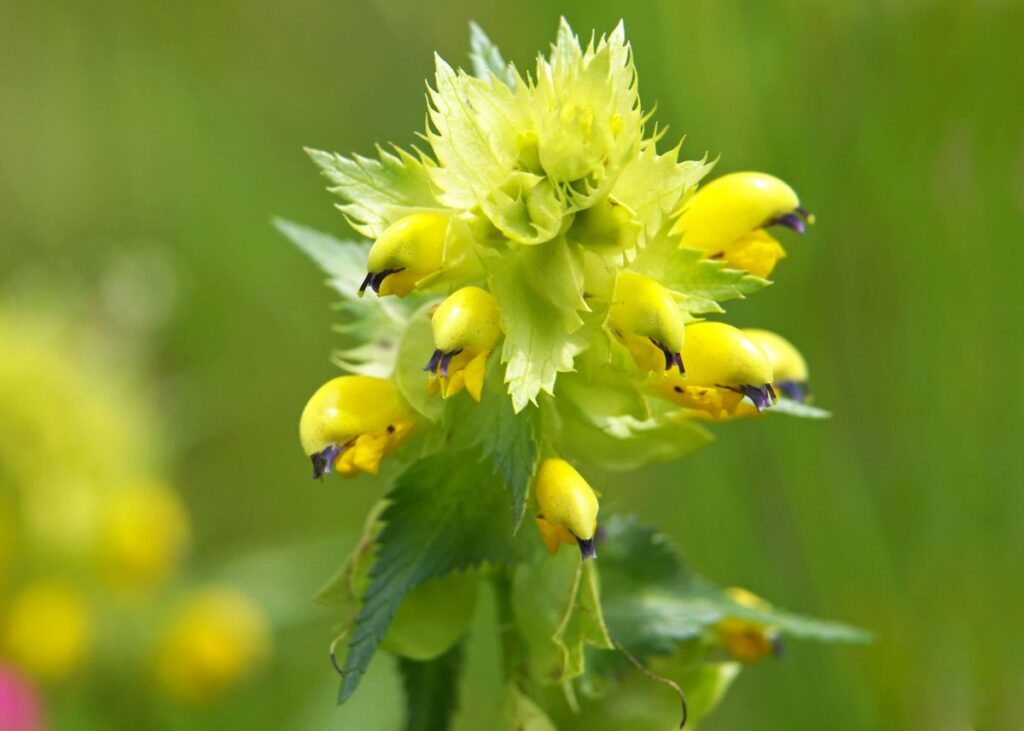
In damp hay meadows you'll also find Betony (Stachys officinalis), Great Burnet (Sanguisorba officinalis) and Pignut (Conopodium majus), alongside the more familiar Common Knapweed (Centaurea nigra), Oxeye Daisy (Leucanthemum vulgare) and Bird's-foot Trefoil (Lotus corniculatus). Yellow Rattle (Rhinanthus minor) belongs in almost every Derbyshire mix sown into existing grass — it's a hemi-parasite that draws nutrients from grass roots, weakening the sward's vigour and opening space for everything else to establish.
The grasses matter as much as the flowers, and are easy to overlook. Sweet Vernal-grass (Anthoxanthum odoratum), Crested Dog's-tail (Cynosurus cristatus) and, in the right spot, Quaking Grass (Briza media) are all fine-leaved, well-mannered species that give a Derbyshire meadow its soft, moving texture without swamping the wildflowers sown alongside them — quite different from the coarse, productive ryegrasses found in agricultural leys.
Limestone dale flora and gritstone moorland-fringe flora differ from this lowland assemblage quite markedly — we go into both in more depth in dedicated articles, since the species list changes as fast as the soil does.
Sowing window and what to expect in year one
Late August to early October is the best sowing window across most of Derbyshire — soil is still warm from summer, late-summer rain tends to break any dry spell, and seedlings get a full autumn and winter to root before having to cope with spring competition from grasses. A spring window, March to April, works as a fallback, but expect a weedier, slower first season.
Sowing rate and method depend on the specific mix, so always work from the rate printed on your seed pack rather than a rule of thumb. As a general approach, broadcast by hand or spreader in two directions for even coverage, rake lightly to work seed into the surface, then firm the ground by rolling or light treading — good seed-to-soil contact matters more to germination than sowing thickly.
Be realistic about year one: most of the visible growth will be grass and a handful of quick annuals if your mix includes them. The perennials that make up the bulk of a Derbyshire meadow — knapweed, scabious, trefoils, Wood Crane's-bill where included — spend their first year building roots, not flowers. Real flowering generally arrives in year two, with the meadow reaching its settled character by year three. Anyone promising an instant meadow from seed isn't being straight with you.
Long-term management: the part most people underestimate
A meadow is a long-term relationship with a piece of ground, not a one-off sowing. The single most important task is an annual cut, timed after flowering and seed drop (typically late July to September depending on altitude), with the arisings raked off and removed — left in place, they rot down and add exactly the fertility a wildflower meadow doesn't want.
Never fertilise a wildflower meadow. It sounds counterintuitive if you're used to lawn or pasture management, but low nutrient levels are what let wildflowers compete with grass in the first place. On lowland Peak Fringe sites, aftermath grazing with sheep after the hay cut is a traditional and effective way to keep fertility down and open up the sward for the following year. On ungrazed dale sites, keep an eye on scrub — hawthorn and bramble will encroach if left unchecked for more than a couple of seasons.
It's also worth keeping a simple yearly note of what's flowering and when, even just a few phone photos each June and July. Derbyshire's weather varies enough year to year that a meadow's second and third seasons can look quite different from each other, and a basic record makes it much easier to judge whether the site is genuinely improving or whether something — grazing pressure, a missed cut, a wet spring — needs addressing.
Provenance and agri-environment schemes in Derbyshire
A growing number of Derbyshire landowners are creating meadows as part of Biodiversity Net Gain (BNG) commitments or Countryside Stewardship agreements, both of which increasingly expect evidence of appropriate, often locally sourced, seed provenance rather than any generic wildflower mix.
Requirements differ between schemes and individual agreements, and it's worth checking the specific wording of yours before ordering seed — some specify UK-native origin, others go further and expect seed matched to the relevant National Character Area or Local Nature Recovery Strategy area. Derbyshire-provenance seed, sourced and matched as described above, is generally well positioned to meet the stricter end of these requirements. Still, we'd always rather confirm against your specific paperwork than assume.
If you're planning a scheme-linked project, get in touch with a copy of the relevant seed specification alongside your site details — it's a five-minute conversation that avoids ordering the wrong mix for a legal agreement.
Wildahome's Derbyshire-Matched Seed Mixes
We supply Derbyshire and Peak District-matched wildflower and wildflower-grass mixes built around the species and provenance principles set out above, along with seed mats for smaller areas, paddock margins and verges where a full ground-prep sowing isn't practical. Each mix is put together for a specific zone rather than sold as one-size-fits-all — because, as this article sets out, Derbyshire doesn't work that way.
If you're not sure which zone your site falls into, that's a very normal starting point, not a barrier — it's the first thing we help customers work out.
Get in Touch
If you're planning a Derbyshire meadow — whether that's a garden corner, a paddock, or a larger restoration project — get in touch with a few details about your site: rough location, soil type if you know it, and what the land is used for now. We'll point you towards the right provenance-matched mix, or towards our more detailed guides on limestone soils and practical sowing across the Peak District.
Ready to get started?
Shop: Traditional Wildflower Meadow Mix →Frequently asked questions
When's the best time to sow a wildflower mix?
Late summer to early autumn (August to September) is the best sowing window for most of the UK -- seed goes into warm, moist soil ahead of winter and gets the cold, damp period many native wildflower seeds need to break dormancy. A second window opens in spring (March to April) once the ground has warmed, though autumn sowing usually establishes faster with fewer weed problems.
Why does local seed provenance matter?
Seed grown from populations adapted to similar soil, rainfall and temperature conditions germinates more reliably and settles into a stronger, longer-lived meadow than seed sourced from a very different climate. That's why we match seed to comparable growing conditions rather than supplying one generic UK-wide mix.
Do I need to prepare the ground before sowing?
Yes, and it's the single biggest factor in whether a meadow succeeds. Existing vegetation and topsoil fertility need to be reduced, since most UK soils are too nutrient-rich for wildflowers and favour competitive grasses and weeds instead. In practice that usually means clearing down to bare soil, raking to a fine tilth, and sometimes sowing yellow rattle alongside the mix to suppress grass vigour.
How long before it looks like a proper meadow?
Most sites show flowers in year one, but a settled, species-rich meadow typically takes two to three growing seasons to establish as slower perennials build up and the balance between grasses and wildflowers matures. Very fertile ground can take longer, since excess nutrients need to be drawn down through repeated cutting and removal of cuttings.
What ongoing management does a wildflower meadow need?
An annual cut in late summer, after flowering and seed-set, with the cuttings removed rather than left to rot down, is the core of long-term management. This keeps fertility low and stops coarse grasses and scrub taking over. Spring topping and occasional scarification help in the early years, and light grazing can replace cutting on some sites.
More county guides
Find the right native wildflower mix for your county, or browse our full list by region.