

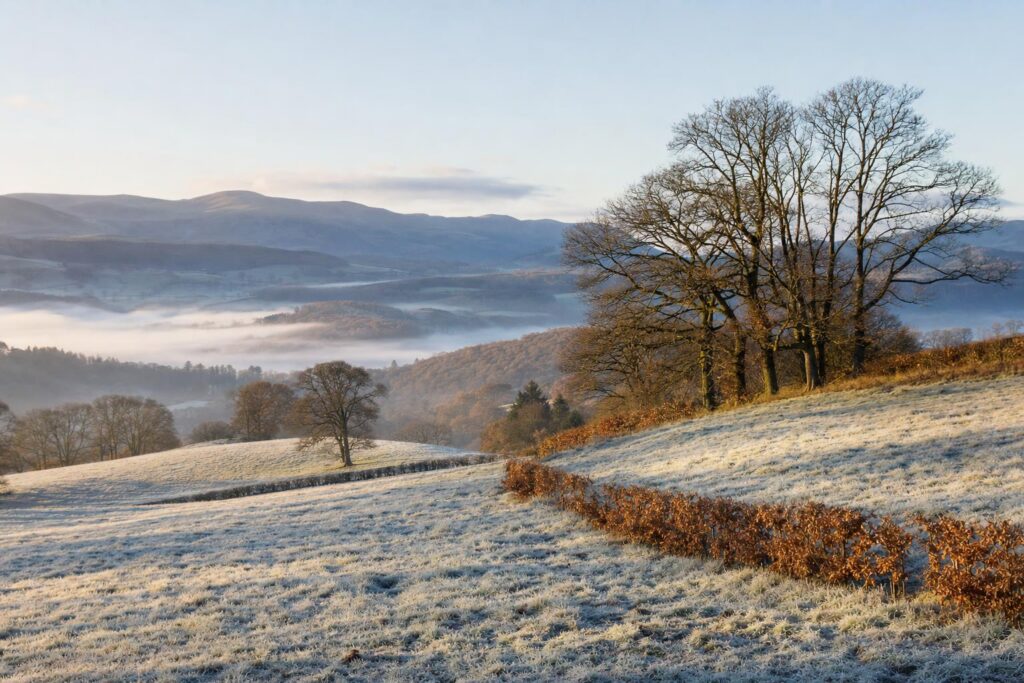
Wildflower Meadow in Winter: What to Do from November to February
Wildflower Meadow in Winter: What to Do from November to February
A wildflower meadow in winter looks like there is nothing to do. The flowers are long gone, the hay is in, and the field is a flat, brownish green until March. But the decisions you make between November and February shape the next summer more than almost anything else you do all year. Get the sward short and keep it that way, keep heavy feet off wet ground, take the scrub back before birds nest, and use the quiet months to plan.
This guide works through those jobs month by month, for anyone managing a meadow in a garden, a paddock or a whole field. It also covers the jobs that are easy to get wrong, from feeding hay on the meadow to sowing a mix in the wrong month, and what a newly sown meadow should look like going into its first winter.
The underlying logic is the same as the rest of the meadow year, set out in full in our guide to how to establish a wildflower meadow. A meadow is low-fertility grassland that is left to flower and seed in summer, cut for hay, then grazed or mown short through autumn and winter. Winter is the “kept short” part of that cycle, and it matters for a simple reason: a short sward lets light reach the low rosettes of perennial wildflowers, while a long, matted one smothers them.
Why winter meadow management matters
Most meadow wildflowers spend the cold months as rosettes pressed flat to the ground: Ox-eye Daisy, Common Knapweed, Bird’s-foot Trefoil, Rough Hawkbit, Selfheal. They keep photosynthesising whenever the weather allows. If the grass around them is left long and then collapses into a wet mat, those rosettes sit in the dark for months, and the coarser grasses come back first in spring.
Short grass going into winter also leaves small gaps of bare soil. That matters for Yellow Rattle, which needs a cold winter on the soil surface to germinate, and for the many meadow species that rely on seed falling into gaps to keep the sward diverse.
The third reason is nutrients. Every time vegetation is cut and removed, or grazed by stock that are then moved off, a little fertility leaves the field. A meadow is a low-nutrient system, and good winter meadow management keeps it that way. Anything that adds nutrients back, such as cuttings left to rot, supplementary feed or dung piling up in one corner, works against you.
November: finish the autumn jobs
November is the tail end of the autumn programme. A few jobs still have a deadline.
Get the sward short before winter
If the meadow was cut for hay in late July or August, the regrowth (the aftermath) should be grazed or mown down through autumn. By the end of November you are aiming for a sward roughly 5–7 cm tall across the whole meadow, with no long, tussocky patches except where you have chosen to leave them.
If you mow rather than graze, make this last cut on a dry day and always take the cuttings off. Rake them up on a small plot; on a field, collect them with the mower or a forage harvester. Our article on using grass cuttings and log piles has ideas for what to do with them, though the main rule is simple: never leave them on the meadow.
Last call for Yellow Rattle
Yellow Rattle (Rhinanthus minor) has to be sown in autumn. The seed needs several weeks of winter cold before it will germinate, and seed sown in spring is usually wasted. The best window is September to the end of October, but November still works. Aim to have the seed on the ground by the end of November; from December onwards it is too late for this season.
Sow it onto short grass with plenty of bare soil showing. Scarify hard first if the sward is dense. Our step-by-step guide on how to sow Yellow Rattle covers rates and preparation.
Plant wildflower bulbs
Most native bulbs go in between September and the end of November. Snowdrops, Bluebells, Wild Daffodils and Winter Aconite all add colour in the months before the meadow flowers start, and they suit the edges of a meadow, a hedge bottom or the shade under trees. Our guide to planting wildflower bulbs explains which bulbs suit which ground and how to manage the grass around them.
Do not sow your main seed mix now
This is the commonest winter mistake. A general wildflower or meadow mix sown in November, December, January or February will sit in cold, wet soil, and much of it rots, gets eaten or germinates into a frost. The best time to sow is mid-August to late October. If you missed that window, wait for late March to May and sow in Spring instead.
The exception is Yellow Rattle, which needs the cold, plus native bulbs, which are planted rather than sown.
December: grazing, wet ground and leaving things alone
December is usually the quietest month, and on a well-run meadow that is how it should be.
Winter grazing a meadow
Light grazing through autumn and winter is the traditional way to keep a hay meadow short, and it does things a mower cannot. Hooves press seed into the soil and open small gaps; stock graze tussocks unevenly, which creates structure; and dung in small amounts feeds the soil invertebrates that birds rely on.
Sheep and cattle both work well. Cattle are better at tackling coarse grass and tussocks; sheep graze tighter and lighter. Horses and ponies can be used too, but they graze very unevenly, leaving dunging areas that become rank and nutrient-rich while they crop other areas almost bare. If you keep horses, our guide to nature-friendly equestrian sites has more on managing that.
A few rules hold whatever stock you use:
- Keep stock off waterlogged ground. Poaching, where hooves churn wet soil into mud, damages the sward and lets docks, thistles and rushes in. This matters most on heavy clay, which holds water through winter. Move stock to drier ground, or off the meadow entirely, during wet spells.
- Do not feed hay or concentrates on the meadow. Supplementary feed brings nutrients onto the field, and hay brings in seed from wherever it was made, often ryegrass and docks. Feed on a hard standing or a field you are not trying to keep species-rich.
- Graze lightly. The aim is a short, even sward, not bare earth. If the ground is showing through everywhere, take the stock off.
If you do not have stock
Plenty of meadows are managed without animals, especially in gardens and small paddocks. A mown meadow still works well, provided the autumn cut leaves the sward short and the cuttings are removed. If growth carries on through a mild winter and the sward is getting long again by February, a second light cut on a dry day in late winter does the same job as grazing.
Our article on how to create and care for a wildflower garden or meadow covers small-scale management in more detail.
Leave some areas uncut
Not every square metre needs to be short. Leaving a strip or corner uncut through winter, ideally about a tenth of the meadow and in a different place each year, gives overwintering insects somewhere to shelter. Many butterfly and moth caterpillars, beetles and spiders spend the winter in hollow stems and tussocks, and a meadow cut uniformly to the ground has nowhere for them to go.
Standing seed heads, such as Common Knapweed and Teasel, also feed finches through the winter. Leaving them along a field edge or hedge bottom is a small change with real value for wildlife, and our guide to the best wildflower seeds for pollinators explains why that structure matters through the whole year.
January: scrub, hedges and problem plants
January is the best time to deal with anything woody or invasive, while the ground is visible and before birds start nesting.
Cut back scrub and bramble
Bramble, Blackthorn suckers, Hawthorn and young Birch or Willow will creep into any meadow that is not grazed or cut hard. A little scrub along a boundary is good habitat; scrub advancing across the field is not. Cut it back in winter, outside the bird nesting season, and dig out or cut regrowing stumps low.
On a field scale, rotate the work: cut a different section each winter, rather than clearing every edge at once, so there is always some cover.
Hedges and field margins
Hedges around a meadow are part of the same habitat. Cut them in late winter (January and February) once birds have eaten the berries, and cut on a rotation of two or three years rather than every year, so there is always some flower and fruit. On farmland in England and Wales, hedge cutting is not allowed from 1 March to 31 August, but check the current rules that apply to your holding, especially if it is in an agri-environment agreement.
Flower-rich margins and buffer strips follow the same broad pattern as a meadow. If yours are part of a Sustainable Farming Incentive agreement, our practical guide to flower-rich grass margins (CIPM2) sets out what that action requires.
Docks, thistles and other problem plants
Winter is a useful time to map problem plants, because the meadow is short and they stand out. Mark the worst patches of Broad-leaved Dock, Creeping Thistle, Common Ragwort or rushes, ready to deal with them at the right moment.
Docks can be dug out with a dock lifter when the soil is soft after rain. Taking the top 10–15 cm of the root is usually enough. Thistles and ragwort are better tackled in late spring and summer, by pulling or cutting before they seed, so winter is the time to plan rather than act. Rushes are a sign of wet ground, and they tell you that a wetland and pond margin mix might suit that corner better than fighting the water.
Molehills
Molehills are not all bad. They create small patches of bare soil, which is exactly where wildflower seed establishes, and many meadows benefit from them. But they bring stones and soil up to the level of the mower blade at hay time. Spread them out with a rake or chain harrow in late winter, when the soil is dry enough not to smear.
February: plan, order and prepare
By February the days are lengthening and the meadow is starting to grow again. This is planning month.
Take the stock off
On lowland meadows, the usual rule is to take stock off by late March or early April, leaving the meadow to grow through spring and flower in early summer. Many northern upland hay meadows traditionally keep sheep on later, but the principle is the same: the meadow needs a long, undisturbed rest between spring and the hay cut. Decide now when your stock will come off, and where they will go.
Firm frost-heaved ground
On clay and loam, repeated freezing and thawing can lift young plants partly out of the soil. If you sowed a new meadow last autumn, check it on a dry day in February. If seedlings have been lifted, a light roll once the ground is firm enough to take it (not when wet) presses them back down.
Plan any spring sowing
If you are creating a new meadow, or extending one, February is the time to get organised for a Spring sowing between late March and May. That means:
- Testing your soil. A meadow needs low fertility. If your ground has been fertilised for years, check whether it is too fertile for wildflowers and how to bring fertility down; the establishment guide linked above covers both.
- Choosing your mix. Match it to your soil, not to a picture on a seed packet. Our guide to 80/20 versus 100% wildflower mixes explains the difference, and choosing locally sourced seed for your county gives the best match to your ground.
- Working out quantities. Use 3 g/m² for a 100% wildflower mix and 5 g/m² for an 80/20 meadow mix, with up to 30% extra on slopes and exposed sites. The seed coverage calculator does the arithmetic for you.
- Planning ground preparation. Bare, weed-free soil is what you want by sowing day. If you are clearing turf or fertile topsoil, plan when and how, and where the material will go.
Spring-sown meadows can do well, but they are more exposed to dry spells in the first summer, and Yellow Rattle cannot be sown with them. Our article on the best times to sow wildflower seeds weighs up Spring against Autumn sowing.
Service the kit and keep records
If you cut your own hay, February is the month to service the mower, sharpen blades and check you have a plan for baling or collecting the cut. Then write down what happened last year: which species flowered, where the grass got the upper hand, where docks or thistles spread. Photos taken from the same spot each June are one of the most useful records you can keep, and over several years they show whether the meadow is moving in the right direction.
A newly sown meadow in its first winter
If you sowed in late summer or autumn, the meadow going into its first winter will not look like much. Expect a scatter of small seedlings, many of them grasses and annual weeds from the seed already in the soil. Most meadow perennials spend their first months building roots, and many will not flower until their second or third summer.
That is normal, and it is not a sign of failure. On a winter morning, get down close and look between the weeds: you should find small wildflower seedlings, often in their hundreds.
A few rules for a first-winter meadow:
- Keep feet and stock off it, especially when the ground is wet. Young seedlings are easily churned out.
- Do not cut it in winter unless growth has become long and lush, and then only lightly, on a dry day, with the cuttings taken off.
- Be ready for the first-year cuts. From Spring, whenever growth reaches 100–150 mm, cut it back to 50–60 mm and remove the cuttings. Expect three to five cuts between May and September. This feels wrong, but it is what lets the slower perennials through.
What a well-managed winter meadow leads to
A meadow that goes into winter short, stays dry underfoot, is free of feed and fertiliser, and keeps a few rough corners for wildlife will come out of February in good shape. The rosettes have had light all winter. Yellow Rattle is germinating in the gaps. Scrub is pegged back before nesting, and you know what you are sowing and cutting in the year ahead.
None of these jobs takes long on its own. Together, repeated every winter, they are what keeps a meadow species-rich for decades rather than drifting back to coarse grass in five years. If you want to see how that works on a working farm, we have written about how we manage the land at Tyn-y-Clyn.
Getting ready for the next sowing season
Winter is the point where most people decide what to do differently next year. If you are planning to sow Yellow Rattle into an existing meadow, it needs to be on the ground by the end of November, so it is worth ordering now. The same goes for native bulbs for hedge bottoms and meadow edges, which go in until the end of the month.
For a Spring sowing, ordering in February gives you time to prepare the ground properly. Our seed mixes are matched to soil types, from heavy clay and chalk and limestone to acidic soils, and where the existing grassland just needs more diversity, the restoration mix is designed for that job. On steep banks or awkward patches where loose seed would wash away, a wildflower seed mat is worth considering.
Ask us about your meadow
If you are not sure whether your meadow is being managed the right way, or what to sow next, tell us about the site. We can advise on grazing, cutting, problem plants and seed choice for your soil and county, from a small garden meadow to a larger restoration project. Use our Ask Us form with a few details about the ground and what you are trying to achieve, or browse the full range of seeds and bulbs in the shop.
Frequently Asked Questions
What should I do with a wildflower meadow in winter?
Keep it short and leave it alone. Graze or mow the regrowth after the hay cut down to about 5–7 cm by the end of November, remove any cuttings, and keep stock off waterlogged ground. Use December to February for scrub, hedges and planning rather than cutting or sowing.
Should I cut my wildflower meadow before winter?
Yes, if it has not been grazed. The meadow should go into winter short, at around 5–7 cm, so light reaches the wildflower rosettes. Cut on a dry day in autumn and always take the cuttings off. Leave about a tenth uncut as winter cover for insects, moving that strip each year.
Can I sow wildflower seeds in winter?
Not a general meadow mix. Seed sown from November to February tends to rot or be eaten before it can establish. Sow from mid-August to late October, or from late March to May. Yellow Rattle is the exception: it needs winter cold, so sow it in autumn and no later than the end of November.
Can I graze a wildflower meadow in winter?
Yes, and it is the traditional way to manage a hay meadow. Light grazing with sheep or cattle keeps the sward short and presses seed into the soil. Keep stock off when the ground is waterlogged, never feed hay or concentrates on the meadow, and take stock off by late March or early April on lowland sites.
Is it too late to sow Yellow Rattle in November?
No. November still works, although September to October is better. Yellow Rattle needs several weeks of cold on the soil surface to germinate, so aim to have it sown by the end of November. From December onwards it is too late, and spring-sown Yellow Rattle rarely germinates.
What does a newly sown wildflower meadow look like in winter?
Not much. Expect small, scattered seedlings, many of them grasses and annual weeds. Most perennial wildflowers spend their first winter building roots and will not flower until year two or three. Look closely between the weeds for small rosettes, keep feet and stock off, and be ready to cut in Spring.
When should I cut hedges and scrub around a meadow?
In late winter, January and February, once birds have eaten the berries and before nesting begins. Cut hedges on a two- or three-year rotation rather than annually. On farmland in England and Wales, hedge cutting is not allowed from 1 March to 31 August, so check the rules for your holding.
Ready to get started?
Shop: Traditional Wildflower Meadow Mix →