

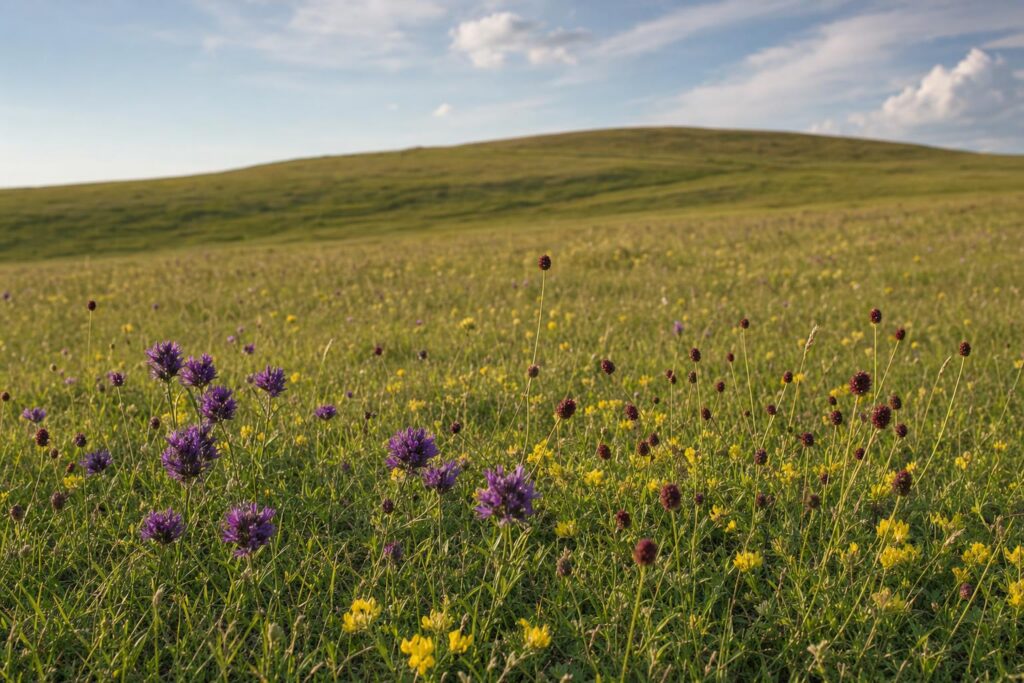
Wildflower Seeds for Berkshire: Native Mixes for Chalk Downland, Clay and the Thames Valley
Wildflower Seeds for Berkshire: Native Mixes for Chalk Downland, Clay and the Thames Valley
Berkshire is a county of surprising contrasts once you look past the M4 corridor. In the west, the chalk of the North Wessex Downs rises toward Walbury Hill, the highest chalk hill in southern England. Around Reading and Wokingham, London Clay takes over — heavy, fertile, slow to drain. Further east, the sandy heaths of Bracknell Forest and the Thames Basin sit on acidic ground that wants nothing to do with a chalk mix. Choosing wildflower seeds for Berkshire means starting with which of these zones your land actually sits in, not reaching for a single “wildflower mix for the South East” and hoping for the best.
This matters more than most people expect. A chalk-adapted mix sown onto heavy Reading clay will struggle — the vigorous grasses that clay favours will simply outcompete species bred for thin, low-nutrient ground. The reverse is just as true: a clay-tolerant mix on free-draining chalk downland will thin out fast. Get the soil match right, though, and Berkshire rewards the effort with some of the most ecologically distinctive grassland in southern England, from the chalk turf of the Downs to the wet floodplain meadows of the Kennet.
Understanding Berkshire’s soils before you sow
Berkshire splits into a handful of clear geological bands running roughly west to east, and each one calls for a different wildflower seed mix.
Western chalk downland
West Berkshire — Newbury, Hungerford, Lambourn, and the villages along the Ridgeway toward Streatley — sits on Cretaceous chalk within the North Wessex Downs National Landscape. The soils here are thin, free-draining and lime-rich: classic wildflower ground, provided you resist the urge to add fertiliser. A chalk and limestone mix suits this zone well.
Central London Clay belt
Reading and Wokingham sit on London Clay, with Reading Formation beds surfacing where rivers cut through. This is heavy, nutrient-rich, slow-draining ground that favours vigorous competitive grasses over the wildflowers trying to establish among them. A heavy clay mix, sown with realistic expectations about the extra work involved, is the right starting point.
South-eastern sandy heaths
Bracknell, Crowthorne, Sandhurst and parts of Windsor sit on Bagshot Group sands underlying the Thames Basin Heaths — acidic, low-nutrient, free-draining soils that suit an acidic soils mix rather than anything built for chalk.
River valleys and the Thames corridor
The Kennet, Lambourn, Pang and Enborne valleys, plus the Thames Valley gravel terraces through Maidenhead, Windsor and Slough, carry damper alluvial and gravel soils. A loam and alluvial mix bridges the gap between the chalk and the wetter, low-lying ground.
Choosing the right wildflower seeds for Berkshire’s habitats
Berkshire’s surviving wildflower habitats give a useful steer on what “good” looks like in each zone.
On the chalk, sites managed by the National Trust at Lardon Chase, The Holies and Lough Down near Streatley show what unimproved downland turf can support: salad burnet, horseshoe vetch, wild thyme and pyramidal orchid are typical of chalk grassland across the North Wessex Downs. Further into the chalk-and-gravel transition zone, the Kennet and Lambourn Floodplain SSSI — a fen and swamp habitat spread across several separated parcels near Newbury and Hungerford, with a component at Rack Marsh managed by BBOWT (the Berkshire, Buckinghamshire and Oxfordshire Wildlife Trust) — supports scarce wetland invertebrates including Desmoulin’s whorl snail, a reminder that even within “chalk country” the river valleys behave quite differently from the downland above them.
On the clay and gravel around Reading and Wokingham, Dinton Pastures Country Park shows how former gravel-pit workings can be restored to wetland and lowland-meadow habitat close to a growth area — a useful precedent for anyone doing habitat creation on similar ground nearby. And on the sandy heaths, the Thames Basin Heaths support a very different palette: heather, dwarf gorse and cross-leaved heath, alongside heathland birds such as Dartford warbler and nightjar where the habitat is large and undisturbed enough to hold them.
Windsor Great Park, meanwhile, is a reminder that not every valuable Berkshire habitat is open grassland — its ancient wood pasture is internationally significant for deadwood invertebrates, and any wildflower work near mature parkland trees should be planned around, not instead of, that existing value.
Sowing wildflower seeds in Berkshire: timing and ground preparation
Autumn sowing, from late August through October, is the more reliable window across most of Berkshire. It lets seed experience a proper winter chill, which species like Yellow Rattle (Rhinanthus minor) need to break dormancy — see our guide to why Yellow Rattle matters for wildflower meadows. A spring window, March to April, works well on the free-draining chalk downland, but is a harder call on Reading’s heavier clay, where wet ground can delay cultivation for weeks.
Ground preparation follows the low-nutrient principle throughout: strip existing turf and topsoil where practical, never add fertiliser, and avoid deep cultivation on clay in particular, since it encourages the very grasses you’re trying to suppress. Our general guide to establishing a wildflower meadow covers the site-prep sequence in more depth, and our note on the best times to sow wildflower seeds is worth reading before committing to a date.
Managing your Berkshire wildflower meadow long-term
A first-year meadow rarely looks like much — most of the plant’s energy goes into root development, not flowers. By year two you’ll see a partial display, and by year three, with the right cutting regime, a proper meadow sward. The regime itself matters as much as the seed: an annual late-summer cut (typically August, once seed has set), with the arisings removed rather than left to rot down and re-fertilise the soil, keeps nutrient levels low and stops coarse grasses from dominating.
On clay ground around Reading and Wokingham, expect to manage rank grass growth more actively in the early years — Yellow Rattle earns its keep here by weakening grass roots and giving wildflowers room to compete. On the sandy heaths further east, by contrast, the risk runs the other way: too little disturbance and birch or gorse scrub will encroach, so periodic scrub control is part of long-term management on acidic ground.
Wildflower seeds for larger-scale projects and Biodiversity Net Gain in Berkshire
Berkshire’s six unitary authorities — West Berkshire, Wokingham, Reading, Bracknell Forest, Windsor and Maidenhead, and Slough — all apply the England-wide mandatory 10% biodiversity net gain requirement on qualifying developments: major applications since 12 February 2024, minor applications since 2 April 2024, secured for at least 30 years against the statutory biodiversity metric. Individual authorities are at different stages of turning this into local policy — Cheshire West’s approach to interim guidance is a useful model elsewhere in the country, and Berkshire’s councils are working through similar territory at their own pace, so it’s worth checking directly with the relevant planning authority before assuming a specific local process applies to your site.
Berkshire’s Local Nature Recovery Strategy was published in autumn 2025, led by the Royal Borough of Windsor and Maidenhead acting as the responsible authority on behalf of all six unitaries. West Berkshire Council has registered legally secured habitat banks, including one at Sulham Woodmeadows near Reading, created in partnership with a habitat banking provider — a genuine example of wildflower meadow creation being used to meet BNG obligations in the county. For anyone assessing land for BNG habitat creation, it’s worth checking whether your site falls within an LNRS priority area, since this tends to strengthen the planning case for using it that way.
Growth pressure in the Thames Valley — around the Thames Valley Science Park at Reading and Wokingham’s fringe, and longer-term proposals such as Grazeley to the south of Reading — is the practical driver behind rising BNG demand in the county, even where specific schemes remain at an early or contested stage. For landowners considering habitat creation, our guide to wildflower seeds for biodiversity net gain beyond the baseline and our page for housing and development projects both cover the practical detail of sourcing seed at this scale.
On the farming side, Berkshire’s chalk downland, river valleys and mixed farmland further east are eligible in principle for the standard suite of Sustainable Farming Incentive wildflower and habitat actions — our practical guides to SFI action CAHL1 (pollen and nectar flower mix) and SFI action CIPM2 (flower-rich grass margins) are a good starting point, though it’s worth checking current codes and rates against GOV.UK before committing, since the scheme has changed more than once in recent years.
Locally sourced wildflower seeds for Berkshire
Wildahome’s seed is harvested from donor meadows in Devon and Powys — chosen for their genetic similarity to lowland southern and western British grassland, not because they’re in Berkshire itself. That distinction matters less than it might sound: what counts is that the seed is suited to Berkshire’s climate and to the same broad soil chemistry ranges the county spans, from chalk to clay to acid sand, rather than being a generic mix with no relationship to real British growing conditions. You can read more about why locally sourced wildflower seeds really matter and how provenance affects establishment success.
For larger or more complex Berkshire sites — estate-scale restoration, a BNG habitat bank, or a site spanning more than one soil zone — our bespoke wildflower seed mixes service builds a blend around your specific soil survey and site aims, rather than asking you to pick a single off-the-shelf product for ground that might genuinely need two.
Ready to choose the right mix?
Whether you’re restoring a paddock on the Downs, establishing a meadow on Reading clay, or planning a habitat bank for a Berkshire development, getting the soil match right at the outset saves years of disappointing results. Browse our full range of wildflower seed mixes, explore our advice section for detailed establishment guides, or get in touch if your site needs a bespoke approach. We’re happy to talk through what will actually work on your land before you buy anything.
Frequently Asked Questions
What are the best wildflower seeds for Berkshire?
It depends on which part of the county you’re in. The chalk downland of West Berkshire around Newbury and Streatley suits a chalk and limestone mix; the London Clay around Reading and Wokingham needs a heavy clay mix; and the sandy heaths around Bracknell and Sandhurst do better with an acidic soils mix. There’s no single mix that fits every Berkshire site.
When should I sow wildflower seeds in Berkshire?
Autumn, ideally late August to October, is the more reliable window across the county — it lets seed go through a proper winter chill before germinating, which species like Yellow Rattle need. A spring window between March and April works well on the free-draining chalk downland, but is a harder call on Reading and Wokingham’s heavier clay.
Can wildflowers grow on Reading’s heavy clay soil?
Yes, though it takes more patience than on chalk ground. London Clay favours vigorous grasses, so success depends on stripping vegetation without deep cultivation, avoiding any added fertility, and choosing species that can compete. Yellow Rattle is particularly valuable on clay, weakening grass roots to give wildflowers room to establish over two to three years.
What is Berkshire’s biodiversity net gain requirement?
All six of Berkshire’s unitary councils — West Berkshire, Wokingham, Reading, Bracknell Forest, Windsor and Maidenhead, and Slough — apply the England-wide mandatory 10% biodiversity net gain on qualifying developments, in force for major applications since 12 February 2024 and minor applications since 2 April 2024, secured for at least 30 years. Berkshire’s Local Nature Recovery Strategy was published in autumn 2025, led by the Royal Borough of Windsor and Maidenhead.
Are there registered BNG habitat banks in Berkshire?
Yes. West Berkshire Council has registered legally secured habitat banks in the county, including one at Sulham Woodmeadows near Reading, created to deliver wildflower meadow and habitat creation as part of biodiversity net gain obligations. It’s worth checking with the relevant planning authority for the current list of registered sites before committing to a specific project.
Is Berkshire seed the same as seed from other counties?
Not exactly, but it’s closely matched. Wildahome’s seed is harvested from donor meadows in Devon and Powys, then selected specifically as wildflower seeds for Berkshire’s chalk-to-clay-to-acid-sand soil range and lowland southern England’s climate, rather than sold as one generic UK mix. For most gardens, paddocks and BNG sites, that regional matching gives noticeably better establishment than seed with no connection to the county’s conditions at all.
How long does it take to establish a wildflower meadow in Berkshire?
Budget three years for a proper result, whichever part of Berkshire you’re in: mostly leaf and root growth in year one, a partial flowering display in year two, and a full meadow from year three onward. Reading’s clay ground in particular tests patience — don’t judge a new meadow’s success by its first summer alone.
Ready to get started?
Shop: Traditional Wildflower Meadow Mix →Frequently asked questions
What are the best wildflower seeds for Berkshire?
It depends on which part of the county you're in. The chalk downland of West Berkshire around Newbury and Streatley suits a chalk and limestone mix; the London Clay around Reading and Wokingham needs a heavy clay mix; and the sandy heaths around Bracknell and Sandhurst do better with an acidic soils mix. There's no single mix that fits every Berkshire site.
When should I sow wildflower seeds in Berkshire?
Autumn, ideally late August to October, is the more reliable window across the county — it lets seed go through a proper winter chill before germinating, which species like Yellow Rattle need. A spring window between March and April works well on the free-draining chalk downland, but is a harder call on Reading and Wokingham's heavier clay.
Can wildflowers grow on Reading's heavy clay soil?
Yes, though it takes more patience than on chalk ground. London Clay favours vigorous grasses, so success depends on stripping vegetation without deep cultivation, avoiding any added fertility, and choosing species that can compete. Yellow Rattle is particularly valuable on clay, weakening grass roots to give wildflowers room to establish over two to three years.
What is Berkshire's biodiversity net gain requirement?
All six of Berkshire's unitary councils — West Berkshire, Wokingham, Reading, Bracknell Forest, Windsor and Maidenhead, and Slough — apply the England-wide mandatory 10% biodiversity net gain on qualifying developments, in force for major applications since 12 February 2024 and minor applications since 2 April 2024, secured for at least 30 years. Berkshire's Local Nature Recovery Strategy was published in autumn 2025, led by the Royal Borough of Windsor and Maidenhead.
Are there registered BNG habitat banks in Berkshire?
Yes. West Berkshire Council has registered legally secured habitat banks in the county, including one at Sulham Woodmeadows near Reading, created to deliver wildflower meadow and habitat creation as part of biodiversity net gain obligations. It's worth checking with the relevant planning authority for the current list of registered sites before committing to a specific project.
Is Berkshire seed the same as seed from other counties?
Not exactly, but it's closely matched. Wildahome's seed is harvested from donor meadows in Devon and Powys, then selected specifically as wildflower seeds for Berkshire's chalk-to-clay-to-acid-sand soil range and lowland southern England's climate, rather than sold as one generic UK mix. For most gardens, paddocks and BNG sites, that regional matching gives noticeably better establishment than seed with no connection to the county's conditions at all.
How long does it take to establish a wildflower meadow in Berkshire?
Budget three years for a proper result, whichever part of Berkshire you're in: mostly leaf and root growth in year one, a partial flowering display in year two, and a full meadow from year three onward. Reading's clay ground in particular tests patience — don't judge a new meadow's success by its first summer alone.
More county guides
Find the right native wildflower mix for your county, or browse our full list by region.