

Wildflower Seeds for Wiltshire: Native Mixes for Chalk Downland, Clay Vales and Beyond
Wildflower Seeds for Wiltshire: Native Mixes for Chalk Downland, Clay Vales and Beyond
Wiltshire looks like grassland country from the air, and much of it still is. Search for wildflower seeds for Wiltshire and you’ll find plenty of generic mixes on offer — but this is a county built on chalk, threaded with clay vales, and holding one of the largest blocks of unimproved chalk grassland left in north-west Europe. Sow the wrong seed here and you’ll spend three years watching coarse grass outcompete everything else. Sow the right seed, matched to your particular patch of downland, clay vale or greensand fringe, and you get a sward that thickens with wildflowers rather than thins.
This guide sets out what Wiltshire’s ground actually asks of a wildflower mix — the chalk of Salisbury Plain and the Marlborough Downs, the clay and greensand of the Vale of Pewsey and the Avon valley, and the pockets of acid ground that don’t fit the chalk-county stereotype. We’ll cover which species suit which soil, when to sow, how to manage a meadow once it’s established, and what Wiltshire’s Biodiversity Net Gain requirements mean if you’re working at development or farm scale. Wildahome doesn’t harvest seed in Wiltshire itself — more on that honestly, later — but our county-matched mixes are built to suit exactly this kind of ground.
Understanding Wiltshire’s soils before you sow
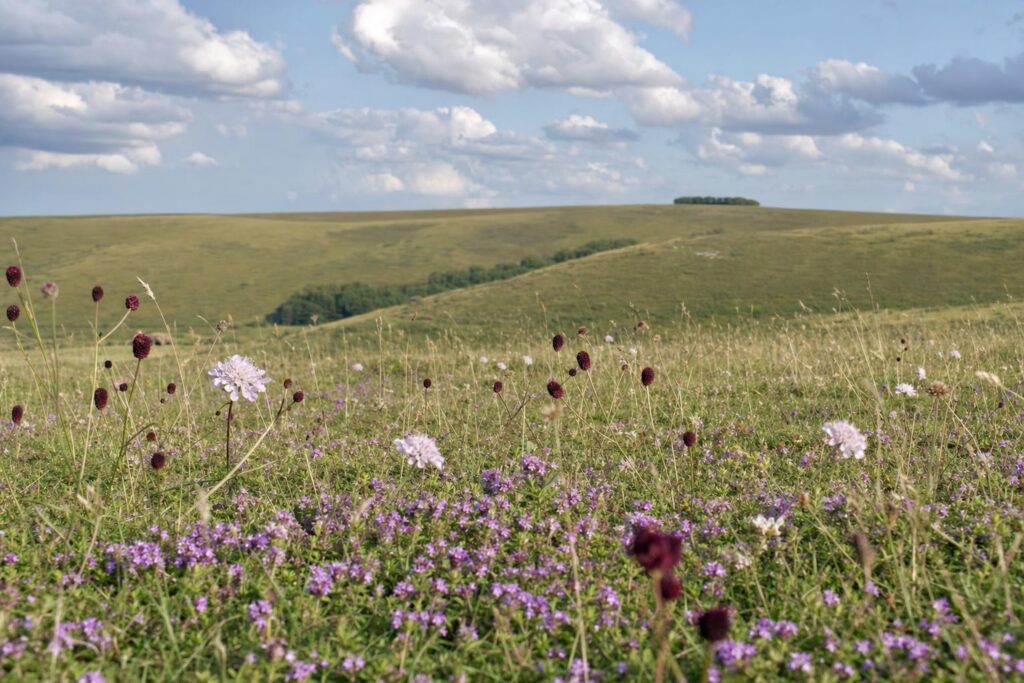
Chalk downland. Salisbury Plain and the West Wiltshire Downs sit on Cretaceous chalk — a very pure, calcium-rich limestone laid down under a shallow sea tens of millions of years ago. The Ministry of Defence manages roughly 38,000 hectares of Salisbury Plain as the UK’s largest training area, and that unusual land use has done more for conservation than most nature reserves: because it has never been ploughed, fertilised or intensively grazed, Salisbury Plain now holds the largest expanse of unimproved chalk grassland left in north-west Europe, much of it designated a Special Area of Conservation. Soils here are thin, free-draining and low in nutrients — exactly the conditions chalk specialists like Wild Thyme (Thymus polytrichus) and Salad Burnet (Sanguisorba minor) need, and exactly what a chalk and limestone mix is built for.
Clay vales and greensand. Move off the downland and the geology changes fast. The Vale of Pewsey cuts across the county on Gault Clay and Upper Greensand, and the Avon valley running south through Salisbury carries deeper, moisture-retentive alluvial soils. These hold nutrients and water far more readily than chalk, which favours a different, more vigorous set of wildflowers — Meadowsweet (Filipendula ulmaria), Common Knapweed (Centaurea nigra) and Ragged-Robin (Silene flos-cuculi) among them. A heavy clay mix, or for the richer floodplain ground a loam and alluvial mix, will establish far better here than a chalk-specialist blend that simply gets swamped by grass.
Acid pockets. Wiltshire isn’t uniformly alkaline. The greensand terrace around Westbury and Warminster, and scattered fragments closer to the New Forest fringe in the south, sit on more acidic, sandier ground that behaves nothing like the chalk above it. Sowing a chalk-specialist mix onto acid soil wastes seed and money — an acidic soils mix is the better starting point. If you’re not sure which category your site falls into, a simple pH test will tell you more in five minutes than guesswork will in a season.
Choosing the right wildflower seeds for Wiltshire’s habitats
Chalk downland in good condition can carry thirty to forty species per square metre, and Wiltshire’s surviving fragments still show what’s possible: Devil’s-bit Scabious (Succisa pratensis), Common Rock-rose (Helianthemum nummularium), Small Scabious (Scabiosa columbaria) and a range of orchids including Pyramidal Orchid (Anacamptis pyramidalis). You won’t get orchids from a seed packet — they depend on mycorrhizal fungi that take years to establish — but a well-chosen chalk mix creates the low-nutrient, open conditions they can eventually colonise into from nearby seed sources.
Hedgebanks and verges. Wiltshire has an extensive network of hedgebanks and road verges, many of them unimproved for decades and quietly holding onto species that have vanished from the fields around them. A hedgerow and banks mix suits this transitional, often partly shaded ground, and pairs well with Yellow Rattle where the existing sward is too grass-dominant for anything else to get a foothold. Yellow Rattle parasitises grass roots and can reduce grass biomass by up to 60% in an established sward — it’s the single most useful species for converting tired grassland into something richer.
Arable reversion and restoration. A good deal of Wiltshire’s chalk was ploughed for cereals in the twentieth century and has never gone back to grassland. If you’re converting former arable land — a single field or a larger restoration scheme — start with a restoration mix built for degraded, nutrient-enriched ground rather than the finer chalk-specialist blends, which will struggle against residual fertility for the first few years.
Gardens and smaller plots. For a garden meadow, paddock margin or community green space that doesn’t fall neatly into one soil category, a general-purpose mix is a sensible starting point. Choosing species with pollinators specifically in mind — Bird’s-foot Trefoil (Lotus corniculatus), Common Knapweed and Field Scabious (Knautia arvensis) among them — helps support the bees and butterflies that Wiltshire’s remaining chalk grassland can no longer feed alone, including scarce specialists like the Shrill Carder Bee (Bombus sylvarum) still recorded around Salisbury Plain.
Sowing wildflower seeds in Wiltshire: timing and ground preparation
Timing. Autumn — roughly late August to October — is the better sowing window for most Wiltshire ground, chalk especially. It lets seed go through a natural cold period over Winter, which many native species (Yellow Rattle above all) need to germinate reliably, and it avoids sowing into the summer drought that increasingly affects thin chalk soils. Spring sowing (March to April) works as a second option on heavier clay or loam ground that stays damp for longer, but getting the sowing calendar right matters more on chalk than almost anywhere else, because there’s so little soil moisture reserve to fall back on.
Ground preparation. Whatever the soil type, the principle is the same: strip or suppress the existing vegetation, cultivate to a fine, firm seedbed, and resist the urge to improve the soil. Wildflowers need low fertility to compete with grass, so skip the fertiliser and compost that instinct tells you to add. On chalk, this often means little more than scarifying the existing thin turf; on clay and loam ground it usually means a fuller cultivation to break up compaction. A full step-by-step guide covers seedbed preparation in more detail than fits here.
Seed mats for tricky ground. Steep downland slopes, verges and banks are awkward to sow conventionally — seed washes off before it can root. A seed mat, a biodegradable, pre-seeded matting, holds seed in place while it establishes, and works particularly well on sloping or hard-to-cultivate ground, including chalk banks and hedgerow margins where loose seed would otherwise blow or wash away.
Building in resilience. Chalk’s free drainage means Wiltshire meadows can dry out fast in a hot Summer, and recent dry Summers have made that more of an establishment risk than it used to be. Choosing deep-rooted, drought-tolerant species and planning for a warmer, drier pattern from the outset is worth the extra thought at the design stage, rather than discovering the gaps in year two.
Managing your Wiltshire wildflower meadow long-term
Expect a three-year process, not a one-Summer transformation. Year one is mostly leaf and root growth below ground, with little to show above it. Year two brings a partial display as perennials establish. By year three, on ground that’s been prepared and managed correctly, you should have a full, flowering meadow. Chalk grassland in particular rewards patience — some of Wiltshire’s best downland took centuries of grazing to reach its current state, and a sown meadow won’t match that species richness quickly, but it will get closer each year if managed well.
Cutting and grazing. A single late-summer cut (August to September), after wildflowers have set seed, with all cuttings removed, is the baseline management most Wiltshire meadows need. Removing the cuttings matters as much as the cutting itself — leaving arisings on the ground returns nutrients to soil that wildflowers need kept low. Where grazing is an option, light aftermath grazing with sheep through Autumn mimics the traditional management that shaped Wiltshire’s downland in the first place, and can outperform mowing alone on larger sites.
Ongoing work. Scrub control — cutting back bramble and hawthorn regrowth before it shades out the sward — is a recurring task on ungrazed sites, and Yellow Rattle often needs topping up in the first two or three years until it’s self-sustaining. If a meadow drifts back towards grass dominance a few years in, that’s usually a sign fertility is creeping up or cuttings aren’t being fully removed, not that the original seed mix was wrong. Advice from someone who’s managed this ground before can save a lot of trial and error.
Wildflower seeds for larger-scale projects and Biodiversity Net Gain in Wiltshire
Biodiversity Net Gain became mandatory for most new developments in England on 12 February 2024 for major developments, and 2 April 2024 for minor developments, under the Environment Act 2021. Developers must demonstrate a minimum 10% net gain in biodiversity units against the pre-development baseline, secured and monitored for at least 30 years. Wiltshire Council enforces this through Core Policy 50 of the Wiltshire Core Strategy, and required a no-net-loss-plus-10%-gain standard from developers ahead of the national mandate taking effect. Wiltshire and Swindon also have an adopted Local Nature Recovery Strategy, agreed by full Council in October 2025, which maps priority areas for habitat restoration — land inside those priority areas tends to generate higher biodiversity unit values than equivalent land outside them.
This matters in Wiltshire specifically because the county carries a significant share of England’s housing growth, with substantial allocations around Swindon and Salisbury among other areas. Every one of those housing developments now needs a workable biodiversity strategy from the planning application stage onward, and wildflower meadow creation — cheaper to establish and maintain than woodland or wetland habitat, and quick to start delivering measurable biodiversity units — is one of the more practical routes to the 10% uplift. The same logic applies to councils and other civic landowners managing parks, verges and school grounds, who often hold exactly the low-value amenity grassland that converts well to species-rich meadow.
A real example. Wiltshire Wildlife Trust’s Coombe Bissett Down project, three miles southwest of Salisbury, doubled the size of one of the county’s chalk grassland reserves to 70.6 hectares of lowland calcareous grassland, restoring former arable fields back to species-rich downland with National Lottery Heritage Fund support. It’s a useful proof of concept for anyone weighing up whether arable reversion to chalk grassland is realistic at scale: it is, with the right seed, preparation and patience, and it delivers exactly the kind of measurable, monitorable habitat uplift that BNG schemes are built around. The Ministry of Defence’s stewardship of Salisbury Plain’s 38,000 hectares shows the same principle at a much larger scale — decades of low-intervention management, not intensive restoration spend, is what has kept it the largest surviving block of unimproved chalk grassland in north-west Europe.
For farmers: SFI options. If you’re farming rather than developing, England’s Sustainable Farming Incentive has two actions that suit Wiltshire’s arable chalk and clay land well: CAHL1, a pollen and nectar flower mix grown as an in-field or margin option, and CIPM2, flower-rich grass margins, blocks and in-field strips that combine grasses and wildflowers for a more permanent habitat feature. Both pay an annual rate per hectare, both suit rotational or marginal land that doesn’t earn its keep in the arable rotation, and both are a lower-commitment way into habitat creation than converting a whole field. Our strategic BNG guidance for developers covers the wider planning and financial context in more depth.
Locally sourced wildflower seeds for Wiltshire
Here’s the honest part. Wildahome’s donor seed sites are in Devon and Powys — we don’t harvest seed in Wiltshire, and anyone claiming to sell seed literally collected from Salisbury Plain or the Marlborough Downs should be asked to prove it, because very few UK suppliers genuinely do county-by-county wild harvesting at commercial scale. What we offer instead are wildflower seeds for Wiltshire matched to your conditions rather than your postcode: our chalk and limestone mixes come from stock adapted to calcareous, free-draining ground of the kind Wiltshire has in abundance, and our clay and loam mixes are drawn from populations suited to heavier, wetter soils comparable to the Vale of Pewsey and the Avon valley.
That distinction matters more than it sounds. A wildflower seed grown on acid Devon moorland and sold simply as “wild British” will struggle on Wiltshire chalk regardless of how well you prepare the ground — the plant’s underlying genetics, not just its species name, are adapted to a different soil chemistry. Matching by habitat and soil type, honestly labelled as such, gives a meadow a far better start than seed marketed on county romance alone. Reading the label properly before you buy is worth the ten minutes it takes.
For larger or more particular Wiltshire projects — a substantial chalk restoration scheme, a mixed-soil BNG site, or a farm running CAHL1 and CIPM2 alongside each other — a bespoke mix built around your specific site brief, rather than picked off the shelf, is usually worth the conversation. It costs more in lead time than a standard 80/20 blend, but for a multi-hectare scheme with genuinely mixed ground, it’s often the better long-term investment.
Ready to choose the right mix?
Wiltshire’s ground rewards the patient and punishes the generic mix. Whether you’re restoring a paddock on the Marlborough Downs, converting former arable land to meet a Biodiversity Net Gain requirement, or reversing a tired lawn on Vale of Pewsey clay, choosing seed matched to your soil — not just your county — is the single biggest factor in whether your meadow establishes. Browse our meadow mixes, or if your site doesn’t fit neatly into one category, get in touch or talk to us about your specific ground before you buy anything.
Frequently Asked Questions
What are the best wildflower seeds for Wiltshire’s chalk downland?
For genuine chalk downland — Salisbury Plain, the Marlborough Downs or the West Wiltshire Downs — a chalk and limestone 80/20 mix suits best, since it’s built for the free-draining, low-nutrient, calcium-rich ground that chalk specialists like Wild Thyme and Salad Burnet need. A generic mix without soil matching will usually lose out to coarse grass within two seasons on this kind of ground.
When should I sow wildflower seeds in Wiltshire?
Autumn, from late August to October, is the better window for most Wiltshire ground, chalk especially — it allows natural cold stratification and avoids sowing into summer drought on thin downland soils. Spring sowing works as a second option on heavier clay or loam ground in the Vale of Pewsey or Avon valley, which holds moisture for longer.
Does Wildahome harvest wildflower seed in Wiltshire?
No. Wildahome’s donor seed sites are in Devon and Powys, not Wiltshire. What we offer instead are wildflower seeds for Wiltshire matched by soil type — chalk, clay and the county’s smaller acid pockets — rather than seed literally harvested within the county boundary. Be cautious of any supplier claiming true Wiltshire-wild-collected seed at commercial volumes; genuine county-level wild harvesting is rare in UK horticulture.
How long does it take to establish a wildflower meadow on Wiltshire chalk?
Expect roughly three years. Year one is mostly root establishment with little visible above ground; year two brings a partial flowering display; year three, on well-prepared ground with correct management, gives a full meadow. Chalk grassland establishes more slowly than richer clay or loam ground, because the low-nutrient conditions that suit wildflowers also slow overall growth rates.
What does Wiltshire’s Biodiversity Net Gain requirement mean for landowners?
Since February 2024, most new developments in England must deliver a minimum 10% net gain in biodiversity units, secured for 30 years, and Wiltshire Council applies a similar no-net-loss-plus-10%-gain standard through its Core Strategy. Landowners and developers can meet part of this obligation through wildflower meadow creation, which is faster and cheaper to establish than woodland or wetland habitat.
Which wildflower seeds suit Wiltshire’s clay soils in the Vale of Pewsey?
Vale of Pewsey and Avon valley ground is heavier and holds more moisture and nutrients than chalk, so a heavy clay or loam and alluvial mix, with species like Meadowsweet, Common Knapweed and Ragged-Robin, will establish far better than a chalk-specialist mix designed for thin, free-draining downland soil.
Can I use SFI payments to fund wildflower seed on my Wiltshire farm?
Yes. England’s Sustainable Farming Incentive includes CAHL1 (pollen and nectar flower mix) and CIPM2 (flower-rich grass margins, blocks and in-field strips), both of which suit Wiltshire’s arable chalk and clay land and pay an annual rate per hectare for establishing and maintaining wildflower habitat on marginal or rotational ground.
Ready to get started?
Shop: Traditional Wildflower Meadow Mix →Frequently asked questions
What are the best wildflower seeds for Wiltshire's chalk downland?
For genuine chalk downland — Salisbury Plain, the Marlborough Downs or the West Wiltshire Downs — a chalk and limestone 80/20 mix suits best, since it's built for the free-draining, low-nutrient, calcium-rich ground that chalk specialists like Wild Thyme and Salad Burnet need. A generic mix without soil matching will usually lose out to coarse grass within two seasons on this kind of ground.
When should I sow wildflower seeds in Wiltshire?
Autumn, from late August to October, is the better window for most Wiltshire ground, chalk especially — it allows natural cold stratification and avoids sowing into summer drought on thin downland soils. Spring sowing works as a second option on heavier clay or loam ground in the Vale of Pewsey or Avon valley, which holds moisture for longer.
Does Wildahome harvest wildflower seed in Wiltshire?
No. Wildahome's donor seed sites are in Devon and Powys, not Wiltshire. What we offer instead are wildflower seeds for Wiltshire matched by soil type — chalk, clay and the county's smaller acid pockets — rather than seed literally harvested within the county boundary. Be cautious of any supplier claiming true Wiltshire-wild-collected seed at commercial volumes; genuine county-level wild harvesting is rare in UK horticulture.
How long does it take to establish a wildflower meadow on Wiltshire chalk?
Expect roughly three years. Year one is mostly root establishment with little visible above ground; year two brings a partial flowering display; year three, on well-prepared ground with correct management, gives a full meadow. Chalk grassland establishes more slowly than richer clay or loam ground, because the low-nutrient conditions that suit wildflowers also slow overall growth rates.
What does Wiltshire's Biodiversity Net Gain requirement mean for landowners?
Since February 2024, most new developments in England must deliver a minimum 10% net gain in biodiversity units, secured for 30 years, and Wiltshire Council applies a similar no-net-loss-plus-10%-gain standard through its Core Strategy. Landowners and developers can meet part of this obligation through wildflower meadow creation, which is faster and cheaper to establish than woodland or wetland habitat.
Which wildflower seeds suit Wiltshire's clay soils in the Vale of Pewsey?
Vale of Pewsey and Avon valley ground is heavier and holds more moisture and nutrients than chalk, so a heavy clay or loam and alluvial mix, with species like Meadowsweet, Common Knapweed and Ragged-Robin, will establish far better than a chalk-specialist mix designed for thin, free-draining downland soil.
Can I use SFI payments to fund wildflower seed on my Wiltshire farm?
Yes. England's Sustainable Farming Incentive includes CAHL1 (pollen and nectar flower mix) and CIPM2 (flower-rich grass margins, blocks and in-field strips), both of which suit Wiltshire's arable chalk and clay land and pay an annual rate per hectare for establishing and maintaining wildflower habitat on marginal or rotational ground.
More county guides
Find the right native wildflower mix for your county, or browse our full list by region.