

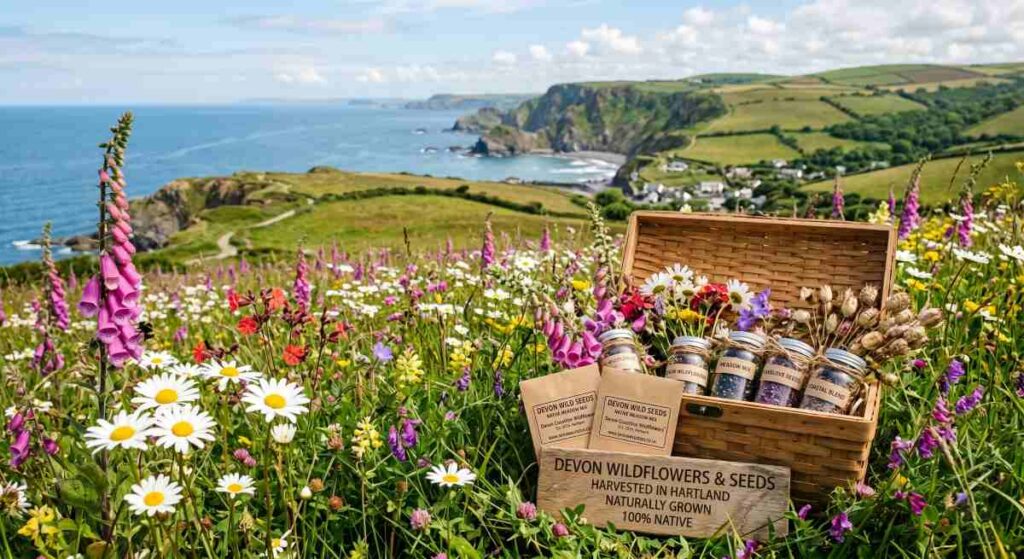
Wildflower Seeds for Devon: Matching Native Mixes to Your Land
Wildflower Seeds for Devon: Matching Native Mixes to Your Land
Devon is as varied as any county in England — acid moorland in the north, rich red clay in the south and east, chalk margins around Torquay, and the sheltered coastal valleys of the Tamar and Exe. If you’re looking for wildflower seeds in Devon, that variation matters. A single generic mix won’t perform across all of it. What works on a well-drained bank near Dartmoor won’t suit the heavy clay of the South Hams.
The good news is that Devon has an extraordinary wildflower heritage to draw on. Species-rich hay meadows, ancient hedgerow banks, wet rush pastures, and purple moor-grass heath — the county holds examples of nearly every UK lowland and upland habitat type. Getting wildflower establishment right in Devon is about reading your site honestly and choosing provenance-matched seed that belongs there.
Understanding Devon’s soils before you sow
Soil type is the first decision point for any wildflower project in Devon. The county’s geology splits broadly into three zones that drive what grows well and what doesn’t.
The Old Red Sandstone soils of mid and north Devon — around Exmoor and the Tarka country — tend to be moderately acidic, free-draining, and naturally low in nutrients. These soils suit traditional meadow mixes well, particularly those including Yellow Rattle (Rhinanthus minor), Betony (Betonica officinalis), and Heath Spotted Orchid (Dactylorhiza maculata) precursors over time.
South and east Devon sits on the Permian red soils — deep, fertile, and often heavy. These are the hardest sites for wildflower establishment because fertility competes against the low-nutrient preference of most meadow species. On these soils, soil preparation is everything: stripped topsoil or years of hay cutting without fertiliser input are the only realistic routes to a species-rich sward.
Dartmoor and its margins bring a third zone — acidic, peaty, and often waterlogged. This is the habitat of Purple Moor-grass (Molinia caerulea), Bog Asphodel (Narthecium ossifragum), and Cross-leaved Heath (Erica tetralix). Standard meadow mixes fail here. Acidic or wetland mixes, sown at the correct time, are the right tool for these conditions.
Choosing the right wildflower seeds for Devon habitats
Match your mix to your site type. Devon’s diversity demands it.
Traditional Meadow Mix — the right choice for most Devon lowland sites with reasonably free-draining, low- to moderate-fertility soil. A balanced blend of native grasses and forbs including Ox-eye Daisy (Leucanthemum vulgare), Meadow Cranesbill (Geranium pratense), Knapweed (Centaurea nigra), and Wild Carrot (Daucus carota). Flowers reliably from April through October and builds in species richness year on year.
Acidic Soils Mix — essential for the moorland fringe, upland pastures, and any site with a pH below 6.0. Suited to the rough ground around Dartmoor, Exmoor’s margins, and the higher ground of mid-Devon. Species include Heath Bedstraw (Galium saxatile), Tormentil (Potentilla erecta), and Harebell (Campanula rotundifolia).
Wetland and Pond Mix — for the wet rush pastures, field margins near watercourses, and boggy low-lying ground that Devon carries a good deal of, particularly in river valleys. Yellow Flag Iris (Iris pseudacorus), Ragged Robin (Lychnis flos-cuculi), and Purple Loosestrife (Lythrum salicaria) are key components. Sow in Autumn for Spring emergence.
Hedgerow and Banks Mix — Devon’s ancient hedgerow banks are among the most biodiverse linear habitats in the UK. The right mix for these raised, often shaded, mixed-soil banks includes Foxglove (Digitalis purpurea), Red Campion (Silene dioica), Herb Robert (Geranium robertianum), and Wild Garlic (Allium ursinum) on the damper faces.
Sowing wildflower seeds in Devon: timing and ground preparation
Devon’s Atlantic climate gives you two reliable sowing windows: late August to October (Autumn sowing) and March to May (Spring sowing). Autumn sowing is generally preferable for perennial-dominated mixes — seeds undergo natural cold stratification over Winter, producing stronger, earlier-emerging plants the following Spring.
Yellow Rattle is the exception — it must be sown fresh in Autumn, ideally September. It will not germinate from Spring-sown seed without pre-treatment. If you’re establishing a new meadow on a grassy site and want to suppress the existing sward, Yellow Rattle is non-negotiable. Include it in your mix or sow it separately into the existing turf in early Autumn.
Ground preparation is the deciding factor on most Devon sites. On existing grassland — particularly the fertile red soils — you cannot simply scatter seed and expect results. The existing grass will win. Strip topsoil to expose subsoil or mineral soil, or scarify hard to create bare ground. Aim for 50–70% bare soil before sowing. On bank sites, a good scrape of the top 2–3cm followed by raking in of seed is often sufficient.
Managing your Devon wildflower meadow long-term
Establishment takes time. Year one is often dominated by annual species and bare ground — this is normal and not a failure. Perennials are putting down roots. Year two typically shows more structure. Year three is where a well-prepared Devon meadow really delivers.
The management rule for most Devon meadows is: cut once in late Summer (August to September), remove all cuttings, and do not fertilise. Ever. Leaving cuttings to rot returns fertility to the soil and suppresses wildflowers. Taking the hay off — even if you compost it elsewhere — keeps nutrients low and gives wildflowers the competitive advantage.
On Dartmoor fringe and upland sites, light livestock grazing in late Autumn and early Winter can replace or supplement cutting. Cattle and ponies are preferable to sheep on most heathland habitats — they graze more selectively and create the structural variety that invertebrates need.
Locally sourced wildflower seeds for Devon
Wildahome’s seed is harvested from UK meadows and partner farms, with provenance matched to the region wherever possible. For Devon projects, the Traditional Meadow, Acidic Soils, Wetland and Pond, and Hedgerow and Banks mixes all carry species appropriate to Devon’s habitats. If you’re unsure which mix fits your site, get in touch — we’re happy to advise on soil type, aspect, and management before you order.
Devon has some of the best wildflower habitat potential in England. The soils, the climate, and the existing network of hedgebanks and traditional farmland all work in your favour. Browse our seed mixes or contact us to talk through your specific site — we’ll help you choose the right mix and give you honest advice on what establishment will look like on your land.
Ready to get started?
Shop: Traditional Wildflower Meadow Mix →Frequently asked questions
When's the best time to sow a wildflower mix?
Late summer to early autumn (August to September) is the best sowing window for most of the UK -- seed goes into warm, moist soil ahead of winter and gets the cold, damp period many native wildflower seeds need to break dormancy. A second window opens in spring (March to April) once the ground has warmed, though autumn sowing usually establishes faster with fewer weed problems.
Why does local seed provenance matter?
Seed grown from populations adapted to similar soil, rainfall and temperature conditions germinates more reliably and settles into a stronger, longer-lived meadow than seed sourced from a very different climate. That's why we match seed to comparable growing conditions rather than supplying one generic UK-wide mix.
Do I need to prepare the ground before sowing?
Yes, and it's the single biggest factor in whether a meadow succeeds. Existing vegetation and topsoil fertility need to be reduced, since most UK soils are too nutrient-rich for wildflowers and favour competitive grasses and weeds instead. In practice that usually means clearing down to bare soil, raking to a fine tilth, and sometimes sowing yellow rattle alongside the mix to suppress grass vigour.
How long before it looks like a proper meadow?
Most sites show flowers in year one, but a settled, species-rich meadow typically takes two to three growing seasons to establish as slower perennials build up and the balance between grasses and wildflowers matures. Very fertile ground can take longer, since excess nutrients need to be drawn down through repeated cutting and removal of cuttings.
What ongoing management does a wildflower meadow need?
An annual cut in late summer, after flowering and seed-set, with the cuttings removed rather than left to rot down, is the core of long-term management. This keeps fertility low and stops coarse grasses and scrub taking over. Spring topping and occasional scarification help in the early years, and light grazing can replace cutting on some sites.
More county guides
Find the right native wildflower mix for your county, or browse our full list by region.