

Wildflower Seeds for Cheshire: Native Mixes for the Plain, the Sandstone Ridge and the Mosses
Wildflower Seeds for Cheshire: Native Mixes for the Plain, the Sandstone Ridge and the Mosses
Cheshire Wildlife Trust puts the scale of the problem plainly: 99% of the county’s hay meadows have been lost. That figure sits behind everything in this guide, because it explains why choosing the right wildflower seeds for Cheshire — and giving them a genuine chance to establish — matters more here than in counties where more of the old grassland survives. The good news is that Cheshire’s varied geology, from heavy clay plain to sandstone ridge to peat moss, gives you real options once you understand which zone your land sits in.
This is not a county with one dominant soil type. The Cheshire Plain’s boulder clay behaves nothing like the free-draining sandstone ridge running through its middle, and neither behaves anything like the acidic, waterlogged peat of a lowland raised bog. Sowing the wrong mix on the wrong ground is the single most common reason a new Cheshire meadow disappoints in its first two years — so this guide starts with soil, not seed.
Understanding Cheshire’s soils before you sow
Cheshire’s geology runs in identifiable bands, and each one points toward a different wildflower seed mix.
The Cheshire Plain
The central belt around Sandbach, Middlewich and Crewe sits on Triassic Mercia Mudstone blanketed by glacial till — heavy, slow-draining boulder clay that dominates the county’s dairy and arable land. This is heavy clay mix territory: expect vigorous grass competition and plan your ground preparation accordingly.
The Mid-Cheshire Sandstone Ridge
A north–south spine of Sherwood Sandstone runs roughly Frodsham–Delamere–Tarporley–Peckforton–Beeston–Malpas, linked by the Sandstone Trail. Soils on the ridge crest are thin, free-draining and often acidic-to-neutral, suiting an acidic soils mix, while richer till on the lower slopes behaves more like the surrounding plain.
The salt belt: Northwich to Nantwich
Around Northwich, Winsford, Nantwich and Middlewich, historic brine pumping over Triassic salt beds has caused subsidence, creating “flashes” — wetland ponds — at sites such as Marbury. Margins here suit a loam and alluvial mix, with a wetland and pond mix for the wetter flash edges themselves.
The eastern Peak District fringe
Around Macclesfield, Bollington and Rainow, millstone grit and shale grade into the Dark Peak, giving more acidic upland soils distinct from the calcareous ground further south and east — another case for the acidic soils mix, adjusted for altitude and exposure.
Choosing the right wildflower seeds for Cheshire’s habitats
Cheshire’s surviving wildflower and wetland habitats show what’s achievable on each soil type. Wybunbury Moss, near Nantwich — a 16.5 hectare National Nature Reserve managed by Natural England and one of only three British subsidence mires — demonstrates the extreme acidic-wetland end of the spectrum, with cranberry, cross-leaved heath and round-leaved sundew growing on a floating peat raft. Danes Moss, near Macclesfield, is Cheshire’s largest lowland raised bog (reserve size is reported variously as around 13 to 23 hectares depending on the source), managed by Cheshire Wildlife Trust and home to the nationally rare Labrador-tea alongside marsh cinquefoil and bottle sedge.
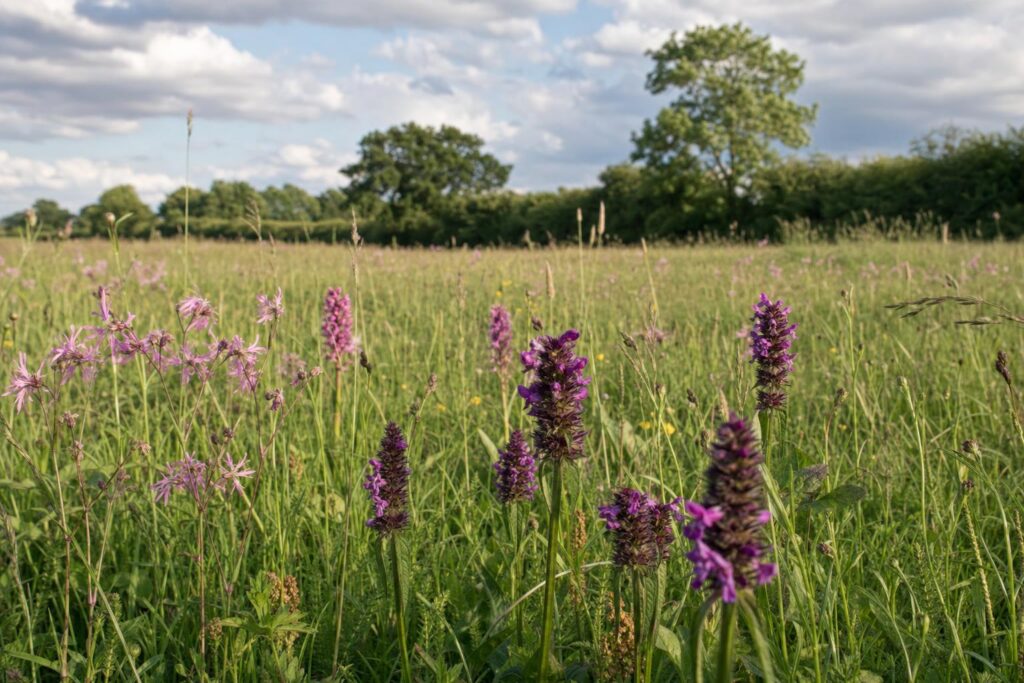
On the clay plain itself, Gowy Meadows near Chester — 165.8 hectares of low-lying wet pasture managed by Cheshire Wildlife Trust on behalf of Shell UK — shows how floodplain grassland can support water voles, otters and breeding snipe and lapwing even on heavy ground, while Swettenham Valley near Holmes Chapel is a genuine local-provenance restoration story: in 2016, part of the reserve was restored using green hay harvested from a neighbouring meadow, bringing in betony, devil’s-bit scabious, ragged robin and common spotted orchid without a single bag of shop-bought seed. Rostherne Mere, the largest of the Cheshire meres near Knutsford, rounds out the picture as a Ramsar wetland site of international importance for wintering wildfowl.
Cheshire Wildlife Trust’s own “Pollinating Cheshire” initiative — targeting 300 hectares of new species-rich grassland by 2030 — is worth knowing about if you’re considering a larger restoration project, since it signals where local support and expertise are concentrated.
Sowing wildflower seeds in Cheshire: timing and ground preparation
Autumn sowing, from late August through October, is the safer default across Cheshire’s clay-dominated landscape — it allows Yellow Rattle (Rhinanthus minor) and other cold-requiring species to break dormancy over winter, as explained in our guide to why Yellow Rattle is essential for wildflower meadows. Spring sowing (March–April) is a realistic option on the free-draining sandstone ridge, but on the Cheshire Plain’s heavy clay, wet ground often delays cultivation well into spring, making the autumn window the more practical choice.
Ground preparation on clay demands particular discipline: strip existing vegetation without deep cultivation, which only brings more weed seed to the surface and improves conditions for the coarse grasses you’re trying to suppress. Our step-by-step guide to establishing a wildflower meadow and our note on the best times to sow both cover this in more detail.
Managing your Cheshire wildflower meadow long-term
Expect three years before a Cheshire meadow looks properly established: root and leaf growth dominate year one, a partial flowering display appears in year two, and a full sward develops from year three. An annual late-summer cut, with arisings removed rather than left to rot down, is the single most important ongoing management task — it keeps soil fertility low, which is exactly the condition wildflowers need and coarse grass doesn’t want.
On the clay plain, be prepared for more active early management: Yellow Rattle is your main tool here, weakening the grass roots that would otherwise crowd out slower-establishing wildflowers. On the sandstone ridge and moss-edge ground, the opposite risk applies — periodic scrub and birch control prevents acid grassland and heath from reverting to woodland.
Wildflower seeds for larger-scale projects and Biodiversity Net Gain in Cheshire
Cheshire’s biodiversity net gain landscape is more developed than in many counties, and it’s genuinely useful to know before starting a project. Cheshire East consulted on a draft Ecology and Biodiversity Net Gain Supplementary Planning Document from October 2023, bringing the council into line with the Environment Act 2021 ahead of the February 2024 national BNG mandate. Cheshire West and Chester went further, publishing an Interim BNG and Ecological Networks Guidance Note in March 2024 that maps a countywide ecological network — core areas, corridors, stepping stones and restoration zones — and applies a 1.15x weighting multiplier to habitat created within it, with priority habitat types explicitly including lowland meadow.
Cheshire West and Chester has also set up its first council-run habitat bank at Grange Woods, between Chester and Frodsham — 8.56 hectares registered with Natural England, creating species-rich grassland, native broadleaved woodland and ponds — alongside a separate commercial habitat bank agreement at Eaton Lane, Davenham. Cheshire Wildlife Trust itself was appointed a Defra-registered Responsible Body in mid-to-late 2025, enabling it to enter legally binding Conservation Covenants with landowners and developers, and operates its own registered biodiversity gain sites at Saltersford Farm and Greenbooth. Cheshire’s Local Nature Recovery Strategy, led by Cheshire West and Chester Council as the statutory responsible authority, went through consultation from February 2025 with final adoption following in early 2026 — describing Cheshire as “one of the most species-depleted counties in England” and setting a headline target of creating or restoring 5,000km of hedgerows alongside grassland restoration.
Growth around Crewe and South East Warrington is the backdrop to rising BNG demand in the county, though the long-discussed HS2 link to Crewe has been in genuine doubt since late 2025 and shouldn’t be treated as a confirmed project. For anyone assessing land for habitat banking, our guide to wildflower seeds for biodiversity net gain beyond the baseline and our housing and development page cover sourcing seed for schemes at this scale.
Cheshire’s dairy and mixed farming base is well suited to Sustainable Farming Incentive wildflower and habitat actions — see our practical guides to SFI action CAHL1 (pollen and nectar flower mix) and SFI action CIPM2 (flower-rich grass margins) — though no county-specific uptake figures are published, so treat any national or regional statistics you see quoted as context rather than a Cheshire number.
Locally sourced wildflower seeds for Cheshire
Wildahome’s seed comes from donor meadows in Devon and Powys, chosen for genetic compatibility with lowland British grassland rather than for proximity to Cheshire itself. What matters for establishment success is that the seed suits the county’s climate and its range of soil chemistry, from acidic sandstone ridge to heavy Plain clay, rather than being a one-size-fits-all mix with no real connection to British growing conditions. Our page on why locally sourced wildflower seeds really matter explains the reasoning in more depth.
For larger or mixed-soil Cheshire sites — a farm spanning both Plain clay and sandstone ridge, or a BNG habitat bank with several distinct habitat targets — our bespoke wildflower seed mixes service builds a blend to match your actual site survey.
Ready to choose the right mix?
Whether you’re restoring a meadow on the Cheshire Plain, working with sandstone-ridge grassland, or planning habitat creation for a BNG obligation, matching the mix to your soil is the decision that determines everything downstream. Browse our full range of wildflower seed mixes, read our advice section for detailed establishment guidance, or get in touch to talk through a bespoke approach for your site.
Frequently Asked Questions
What are the best wildflower seeds for Cheshire?
It depends on which part of the county you’re in. The Cheshire Plain’s heavy boulder clay around Sandbach and Crewe needs a heavy clay mix; the Mid-Cheshire Sandstone Ridge suits an acidic soils mix; and the salt-affected flashes around Northwich and Nantwich do better with a loam and alluvial or wetland mix. There’s no single mix that fits every Cheshire site.
When should I sow wildflower seeds in Cheshire?
Autumn, ideally late August to October, is the safer window across most of the county — it lets seed go through a proper winter chill before germinating, which species like Yellow Rattle need. A spring window between March and April works on the free-draining Sandstone Ridge, but is a harder call on the Cheshire Plain’s heavier clay.
Can wildflowers grow on the Cheshire Plain’s clay soil?
Yes, though it takes more patience than on the sandstone ridge. Boulder clay favours vigorous grasses, so success depends on stripping vegetation without deep cultivation, avoiding any added fertility, and choosing species that can compete. Yellow Rattle is particularly valuable here, weakening grass roots to give wildflowers room to establish over two to three years.
What is Cheshire’s biodiversity net gain requirement?
Cheshire’s authorities apply the England-wide mandatory 10% biodiversity net gain on qualifying developments, in force since February and April 2024. Cheshire West and Chester has published its own Interim BNG and Ecological Networks Guidance Note, and Cheshire Wildlife Trust was appointed a Defra-registered Responsible Body in 2025, enabling it to enter legally binding Conservation Covenants with landowners and developers.
Are there registered BNG habitat banks in Cheshire?
Yes. Cheshire West and Chester Council runs a habitat bank at Grange Woods between Chester and Frodsham, and Cheshire Wildlife Trust operates its own registered biodiversity gain sites at Saltersford Farm and Greenbooth. It’s worth checking current availability directly, since gain-site capacity changes as units sell.
Is Cheshire seed the same as seed from other counties?
Not exactly, but it’s closely matched. Wildahome’s seed is harvested from donor meadows in Devon and Powys, then selected specifically as wildflower seeds for Cheshire’s clay-to-sandstone-to-acid-moss soil range and the county’s climate, rather than sold as one generic UK mix. For most gardens, paddocks and BNG sites, that regional matching gives noticeably better establishment than seed with no connection to the county’s conditions at all.
How long does it take to establish a wildflower meadow in Cheshire?
Budget three years for a proper result, whichever part of Cheshire you’re in: mostly leaf and root growth in year one, a partial flowering display in year two, and a full meadow from year three onward. Cheshire Plain clay in particular tests patience — don’t judge a new meadow’s success by its first summer alone.
Ready to get started?
Shop: Traditional Wildflower Meadow Mix →Frequently asked questions
What are the best wildflower seeds for Cheshire?
It depends on which part of the county you're in. The Cheshire Plain's heavy boulder clay around Sandbach and Crewe needs a heavy clay mix; the Mid-Cheshire Sandstone Ridge suits an acidic soils mix; and the salt-affected flashes around Northwich and Nantwich do better with a loam and alluvial or wetland mix. There's no single mix that fits every Cheshire site.
When should I sow wildflower seeds in Cheshire?
Autumn, ideally late August to October, is the safer window across most of the county — it lets seed go through a proper winter chill before germinating, which species like Yellow Rattle need. A spring window between March and April works on the free-draining Sandstone Ridge, but is a harder call on the Cheshire Plain's heavier clay.
Can wildflowers grow on the Cheshire Plain's clay soil?
Yes, though it takes more patience than on the sandstone ridge. Boulder clay favours vigorous grasses, so success depends on stripping vegetation without deep cultivation, avoiding any added fertility, and choosing species that can compete. Yellow Rattle is particularly valuable here, weakening grass roots to give wildflowers room to establish over two to three years.
What is Cheshire's biodiversity net gain requirement?
Cheshire's authorities apply the England-wide mandatory 10% biodiversity net gain on qualifying developments, in force since February and April 2024. Cheshire West and Chester has published its own Interim BNG and Ecological Networks Guidance Note, and Cheshire Wildlife Trust was appointed a Defra-registered Responsible Body in 2025, enabling it to enter legally binding Conservation Covenants with landowners and developers.
Are there registered BNG habitat banks in Cheshire?
Yes. Cheshire West and Chester Council runs a habitat bank at Grange Woods between Chester and Frodsham, and Cheshire Wildlife Trust operates its own registered biodiversity gain sites at Saltersford Farm and Greenbooth. It's worth checking current availability directly, since gain-site capacity changes as units sell.
Is Cheshire seed the same as seed from other counties?
Not exactly, but it's closely matched. Wildahome's seed is harvested from donor meadows in Devon and Powys, then selected specifically as wildflower seeds for Cheshire's clay-to-sandstone-to-acid-moss soil range and the county's climate, rather than sold as one generic UK mix. For most gardens, paddocks and BNG sites, that regional matching gives noticeably better establishment than seed with no connection to the county's conditions at all.
How long does it take to establish a wildflower meadow in Cheshire?
Budget three years for a proper result, whichever part of Cheshire you're in: mostly leaf and root growth in year one, a partial flowering display in year two, and a full meadow from year three onward. Cheshire Plain clay in particular tests patience — don't judge a new meadow's success by its first summer alone.
More county guides
Find the right native wildflower mix for your county, or browse our full list by region.