

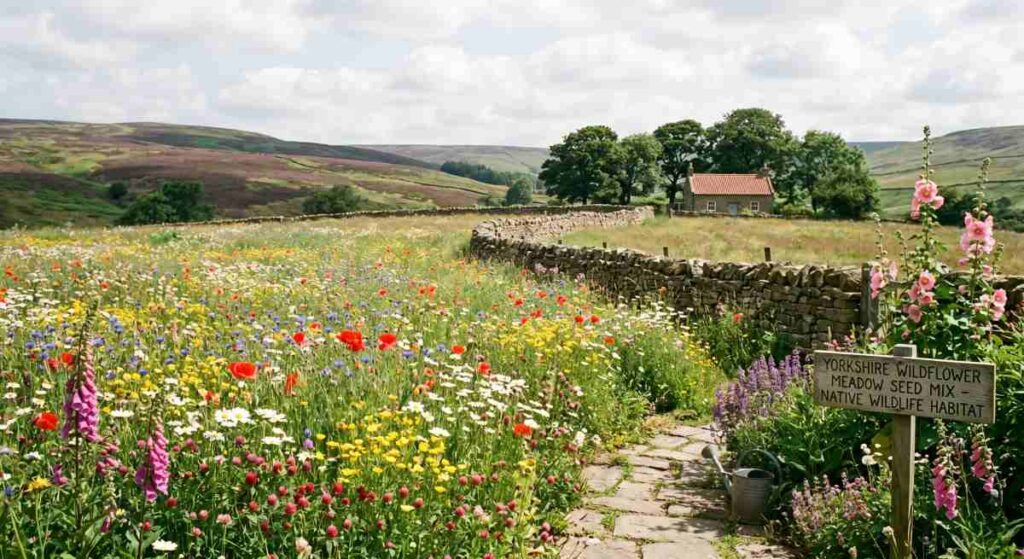
Wildflower Seeds for Yorkshire: Native Mixes Across England’s Largest County
Wildflower Seeds for Yorkshire: Native Mixes Across England’s Largest County
Yorkshire is England’s largest historic county, and its ecological range is correspondingly vast. The Yorkshire Dales in the west carry some of the finest limestone grassland and hay meadow communities anywhere in Britain. The North York Moors to the north-east hold the largest continuous area of heather moorland in England. The Yorkshire Wolds — the chalk arc curving from the Humber through Driffield to Scarborough — are home to calcareous grassland of national importance. The Pennine uplands in the west carry acidic moorland, blanket bog, and the distinctive hay meadow communities of the Dales. And the Vale of York and the river valleys of the Ouse, Aire, Wharfe, Swale, and Ure carry alluvial meadow and wetland habitats.
For anyone looking for wildflower seeds in Yorkshire, this diversity makes site assessment even more important than usual. What works in a Dales limestone meadow above Leyburn is quite different from what’s needed on a Pennine moorland fringe above Hebden Bridge, or on the chalk Wolds above Driffield, or on a Vale of York riverside floodplain near York itself. The right mix starts with an honest reading of your ground.
Yorkshire’s soils and habitats: five landscapes, five approaches
The Yorkshire Dales — the national park running from Swaledale in the north to Wharfedale and Malhamdale in the south — sit predominantly on Carboniferous Limestone, producing some of the richest calcareous grassland in Britain. The Dales limestone meadows carry Wood Crane’s-bill (Geranium sylvaticum), Melancholy Thistle (Cirsium heterophyllum), Globeflower (Trollius europaeus), Common Rock-rose (Helianthemum nummularium), Bird’s-eye Primrose (Primula farinosa), and Mountain Pansy (Viola lutea). These are internationally significant habitats — any restoration work should draw on Yorkshire Wildlife Trust guidance and agri-environment scheme frameworks.
The North York Moors carry the largest single block of heather moorland in England on acidic, peaty Jurassic sandstone soils. Heather (Calluna vulgaris), Bell Heather (Erica cinerea), Bilberry (Vaccinium myrtillus), and Purple Moor-grass (Molinia caerulea) define the plateau. On intact moorland, management is the primary tool. An Acidic Soils mix supports restoration on degraded moorland margins and disturbed upland ground.
The Yorkshire Wolds — the chalk escarpment running from the Humber through Driffield and Sledmere to Scarborough — carry thin, alkaline, free-draining chalk soils. The surviving chalk grassland holds Clustered Bellflower (Campanula glomerata), Chalk Milkwort (Polygala calcarea), Horseshoe Vetch (Hippocrepis comosa), and Squinancywort (Asperula cynanchica).
The Pennine uplands — the high ground from Saddleworth Moor north through Ilkley Moor, Brimham Rocks, and Nidderdale — carry acidic, peaty, waterlogged soils on Millstone Grit. Purple Moor-grass, Cotton Grass (Eriophorum angustifolium), and Heather are characteristic. On lower slopes and enclosed pasture below the moor edge, traditional meadow and acidic soils mixes establish well on moderately acidic ground.
The Vale of York Ings — the traditional flood meadows along the Swale, Ure, Wharfe, and Derwent — are among the most important surviving wet meadow habitats in northern England. Marsh Marigold (Caltha palustris), Cuckooflower (Cardamine pratensis), and Great Burnet (Sanguisorba officinalis) characterise the best-managed sites.
Choosing the right wildflower seeds for Yorkshire
Chalk and Limestone Mix — for the Yorkshire Wolds chalk grassland, the Dales limestone grassland, and any site with thin, alkaline, free-draining calcareous soil with a pH above 6.5. Horseshoe Vetch, Common Rock-rose, Clustered Bellflower, Small Scabious (Scabiosa columbaria), Salad Burnet (Sanguisorba minor), Kidney Vetch (Anthyllis vulneraria), and Wild Thyme (Thymus polytrichus) are appropriate across both chalk and limestone habitats. On Dales limestone inbye meadows, seek specialist input before sowing — the existing communities may be nationally important.
Traditional Meadow Mix — for the Vale of York lowland farmland, the lower Dales valley floors, and any moderately fertile, reasonably well-drained site. Meadow Cranesbill (Geranium pratense), Knapweed (Centaurea nigra), Ox-eye Daisy (Leucanthemum vulgare), Yellow Rattle (Rhinanthus minor), Great Burnet (Sanguisorba officinalis), and Bird’s-foot Trefoil (Lotus corniculatus) are characteristic of the northern meadow flora. Yellow Rattle is essential on any site with established grass.
Acidic Soils Mix — for the North York Moors fringe, the Pennine lower slopes, and any site with a pH below 5.5 and acidic, free-draining or peaty soils. Heath Bedstraw (Galium saxatile), Tormentil (Potentilla erecta), Harebell (Campanula rotundifolia), Devil’s Bit Scabious (Succisa pratensis), and Heath Spotted Orchid precursors are the target species for acidic Yorkshire grassland restoration.
Wetland and Pond Mix — for the Yorkshire Ings flood meadows, river margins along the Ouse, Swale, Ure, Derwent, and Wharfe, and any site with seasonally waterlogged conditions. Ragged Robin (Lychnis flos-cuculi), Yellow Flag Iris (Iris pseudacorus), Meadowsweet (Filipendula ulmaria), Purple Loosestrife (Lythrum salicaria), Marsh Marigold, and Great Willowherb (Epilobium hirsutum) suit the Yorkshire river valley conditions. Sow in Autumn into exposed wet or moist soil.
Sowing wildflower seeds in Yorkshire: timing and ground preparation
Yorkshire’s climate varies significantly across the county. The western Pennines are among the wettest parts of England, regularly receiving over 1,500mm annually. The Vale of York and the Wolds are considerably drier, closer to 600 to 700mm. Autumn sowing (late August to October) is the preferred approach across all soil types and climate zones.
Yellow Rattle must be sown in September on all lowland and valley sites where grass competition is the main threat. On the naturally low-fertility limestone and chalk grasslands of the Dales and Wolds, it is less urgent. On the fertile Vale of York alluvial soils, it is the most important single component of any meadow mix. On upland Pennine sites, grass competition is less intense and Yellow Rattle can be included or omitted depending on the grassland character.
On the chalk Wolds and Dales limestone, scarification to expose 40 to 60 percent bare calcareous soil is usually sufficient. On the Vale of York clay and alluvial soils, rotovation or topsoil stripping targets 50 to 70 percent bare soil. On the Pennine acidic soils, shallow scarification avoiding deep disturbance is preferred — on slopes with high rainfall, over-preparation creates erosion risk.
Managing Yorkshire wildflower habitats for the long term
The Yorkshire Dales hay meadow management tradition — cut for hay in late July or August after wildflowers have set seed, remove all cuttings, graze the aftermath lightly with cattle or sheep through Autumn, never fertilise — is among the most effective wildflower grassland management systems in Britain. It is the direct model for any traditional meadow establishment in Yorkshire.
On the North York Moors and Pennine uplands, rotational management of heather — cutting or burning on a 10 to 15 year cycle — maintains the structural variety that moorland invertebrates and ground-nesting birds need. On the lower slopes and enclosed moorland-edge pastures, the traditional meadow cutting regime is appropriate.
On the Yorkshire Ings and river valley wet meadows, water level control is the critical management tool. Winter flooding and summer drawdown — the natural flood meadow cycle — maintains the characteristic Ings flora. Where hydrology has been modified by drainage, working with the Environment Agency and Yorkshire Wildlife Trust to restore water level regimes is more important than seed introduction alone.
Locally sourced wildflower seeds for Yorkshire
Wildahome sources seed from UK meadows and partner farms, with provenance matched to regional habitats wherever possible. For Yorkshire projects, the Chalk and Limestone, Traditional Meadow, Acidic Soils, and Wetland and Pond mixes all contain species appropriate to the county’s extraordinary range of habitats. Yorkshire’s ecological complexity makes a conversation before ordering always worthwhile. Contact us and we’ll help identify the right mix for your specific ground.
From the Dales hay meadows to the Wolds chalk grassland, the Pennine moorland to the Yorkshire Ings, this county holds some of the most celebrated wildflower habitats in Britain. Browse our seed mixes or contact us to discuss your project.
Ready to get started?
Shop: Traditional Wildflower Meadow Mix →Frequently asked questions
When's the best time to sow a wildflower mix?
Late summer to early autumn (August to September) is the best sowing window for most of the UK -- seed goes into warm, moist soil ahead of winter and gets the cold, damp period many native wildflower seeds need to break dormancy. A second window opens in spring (March to April) once the ground has warmed, though autumn sowing usually establishes faster with fewer weed problems.
Why does local seed provenance matter?
Seed grown from populations adapted to similar soil, rainfall and temperature conditions germinates more reliably and settles into a stronger, longer-lived meadow than seed sourced from a very different climate. That's why we match seed to comparable growing conditions rather than supplying one generic UK-wide mix.
Do I need to prepare the ground before sowing?
Yes, and it's the single biggest factor in whether a meadow succeeds. Existing vegetation and topsoil fertility need to be reduced, since most UK soils are too nutrient-rich for wildflowers and favour competitive grasses and weeds instead. In practice that usually means clearing down to bare soil, raking to a fine tilth, and sometimes sowing yellow rattle alongside the mix to suppress grass vigour.
How long before it looks like a proper meadow?
Most sites show flowers in year one, but a settled, species-rich meadow typically takes two to three growing seasons to establish as slower perennials build up and the balance between grasses and wildflowers matures. Very fertile ground can take longer, since excess nutrients need to be drawn down through repeated cutting and removal of cuttings.
What ongoing management does a wildflower meadow need?
An annual cut in late summer, after flowering and seed-set, with the cuttings removed rather than left to rot down, is the core of long-term management. This keeps fertility low and stops coarse grasses and scrub taking over. Spring topping and occasional scarification help in the early years, and light grazing can replace cutting on some sites.
More county guides
Find the right native wildflower mix for your county, or browse our full list by region.