

Gwent Levels Wildflower Meadows: A Practical Guide for Developers
Building on or beside the Gwent Levels means working in one of the most protected lowland landscapes in Wales. Get the wildflower element right and it can carry much of a scheme’s biodiversity case. Get it wrong and you are left with a rush-choked, waterlogged verge that satisfies nobody, least of all the planning officer.
This guide covers how to plan, sow and manage Gwent Levels wildflower meadows on development, commercial and infrastructure sites between Cardiff and Chepstow. It is written for developers, landscape architects, ecologists and site managers who need a meadow that establishes properly and still looks right five years after handover.
The Levels are not a typical lowland site. The soils are wet, heavy alluvial clay. Water is managed through a network of drainage ditches that is centuries old. And since 2024, Welsh planning policy has asked every development to deliver a net benefit for biodiversity, not simply to avoid harm.
Below we cover what makes the ground different, what Welsh policy expects, which native species thrive here, how to prepare and sow wet clay soil, and how to manage the meadow for the long term. Where there are limits or risks, we say so.
What makes the Gwent Levels different
The Gwent Levels (Gwastadeddau Gwent) are a strip of reclaimed coastal land running along the Severn Estuary from the eastern edge of Cardiff to Chepstow. The River Usk splits them in two: the Wentlooge Level to the west and the Caldicot Level to the east. Most of the land rarely rises more than 10 metres above sea level, and a sea wall keeps the tide out.
Across the Levels there are over 1,500 km of reens and ditches. These are the straight, man-made drainage channels that define the landscape and carry much of its wildlife value. Eight Sites of Special Scientific Interest cover a large share of the area, and the reens support rare aquatic plants such as hairlike pondweed, along with water voles, otters and the great silver water beetle.
Soils: wet alluvial clay
Beneath the Levels lie metres of estuarine clay and silt laid down over thousands of years, with peat beds in places. The typical soil is a groundwater gley: a silty topsoil over a dense, poorly drained clay subsoil. The better-drained ground has been cropped, but the wetter land has stayed largely in permanent pasture, much of it infested with rushes.
For meadow creation, two things matter most. First, the subsoil holds water for long periods in winter. Second, pasture that has been improved or cropped often carries high residual fertility in the topsoil. Both shape what you can sow and how you prepare.
Climate and water management
The Levels are mild and low-lying, with a longer growing season than the Welsh uplands but heavy, wet winters. Water levels in the reens are actively managed, and the system depends on rainfall, springs and winter run-off rather than a large river supply.
Since 2015, Natural Resources Wales (NRW) has run the internal drainage district that manages the reens. Works in or close to a reen usually need consent, so check before you plan any meadow margin, swale or outfall that touches the network.
Biodiversity net gain in Wales: what developers on the Levels need to know
If you have worked in England, put the Biodiversity Metric to one side. England’s mandatory biodiversity net gain does not apply in Wales. Instead, Planning Policy Wales asks every development to deliver a net benefit for biodiversity, using a stepwise approach: avoid harm first, then minimise, then mitigate, and only compensate as a last resort.
There is no single statutory metric. Proposals are judged on ecosystem resilience, using five attributes often shortened to DECCA: diversity, extent, condition, connectivity and adaptability. A gain in one attribute cannot be traded against a loss in another.
The Gwent Levels National Natural Resource Area
Future Wales, the national development plan, identifies the Gwent Levels as one of nine National Natural Resource Areas. In February 2026 the Welsh Government consulted on draft strategic planning guidance for this area. If adopted as drafted, the key points for developers are:
- Every land use in the area should deliver a net benefit for biodiversity.
- In the most sensitive Core Zone, that benefit should be delivered entirely on-site.
- Ecological information is expected with the application, not deferred to conditions.
- Surface water discharges should match greenfield run-off rates, without affecting water levels or quality in the reens.
The guidance was still a draft at the time of writing, so check the adopted version with the local planning authority before you finalise a scheme. The direction of travel is clear, though: on-site habitat that is well designed and properly managed will carry real weight. Species-rich grassland is exactly that kind of habitat.
Which plants thrive in Gwent Levels wildflower meadows
Most development sites on the Levels have two kinds of ground: wet, low-lying clay close to reens and swales, and drier made-up or raised ground around buildings, roads and bunds. Match the mix to each zone rather than spreading one mix across the whole site.
Great Traston Meadow, a Gwent Wildlife Trust reserve near Newport, shows the pattern well. Lesser spearwort, rushes and sedges grow in the damper hollows. Yellow rattle, southern marsh orchid and grass vetchling grow on the drier ground.
Wet ground, swales and reen buffers
On ground that is waterlogged in winter but dries in summer, use a wet-meadow mix. Meadowsweet (Filipendula ulmaria), ragged robin (Silene flos-cuculi), greater bird’s-foot trefoil (Lotus pedunculatus), marsh woundwort (Stachys palustris) and water mint (Mentha aquatica) all suit these conditions. Purple loosestrife (Lythrum salicaria) adds height along swale edges, and yellow flag iris (Iris pseudacorus) suits the wettest swale bottoms.
Do not sow into the reen banks themselves on or near an SSSI. Those margins have their own flora and their own consent regime. A sown buffer strip set back from the bank is the better contribution.
Drier ground, bunds and raised areas
On better-drained ground, use a mix built for heavy clay. Common knapweed (Centaurea nigra), oxeye daisy (Leucanthemum vulgare), bird’s-foot trefoil (Lotus corniculatus), red clover (Trifolium pratense) and meadow vetchling (Lathyrus pratensis) all establish reliably on heavy soils.
Yellow rattle (Rhinanthus minor) belongs on this ground too. It weakens vigorous grasses, which matters on former pasture where ryegrass is never far away.
Planting for the shrill carder bee
The Levels are one of the last UK strongholds of the shrill carder bee (Bombus sylvarum), one of Britain’s rarest bumblebees. It needs a long run of flowers from spring into early autumn and a large area of connected habitat.
Red clover, common knapweed, bird’s-foot trefoil, vetches and red bartsia (Odontites vernus) are all valuable forage. A development meadow that stays in flower through August and September, linked to neighbouring field margins, is a direct contribution to this species. It also gives an ecologist something concrete to point to in the net benefit case.
Preparing wet clay soil for wildflower seed
Ground preparation decides most of the outcome, and on development sites it is where most meadows fail. The two problems to solve are excess fertility and compaction.
Reduce fertility, never add it
Wildflowers do best in low-nutrient soil. Fertile topsoil favours docks, thistles and coarse grasses, which swamp sown seedlings within a season. On former pasture or arable land, consider stripping the top 50–150mm of topsoil from the meadow area and reusing it under hard landscaping or in amenity lawns. On some sites, inverting the soil to bring subsoil to the surface does the same job.
Do not bring in topsoil, compost, manure or fertiliser for meadow areas. This is the most common specification error we see. A bare, slightly hungry clay surface is a better starting point than a rich loam.
Deal with compaction and drainage
Construction traffic compacts clay badly, and compacted clay ponds water. Before sowing, decompact running routes and laydown areas with a subsoiler when the ground is dry enough to fracture rather than smear. Shape swales and scrapes so that standing water drains away. Wet-meadow plants tolerate seasonal waterlogging, but few survive months under water.
- Do: strip or invert fertile topsoil in meadow zones.
- Do: decompact haul routes in dry weather.
- Do: clear rushes, docks and thistles before sowing.
- Avoid: imported topsoil, compost or fertiliser.
- Avoid: working the clay when it is wet and plastic.
When and how to sow wildflower seeds in South Wales clay
The sowing window for wildflower seeds in South Wales is mid-August to late October. On the Levels, aim for the earlier half of that window. Clay can become too wet to work by November, and seed sown in late summer has time to germinate before winter.
Autumn sowing also matters for yellow rattle and several other natives, which need a period of winter cold before they will germinate in spring.
- Prepare a fine, firm surface. A rough tilth is fine on clay, provided there are no large clods.
- Mix the seed with kiln-dried sand so you can see where it has gone and spread it evenly.
- Sow on the surface. Do not rake the seed in, because most wildflower seed needs light to germinate.
- Roll or tread the surface to press the seed into contact with the soil.
- Leave it. Routine watering is not needed, and autumn rain will do the work.
Sow 100% wildflower mixes at 3g/m² and 80/20 grass and wildflower mixes at 5g/m². On larger sites, a seed broadcaster gives more even coverage than hand sowing.
Long-term management of Gwent Levels wildflower meadows
A meadow is a managed habitat, not a one-off planting. Planning authorities on the Levels will expect a management plan for the life of the development, and the meadow will only keep its value if that plan is followed.
Year one
Expect annual weeds to dominate the first summer. Cut the sward to 50–75mm whenever it reaches about 150mm, and remove the cuttings. This lets light reach the slower-growing perennials. Many sown species will not flower until year two.
Year two onwards
Take a hay cut once the main flowering has finished and seed has set. On the Levels this is usually late July to late August. Leave the hay to dry for a few days so seed drops, then remove it. Cutting without removing adds nutrients back to the soil and reverses your preparation.
Wetter areas can be cut later, once the ground firms up. Leave 10–20% uncut each year as rotating refuge strips for overwintering insects, which also helps the shrill carder bee. Where grazing is available, light aftermath grazing with cattle or sheep in autumn is ideal.
Meadows take three to five years to settle. Species balance will shift from year to year, and an early flush of one or two species such as ribwort plantain is normal. Keep rushes in check by cutting before they seed.
Where native bulbs fit on Levels sites
Native bulbs are a useful addition to development landscaping, but they belong in the right part of the site. They do not suit the open, seasonally waterlogged grassland of the Levels.
Plant them in shaded, better-drained areas: under retained hedgerows, along woodland edges and in tree planting around buildings. Wild garlic or ramsons (Allium ursinum) thrives in damp, shaded hedge bases. Native bluebells (Hyacinthoides non-scripta) and wild daffodils (Narcissus pseudonarcissus) suit drier shade under trees. Plant bulbs in autumn, at the same time as meadow sowing, so the whole scheme establishes on one programme.
Choosing the right Wildahome mix for a Levels site
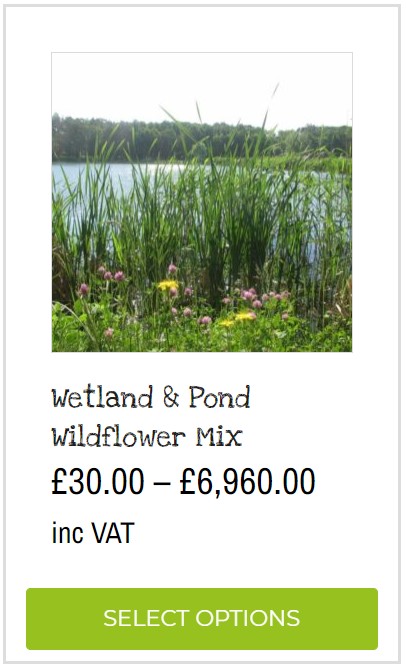
For wet zones, swales and reen buffers, our Wetland & Pond mix is the natural starting point. Use the 100% wildflower version where you want maximum flower cover, or the 80/20 version where you need a grass sward to stabilise swale sides and resist erosion.
For drier made ground and bunds on the clay, our Heavy Clay mix is the better fit. Where the soil is siltier and drains more freely, the Loam & Alluvial mix suits it. Either pairs well with additional Yellow Rattle wherever the ground was previously improved pasture.
For larger schemes, we can blend standard mixes to suit the wet and dry zones on your plans. We harvest seed as close to the site as we can and match it to local soil types.
Planning a meadow on the Gwent Levels?
If you are preparing a landscape or net benefit strategy for a site on the Levels, send us the site plan and the areas you need to cover. We will recommend mixes for each zone, quantities and a sowing programme your contractor can follow, and quote for bulk supply. Get in touch on 0333 242 0602 or paul@wildahome.co.uk. If your site sits further inland, see our Monmouthshire guide.
Frequently Asked Questions
Does biodiversity net gain apply to developments in Wales?
Not in the English sense. England’s mandatory 10% biodiversity net gain does not apply in Wales. Instead, Planning Policy Wales requires every development to deliver a net benefit for biodiversity, using a stepwise approach and judged on ecosystem resilience rather than a single metric. On the Gwent Levels, draft guidance also expects that benefit to be delivered on-site in the most sensitive areas.
What wildflowers grow on the Gwent Levels?
Wet meadow species do well on the damper ground: meadowsweet, ragged robin, greater bird’s-foot trefoil, marsh woundwort and water mint. On drier ground, common knapweed, oxeye daisy, bird’s-foot trefoil, red clover and yellow rattle all establish reliably. Local reserves such as Great Traston Meadow also support southern marsh orchid and grass vetchling.
When should I sow Gwent Levels wildflower meadows?
Sow between mid-August and late October, ideally in late August or September. The clay soils on the Levels often become too wet to work by November. Autumn sowing also gives yellow rattle and other natives the winter cold they need to germinate the following spring.
Can you sow wildflower seed on wet clay soil?
Yes, provided you choose species that tolerate seasonal waterlogging and prepare the ground properly. Reduce fertility by stripping or inverting topsoil, relieve compaction in dry weather, and make sure standing water can drain away. A wetland meadow mix suits the wettest areas. A heavy clay mix suits drier ground.
Do I need consent to create a wildflower buffer next to a reen?
Often, yes. NRW manages the internal drainage district on the Gwent Levels, and works in or near reens normally need its consent. Many reens also sit within SSSIs, which brings additional requirements. Check with NRW and your ecologist before you design anything that touches the reen network.
How long does a Gwent Levels wildflower meadow take to establish?
Allow three to five years. The first summer is mostly annual weeds and leafy rosettes, and many perennials only flower from year two. With regular cut-and-remove management, the meadow settles into a stable, species-rich sward over the following seasons.
Which wildflowers help the shrill carder bee?
The shrill carder bee feeds on red clover, common knapweed, bird’s-foot trefoil, vetches and red bartsia. It needs flowers from spring into early autumn across a large, connected area. Late-flowering meadows linked to neighbouring field margins and uncut refuge strips give it the best chance.
Ready to get started?
Shop: Traditional Wildflower Meadow Mix →