

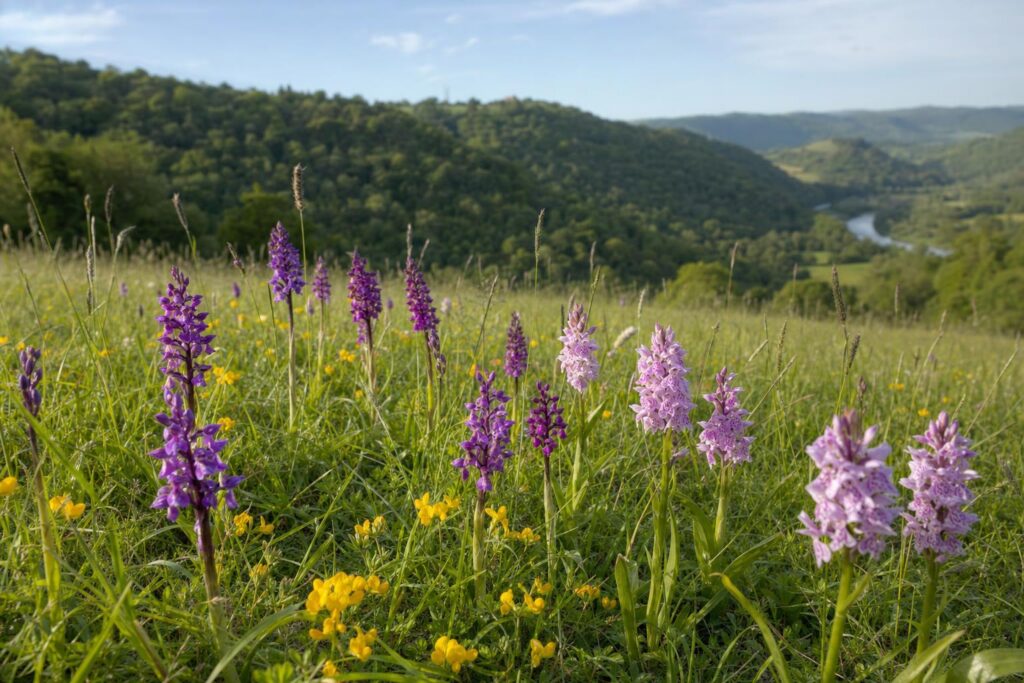
Wildflower Seeds for Monmouthshire: Native Mixes for the Wye Valley, Vale of Usk and Gwent Levels
Wildflower Seeds for Monmouthshire: Native Mixes for the Wye Valley, Vale of Usk and Gwent Levels
Monmouthshire packs an unusual amount of geological variety into a relatively small county. Old Red Sandstone dominates the Black Mountains fringe and the Vale of Usk, giving free-draining, slightly acid-to-neutral ground. The Wye Valley’s limestone slopes around Chepstow and Tintern are thin, lime-rich and free-draining — closer in character to chalk downland than anything else in Wales. And down on the coast, the Gwent Levels are something else again: reclaimed estuarine land, heavy and waterlogged, drained by a centuries-old network of ditches called reens. Choosing wildflower seeds for Monmouthshire means recognising which of these very different landscapes you’re actually standing on.
It’s also worth knowing, before you start, that Wales doesn’t regulate biodiversity the way England does. There’s no mandatory 10% metric here — Welsh planning policy takes a different, case-by-case approach, and it matters for anyone planning a larger habitat project. More on that below.
Understanding Monmouthshire’s soils before you sow
Monmouthshire’s bedrock falls into a few clear bands that map directly onto wildflower seed mix choice.
Old Red Sandstone uplands and the Vale of Usk
The dominant bedrock across central and northern Monmouthshire, forming the Black Mountains escarpment — Hatterrall Hill, Sugar Loaf, Ysgyryd Fawr — and the country around Abergavenny, Raglan, Monmouth and Usk. Soils are generally free-draining and slightly acid-to-neutral, suiting a general-purpose neutral grassland approach; our acidic soils mix is the right starting point on the more acid upland fringes.
The Usk Inlier
Around Usk itself and toward Pontypool, older Silurian shales and limestones create locally calcareous, often thin soils within the Vale of Usk — worth treating as its own pocket rather than assuming the whole vale is uniform sandstone country. A chalk and limestone mix often suits this ground better than a generic neutral blend.
Wye Valley limestone slopes
The valley sides around Chepstow, Tintern and toward Monmouth sit on Carboniferous Limestone — thin, free-draining, lime-rich soils that behave much like chalk downland further east. A chalk and limestone mix is the clear choice here too.
The Gwent Levels
The coastal strip from Magor and Undy to Caldicot and the Newport border is reclaimed intertidal land: roughly 15 metres of alluvial clay and silt over sand and gravel, forming heavy, seasonally waterlogged gleys drained by the reen network. This is genuinely different ground from the rest of the county, calling for a wetland and pond mix or heavy clay mix depending on how wet the specific site is, and a very different establishment approach — there’s no simple scrape-and-sow here, and managing wetness and rush encroachment is an ongoing job rather than a one-off task.
Choosing the right wildflower seeds for Monmouthshire’s habitats
Monmouthshire’s surviving grassland habitats illustrate what each zone can support. On the Old Red Sandstone near Penallt, south of Monmouth, Gwent Wildlife Trust’s Pentwyn Farm Grasslands — 7.6 hectares of traditionally managed unimproved neutral grassland — holds one of the county’s largest green-winged orchid populations, alongside common spotted orchid, common twayblade and greater butterfly orchid, on classic brown-earth soils over sandstone. It’s a useful benchmark for what patient, low-nutrient management can achieve on ORS ground.
Down on the Levels, Magor Marsh — a 36 hectare Gwent Wildlife Trust reserve on peat up to 4.6 metres deep, with a drainage pattern largely unchanged since the 14th century — is one of the richest sites in Wales for wetland beetles and soldier-flies, and supports breeding redshank and snipe. It’s a genuine illustration of what the Gwent Levels’ reens and wet pasture can support when managed for wildlife rather than drained hard for intensive grazing. Monmouthshire holds over 700 Sites of Importance for Nature Conservation, with roughly half of them designated for species-rich grassland — and of the county’s 11 grassland SSSIs, three are recorded as being in unfavourable condition, a sobering local echo of the well-known UK-wide figure that around 97% of species-rich grassland has been lost since the 1930s.
In the Wye Valley itself, woodland-edge grassland around ancient sites such as Croes Robert Wood near Mitchel Troy and Fiddler’s Elbow National Nature Reserve near Monmouth shows the limestone slopes’ potential — bluebell woodland with rare ghost orchid records at Fiddler’s Elbow gives a sense of just how ecologically rich this part of the county remains, even where open grassland has given way to woodland.
Sowing wildflower seeds in Monmouthshire: timing and ground preparation
Autumn sowing, from late August through October, is the more reliable window across Monmouthshire’s Old Red Sandstone and Wye Valley limestone ground, letting seed experience the winter chill that Yellow Rattle (Rhinanthus minor) and similar species need — our guide to why Yellow Rattle is essential for wildflower meadows explains why. On the Gwent Levels, timing is dictated as much by water table as by calendar — wait until the ground is workable rather than sowing to a fixed date, and expect the wettest sites to need more active drainage management before sowing at all.
Ground preparation on the sandstone and limestone zones follows the standard low-nutrient principle: strip vegetation, avoid deep cultivation, never add fertiliser. On the Levels, the priority shifts toward controlling rush and reed encroachment before sowing and being realistic about how long full establishment will take on heavy, wet ground. Our guide to establishing a wildflower meadow and note on the best times to sow cover the general sequence in more depth.
Managing your Monmouthshire wildflower meadow long-term
As with most of Britain, budget three years for a Monmouthshire meadow to reach its full potential: root and leaf growth in year one, a partial flowering display in year two, and a proper sward from year three onward. An annual late-summer cut with arisings removed is the backbone of long-term management everywhere in the county, keeping fertility low.
On the Gwent Levels specifically, ongoing reen and ditch management matters as much as cutting the sward itself — waterlogged ground left unmanaged will revert to rush and reed within a few seasons. On the Wye Valley’s limestone slopes, by contrast, the main long-term risk is scrub encroachment on steeper, less accessible ground, so periodic clearance is worth planning for from the outset.
Wildflower seeds for larger-scale projects and biodiversity in Monmouthshire
Wales handles biodiversity policy differently from England, and it’s worth understanding the distinction before planning a larger Monmouthshire project. There is no mandatory 10% Biodiversity Net Gain metric here. Instead, the Environment (Wales) Act 2016 places a Section 6 duty on public bodies — councils, Natural Resources Wales, Welsh Government agencies — to seek to maintain and enhance biodiversity in exercising their own functions. On the planning side, developers work to “Net Benefit for Biodiversity” (NBB), set out in Chapter 6 of Planning Policy Wales and in force since October 2023, consolidated into PPW Edition 12 in February 2024. NBB requires development to leave biodiversity measurably better off, judged case-by-case through an avoid-minimise-mitigate-compensate-enhance hierarchy rather than a fixed percentage uplift — Monmouthshire County Council applies this approach to all approved planning applications, and publishes guidance noting that not every application needs a professional ecologist involved.
The South East Wales Area Statement, produced by Natural Resources Wales, covers Monmouthshire and identifies the Gwent Levels as one of its priority landscapes, while the Monmouthshire Local Nature Recovery Action Plan sets out three landscape zones for the county — central Monmouthshire farmland, Wye Valley and Wentwood woodland, and the Gwent Levels — with grassland loss and condition flagged as a headline local priority. For farmers, Wales’s new Sustainable Farming Scheme, replacing Glastir and the Basic Payment Scheme from January 2026, includes a Universal Action 5 for maintaining existing semi-natural habitat and a Universal Action 6 for creating temporary habitat where a holding falls short of a mandatory minimum 10% habitat threshold, calculated across semi-natural habitat, broadleaf woodland, hedgerows and temporary habitat combined. Monmouthshire’s predominantly livestock and mixed grassland farming base — concentrated on the Old Red Sandstone uplands and the Vale of Usk — means this threshold applies broadly across the county’s holdings, though no Monmouthshire-specific uptake figures for the scheme have been published yet.
Growth pressure around Chepstow, Monmouth and Abergavenny, along with development near the M4 corridor at Magor and Undy, is the practical backdrop driving demand for habitat creation and enhancement across the county, even without England’s metric-driven system behind it. For anyone planning habitat work tied to a planning application, our guide to wildflower seeds for biodiversity net gain beyond the baseline and our housing and development page cover sourcing seed for projects at this scale, and our page on civic institutions may be useful for public-body projects responding to the Section 6 duty directly.
Locally sourced wildflower seeds for Monmouthshire
Wildahome’s seed is harvested from donor meadows in Devon and Powys — Powys in particular sits just across the Monmouthshire border, giving genuinely close climatic and soil-chemistry compatibility with much of the county’s Old Red Sandstone ground. That said, what matters most is that the seed suits Monmouthshire’s actual range of conditions, from Wye Valley limestone to Gwent Levels clay, rather than proximity alone. Read more about why locally sourced wildflower seeds really matter.
For larger or mixed-soil Monmouthshire sites — land spanning Old Red Sandstone and Gwent Levels ground, or a habitat project responding to Net Benefit for Biodiversity requirements — our bespoke wildflower seed mixes service builds a blend around your actual site survey.
Ready to choose the right mix?
Whether you’re restoring grassland on the Vale of Usk, managing wet pasture on the Gwent Levels, or planning habitat enhancement for a Monmouthshire development, matching the mix to your ground is the decision everything else depends on. Browse our full range of wildflower seed mixes, explore our advice section, or get in touch if your site needs a bespoke approach.
Frequently Asked Questions
What are the best wildflower seeds for Monmouthshire?
It depends on which part of the county you’re in. The Old Red Sandstone uplands around the Black Mountains and Vale of Usk suit a general neutral grassland mix; the Wye Valley’s limestone slopes around Chepstow and Tintern need a chalk and limestone mix; and the Gwent Levels’ heavy, wet ground does better with a wetland or heavy clay mix. There’s no single mix that fits every Monmouthshire site.
When should I sow wildflower seeds in Monmouthshire?
Autumn, ideally late August to October, is the more reliable window on the sandstone and limestone ground across most of the county — it lets seed go through a proper winter chill before germinating, which species like Yellow Rattle need. On the Gwent Levels, timing depends more on water table than calendar, so wait until the ground is genuinely workable.
Can wildflowers grow on the Gwent Levels’ wet clay soil?
Yes, though it needs a different approach from the rest of Monmouthshire. The Levels’ reclaimed estuarine clay is heavy and seasonally waterlogged, so success depends on managing rush and reed encroachment, choosing a wetland-tolerant mix, and accepting that establishment will take longer and need more ongoing ditch and reen management than on drier ground.
Does Monmouthshire have a mandatory Biodiversity Net Gain requirement like England?
No. Wales does not use England’s mandatory 10% Biodiversity Net Gain metric. Instead, Welsh planning policy uses “Net Benefit for Biodiversity,” a case-by-case approach set out in Planning Policy Wales that requires developments to leave biodiversity measurably better off through an avoid-minimise-mitigate-compensate-enhance hierarchy, applied by Monmouthshire County Council to all approved planning applications.
What is the Sustainable Farming Scheme and does it affect Monmouthshire farmers?
The Sustainable Farming Scheme (SFS) is Wales’s successor to Glastir and the Basic Payment Scheme, starting January 2026. It requires at least 10% of a holding to be active habitat, calculated across semi-natural habitat, woodland, hedgerows and temporary habitat combined — a requirement that applies broadly across Monmouthshire’s largely livestock and mixed grassland farms, particularly on the Old Red Sandstone uplands and Vale of Usk.
Is Monmouthshire seed the same as seed from other counties?
Not exactly, but it’s closely matched. Wildahome’s seed is harvested from donor meadows in Devon and Powys — Powys sits just across the Monmouthshire border — then selected specifically as wildflower seeds for the county’s sandstone-to-limestone-to-clay soil range, rather than sold as one generic UK mix. For most gardens, paddocks and habitat projects, that regional matching gives noticeably better establishment than seed with no connection to local conditions.
How long does it take to establish a wildflower meadow in Monmouthshire?
Budget three years for a proper result on the sandstone and limestone ground that covers most of the county: mostly leaf and root growth in year one, a partial flowering display in year two, and a full meadow from year three onward. On the Gwent Levels’ wet clay, allow longer still, and don’t judge success by the first summer alone.
Ready to get started?
Shop: Traditional Wildflower Meadow Mix →Frequently asked questions
What are the best wildflower seeds for Monmouthshire?
It depends on which part of the county you're in. The Old Red Sandstone uplands around the Black Mountains and Vale of Usk suit a general neutral grassland mix; the Wye Valley's limestone slopes around Chepstow and Tintern need a chalk and limestone mix; and the Gwent Levels' heavy, wet ground does better with a wetland or heavy clay mix. There's no single mix that fits every Monmouthshire site.
When should I sow wildflower seeds in Monmouthshire?
Autumn, ideally late August to October, is the more reliable window on the sandstone and limestone ground across most of the county — it lets seed go through a proper winter chill before germinating, which species like Yellow Rattle need. On the Gwent Levels, timing depends more on water table than calendar, so wait until the ground is genuinely workable.
Can wildflowers grow on the Gwent Levels' wet clay soil?
Yes, though it needs a different approach from the rest of Monmouthshire. The Levels' reclaimed estuarine clay is heavy and seasonally waterlogged, so success depends on managing rush and reed encroachment, choosing a wetland-tolerant mix, and accepting that establishment will take longer and need more ongoing ditch and reen management than on drier ground.
Does Monmouthshire have a mandatory Biodiversity Net Gain requirement like England?
No. Wales does not use England's mandatory 10% Biodiversity Net Gain metric. Instead, Welsh planning policy uses "Net Benefit for Biodiversity," a case-by-case approach set out in Planning Policy Wales that requires developments to leave biodiversity measurably better off through an avoid-minimise-mitigate-compensate-enhance hierarchy, applied by Monmouthshire County Council to all approved planning applications.
What is the Sustainable Farming Scheme and does it affect Monmouthshire farmers?
The Sustainable Farming Scheme (SFS) is Wales's successor to Glastir and the Basic Payment Scheme, starting January 2026. It requires at least 10% of a holding to be active habitat, calculated across semi-natural habitat, woodland, hedgerows and temporary habitat combined — a requirement that applies broadly across Monmouthshire's largely livestock and mixed grassland farms, particularly on the Old Red Sandstone uplands and Vale of Usk.
Is Monmouthshire seed the same as seed from other counties?
Not exactly, but it's closely matched. Wildahome's seed is harvested from donor meadows in Devon and Powys — Powys sits just across the Monmouthshire border — then selected specifically as wildflower seeds for the county's sandstone-to-limestone-to-clay soil range, rather than sold as one generic UK mix. For most gardens, paddocks and habitat projects, that regional matching gives noticeably better establishment than seed with no connection to local conditions.
How long does it take to establish a wildflower meadow in Monmouthshire?
Budget three years for a proper result on the sandstone and limestone ground that covers most of the county: mostly leaf and root growth in year one, a partial flowering display in year two, and a full meadow from year three onward. On the Gwent Levels' wet clay, allow longer still, and don't judge success by the first summer alone.
More county guides
Find the right native wildflower mix for your county, or browse our full list by region.