

Wildflower Seeds for Glamorgan: Native Mixes for the Heritage Coast, Gower and the Valleys
Wildflower Seeds for Glamorgan: Native Mixes for the Heritage Coast, Gower and the Valleys
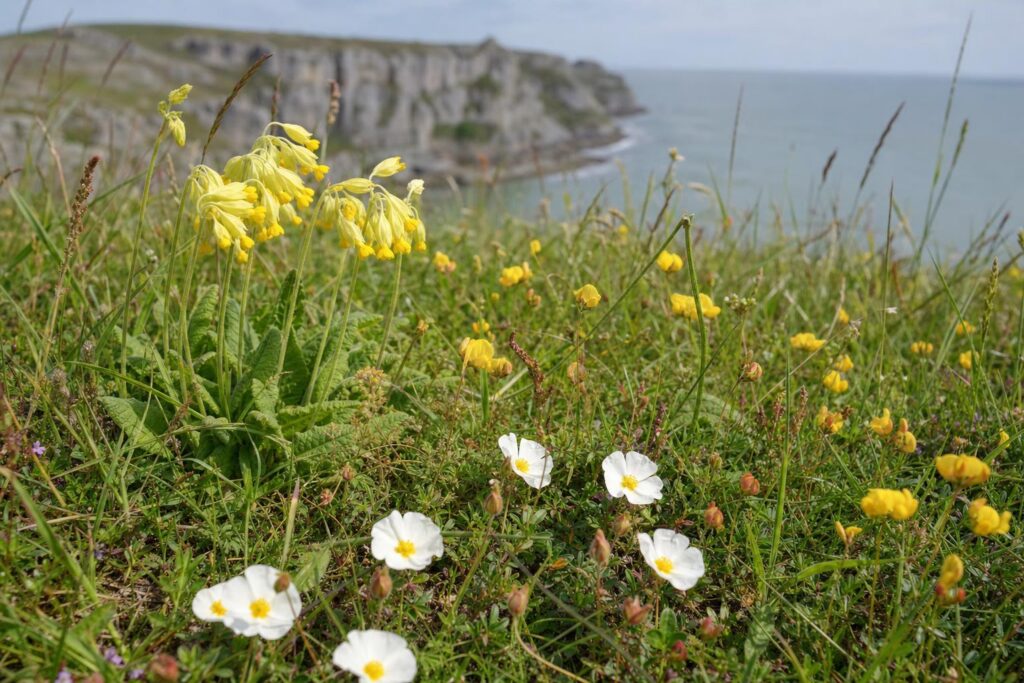
Glamorgan is Wales’s most botanically varied historic county, and it shows in the ground itself. The Heritage Coast running from Penarth to Ogmore is built on Liassic limestone and shale, giving calcareous grassland found nowhere else in South Wales at this scale. The Gower Peninsula, England and Wales’s first Area of Outstanding Natural Beauty, adds dramatic limestone cliffs in the south and some of the most important sand dune systems in Europe along its western edge. And inland, the South Wales Coalfield and its valleys carry a very different legacy — acid upland, marshy grassland and post-industrial ground shaped by two centuries of coal mining. Between them, this one historic county holds over 80% of the entire vascular plant flora of Wales. Choosing wildflower seeds for Glamorgan starts with knowing which of these landscapes your ground belongs to.
That flora total is worth sitting with for a moment: no other Welsh county comes close to Glamorgan’s botanical range, and it reflects genuinely different soil chemistry across a relatively compact area — acidic uplands, calcareous coast and everything in between.
Understanding Glamorgan’s ground before you sow
Glamorgan splits into three practical zones: the limestone coast, the Gower dunes, and the valleys.
The Heritage Coast and Vale limestone
From Penarth to Ogmore, and across much of the Vale of Glamorgan inland of the coast itself, Liassic limestone and shale give calcareous, free-draining soil. A chalk and limestone mix is the natural fit here, and it’s some of the lowest-input ground in the county for wildflower establishment.
Gower’s dunes and limestone cliffs
The south Gower coast holds dramatic limestone cliffs, again suited to a chalk and limestone approach, while the peninsula’s western dune systems — among the finest in Europe — are specialist coastal conservation habitat rather than ground for a standard seed mix. Land just inland of the dunes, with genuinely sandy soil, generally does well with a general-purpose neutral grassland mix.
The Valleys and coalfield
North of the Vale, the South Wales Coalfield and its valleys carry acidic upland soil and post-industrial ground, including coal spoil, with pockets of marshy grassland running up through the coalfield into Gower’s own spine. An acidic soils mix suits most of this ground, though former industrial sites, like brownfield anywhere, vary enough to warrant a soil check before committing to a blend.
Choosing the right wildflower seeds for Glamorgan’s habitats
The Vale’s coastal grassland is Glamorgan’s most accessible calcareous habitat, supporting species like clustered bellflower, purple gromwell and tuberous thistle on ground that’s been grazed and managed lightly for generations. Cosmeston Lakes Country Park, managed by the Vale of Glamorgan Council, is a good practical local model: its meadow areas are cut annually after flowering with the cuttings removed, and lightly grazed by cattle from October through March, supporting cowslip, primrose, bird’s-foot trefoil and pink willowherb — proof that a straightforward cut-and-graze regime, applied consistently, delivers real results on this soil type.
Further west, Gower’s south coast limestone cliffs support genuinely rare specialists like yellow whitlow-grass and goldilocks aster, adapted to exposed, calcium-rich rock faces — plants that won’t feature in any standard mix but which confirm how well limestone habitat performs botanically across this coastline generally. Gower’s dune systems, running from Merthyr Mawr in the east through to Whiteford and Oxwich in the west, are recognised among the finest in Europe: Merthyr Mawr National Nature Reserve alone is rated the second-highest in Europe for its sand dunes, and sites like Kenfig support fen orchid and sea stock in the nutrient-poor, lime-rich conditions dune slacks provide. These systems are actively managed by Natural Resources Wales specifically to control scrub encroachment and prevent succession from closing off the open sand and dune-slack habitat that rare specialists depend on — a reminder that even naturally low-nutrient ground needs ongoing management, not just protection from development.
Inland, the coalfield and valleys tell a different story. Marshy grassland runs from Gower’s spine north through the Vale and up into the coalfield, supporting moisture-loving acid-ground species like cornish moneywort and ivy-leaved bellflower. Old coal spoil and brownfield sites across the Valleys carry their own distinctive flora too, including basil thyme and, occasionally, green helleborine — evidence that Glamorgan’s industrial legacy has, in places, created accidental habitat rather than simply scarred the land. For a landowner or community group working with former industrial ground in the Valleys, that’s genuinely encouraging: this isn’t necessarily poor ground for wildflowers, just different ground, and worth assessing on its own terms rather than assumed to need heavy remediation before anything will grow.
Sowing wildflower seeds in Glamorgan: timing and ground preparation
Autumn sowing, ideally August to October, is the standard optimal window across Glamorgan, and the county’s relatively mild, maritime-influenced climate — milder on the coast than in the upper valleys — gives a reasonably long workable window either side of that. On the limestone coast and Gower’s dune-adjacent ground, autumn sowing reduces drought risk on free-draining soil. In the valleys, where ground can be wetter and colder, autumn sowing lets seed go through a genuine winter chill before spring germination — important for Yellow Rattle, which needs proper cold stratification and does much of the work of opening up a grass-dominated sward.
Limestone coast ground is often naturally low-fertility already, needing minimal preparation before sowing. Valley and coalfield ground needs individual assessment: genuinely unimproved acid grassland needs little work, while former arable or heavily improved pasture needs topsoil removal or several seasons of cropping off without fertiliser first, and old industrial sites need a proper site check before any planting. Our guide to establishing a wildflower meadow and note on the best times to sow cover the general sequence in more depth.
Managing your Glamorgan wildflower meadow long-term
Budget three years for a proper result across most of Glamorgan: modest root and leaf growth in year one, a partial flowering display in year two, and a full meadow from year three onward. An annual late-summer cut with arisings removed is the backbone of long-term management everywhere in the county.
The Vale of Glamorgan Council’s own approach at Cosmeston — an annual cut after flowering, cuttings removed, and light cattle grazing through the dormant winter months — is a genuinely useful template to follow at any scale, from a large paddock down to a modest garden plot managed by cutting alone rather than grazing. On coastal and dune-adjacent land, periodic scrub clearance matters as much as cutting, echoing the work Natural Resources Wales carries out on Gower’s protected dune systems to stop succession closing off open ground. Whatever your ground type, avoid fertilising — low nutrient status is what keeps a Glamorgan meadow a meadow rather than a grass sward with a few flowers scattered through it.
Wildflower seeds for larger-scale projects and biodiversity in Glamorgan
Wales does not use England’s mandatory 10% Biodiversity Net Gain metric. Instead, planning authorities across Glamorgan — the Vale of Glamorgan, Cardiff, Swansea, Bridgend, Rhondda Cynon Taf and Merthyr Tydfil councils — apply Planning Policy Wales’s Net Benefit for Biodiversity requirement, which asks that development leave biodiversity in a significantly better state than before, demonstrated through a Green Infrastructure Statement and the DECCA framework — assessing diversity, extent, condition, connectivity and adaptability rather than a single fixed percentage. This sits alongside the Environment (Wales) Act 2016’s Section 6 duty, which requires every Welsh local planning authority to actively seek to maintain and enhance biodiversity and promote ecosystem resilience through the decisions it makes, including planning. If Net Benefit for Biodiversity genuinely can’t be achieved on a scheme, the guidance is clear that permission should be refused rather than the requirement waived.
The mitigation hierarchy applies here just as it does in England: avoid harm first, minimise what can’t be avoided, then mitigate and compensate as a last resort, with enhancement scaled proportionately to the development rather than treated as a fixed, one-size formula. For Glamorgan’s farmers, the Sustainable Farming Scheme — Wales’s successor to Glastir and the Basic Payment Scheme — requires at least 10% of a holding to be active habitat, calculated across semi-natural habitat, woodland, hedgerows and temporary habitat combined, a requirement newly created wildflower ground can help meet directly across the county’s valley and coalfield farms in particular. Our guide to why locally sourced wildflower seeds really matter covers sourcing seed appropriately for habitat schemes at any scale.
Locally sourced wildflower seeds for Glamorgan
Wildahome’s seed is harvested from donor meadows in Devon and Powys, then selected specifically as wildflower seeds for Glamorgan’s limestone-to-valley soil range and South Wales’s climate, rather than sold as one generic UK mix. For most gardens, paddocks and habitat projects, that regional matching gives noticeably better establishment than seed with no connection to local conditions at all.
For larger or mixed-soil Glamorgan sites — land spanning coastal limestone and valley acid ground, or a habitat scheme responding to Net Benefit for Biodiversity requirements — our bespoke wildflower seed mixes service builds a blend around your actual site survey.
Ready to choose the right mix?
Whether you’re restoring calcareous grassland on Glamorgan’s Heritage Coast, working with sandy ground near Gower’s dune systems, or establishing meadow on acid valley pasture, matching the mix to your ground is the decision everything else depends on. Browse our full range of wildflower seed mixes, explore our advice section, or get in touch if your site needs a bespoke approach.
Frequently Asked Questions
What are the best wildflower seeds for Glamorgan?
It depends on which part of the county you’re in. The Heritage Coast and Vale limestone, plus Gower’s south coast, suit a chalk and limestone mix; land near Gower’s dune systems suits a general-purpose neutral grassland mix; and the Valleys and coalfield generally need an acidic soils mix, with former industrial sites assessed individually.
When should I sow wildflower seeds in Glamorgan?
Autumn, ideally August to October, is the standard window across the county. It reduces drought risk on the free-draining limestone coast and gives seed the winter chill it needs before spring germination in the cooler valleys.
Does Glamorgan have a mandatory Biodiversity Net Gain requirement like England?
No. Wales does not use England’s mandatory 10% Biodiversity Net Gain metric. Instead, planning authorities across Glamorgan require developments to deliver Net Benefit for Biodiversity under Planning Policy Wales and the Environment (Wales) Act 2016’s Section 6 duty — a case-by-case approach based on avoiding, mitigating and compensating harm, assessed through a Green Infrastructure Statement, rather than a fixed percentage uplift.
What is the Sustainable Farming Scheme and does it affect Glamorgan farmers?
The Sustainable Farming Scheme (SFS) is Wales’s successor to Glastir and the Basic Payment Scheme, requiring at least 10% of a holding to be active habitat, calculated across semi-natural habitat, woodland, hedgerows and temporary habitat combined. It applies across Glamorgan’s valley and coalfield farms in particular, and newly created wildflower habitat can help meet the requirement directly.
Can wildflowers grow on former industrial land in the Valleys?
Often, yes. Old coal spoil and brownfield sites across the South Wales Coalfield carry their own distinctive flora, including basil thyme and occasionally green helleborine — genuinely valuable habitat rather than simply degraded ground. Site conditions vary enormously though, so a soil check is worth doing before planting.
Is Glamorgan seed the same as seed from other counties?
Not exactly, but it’s closely matched. Wildahome’s seed is harvested from donor meadows in Devon and Powys, then selected specifically as wildflower seeds for Glamorgan’s limestone-to-valley soil range and South Wales’s climate, rather than sold as one generic UK mix. For most gardens, paddocks and habitat projects, that regional matching gives noticeably better establishment than seed with no connection to local conditions.
How long does it take to establish a wildflower meadow in Glamorgan?
Budget three years for a proper result across most of the county: mostly root and leaf growth in year one, a partial flowering display in year two, and a full meadow from year three onward. Don’t judge a new Glamorgan meadow’s success by its first summer alone.
Ready to get started?
Shop: Traditional Wildflower Meadow Mix →Frequently asked questions
More county guides
Find the right native wildflower mix for your county, or browse our full list by region.