

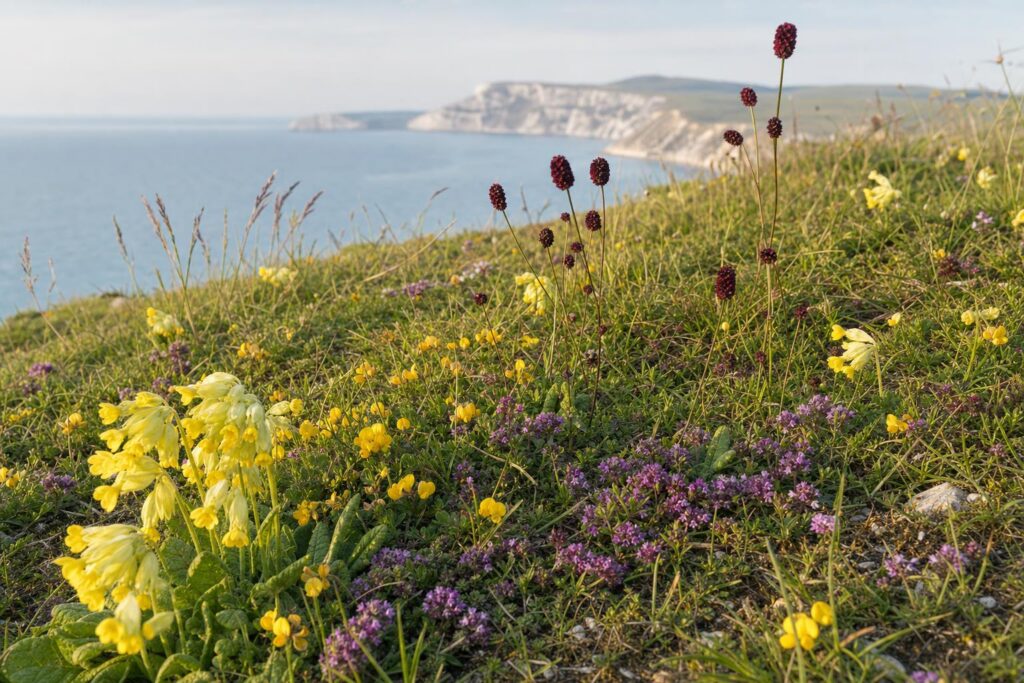
Wildflower Seeds for the Isle of Wight: Native Mixes for Chalk Downland, Greensand and Clay
Wildflower Seeds for the Isle of Wight: Native Mixes for Chalk Downland, Greensand and Clay
The Isle of Wight packs a surprising amount of geological variety into 380 square kilometres. A central chalk ridge runs the width of the island from Culver Down in the east to The Needles in the west, with a second chalk downland block rising near Shanklin and Ventnor in the south. Either side of that spine sits greensand — free-draining and sandy — and beyond it, heavier gault clay and Wealden clay-and-sand ground around Compton Bay and Sandown Bay. For an island this size, that’s three genuinely different growing conditions, and it means the right wildflower mix for the Isle of Wight depends entirely on where on the island you’re standing.
Chalk downland is the island’s best-known habitat, and it comes with a strong restoration track record already: private landowners and conservation bodies have been actively restoring downland grassland here for years, turning former arable and improved pasture back into the species-rich turf the island is known for. That makes the Isle of Wight a genuinely good place to be doing this work — there’s real local expertise and real local precedent to draw on.
Understanding the Isle of Wight’s soils before you sow
The island divides into three practical zones for wildflower establishment: chalk downland, greensand, and clay.
The chalk downland ridge
The central ridge from Culver Down to The Needles, plus the southern downland block near Shanklin and Ventnor, gives shallow, alkaline, free-draining soil over chalk — classic downland conditions. A chalk and limestone mix is the right starting point across this ridge, and it’s naturally low-fertility ground, which works in wildflowers’ favour from day one.
Greensand ground
The Lower and Upper Greensand formations either side of the chalk ridge give well-drained, often sandy soil that warms quickly in spring but can dry out hard in summer. It sits between chalk and clay in character, and generally does well with a general-purpose neutral grassland mix, watched closely for drought stress in the first establishing season.
Gault clay and the Wealden south
Around Compton Bay and Sandown Bay in the south, and across pockets of gault clay elsewhere on the island, ground is heavier and slower-draining. A heavy clay mix suits this ground, and it needs more thorough preparation and more patience before it competes properly with established grass.
Choosing the right wildflower seeds for the Isle of Wight’s habitats
The island’s chalk downland has seen genuine, well-documented restoration success. On private estate land, former arable ground has been taken out of cultivation and re-established as species-rich downland turf over a period of years, with cowslip, salad burnet, horseshoe vetch and wild thyme returning to ground that was under the plough within living memory — a useful reminder that chalk restoration on the Isle of Wight isn’t a slow, uncertain process when it’s done with patience and the right low-nutrient approach.
The Hampshire and Isle of Wight Wildlife Trust has also run traditional hay harvests to help restore rare wildflower meadow on the island, using old-fashioned cutting and removal techniques rather than modern silage machinery specifically because it favours the wildflower seed bank and avoids compacting or over-fertilising sensitive ground. It’s a good local case study in why removing arisings after cutting, rather than leaving them to rot down and feed the soil, matters as much on the Isle of Wight as anywhere else. Culver Down and the chalk cliffs around it also hold classic maritime chalk grassland, where salt-tolerant, wind-pruned turf supports species that don’t survive further inland — a distinctive coastal variant worth knowing about if your land runs close to the cliff edge.
The island’s status as a UNESCO Biosphere Reserve, one of relatively few in the UK, reflects this concentration of habitat value on a small landmass, and it’s a point worth keeping in mind when planning any new wildflower scheme here — there’s a genuinely engaged conservation community already working across the island’s downland, greensand heath and coastal habitats to draw on for advice and precedent.
Sowing wildflower seeds on the Isle of Wight: timing and ground preparation
Autumn sowing, ideally August to October, is the standard optimal window for the Isle of Wight, and the island’s relatively mild, maritime climate gives a slightly longer workable autumn window than many inland counties. On the free-draining chalk ridge and greensand, autumn sowing reduces the drought risk young seedlings face if a dry spell hits before roots are established. On gault and Wealden clay ground in the south, it avoids trying to cultivate wet, sticky soil in spring. Our guide to why Yellow Rattle is essential for wildflower meadows explains its role in opening up a grass-dominated sward.
Chalk downland ground on the island is often naturally low-fertility already, needing minimal soil stripping before sowing — genuinely one of the easier starting points for wildflower establishment anywhere in England. Greensand needs a little more thought around moisture retention in dry summers. Clay ground, and any former arable or improved pasture across the island, needs proper preparation: topsoil removal where practical, or several seasons of cropping off without fertiliser, before a wildflower mix will out-compete vigorous grass. Our guide to establishing a wildflower meadow and note on the best times to sow cover the general sequence in more depth.
Managing your Isle of Wight wildflower meadow long-term
Budget three years for a proper result across most of the island: modest establishment growth in year one, a partial flowering display in year two, and a full meadow from year three onward. An annual late-summer cut with arisings removed — after flowering has finished and seed has dropped — is the backbone of long-term management on all three soil types, though timing shifts slightly by zone: chalk downland can often be cut a little earlier than clay ground further south, once flowering is genuinely done.
The island’s chalk restoration projects lean on light grazing as well as cutting where the land allows it, keeping turf open and preventing the coarse grasses and scrub that would otherwise creep back in on ungrazed downland. On greensand and clay ground without grazing access, a strict late-summer cutting regime with arisings removed does the same job. Whatever the ground type, avoid fertilising — low nutrient status is what keeps an Isle of Wight meadow a meadow rather than a grass sward with a scattering of flowers in it.
Wildflower seeds for larger-scale projects and Biodiversity Net Gain on the Isle of Wight
Isle of Wight Council applies the mandatory England-wide 10% Biodiversity Net Gain requirement, in force for major developments since 12 February 2024 and for small sites since 2 April 2024, calculated against the statutory biodiversity metric. Some development types are exempt, including householder applications, self-build and custom-build projects, and works affecting less than 25 square metres of non-priority habitat or 5 metres of linear features such as hedgerows — worth checking against your specific project before assuming BNG applies or doesn’t.
One registered off-site habitat bank, Kings Manor Farm, already operates on the island, giving developers a local option for delivering gain off-site rather than shipping the requirement to the mainland. The council secures significant on-site gains and all off-site biodiversity improvements through Section 106 legal agreements, with tiered monitoring fees running from roughly £1,438 to £3,816 depending on scheme scale, covering 30 years of oversight. For landowners with suitable downland, greensand or clay ground and a long-term view, that’s a real local opportunity worth investigating alongside the island’s existing Local Nature Recovery Strategy work with the Hampshire and Isle of Wight Wildlife Trust and the local nature partnership. Our guide to wildflower seeds for Biodiversity Net Gain beyond the baseline and our housing and development page cover sourcing seed for projects at this scale.
Locally sourced wildflower seeds for the Isle of Wight
Wildahome’s seed is harvested from donor meadows in Devon and Powys, then selected specifically as wildflower seeds for the Isle of Wight’s chalk-to-clay soil range and its mild, maritime climate, rather than sold as one generic UK mix. For most gardens, paddocks and BNG sites, that regional matching gives noticeably better establishment than seed with no connection to the island’s conditions at all. Read more about why locally sourced wildflower seeds really matter.
For larger or mixed-soil Isle of Wight sites — land spanning downland and greensand, or a habitat scheme responding to Biodiversity Net Gain requirements — our bespoke wildflower seed mixes service builds a blend around your actual site survey.
Ready to choose the right mix?
Whether you’re restoring chalk downland along the island’s central ridge, working with greensand ground, or converting clay pasture near Compton Bay or Sandown Bay, matching the mix to your ground is the decision everything else depends on. Browse our full range of wildflower seed mixes, explore our advice section, or get in touch if your site needs a bespoke approach.
Frequently Asked Questions
What are the best wildflower seeds for the Isle of Wight?
It depends on which part of the island you’re on. The central chalk ridge from Culver Down to The Needles, and the southern downland near Shanklin and Ventnor, suit a chalk and limestone mix; greensand ground either side of the ridge suits a general-purpose neutral grassland mix; and heavier gault and Wealden clay around Compton Bay and Sandown Bay needs a heavy clay mix.
When should I sow wildflower seeds on the Isle of Wight?
Autumn, ideally August to October, is the standard window. It reduces drought risk on the free-draining chalk and greensand ground, and avoids cultivating wet clay in spring further south. The island’s mild maritime climate gives a slightly longer workable autumn window than many inland counties.
Does the Isle of Wight have a mandatory Biodiversity Net Gain requirement?
Yes. Isle of Wight Council applies the England-wide mandatory 10% Biodiversity Net Gain requirement, in force for major developments since February 2024 and small sites since April 2024, with some exemptions for very small works. One registered off-site habitat bank, Kings Manor Farm, already operates on the island.
Is chalk downland restoration realistic on the Isle of Wight?
Yes, and there’s already a strong local track record. Private landowners and conservation bodies on the island have successfully restored former arable and improved pasture back to species-rich chalk downland turf, and the Hampshire and Isle of Wight Wildlife Trust runs traditional hay-harvest restoration work specifically to protect the wildflower seed bank.
Can I get funding for habitat creation on the Isle of Wight?
Biodiversity Net Gain-linked routes are increasingly the most reliable funding path where your land qualifies, alongside general agri-environment schemes. It’s worth checking current eligibility directly with the council or a local ecological consultant, since scheme availability changes.
Is Isle of Wight seed the same as seed from other counties?
Not exactly, but it’s closely matched. Wildahome’s seed is harvested from donor meadows in Devon and Powys, then selected specifically as wildflower seeds for the island’s chalk-to-clay soil range and mild maritime climate, rather than sold as one generic UK mix. For most gardens, paddocks and BNG sites, that regional matching gives noticeably better establishment than seed with no connection to local conditions.
How long does it take to establish a wildflower meadow on the Isle of Wight?
Budget three years for a proper result across most of the island: modest growth in year one, a partial flowering display in year two, and a full meadow from year three onward. Clay ground in the south, in particular, tests patience — don’t judge a new meadow’s success by its first summer alone.
Ready to get started?
Shop: Heavy Clay Wildflower Meadow Mix →Frequently asked questions
More county guides
Find the right native wildflower mix for your county, or browse our full list by region.