

Wildflower Seeds for East Sussex: Native Mixes for the South Downs, High Weald and the Levels
Wildflower Seeds for East Sussex: Native Mixes for the South Downs, High Weald and the Levels
East Sussex divides into four genuinely different landscapes. The South Downs run chalk along the county’s southern edge, from Lewes through Seaford towards Eastbourne. North of that, the High Weald’s sandstone ridges and clay valleys cover most of the county’s interior — Ashdown Forest, Heathfield, Battle, Crowborough. Between the two sits the heavier Low Weald clay vale, and along the coast the Pevensey and Rye Levels are flat, reclaimed marshland unlike anything else in the county. Choosing wildflower seeds for East Sussex means recognising which of these four worlds your land actually belongs to.
East Sussex is also home to some of the most ambitious chalk grassland restoration happening anywhere in England right now, and to a newly designated National Nature Reserve on its southern coast — both worth knowing about before you order seed, because they show what’s realistically achievable on this ground.
Understanding East Sussex’s soils before you sow
East Sussex’s landscape character runs in bands from the coast inland, each with a distinct soil story.
The South Downs chalk
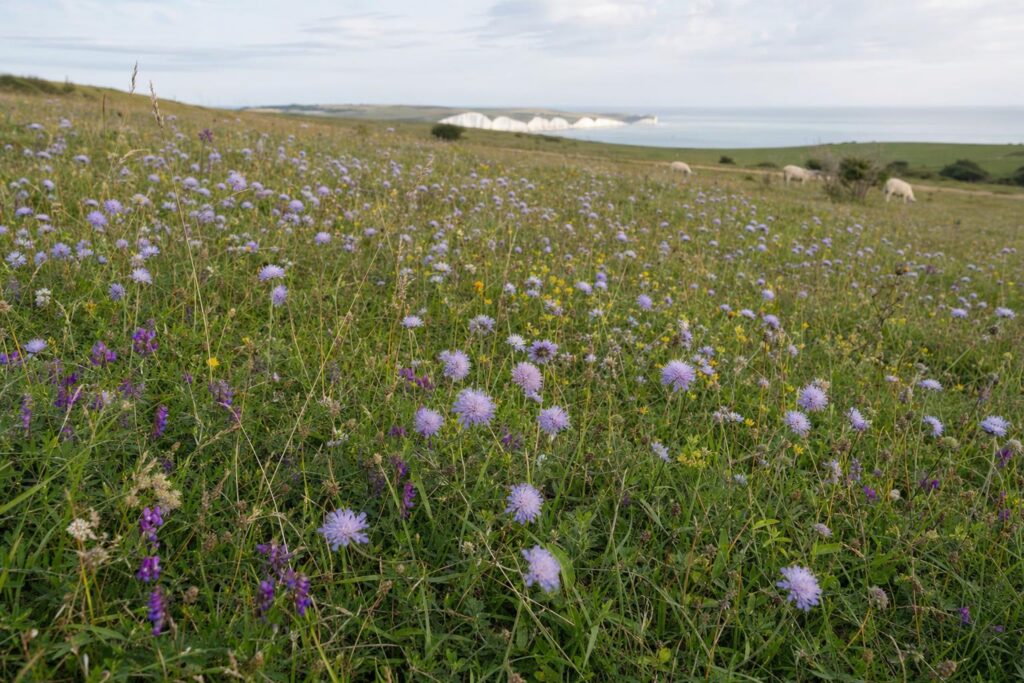
Thin, free-draining, alkaline chalk runs along the county’s south — Lewes, Seaford, the Eastbourne hinterland, Ditchling Beacon, the Cuckmere Valley and Beachy Head. This is classic low-nutrient wildflower ground; a chalk and limestone mix is the natural choice.
The High Weald sandstone ridges
Alternating sandstone ridges and clay valleys cover most of northern and central East Sussex — Ashdown Forest, Heathfield, Wadhurst, Mayfield, Battle, Crowborough. Acidic, nutrient-poor soils suit an acidic soils mix.
The Low Weald clay vale
An undulating heavy clay vale sits between the High Weald and the Downs, around Uckfield and the Ouse valley fringes — slow-draining, often neutral-to-slightly-acid ground that needs a heavy clay mix and more robust, competitive species.
The Levels
The Pevensey Levels and the Rye and Eastbourne Levels are flat, reclaimed marshland — alluvial, often peaty or silty, seasonally wet. This is genuinely different ground, calling for a wetland and pond mix and a very different establishment approach from the rest of the county.
Choosing the right wildflower seeds for East Sussex’s habitats
East Sussex’s chalk grassland is sometimes described as comparable in plant diversity to tropical rainforest, thanks to the thin, nutrient-poor soil that prevents any one species dominating. The county flower, round-headed rampion, grows here alongside orchids, Adonis blue and chalkhill blue butterflies and yellow meadow ant colonies — all dependent on grazing to keep scrub from taking over.
The clearest large-scale example of what’s achievable is Changing Chalk, a four-year National Trust-led programme running 2022 to 2026 across 458 square kilometres of the eastern South Downs from Shoreham to Eastbourne. It has restored or improved over 650 hectares of chalk grassland, including 50 hectares of new wildflower habitat converted from arable land at Gayles Farm near Seaford, alongside relocating 32 wart-biter bush-crickets to establish a new population. In March 2026, a new 1,500-hectare National Nature Reserve was announced spanning Seaford to Eastbourne — encompassing the Seven Sisters cliffs, Cuckmere Valley and Lullington Heath — with plans to extend conservation grazing and regenerative farming onto adjoining private land.
On the Weald, ancient hay meadows can carry up to 100 grass and wildflower species where management has stayed low-input and undisturbed — one of the High Weald’s most endangered habitat types. And on the Pevensey Levels, one of the largest wetland grazing marsh landscapes in lowland Britain supports the UK’s largest population of the nationally rare fen raft spider, alongside lapwing, redshank and snipe.
The High Weald’s Weald Meadows Partnership, working since 1996, has focused specifically on restoring and creating meadows using native, local-provenance seed rather than generic mixes — a principle Wildahome shares, and a useful sign that this kind of careful, locally matched establishment has a long track record on Weald ground, not just on chalk. It’s worth remembering that low-input, undisturbed grassland has value even where diversity is modest to start with; on the Weald, patience with an existing sward often beats starting from bare ground.
Sowing wildflower seeds in East Sussex: timing and ground preparation
Autumn sowing, ideally August to October, is the more reliable window on the chalk and Weald sandstone, letting seed go through a proper winter chill before germinating — essential for species like Yellow Rattle (Rhinanthus minor). Our guide to why Yellow Rattle is essential for wildflower meadows explains why.
On the Low Weald clay, ground preparation takes more work — cultivation to break up heavy ground, careful timing to avoid a waterlogged autumn window, and a stronger reliance on Yellow Rattle to open up competitive grass. On the Levels, timing is dictated by water table rather than calendar; wait until the ground is genuinely workable rather than sowing to a fixed date. Our guide to establishing a wildflower meadow and note on the best times to sow cover the general sequence in more depth.
Managing your East Sussex wildflower meadow long-term
Budget three years for an East Sussex meadow to reach its full potential: mostly root and leaf growth in year one, a partial flowering display in year two, and a proper sward from year three onward. An annual late-summer cut with arisings removed is the backbone of long-term management on the chalk and Weald, keeping fertility low.
On chalk downland specifically, grazing between mid-July and April — sheep or cattle, as used at Malling Down and Ditchling Beacon — is what keeps scrub from creeping back in and maintains the structural diversity that chalk grassland species depend on. On the Levels, ongoing ditch and reen management matters as much as cutting the sward itself; waterlogged ground left unmanaged reverts to rush and reed within a few seasons.
Wildflower seeds for larger-scale projects and Biodiversity Net Gain in East Sussex
East Sussex is a two-tier planning county: district and borough councils — Wealden, Rother, Lewes, Eastbourne, Hastings — are the local planning authority for most applications, while the South Downs National Park Authority handles land within the National Park boundary. The mandatory England-wide 10% Biodiversity Net Gain requirement applies across both, calculated against the statutory biodiversity metric and secured for a minimum of 30 years. Wealden District Council has signalled an intention to go further, aiming for 20% net gain on qualifying sites tied to its emerging Local Plan.
The South Downs National Park Authority runs its own Biodiversity Net Gain Technical Advice Note and habitat bank criteria, and operates ReNature Credits — a scheme selling biodiversity and carbon credits generated through habitat restoration on partner estates to developers needing to meet BNG obligations. It’s a concrete route for East Sussex landowners with suitable land to generate income from habitat creation.
East Sussex’s Local Nature Recovery Strategy, published as part of a Sussex-wide set of strategies in 2026, sets out eight priority habitat groupings including species-rich grasslands and chalk grassland specifically, and identifies the Pevensey Levels, Rye Levels, South Downs and Ashdown Forest as priority geographic areas. Development pressure is real here too: an 80-hectare solar farm has been proposed at Colbrans, Laughton, near the National Park boundary, alongside ongoing housing growth across the county’s districts. For farmers in the High Weald National Landscape, Farming in Protected Landscapes grants — recently extended for a further three years — fund grassland and meadow management work alongside national schemes. Our guide to wildflower seeds for Biodiversity Net Gain beyond the baseline and our housing and development page cover sourcing seed for projects at this scale.
Locally sourced wildflower seeds for East Sussex
Wildahome’s seed is harvested from donor meadows in Devon and Powys, then selected specifically as wildflower seeds for East Sussex’s chalk-to-clay soil range and the South East’s climate, rather than sold as one generic UK mix. For most gardens, paddocks and BNG sites, that regional matching gives noticeably better establishment than seed with no connection to the county’s conditions at all. Read more about why locally sourced wildflower seeds really matter.
For larger or mixed-soil East Sussex sites — land spanning chalk and Weald clay, or a habitat project responding to Biodiversity Net Gain requirements — our bespoke wildflower seed mixes service builds a blend around your actual site survey.
Ready to choose the right mix?
Whether you’re restoring chalk grassland on the South Downs, managing Weald clay pasture, or planning habitat enhancement for an East Sussex development, matching the mix to your ground is the decision everything else depends on. Browse our full range of wildflower seed mixes, explore our advice section, or get in touch if your site needs a bespoke approach.
Frequently Asked Questions
What are the best wildflower seeds for East Sussex?
It depends on which part of the county you’re in. The South Downs chalk suits a chalk and limestone mix; the High Weald’s sandstone ridges need an acidic soils mix; the Low Weald clay vale needs a heavy clay mix; and the Pevensey and Rye Levels’ wet ground does better with a wetland and pond mix. There’s no single mix that fits every East Sussex site.
When should I sow wildflower seeds in East Sussex?
Autumn, ideally August to October, is the more reliable window on the chalk and Weald sandstone — it lets seed go through a proper winter chill before germinating, which species like Yellow Rattle need. On the Levels, timing depends more on water table than calendar, so wait until the ground is genuinely workable.
Can wildflowers grow on the Pevensey Levels’ wet clay soil?
Yes, though it needs a different approach from the rest of East Sussex. The Levels’ reclaimed marshland is heavy and seasonally waterlogged, so success depends on managing rush and reed encroachment, choosing a wetland-tolerant mix, and accepting that establishment will take longer and need more ongoing ditch management than on drier ground.
What is East Sussex’s biodiversity net gain requirement?
East Sussex’s district and borough councils, and the South Downs National Park Authority within the National Park boundary, apply the England-wide mandatory 10% biodiversity net gain on qualifying developments, calculated against the statutory biodiversity metric and secured for at least 30 years. Wealden District Council has signalled an intention to raise this to 20% on qualifying sites under its emerging Local Plan.
How do I set up a BNG habitat bank in East Sussex?
The South Downs National Park Authority runs ReNature Credits, a scheme that sells biodiversity and carbon credits generated through habitat restoration on partner estates to developers needing to meet BNG obligations. It’s a concrete route for landowners with suitable South Downs land within East Sussex to generate income from habitat creation, alongside more conventional Section 106-secured habitat banks arranged through district councils.
Is East Sussex seed the same as seed from other counties?
Not exactly, but it’s closely matched. Wildahome’s seed is harvested from donor meadows in Devon and Powys, then selected specifically as wildflower seeds for East Sussex’s chalk-to-clay soil range and the South East’s climate, rather than sold as one generic UK mix. For most gardens, paddocks and BNG sites, that regional matching gives noticeably better establishment than seed with no connection to the county’s conditions at all.
How long does it take to establish a wildflower meadow in East Sussex?
Budget three years for a proper result, whichever part of East Sussex you’re in: mostly leaf and root growth in year one, a partial flowering display in year two, and a full meadow from year three onward. Pevensey Levels’ wet clay in particular tests patience — don’t judge a new meadow’s success by its first summer alone.
Ready to get started?
Shop: Traditional Wildflower Meadow Mix →Frequently asked questions
What are the best wildflower seeds for East Sussex?
It depends on which part of the county you're in. The South Downs chalk suits a chalk and limestone mix; the High Weald's sandstone ridges need an acidic soils mix; the Low Weald clay vale needs a heavy clay mix; and the Pevensey and Rye Levels' wet ground does better with a wetland and pond mix. There's no single mix that fits every East Sussex site.
When should I sow wildflower seeds in East Sussex?
Autumn, ideally August to October, is the more reliable window on the chalk and Weald sandstone — it lets seed go through a proper winter chill before germinating, which species like Yellow Rattle need. On the Levels, timing depends more on water table than calendar, so wait until the ground is genuinely workable.
Can wildflowers grow on the Pevensey Levels' wet clay soil?
Yes, though it needs a different approach from the rest of East Sussex. The Levels' reclaimed marshland is heavy and seasonally waterlogged, so success depends on managing rush and reed encroachment, choosing a wetland-tolerant mix, and accepting that establishment will take longer and need more ongoing ditch management than on drier ground.
What is East Sussex's biodiversity net gain requirement?
East Sussex's district and borough councils, and the South Downs National Park Authority within the National Park boundary, apply the England-wide mandatory 10% biodiversity net gain on qualifying developments, calculated against the statutory biodiversity metric and secured for at least 30 years. Wealden District Council has signalled an intention to raise this to 20% on qualifying sites under its emerging Local Plan.
How do I set up a BNG habitat bank in East Sussex?
The South Downs National Park Authority runs ReNature Credits, a scheme that sells biodiversity and carbon credits generated through habitat restoration on partner estates to developers needing to meet BNG obligations. It's a concrete route for landowners with suitable South Downs land within East Sussex to generate income from habitat creation, alongside more conventional Section 106-secured habitat banks arranged through district councils.
Is East Sussex seed the same as seed from other counties?
Not exactly, but it's closely matched. Wildahome's seed is harvested from donor meadows in Devon and Powys, then selected specifically as wildflower seeds for East Sussex's chalk-to-clay soil range and the South East's climate, rather than sold as one generic UK mix. For most gardens, paddocks and BNG sites, that regional matching gives noticeably better establishment than seed with no connection to the county's conditions at all.
How long does it take to establish a wildflower meadow in East Sussex?
Budget three years for a proper result, whichever part of East Sussex you're in: mostly leaf and root growth in year one, a partial flowering display in year two, and a full meadow from year three onward. Pevensey Levels' wet clay in particular tests patience — don't judge a new meadow's success by its first summer alone.
More county guides
Find the right native wildflower mix for your county, or browse our full list by region.