

South Downs Wildflower Seeds: A Practical Guide to Chalk Downland
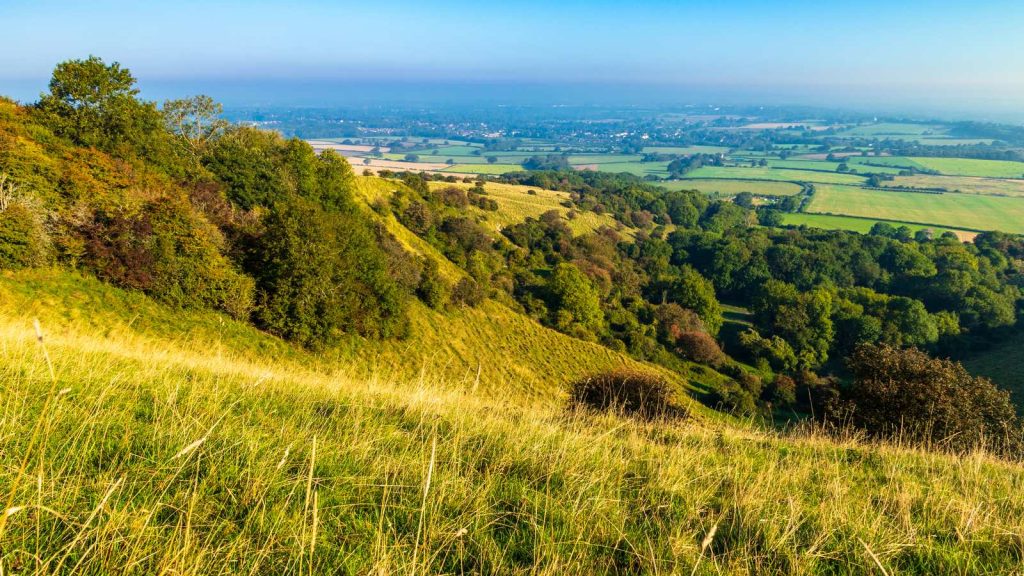
The South Downs hold some of the richest grassland in Britain. On a well-grazed slope of old chalk turf you can find dozens of plant species in a single square metre, from salad burnet and horseshoe vetch to orchids that grow nowhere else in such numbers. If you are choosing South Downs wildflower seeds for a field, verge or large garden, the aim is to work with that chalk rather than against it.
That starts with an honest picture of what the downs are. Most of the chalk grassland that once covered them has gone. What survives is scattered, often in pockets of under a hectare, and the soil under your feet may not be chalk at all. Large parts of the National Park sit on sands and clays that need a completely different approach.
This guide explains how to tell whether your ground suits a chalk meadow, which downland wildflowers will establish from seed and which will not, and how to sow and manage the result so it improves year on year. It is written for landowners, smallholders and gardeners who want a meadow that belongs in this landscape, not a short-lived splash of colour.
What makes South Downs chalk grassland so distinctive
The South Downs are a long ridge of chalk running from near Winchester in Hampshire to Beachy Head in East Sussex. Natural England maps this chalk spine as National Character Area 125. A steep north-facing scarp looks over the Weald, and a long, gentler dip slope runs south towards the coast, cut through by the Arun, Adur, Ouse and Cuckmere.
Over the chalk the soil is thin, free-draining and lime-rich, often only a few centimetres of dark crumbly earth over white rock. It holds few nutrients and dries quickly in summer. Those are hard conditions for vigorous grasses, which is exactly why so many small, slow-growing wildflowers can hold their own.
Centuries of sheep grazing kept the turf short and open. That combination of poor soil and constant light grazing produced the classic downland sward: fine fescues, quaking grass, rosettes of hawkbit and plantain, and low mats of thyme and vetch.
How much chalk grassland survives
The South Downs National Park Authority’s survey of lowland calcareous grassland (fieldwork 2012–2015, published 2016) estimated that around 90% of the downs’ chalk grassland had been lost over the previous 70 years, mainly to ploughing, fertiliser and the decline of grazing. Just over 6,600 hectares survived inside the Park, about 4% of its area. Over a third of surveyed sites were smaller than one hectare.
The same survey found that scrub encroachment and lack of grazing were the main threats to what remains. That matters for anyone creating new grassland: sowing is only the first step, and long-term grazing or cutting decides whether a chalk meadow thrives.
Not all of the South Downs is chalk
The National Park boundary and the chalk do not match. The Park takes in a large area north of the scarp, the Western Weald around Petersfield, Midhurst, Petworth and Liss, which lies on greensand sands and heavy clays. That country is wooded, acidic and home to heathland at places like Woolmer Forest and Iping Common. A chalk seed mix will fail there, and could harm heathland that depends on poor, acid soils.
Even on the chalk itself there are exceptions. Pockets of clay-with-flints cap some of the higher ground, the scarp foot has a band of Gault clay and Upper Greensand, and the river valleys are filled with wet alluvium and peat. At Lullington Heath, acid deposits over chalk support rare chalk heath, where heather grows beside lime-loving herbs.
Quick ways to check your ground
- Look at the soil. Flecks of white chalk and flints in a thin, pale-brown topsoil are a good sign. Sticky orange clay or loose yellow sand is not.
- Look at what grows nearby. Salad burnet, wild thyme and quaking grass point to chalk. Heather, bracken and gorse point to acid soil.
- Test the pH. Chalk soils usually test above pH 7. Anything well below that needs a different mix.
If your site is in the Western Weald or on clay, see our guides to the Weald and to acid and clay soils instead.
Test your soil before buying South Downs wildflower seeds
On chalk, pH is rarely the problem. Fertility is. The phosphorus left behind by decades of arable farming is the main reason chalk meadows fail. High phosphorus feeds vigorous grasses and weeds, which smother the slower downland flowers within a couple of seasons.
A standard soil test reports phosphorus as an index from 0 upwards. Natural England’s guidance on arable reversion treats index 0 and 1 as suitable for species-rich chalk grassland, index 2 as marginal, and index 3 or above as unsuitable unless the ground is raw, exposed chalk where drought keeps grasses in check. Test before you buy seed, not after.
If your soil is too fertile
There is no quick fix, but there are options. On ex-arable land, growing one or more crops without fertiliser draws phosphorus down. On grassland, taking a hay cut and removing it every year has the same effect, slowly. Removing the topsoil gets you to low fertility at once, but it is expensive and disruptive.
Do not strip topsoil or plough deeply on steep slopes, where erosion follows, or anywhere with archaeology. The downs are covered in barrows, field systems and hillforts, many of them scheduled monuments that need consent before any ground disturbance. Check before you start.
Which chalk downland wildflowers grow well from seed
Research and practical experience across the southern chalk point the same way. Some downland plants establish reliably from seed on low-fertility chalk. Others are slow and work better added later. A third group should be left to the old turf and not expected from any seed mix.
The reliable backbone
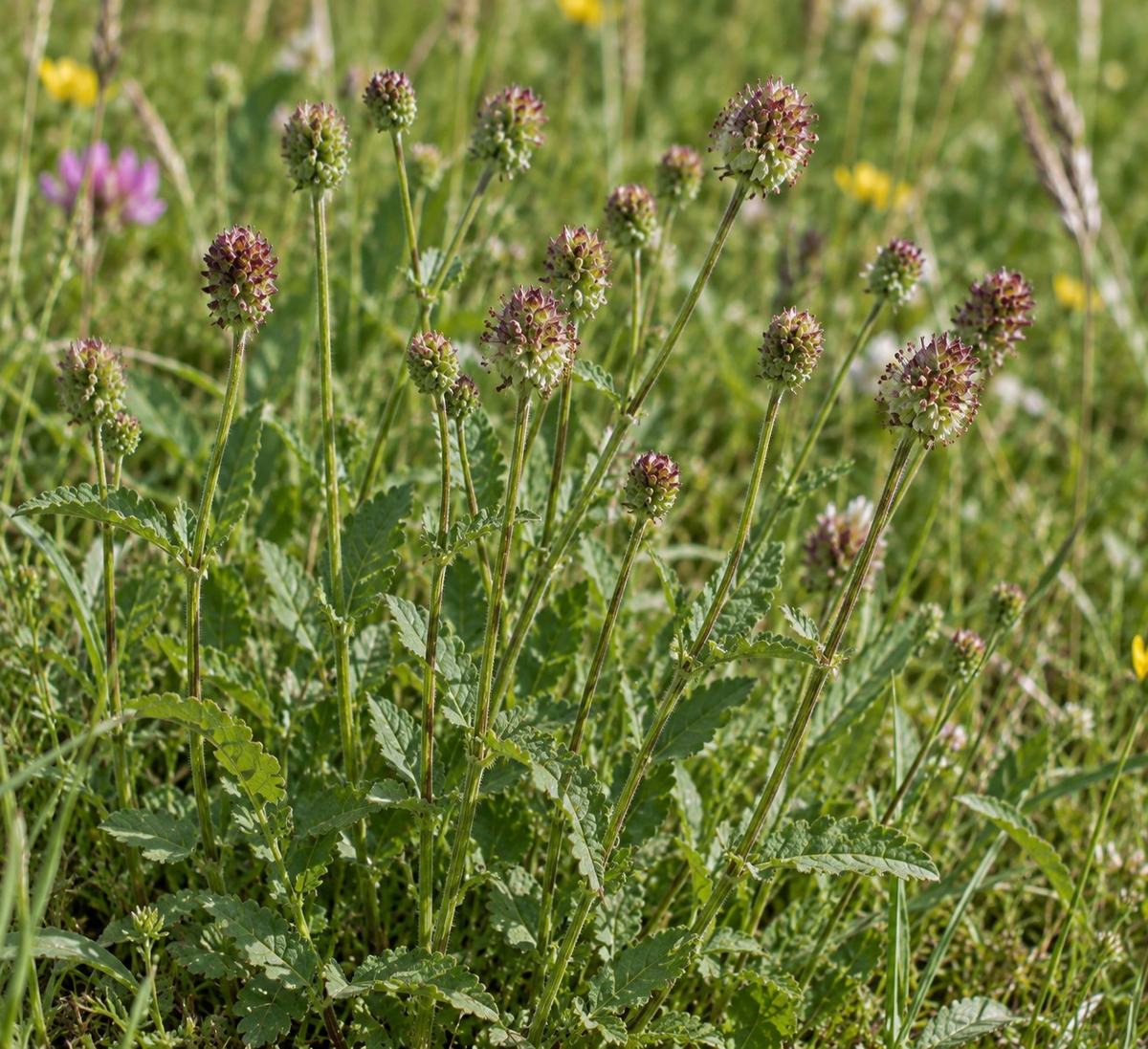
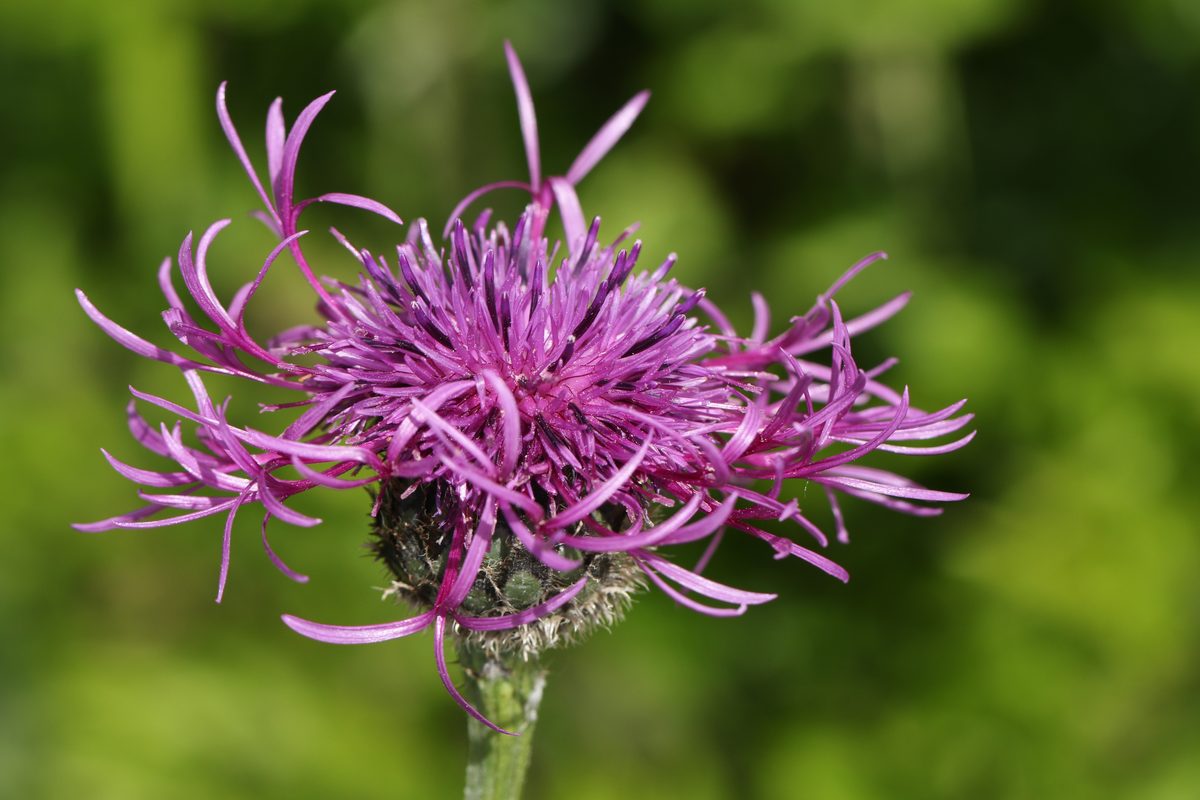
These are the species to build a chalk meadow around. Salad burnet (Poterium sanguisorba) is the signature chalk plant and germinates well. Greater knapweed (Centaurea scabiosa), field scabious (Knautia arvensis) and lady’s bedstraw (Galium verum) give height and colour through high summer. Kidney vetch (Anthyllis vulneraria) and bird’s-foot-trefoil (Lotus corniculatus) colonise open ground quickly. Wild carrot (Daucus carota), rough hawkbit (Leontodon hispidus), hoary plantain (Plantago media) and wild marjoram (Origanum vulgare) complete the picture.
The grasses matter as much as the flowers. Sheep’s fescue (Festuca ovina), red fescue (Festuca rubra), crested dog’s-tail (Cynosurus cristatus) and quaking grass (Briza media) form a fine, open sward that leaves room for wildflowers. Yellow rattle (Rhinanthus minor) is worth including in almost every chalk sowing. It is a semi-parasite on grass roots that weakens the grasses and opens gaps for flowers.
Slow starters worth the wait
Cowslip (Primula veris), horseshoe vetch (Hippocrepis comosa), small scabious (Scabiosa columbaria) and agrimony (Agrimonia eupatoria) are true downland plants, but they establish slowly and struggle against competition in the first years. Cowslip needs a cold winter to break dormancy, so it only germinates well from autumn sowing. Treat these as a second phase: oversow or plug-plant them once the sward has settled and fertility has dropped.
Leave these to the old downs
The South Downs are famous for round-headed rampion (Phyteuma orbiculare), known as the Pride of Sussex, and for early spider-orchid and burnt orchid at sites such as Castle Hill and Lewes Downs. These, along with early gentian, squinancywort, bastard-toadflax, wild thyme and common rock-rose, depend on ancient, undisturbed turf or on fungal partners in the soil. They do not come reliably from a seed mix. Be wary of any mix that promises them.
Two grasses should be kept out of sown mixes too. Tor-grass (Brachypodium pinnatum) and upright brome (Bromopsis erecta) are native to the downs, but they spread aggressively wherever grazing slackens and can swamp a young meadow.
Chalk downland wildflowers and the wildlife they support
Chalk grassland is one of the best habitats in Britain for butterflies, bees and other insects, and many of those links run through particular plants.
- Chalkhill blue and Adonis blue. Both butterflies lay their eggs on horseshoe vetch. The Adonis blue needs very short, warm turf, which is why grazing is so important.
- Small blue. Britain’s smallest butterfly relies on kidney vetch, laying eggs in its flowerheads.
- Duke of Burgundy. This scarce butterfly lays on cowslip and primrose growing in the shelter of scrubby grassland edges.
- Field scabious mining bee. A scarce solitary bee (Andrena hattorfiana) that collects pollen almost entirely from field scabious and related plants.
Flowers such as knapweeds, marjoram and bird’s-foot-trefoil feed a wide range of bumblebees and solitary bees through summer, and open downland supports ground-nesting birds such as skylark.
Sowing the right plants gives these species something to use, but it does not guarantee they will arrive. Butterflies like the Adonis blue rarely travel far, so new grassland is most valuable when it sits near existing populations and is managed to the right height. Linking and buffering surviving downland does far more than isolated patches.
How to sow a wildflower meadow on chalk
Good preparation does more for a chalk meadow than any choice of species.
Prepare the ground
Deal with perennial weeds first. Couch grass, docks, nettles and creeping thistle will outcompete a young meadow, and you cannot treat them easily once wildflowers are sown. Then create a firm, fine seedbed with plenty of bare soil. Flints at the surface are normal on the downs and do no harm.
Do not add compost, manure, topsoil or fertiliser. Low fertility is what gives downland flowers their advantage.
Sow in late summer to autumn
Sow between mid-August and late October. Autumn sowing gives yellow rattle and cowslip the winter cold they need, and seedlings establish before the summer drought that thin chalk soils face.
Mix the seed with kiln-dried sand so you can see where it has gone and spread it evenly. Sow on the surface, then roll or tread it in. Never rake it in. Many wildflower seeds need light to germinate, and buried seed is wasted. There is no need to water. Use 3 g/m² for a 100% wildflower mix and 5 g/m² for an 80/20 mix of grasses and wildflowers.
Consider green hay near existing downland
If your land sits next to species-rich chalk turf, freshly cut green hay from that donor site can carry local seed of species no supplier sells. It needs the landowner’s permission, careful timing in mid-summer, and consent from Natural England if the donor site is an SSSI. Where it is possible, it is the best way to restore downland with genuinely local provenance.
Managing chalk downland for the long term
In the first year, expect annual weeds to come through as the soil is disturbed. Cut them and remove the cuttings before they set seed, keeping the growth short and open so light reaches the seedlings below.
Once the meadow is established, take a hay cut between mid-July and September, after the main flowers have set seed. Leave the cut material for a few days to drop its seed, then remove it all. Leaving cuttings in place feeds the soil and the grasses.
Grazing in autumn and winter after the hay cut is ideal if you have access to stock. Sheep, cattle and hardy ponies keep the turf short and open, and their hooves press seed into the soil. On smaller sites, a second cut-and-collect in autumn does a similar job.
Keep an eye on scrub. Hawthorn, dogwood and bramble invade ungrazed chalk quickly. A little scrub at the edges is valuable for insects such as the Duke of Burgundy, but it needs cutting back before it takes over.
Be patient. A sown chalk meadow takes three to five years to settle, and the balance of species keeps shifting after that. Plants that seemed to fail in the first year often appear in the third.
Wildahome Chalk & Limestone mixes for South Downs sites
For chalk sites across the South Downs we recommend our Chalk & Limestone wildflower seed range. The 100% wildflower mix contains 23 native species for sowing into existing grass or where you want flowers only. The 80/20 mix combines 28 wildflowers with 9 fine native grasses for bare ground and arable reversion.
To be clear about provenance: these mixes contain UK-native species chosen for chalk soils. They are not harvested on the South Downs. For sites next to existing downland, inside designated sites, or where local provenance matters to your project, talk to us about a bespoke mix or a green hay approach.
Plan your South Downs meadow
Start with a soil test. Confirm you are on chalk and check your phosphorus index, then choose the mix that fits: 100% wildflower for enhancing existing grassland, 80/20 for bare ground. If your site sits on the Western Weald, on clay-with-flints or in a river valley, or you are working near designated downland, email us at hello@wildahome.co.uk with your location, soil results and goals. We will help you choose a mix and a management plan suited to your ground.
Frequently Asked Questions
What wildflower seeds grow best on the South Downs?
On genuine chalk soils, salad burnet, greater knapweed, field scabious, lady’s bedstraw, kidney vetch, bird’s-foot-trefoil, wild carrot and rough hawkbit establish reliably from seed, with fine grasses such as sheep’s fescue and quaking grass. Add yellow rattle to weaken grass growth. Cowslip and horseshoe vetch are slower and best added once the meadow has settled.
Are South Downs wildflower seeds locally sourced?
Not usually. Most chalk seed mixes, including ours, contain UK-native species chosen for chalk soils rather than seed harvested on the downs. Truly local seed comes from green hay or seed harvested from nearby species-rich downland, which needs the landowner’s permission. If local provenance matters to your project, ask us about bespoke options.
When should I sow a chalk downland wildflower meadow?
Sow between mid-August and late October. Autumn sowing lets yellow rattle and cowslip go through the winter cold they need to germinate, and lets seedlings establish before the summer drought that thin chalk soils face. Sow on the surface, roll or tread the seed in, and do not water.
Can I grow South Downs wildflowers in my garden?
Yes, if your garden sits on chalk and the soil has not been heavily fed. Many downland gardens have thin, flinty soil that suits chalk wildflowers well. Avoid areas that have had years of compost or fertiliser, and plan to cut and remove the growth each summer. Test the soil first, as many gardens on the downs are not on chalk.
Can I sow orchids or round-headed rampion?
Not reliably. Chalk orchids depend on fungi in the soil, and round-headed rampion, early gentian and similar rarities rely on ancient, undisturbed turf. They do not establish from standard seed mixes. The best way to help them is to protect and graze existing downland and create low-fertility grassland next to it.
Will a chalk seed mix bring chalkhill blue butterflies?
It can help, but there are no guarantees. Chalkhill and Adonis blues lay their eggs on horseshoe vetch, which is slow to establish from seed. These butterflies rarely travel far, so new grassland is most likely to be used when it lies close to existing colonies and is grazed or cut to keep the turf short.
Do I need permission to sow wildflowers in the South Downs National Park?
Sowing on your own land does not normally need planning permission. However, work on an SSSI needs Natural England’s consent, scheduled monuments need consent before any ground disturbance, and land in an agri-environment agreement must follow its terms. Never collect seed or hay from protected sites without permission.
Ready to get started?
Shop: Traditional Wildflower Meadow Mix →