

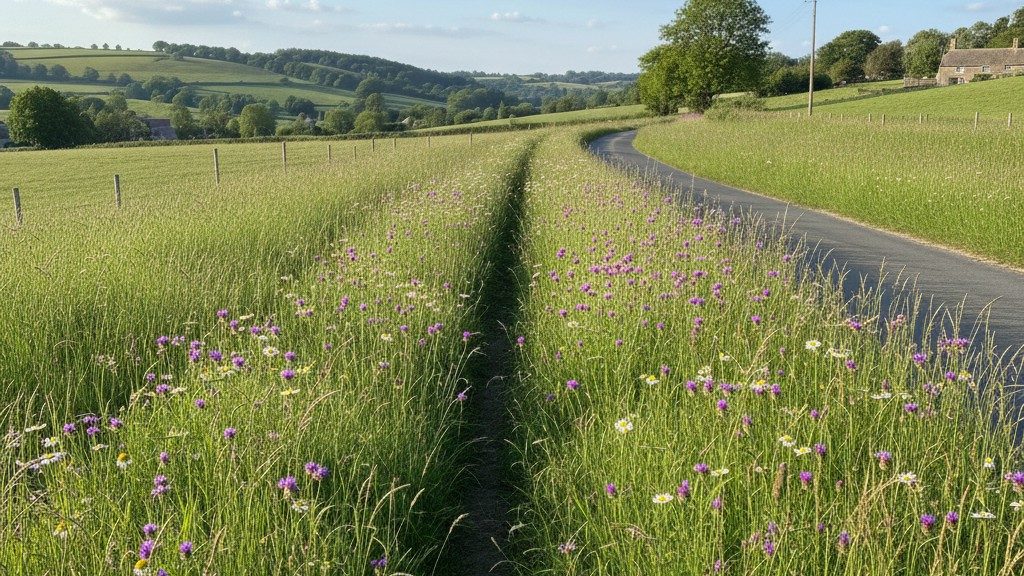
Cotswolds Wildflower Seeds: A Guide to Limestone Meadows
The Cotswolds are known for honey-coloured stone, dry stone walls and rolling wold. Less well known is that the same limestone once carried some of the richest wildflower grassland in England, and that the Cotswolds still hold more than half of the UK’s surviving unimproved Jurassic limestone grassland. If you are choosing Cotswolds wildflower seeds, the soil beneath you decides almost everything.
The Cotswolds are not uniformly limestone. The high wold and dip slope sit on thin, stony limestone soil. The steep western scarp holds the ancient commons. The river valleys carry deeper, wetter alluvium, and bands of clay and Fuller’s Earth create damp springlines and heavier ground. Each needs a different approach.
This guide explains how to read your Cotswold ground, which limestone wildflowers establish from seed and which do not, and how to sow and manage a meadow that will improve over time. It is written for landowners, farmers, smallholders and gardeners across Gloucestershire, Oxfordshire, Wiltshire and the wider Cotswolds.
Cotswold limestone grassland: what is left and why it matters
The Cotswolds are a classic scarp-and-dip landscape of Jurassic limestone, rising steeply in the west to around 330 metres at Cleeve Hill and falling gently east towards Oxford and the Thames. Natural England maps the area as National Character Area 107. Around two-thirds of it lies within the Cotswolds National Landscape, formerly the Cotswolds Area of Outstanding Natural Beauty.
According to the Cotswolds National Landscape, wildflower-rich limestone grassland covered about 40% of the area in the 1930s. Today it covers less than 1.5%, much of it on the steep scarp and commons too steep to plough. Flower-rich hay meadows in the valleys have fared even worse, with almost all lost or improved since the war.
That is why new grassland matters here. The Cotswolds Nature Recovery Plan aims to restore thousands of hectares of species-rich limestone grassland by 2050, much of it on farmland that is currently arable.
Know your Cotswold ground before choosing a seed mix
The high wold and dip slope
Most of the Cotswolds is gently rolling limestone plateau and dip slope, farmed in large fields behind dry stone walls. Soils are thin, stony and free-draining, typically lime-rich and well above pH 7. Almost all the old turf here was ploughed long ago, so this is where most new limestone grassland can be created, on arable reversion, field margins and paddocks.
The western escarpment
The steep scarp running from Bath to Mickleton, with outliers such as Bredon Hill and Cam Long Down, is the heart of surviving Cotswold grassland. Commons such as Rodborough, Cleeve, Painswick, Crickley and Swift’s Hill hold rare plants and insects on thin, unploughed soil. Here the priority is grazing and scrub control, not sowing.
River valleys
The Windrush, Coln, Evenlode and other dip-slope rivers widen downstream into flat floodplains with deep, moist alluvial soil. These valleys once held flower-rich hay meadows with great burnet and meadowsweet. Limestone wildflowers will not thrive here: the soil is too deep, too wet and too fertile.
Clay and Fuller’s Earth
Where water soaking through the limestone meets clay or Fuller’s Earth, it emerges as springs, creating damp flushes and heavier, neutral soils. Similar heavy ground occurs on the Lias clays below the scarp and in the Vale of Moreton. These soils suit neutral meadow plants rather than lime-lovers.
A soil test settles the question. Check pH and phosphorus field by field: limestone grassland needs a pH above about 6.5 and a phosphorus index of 0 or 1. Index 2 needs careful management, and index 3 or more favours vigorous grasses and weeds until fertility drops.
Is Cotswold limestone grassland different from chalk downland?
It is a fair question, and it matters when choosing a seed mix. Cotswold limestone and the chalk of the South Downs and Chilterns support the same core group of lime-loving plants: salad burnet, bird’s-foot-trefoil, lady’s bedstraw, greater knapweed, small scabious, cowslip and quaking grass all grow on both.
The differences lie elsewhere. Old Cotswold commons tend towards taller grassland dominated by upright brome and tor-grass, where the classic chalk downs have shorter, finer turf. The Cotswolds also have their own rarities, such as pasqueflower, Cotswold pennycress and purple milk-vetch, along with quarry scree, landslips and springlines that chalk lacks.
None of those rarities can be sown from a commercial mix, and the coarse grasses should be kept out of one. So a well-chosen chalk and limestone mix suits Cotswold limestone just as well as chalk. What makes a meadow truly Cotswold is local provenance, good grazing and time, not a different recipe.
Which limestone wildflowers grow well from seed
The reliable core
On the high wold and dip slope, build around species that establish well on thin, low-fertility limestone. Salad burnet (Poterium sanguisorba), lady’s bedstraw (Galium verum), greater knapweed (Centaurea scabiosa), bird’s-foot-trefoil (Lotus corniculatus) and kidney vetch (Anthyllis vulneraria) form the backbone. Hoary plantain (Plantago media), rough hawkbit (Leontodon hispidus), wild basil (Clinopodium vulgare) and oxeye daisy (Leucanthemum vulgare) add variety.
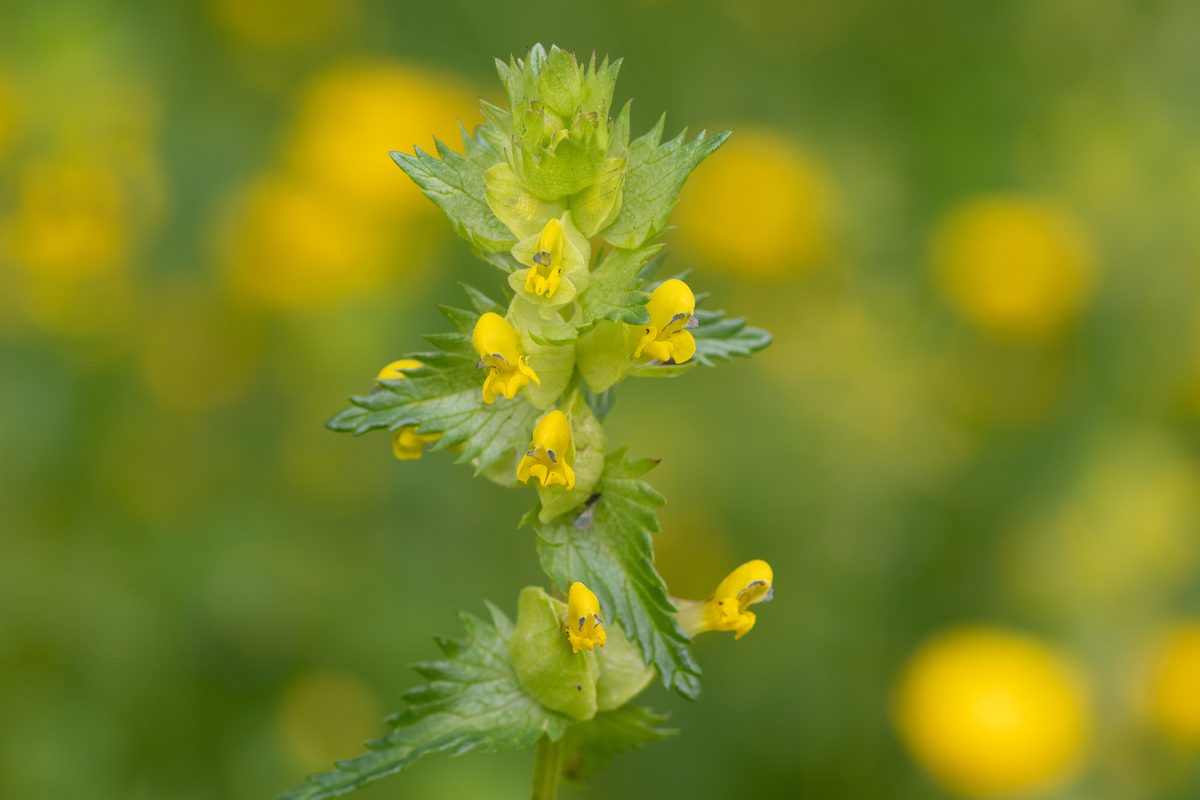
Fine grasses keep space open for flowers: sheep’s fescue (Festuca ovina), red fescue (Festuca rubra), crested dog’s-tail (Cynosurus cristatus), quaking grass (Briza media) and yellow oat-grass (Trisetum flavescens). Yellow rattle (Rhinanthus minor) should go in almost every sowing to weaken the grasses.
Slower species
Small scabious (Scabiosa columbaria), cowslip (Primula veris) and dropwort (Filipendula vulgaris) are true limestone plants but slower to establish. Common rock-rose and wild thyme do best on very thin, stony ground with little grass competition. On deeper or richer soil, add them later or let them arrive naturally.
Keep these out of the mix
Tor-grass (Brachypodium pinnatum) and upright brome (Bromopsis erecta) dominate many Cotswold commons, but sown into new grassland they spread fast and smother smaller flowers. Agricultural ryegrass and vigorous fescues have no place in a limestone meadow either. Pasqueflower, Cotswold pennycress, purple milk-vetch and all orchids cannot be established reliably from seed and should never be taken from the wild.
Wildlife of Cotswold grasslands
The best Cotswold commons can hold more than 40 plant species in a square metre, and their wildlife depends as much on structure as on flowers: short turf, taller tussocks, bare ground, anthills and scrubby edges.
- Blue butterflies. Chalkhill, Adonis and small blues all occur on Cotswold limestone. Their caterpillars feed on horseshoe vetch and kidney vetch, and the large blue has been successfully reintroduced to the Cotswolds.
- Bees. Scarce species such as the red-shanked carder bee rely on flower-rich limestone grassland, alongside common bumblebees and many solitary bees feeding on trefoil, knapweed and scabious.
- Moths and beetles. Six-spot burnet and chimney sweeper moths fly over the turf, and specialists such as the rock-rose pot beetle depend on particular limestone plants.
Open grassland and arable margins on the wold also support skylarks, yellowhammers and corn buntings. As elsewhere, sowing the plants does not guarantee these species will appear. They are most likely where new grassland sits close to existing commons and is grazed or cut to keep a varied structure.
How to sow Cotswolds wildflower seeds on limestone
Clear perennial weeds first. On ex-arable land, ploughing wakes dormant weed seed, so allow a flush to germinate and remove it before sowing. Cultivate to a fine, firm seedbed; stones at the surface are normal and do no harm. Do not add compost, manure, topsoil or fertiliser.
Sow between mid-August and late October. Mix the seed with kiln-dried sand for an even spread, sow on the surface and roll or tread it in. Never rake it in, and do not water. Use 3 g/m² for a 100% wildflower mix and 5 g/m² for an 80/20 mix of grasses and wildflowers.
Near the scarp commons and other protected grassland, local seed is better than any bought mix. Programmes in the Cotswolds have restored hundreds of hectares using green hay and seed brush-harvested from Cotswold donor meadows. If you are near an old common, ask locally before sowing anything else.
Managing a Cotswold limestone meadow through the year
In the first year, cut and remove annual weeds before they set seed. Keep livestock and rabbits off newly sown ground until the plants have rooted well; on thin limestone this can take two or three years.
Once established, take a hay cut in July or August after flowering and seed set, leave it for a few days to drop its seed, and remove it all. Aftermath grazing in autumn and winter, ideally with cattle, keeps coarse grasses in check. Light winter grazing suits unproductive limestone ground well. Avoid heavy spring sheep grazing on flowering meadows, as sheep pick out the flower heads.
Spring brings cowslips and early-purple orchids on established grassland; summer is the peak for trefoil, knapweed, scabious and blue butterflies; autumn is the main sowing window and the season for waxcap fungi on old turf. Expect three to five years for a sown limestone meadow to settle.
Wildahome seed mixes for Cotswold sites
For the limestone wold and dip slope we recommend our Chalk & Limestone range. The 100% wildflower mix contains 23 native species for sowing into prepared grassland. The 80/20 mix combines 28 wildflowers with 9 fine native grasses for bare ground and arable reversion. For river valleys, our Loam & Alluvial mix suits deeper, moister soil, and for clay and springline ground our Heavy Clay mix is the better match.
To be clear about provenance, these mixes contain UK-native species chosen for the soil. They are not harvested in the Cotswolds. Near the scarp commons or where local provenance matters, talk to us about a bespoke approach or local green hay.
Plan your Cotswold meadow
Work out which part of the Cotswolds you are on, then test pH and phosphorus. Thin limestone with low phosphorus suits our Chalk & Limestone mixes; valley alluvium suits Loam & Alluvial; clay and springline ground suits Heavy Clay. Email hello@wildahome.co.uk with your location, soil results and goals and we will help you choose.
Frequently Asked Questions
What wildflower seeds grow best in the Cotswolds?
On thin limestone soils, salad burnet, lady’s bedstraw, greater knapweed, bird’s-foot-trefoil, kidney vetch, hoary plantain and rough hawkbit establish well, with fine grasses such as sheep’s fescue and quaking grass. Add yellow rattle in autumn. Small scabious and cowslip are slower and can be added later.
Can I use a chalk seed mix on Cotswold limestone?
Yes. Cotswold limestone and southern chalk share the same core lime-loving plants, so a good chalk and limestone mix suits both. What differs is the rarer flora and the coarse grasses of old commons, neither of which belongs in a sown mix.
Are Cotswolds wildflower seeds locally sourced?
Most are not. Standard mixes, including ours, contain UK-native species chosen for limestone soil rather than seed harvested in the Cotswolds. Genuinely local seed comes from green hay or brush-harvested seed from Cotswold donor meadows, which is the best option near the scarp commons.
When should I sow wildflowers on limestone?
Sow between mid-August and late October. Autumn sowing lets yellow rattle and cowslip go through the winter cold they need and gives seedlings time to root before summer drought on thin limestone. Sow on the surface, roll it in and do not water.
Why is tor-grass left out of limestone seed mixes?
Tor-grass is native to Cotswold limestone but spreads quickly by underground stems wherever grazing is light. It builds up thick dead growth that shades out smaller wildflowers and anthills, so it is never sown into new grassland.
Will wildflowers grow in a Cotswold river valley?
Yes, but not limestone wildflowers. Valley floors have deeper, moister soil that suits floodplain and neutral meadow plants such as great burnet, meadowsweet and knapweed. Choose a loam and alluvial mix and manage it as a hay meadow.
How long does a limestone meadow take to establish?
Expect three to five years for a sown limestone meadow to settle, and longer on ex-arable land with a history of fertiliser. Keep grazing off for the first couple of years, cut and remove the hay each summer, and the slower species will build up over time.
Ready to get started?
Shop: Traditional Wildflower Meadow Mix →