

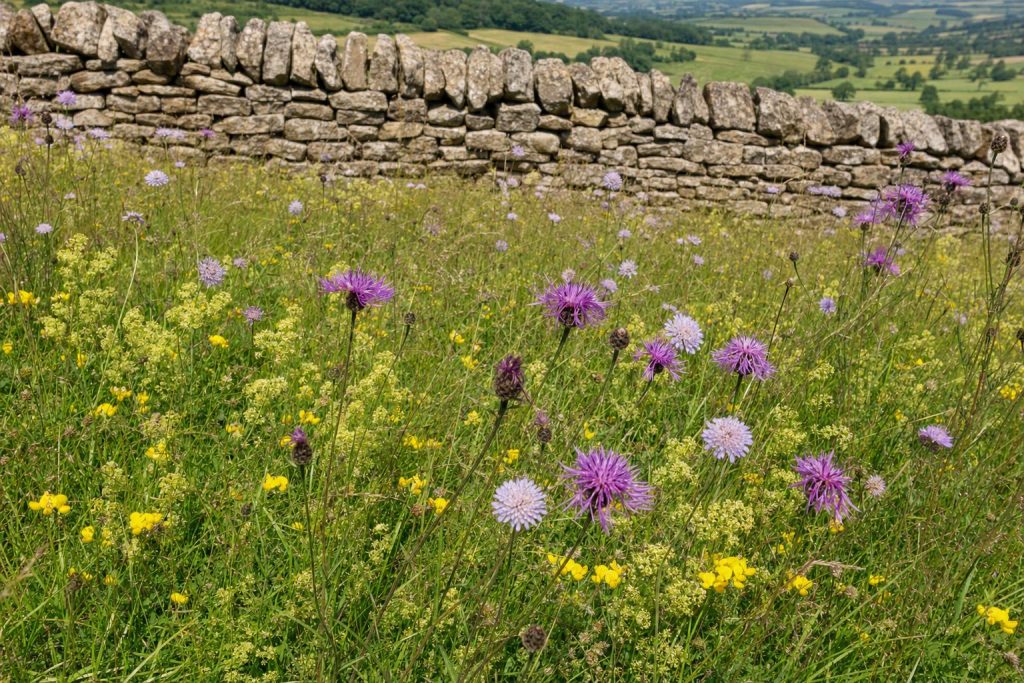
Wildflower Seeds for Gloucestershire: Native Mixes for the Cotswolds, the Severn Vale and the Forest of Dean
Gloucestershire is three counties in one. To the east, the Cotswolds rise on oolitic limestone, carrying some of the best limestone grassland in England. Down the middle, the Severn Vale spreads out on heavy clay and river alluvium, with floodplain meadows that still flood most winters. West of the Severn, the Forest of Dean sits on sandstone and coal measures, with acidic soils, ancient woodland and the wild daffodil country around Dymock and Newent. Choosing wildflower seeds for Gloucestershire means deciding first which of those three landscapes you are actually standing in.
This guide works through Gloucestershire’s soils and habitats, matches each to the right native seed mix, and sets out sowing and long-term management that suit the county’s conditions. It is written for landowners, farmers, estate managers, developers and community groups, as well as gardeners with an acre or a paddock to turn into meadow.
The principle is the same everywhere: match the mix to the ground, get fertility down, sow at the right time, and manage the meadow as hay. Gloucestershire’s variety makes the first step matter more than usual. For other counties, see our wildflower seeds by county guides.
Understanding Gloucestershire’s soils before you sow
Before choosing any mix, find out what you have. A simple pH test and a look at a spade’s depth of soil will tell you most of what you need.
- Cotswold limestone: thin, free-draining, alkaline soils over Jurassic oolite, often stony, especially on the scarp and on old commons. These are the best soils in the county for species-rich grassland.
- Severn Vale clay: heavy, slow-draining Lias clay across the vale from Tewkesbury down towards Berkeley, often fertile after decades of dairying and arable.
- Floodplain alluvium: silty, fertile soils along the Severn, the Leadon and the lower Avon, wet in winter and prone to flooding.
- Forest of Dean and the north-west: sandstones, shales and coal measures giving acidic to neutral soils, often clayey and damp in the north-west around Dymock and Newent.
Soil type sets which species will thrive. Fertility sets whether they can compete. On much of the vale and on improved Cotswold farmland, fertility is the bigger problem, so do not skip the sections on preparation below.
Choosing the right wildflower seeds for Gloucestershire’s habitats
The Cotswolds: limestone grassland
The Cotswold escarpment and its commons, such as Rodborough, Minchinhampton and Painswick, hold some of the richest grassland in the county: cowslip, common rock-rose, horseshoe vetch, kidney vetch, small scabious, clustered bellflower, greater knapweed, wild thyme and, in a few special places, pasque flower and orchids. On thin limestone soils this is the community to aim for.
Our chalk and limestone 80/20 meadow mix is built for this ground, with fine, non-competitive grasses and lime-loving wildflowers. On the thinnest, stoniest soils, or where you want maximum flower, the 100% chalk and limestone wildflower mix can be oversown into an existing fine sward. Our guide to wildflower seeds for chalk and limestone soils covers the species in more detail.
Deeper soils on the dip slope, where the limestone is buried under clay or brash that has been farmed for years, behave more like a neutral loam. There a traditional 80/20 meadow mix is often the better choice.
The Severn Vale: heavy clay
Clay is harder work but supports a good meadow flora: common knapweed, bird’s-foot trefoil, meadow vetchling, ox-eye daisy, field scabious, meadow buttercup and great burnet in damper spots. The challenge is fertility and weed seed, not the clay itself.
Our heavy clay soils 80/20 meadow mix uses species that cope with wet winters and baked summers. Our guide to wildflower seeds for heavy clay soil explains preparation on this kind of ground.
Severn floodplain meadows
The Severn and its tributaries once supported extensive floodplain hay meadows, cut for hay and grazed in late summer, with great burnet, meadowsweet, pepper saxifrage and meadow foxtail. A few survive in the county and are among its most valuable habitats.
On fertile, silty floodplain soils, use our loam and alluvial 80/20 meadow mix. In wetter hollows, ditch edges and around ponds, the wetland and pond 80/20 wildflower mix suits ground that is wet for long periods. Our guide to wildflower seeds for loam and alluvial soils has more on these sites.
The Forest of Dean and the north-west
West of the Severn, soils are generally acidic to neutral. Open ground in the Forest supports acid grassland and heathy vegetation with tormentil, heath bedstraw, sheep’s sorrel and harebell, while damp meadows in the north-west carry betony, devil’s-bit scabious and sneezewort. For acidic, free-draining ground, use our acidic soils 80/20 meadow mix; our guide to wildflower seeds for acidic soils explains the species.
The north-west of the county, around Dymock, Kempley and Newent, is famous for wild daffodils in woods, orchards and old meadows each March. On suitable ground, wild daffodil bulbs planted under trees and along field edges continue that tradition.
Hedges, verges and woodland edges
Gloucestershire’s hedges and road verges are important corridors, linking scattered meadows across farmland. For hedge bottoms and banks, our hedgerow and banks 80/20 wildflower mix suits the part shade and steeper ground. For shaded woodland edges and rides in the Forest and Cotswold beechwoods, the woodland and heavy shade 80/20 mix is the right choice. Our guide to wildflower seeds for road verges covers verge projects.
80/20 or 100% wildflowers?
An 80/20 mix is 80% fine native grasses and 20% wildflowers by weight. It creates a complete, stable sward that resists weeds and suits most new meadows. A 100% wildflower mix is used to add flowers to an existing sward or for small, high-impact areas. Our explainer on 80/20 vs 100% wildflower seed mixes helps you decide.
Sowing wildflower seeds in Gloucestershire: timing and preparation
When to sow
The best time to sow wildflower seeds in Gloucestershire is mid-August to late October. The soil is still warm, autumn rain does the watering, and many meadow species need winter cold to germinate. Late March to May also works, particularly on the wettest Severn Vale ground, where autumn sowings can sit in water. Avoid November to February.
Getting fertility down
Wildflowers lose to grass on fertile ground. Much of the vale and the farmed Cotswold plateau has a long history of fertiliser use, so reducing fertility is often the single biggest factor in success. On improved grassland that can mean stripping turf and topsoil, cutting and removing hay for several years first, or growing a cereal crop without fertiliser for a season. Never add compost, manure, topsoil or fertiliser.
Preparing the seedbed
Aim for bare, weed-free soil with a fine, firm surface. On clay, wait for a dry spell and avoid deep cultivation, which brings nutrients and weed seed to the surface. On thin Cotswold soils, a light scarify and a roll is often enough.
Sowing
Sow 3 g/m² for a 100% wildflower mix or 5 g/m² for an 80/20 mix, adding up to 30% on slopes and exposed ground. Mix the seed with dry sand to bulk it out, sow half in one direction and half at right angles, then roll or tread it in. Never rake it in or bury it: most wildflower seed needs light to germinate. Our step-by-step meadow establishment guide covers each stage, and the seed coverage calculator works out quantities.
On the steep Cotswold scarp and on banks where rain will wash loose seed away, a wildflower seed mat holds the seed in place while it establishes.
Adding Yellow Rattle
On existing grassland, Yellow Rattle is the most effective way to weaken grasses and make room for wildflowers. It is semi-parasitic on grass roots and can substantially reduce grass growth where it takes. It must be sown in autumn, by the end of November, because it needs winter cold to germinate. Our guide on how to sow Yellow Rattle explains how.
Managing your Gloucestershire wildflower meadow long-term
A meadow is a management system as much as a seed mix. What you do after sowing decides whether it is still species-rich in ten years.
- Year one: expect weeds and grass first, not flowers. Whenever growth reaches 100–150mm, cut back to 50–60mm and remove the cuttings. Most perennials will not flower until year two or three.
- Every year after: leave the meadow to grow from early Spring, cut for hay in late July or August once seed has set, and take the hay off. Then graze or mow the regrowth short through Autumn.
- Floodplain meadows: follow the traditional pattern of a July hay cut followed by aftermath grazing, timed around flooding.
- Cotswold limestone grassland: light grazing by sheep or cattle, or a late-Summer cut, keeps scrub and coarse grasses down. Watch for hawthorn, bramble and tor-grass spreading on unmanaged banks.
Never leave cuttings on the ground; they return nutrients and smother seedlings. Our guide to the wildflower meadow in winter covers the quieter months.
Wildflower seeds for larger projects and Biodiversity Net Gain in Gloucestershire
Gloucestershire’s growth around Gloucester, Cheltenham, Tewkesbury and the M5 corridor means many developers now need to deliver Biodiversity Net Gain. Under the statutory scheme, most developments in England must deliver at least 10% net gain, measured with the statutory biodiversity metric and usually secured for 30 years. Species-rich grassland created and managed properly is one of the most practical ways to deliver it on site.
The habitat condition you can achieve depends on matching the mix to the soil and committing to long-term management, which is where generic amenity mixes fail. Our guide to wildflower seeds for Biodiversity Net Gain covers this in detail, and our housing and development and civic and institutional pages explain how we support larger sites.
For farmers, flower-rich margins and plots can also fit Sustainable Farming Incentive actions; see our practical guide to SFI action CAHL1. For quantities by the kilo, see our bulk and trade wildflower seed page.
Locally sourced wildflower seeds for Gloucestershire
Provenance matters. Seed from British wild populations, collected as close as practical to your site, produces plants adapted to local climate and soils and fits with local wildlife. Our guide on why locally sourced wildflower seeds really matter explains why.
Gloucestershire borders several counties with shared landscapes. The Cotswolds continue into Oxfordshire and Wiltshire, the Wye Valley and Forest of Dean meet Herefordshire and Monmouthshire, and the southern vale runs towards Bristol.
Where a site needs something specific, such as a mix matched to a particular Cotswold common or a floodplain restoration, we can put together bespoke wildflower seed mixes.
Where to see wildflower grassland in Gloucestershire
Seeing a well-managed site helps you picture what your own ground could become. The Cotswold commons at Rodborough and Minchinhampton, cared for by the National Trust, show species-rich limestone grassland at its best from late spring through summer. In the Severn Vale, Gloucestershire Wildlife Trust’s Coombe Hill Canal and Meadows reserve shows how floodplain meadows work: it floods most winters and is grazed by cattle and sheep in late summer and autumn. In March, the wild daffodil woods and orchards around Dymock and Kempley are worth a visit in their own right.
Ready to choose the right mix?
Start with your soil: limestone, clay, floodplain or acid ground. Then pick the matching mix from our wildflower seed shop and plan to sow between mid-August and late October. If your site crosses several soil types, or you are working on a farm, estate or development, ask us and we will help you match seed, quantities and management to your Gloucestershire ground.
Frequently Asked Questions
What is the best wildflower seed mix for Gloucestershire?
It depends on where you are. On Cotswold limestone, use a chalk and limestone mix. In the Severn Vale, use a heavy clay mix. On floodplain silt, use a loam and alluvial mix, and in the Forest of Dean an acidic soils mix. A soil pH test and a look at your soil will tell you which applies.
When should I sow wildflower seeds in Gloucestershire?
Sow wildflower seeds in Gloucestershire between mid-August and late October, when soil is warm and autumn rain helps germination. Late March to May also works, especially on wet Severn Vale ground that can sit waterlogged in winter. Avoid sowing between November and February. Yellow Rattle must be sown in autumn, by the end of November.
Do Cotswold limestone soils need fertility reduction before sowing?
Thin, unimproved limestone soils on the scarp and commons are often low enough in nutrients to sow directly after light scarifying. Farmed land on the Cotswold plateau usually is not, after years of fertiliser. On improved fields, cut and remove hay for a few seasons, strip topsoil, or grow an unfertilised cereal crop first.
Can I create a wildflower meadow on Severn Vale clay?
Yes. Clay supports a good range of meadow plants, including knapweed, bird’s-foot trefoil, meadow vetchling and ox-eye daisy. Use a heavy clay mix, reduce fertility first, prepare the seedbed in a dry spell without deep cultivation, and expect slower establishment than on lighter soils.
Can I plant wild daffodils in Gloucestershire?
Yes. North-west Gloucestershire, around Dymock and Newent, is one of the best-known areas for wild daffodils. They suit damp, neutral to acidic soils under deciduous trees, in old orchards and along field edges. Plant bulbs in early autumn and leave foliage to die back before cutting.
How long does it take to establish a wildflower meadow in Gloucestershire?
Expect mostly grass and annual weeds in the first year, with regular cutting to control them. Most perennial wildflowers flower in year two or three, and a meadow usually takes three to five years to settle into a stable, species-rich sward, depending on soil fertility and management.
Is wildflower seed suitable for Biodiversity Net Gain in Gloucestershire?
Yes, when the mix matches the soil and the meadow is managed for the long term. Species-rich grassland can count towards the 10% statutory net gain, but the habitat condition achieved depends on establishment and 30-year management. Generic amenity mixes rarely reach the condition a BNG plan assumes.
Ready to get started?
Shop: Traditional Wildflower Meadow Mix →Frequently asked questions
What is the best wildflower seed mix for Gloucestershire?
It depends on where you are. On Cotswold limestone, use a chalk and limestone mix. In the Severn Vale, use a heavy clay mix. On floodplain silt, use a loam and alluvial mix, and in the Forest of Dean an acidic soils mix. A soil pH test and a look at your soil will tell you which applies.
When should I sow wildflower seeds in Gloucestershire?
Sow wildflower seeds in Gloucestershire between mid-August and late October, when soil is warm and autumn rain helps germination. Late March to May also works, especially on wet Severn Vale ground that can sit waterlogged in winter. Avoid sowing between November and February. Yellow Rattle must be sown in autumn, by the end of November.
Do Cotswold limestone soils need fertility reduction before sowing?
Thin, unimproved limestone soils on the scarp and commons are often low enough in nutrients to sow directly after light scarifying. Farmed land on the Cotswold plateau usually is not, after years of fertiliser. On improved fields, cut and remove hay for a few seasons, strip topsoil, or grow an unfertilised cereal crop first.
Can I create a wildflower meadow on Severn Vale clay?
Yes. Clay supports a good range of meadow plants, including knapweed, bird's-foot trefoil, meadow vetchling and ox-eye daisy. Use a heavy clay mix, reduce fertility first, prepare the seedbed in a dry spell without deep cultivation, and expect slower establishment than on lighter soils.
Can I plant wild daffodils in Gloucestershire?
Yes. North-west Gloucestershire, around Dymock and Newent, is one of the best-known areas for wild daffodils. They suit damp, neutral to acidic soils under deciduous trees, in old orchards and along field edges. Plant bulbs in early autumn and leave foliage to die back before cutting.
How long does it take to establish a wildflower meadow in Gloucestershire?
Expect mostly grass and annual weeds in the first year, with regular cutting to control them. Most perennial wildflowers flower in year two or three, and a meadow usually takes three to five years to settle into a stable, species-rich sward, depending on soil fertility and management.
Is wildflower seed suitable for Biodiversity Net Gain in Gloucestershire?
Yes, when the mix matches the soil and the meadow is managed for the long term. Species-rich grassland can count towards the 10% statutory net gain, but the habitat condition achieved depends on establishment and 30-year management. Generic amenity mixes rarely reach the condition a BNG plan assumes.
More county guides
Find the right native wildflower mix for your county, or browse our full list by region.