

Wildflower Seeds for Oxfordshire: Native Mixes for Limestone, Chalk and Thames-Side Clay
Wildflower Seeds for Oxfordshire: Native Mixes for Limestone, Chalk and Thames-Side Clay
Oxfordshire packs an unusual amount of geological variety into one county. Drive from the Cotswold edge near Chipping Norton to the Chiltern scarp above Henley and you’ll cross limestone brash, heavy clay vale and chalk downland within an hour — and each one calls for a different approach when you’re choosing wildflower seeds for Oxfordshire ground. A mix that thrives on the oolitic limestone around Burford will sulk on the Oxford Clay around Bicester, and vice versa.
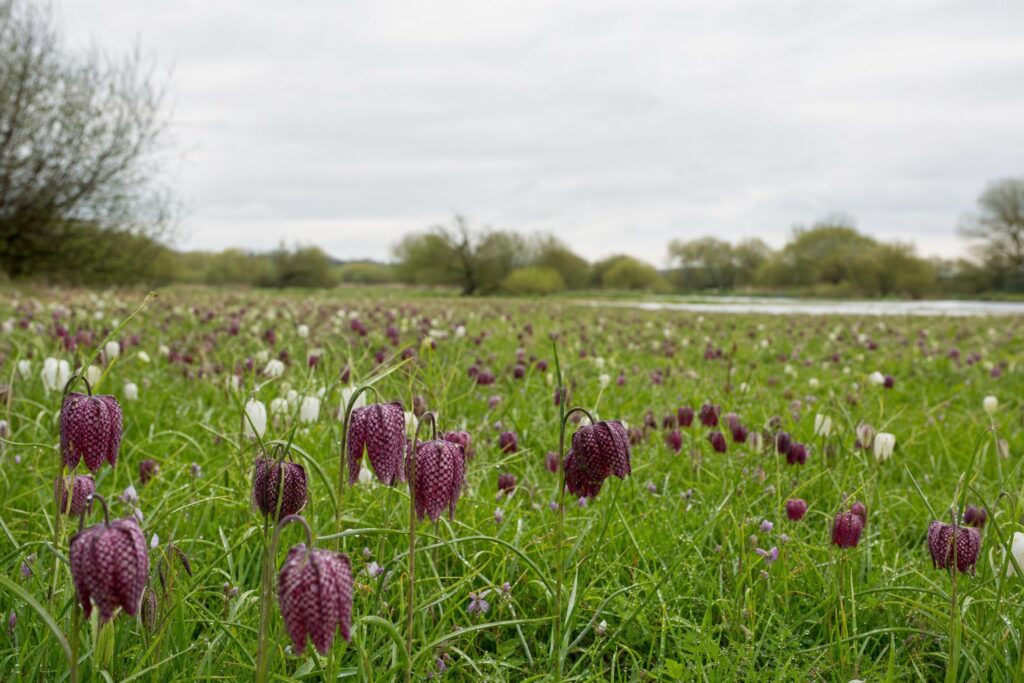
This county also holds some of England’s most significant surviving wildflower meadows — ancient Thames-side hay meadows that have been cut and grazed the same way for centuries, and still carry the snake’s-head fritillary displays to prove it. That history is a useful benchmark for anyone starting or restoring a meadow here: it shows what low-nutrient, well-managed ground can do over the long term. This guide covers Oxfordshire’s soils, the right seed for each habitat, sowing and long-term management, and what’s changed for developers and land managers now that Biodiversity Net Gain is mandatory.
Understanding Oxfordshire’s soils before you sow
Oxfordshire runs roughly north-west to south-east across three distinct geological bands, and working out which one you’re on is the first job before ordering seed.
Cotswold limestone. The north-western fifth of the county, around Chipping Norton, Burford and Woodstock, sits on Jurassic oolitic limestone — the same rock that continues into Gloucestershire. Soils here are typically shallow, free-draining and naturally low in nutrients, which is close to ideal wildflower territory: species like salad burnet (Sanguisorba minor), wild marjoram (Origanum vulgare) and common rock-rose (Helianthemum nummularium) thrive where fertile grasses can’t get the upper hand. If you’re near the Gloucestershire border, our piece on restoring Cotswold limestone grassland covers the same underlying rock and is worth a read.
Chiltern chalk. The south-eastern corner, from Watlington up through Henley and towards Thame, sits on the Chiltern Hills’ chalk escarpment. Chalk grassland is thin, alkaline and low-nutrient, and where it survives it’s some of the most species-rich habitat in lowland England — orchids, cowslip (Primula veris) and a dense forb layer are the signature of a well-managed chalk sward. Very little of it remains undisturbed, which makes new or restored chalk grassland genuinely valuable.
The clay vales. Between the two lies the bulk of the county’s farmed lowland: the Upper Thames Clay Vales and the Oxford Clay belt through Bicester, Witney and the land either side of the Thames itself. These soils are heavier, wetter and considerably more fertile than the limestone or chalk fringes, which means the usual clay-ground problems apply — dominant coarse grasses, slow drainage, and a sward that needs active nutrient-stripping to let wildflowers compete at all.
Thames floodplain and alluvial ground. A special case within the vale: river meadows along the Thames, Cherwell and Windrush carry alluvial soils that flood seasonally and stay low in nutrients as a result — flooding strips fertility rather than adding it, part of why Oxfordshire’s ancient hay meadows survive here rather than on drier, more intensively farmed ground nearby.
A soil test, or at least an honest look at which of these bands your land sits on, should come before any seed order. Read more on why locally sourced, provenance-matched seed really matters once you know your ground.
Choosing the right wildflower seeds for Oxfordshire’s habitats
With three very different soil types in one county, the right mix depends heavily on where you’re sowing.
Limestone and calcareous ground — for the Cotswold fringe in the north-west, a chalk and limestone 80/20 meadow mix is built for exactly this free-draining, alkaline ground, with species selected to compete on low fertility rather than fight it.
Chiltern chalk grassland — the same chalk-and-limestone mix suits the Chilterns’ calcareous soils too, though genuinely rare chalk grassland fragments deserve specialist ecological advice before sowing rather than a standard blend; these are some of the most sensitive habitats the county has left.
Heavy clay vale ground — the Oxford Clay and Upper Thames Clay Vales, covering most of the county’s farmed lowland, need a heavy clay soils 80/20 meadow mix with species proven to establish against competitive, fertile grassland rather than a generalist blend that assumes lean ground.
Thames-side floodplain meadows — for alluvial, seasonally flooded ground along the Thames, Cherwell or Windrush, a loam and alluvial 80/20 meadow mix reflects the species that genuinely tolerate periodic waterlogging alongside summer dryness, the pattern that has shaped Oxfordshire’s ancient hay meadows for centuries.
Wet margins and ditches — where ground stays consistently damp rather than seasonally flooded, such as pond edges or ditch banks feeding into the Thames system, a wetland and pond 80/20 wildflower mix is the better fit.
Degraded or restoration ground — for land coming out of intensive arable or improved pasture anywhere in the county, a restoration 80/20 meadow mix is designed for exactly that starting point, rather than assuming an already-balanced sward.
Resist the temptation to buy the most colourful mix in the catalogue. A blend matched honestly to your soil, even a quieter one at first, will still be thriving in year five — a mismatched one rarely is.
Sowing wildflower seeds in Oxfordshire: timing and ground preparation
Oxfordshire sits firmly in a typical lowland English climate — no coastal extremes, but real variation between its wetter clay vale and its more free-draining limestone and chalk ground.
Sowing windows. Autumn (August to October) is the stronger window across the county, letting seed sit through a Winter cold period before germinating in Spring — several species, including Yellow Rattle, need this chill to break dormancy at all. A Spring window (March to April) works as a second option, particularly on the free-draining limestone and chalk ground where waterlogging isn’t a concern; it’s a harder call on heavy clay, where a wet Spring can make the ground unworkable.
Ground preparation. The same principle applies whatever the soil: strip existing vegetation to bare ground, remove the fertile topsoil layer where you can, and create a fine, firm seedbed. On the clay vale this step matters more than almost anywhere else in the county — skip it and coarse grasses will dominate within a season. On limestone and chalk, there’s often less fertility to strip in the first place, which simplifies the job. See our full guide on how to establish a wildflower meadow for the step-by-step version.
Floodplain and wet ground. On Thames-side alluvial land, sow when the ground is workable and reasonably dry, generally Autumn before Winter flooding returns, or Spring once flood water has receded and the surface has firmed up. Trying to sow into wet, poached ground is one of the most common failure points on floodplain sites.
Slopes and awkward ground. The Chiltern scarp and steeper limestone valleys can make broadcast sowing unreliable, with seed washing downslope before it germinates. A seed mat holds seed in place on sloped or exposed sites and is worth the extra cost where hand-sowing keeps failing. Our piece on why seed mats are a genuine step forward for wildflower planting covers when they’re worth it and when they’re not.
Managing your Oxfordshire wildflower meadow long-term
Establishment is a multi-year process everywhere, and Oxfordshire’s own ancient meadows are the best possible proof of what patient, consistent management delivers: expect leaf and root growth in year one, a partial flowering display in year two, and a proper meadow from year three.
Cutting and removal. Cut and remove arisings after flowering, typically late Summer, on every soil type in the county. On the clay vale this step is non-negotiable — leaving cuttings in place returns nutrients to already-fertile ground and hands the advantage straight back to coarse grasses within a season or two.
Grazing. Oxfordshire’s Thames-side hay meadows have historically been managed with a hay cut in early Summer followed by aftermath grazing into Autumn — the pattern that’s kept the Upper Thames floodplain meadows botanically rich for centuries. Where livestock access is realistic, replicating that hay-then-graze rhythm is often more practical than repeated mechanical cutting alone.
Yellow Rattle. On any Oxfordshire ground with a grassy start, particularly the more fertile clay vale, Yellow Rattle is worth introducing early. It’s semi-parasitic on grass roots, and it does more than almost any other single species to check grass dominance and give wildflowers room to establish.
Learning from the ancient meadows. Oxfordshire’s Thames-side hay meadows didn’t stay species-rich by accident — they stayed that way because the same low-input management repeated, largely unchanged, for generation after generation. That’s the real lesson for a new meadow: consistency over decades matters more than any single input.
No wildflower area in Oxfordshire, or anywhere else, looks after itself. The annual cut and the patience to let a meadow build over three years is the work behind every good result.
Wildflower seeds for larger-scale projects and Biodiversity Net Gain in Oxfordshire
Oxfordshire is under some of the most sustained housing growth pressure in England, and that makes understanding the current planning landscape worthwhile for anyone managing land here at scale.
Biodiversity Net Gain. BNG became a mandatory condition on new planning permissions for major developments in England from 12 February 2024, and for minor developments from 2 April 2024, requiring a minimum 10% measurable uplift calculated with the statutory biodiversity metric. Oxfordshire’s district councils, including South Oxfordshire District Council, have published their own BNG guidance covering onsite and offsite routes, and the Oxfordshire Local Nature Partnership runs a NatureMark habitat bank directory for developers sourcing offsite units within the county. See our BNG overview and the case for treating it as an opportunity rather than an obligation. Wildflower grassland is one of the more straightforward habitat types to deliver measurable uplift with, provided the mix is matched to the site’s actual soil — more on that in BNG beyond the baseline.
The Oxford-Cambridge Arc. Oxfordshire sits at the western end of the Oxford-Cambridge growth corridor, earmarked by government for a substantial share of England’s new housing and employment land over coming decades. Conservation bodies, including the Berks, Bucks and Oxon Wildlife Trust through its 100 Miles Wilder initiative, argue for nature recovery to be designed into that growth from the outset rather than added as an afterthought — a live debate that shapes how much genuine BNG value gets delivered locally versus offset elsewhere.
A local proof of concept. Oxfordshire’s own ancient hay meadows are the county’s clearest demonstration that low-nutrient, well-managed wildflower grassland delivers real, lasting ecological value at scale. Pixey and Yarnton Meads, an 86.4-hectare SSSI within the Oxford Meadows Special Area of Conservation, have been cut for hay and grazed continuously for over a thousand years and now support more than 150 plant species. Nearby, BBOWT’s Iffley Meadows reserve has taken its snake’s-head fritillary (Fritillaria meleagris) population from around 500 flowering plants when the Trust took on management in 1983 to many thousands today, through consistent grazing and hay-meadow management alone. Further west, BBOWT’s 308-hectare Chimney Meadows reserve shows the same principle applied to floodplain restoration. None of this happened quickly — it shows what patient, correctly-matched management delivers over decades, roughly the timescale BNG’s 30-year habitat management requirement is built around.
Farmers and land managers working under the Sustainable Farming Incentive have relevant options, including pollen and nectar flower mix (CAHL1), paying £739 per hectare per year on a three-year agreement, and flower-rich grass margins (CIPM2), both well suited to Oxfordshire’s arable clay vale.
Whether you’re a developer working through a BNG obligation, a council managing public land, or a landowner planning at farm scale, the same rule holds as it does for a single meadow: match the seed to the ground first, and get the provenance right. Our pages for housing and development and civic institutions cover what that looks like project by project.
Locally sourced wildflower seeds for Oxfordshire
Wildahome’s own seed is harvested from donor meadows in Devon and Powys — we’re honest about that rather than claiming seed grown in Oxfordshire itself, because provenance claims matter and we’d rather you trust the ones we make. Read more on why locally sourced, provenance-matched seed really matters.
For Oxfordshire, that means matching you to species genuinely native to lowland England’s provenance zones and the soil type you’re actually working with, rather than a generic mix sold as local regardless of where it was cut. It’s the same underlying principle behind the county’s own ancient meadows — plants adapted over long periods to their local conditions consistently outperform ones that aren’t, whether the timescale is centuries at Yarnton Mead or a single establishment season on your own ground.
If you’re restoring or creating habitat at real scale in Oxfordshire — a farm, an estate, a BNG site — and want to talk through provenance in more detail than a standard product page allows, that’s a conversation worth having directly. It’s the kind of bespoke wildflower seed mix project we can scope properly rather than promise generically.
Our chalk and limestone, heavy clay and loam and alluvial 80/20 blends above all draw on this same regionally matched approach, whichever part of the county you’re working with.
Ready to choose the right mix?
If you’re not sure which of Oxfordshire’s soils you’re dealing with, or you’re scoping something larger than a single meadow — a development site, a farm-scale SFI project, a council-owned green space — talk to us before you order seed. We’d rather help you specify the right mix once than sell you the wrong one and watch it fail. Get in touch, or browse the full range, including the limestone, clay and floodplain mixes covered above, in the shop.
Frequently Asked Questions
What’s the best wildflower seed mix for Oxfordshire?
It depends on your soil. The Cotswold fringe and Chilterns suit a chalk and limestone mix; the clay vale through Bicester and Witney needs a heavy clay mix; Thames-side floodplain ground does best with a loam and alluvial blend. There’s no single “Oxfordshire mix” because the county’s geology genuinely changes from one end to the other.
When should I sow wildflower seeds in Oxfordshire?
Autumn, from August to October, is the stronger window across the county, giving seed a Winter chill before Spring germination. A Spring sowing between March and April works too, especially on free-draining limestone or chalk ground, but is a harder call on the heavier clay vale soils, which can stay wet and unworkable.
Why are Oxfordshire’s Thames-side meadows so important for wildflowers?
Meadows like Pixey and Yarnton Meads and Iffley Meadows have been cut for hay and grazed continuously, in some cases for over a thousand years, without ever being fertilised or ploughed. That consistency is exactly what keeps ground low in nutrients and lets a diverse, wildflower-rich sward persist — they’re a working demonstration of the same low-input principle behind any new meadow.
What is the biodiversity net gain requirement for developments in Oxfordshire?
Biodiversity Net Gain has been a mandatory condition on new planning permissions in England since February 2024 for major developments and April 2024 for minor developments, requiring at least a 10% measurable uplift using the statutory biodiversity metric. Oxfordshire’s district councils, including South Oxfordshire and West Oxfordshire, have published local guidance for applicants on meeting it.
Can I grow a wildflower meadow on Oxfordshire’s clay soil?
Yes, but it takes more upfront preparation than on limestone or chalk. Clay vale ground around Bicester and Witney is naturally fertile, so removing topsoil where possible and cutting and clearing arisings every year is essential to stop coarse grasses out-competing wildflowers. A heavy clay-specific mix, matched to these conditions, gives the best chance of success.
Is Oxfordshire wildflower seed grown in the county?
Wildahome’s seed is harvested from donor meadows in Devon and Powys rather than in Oxfordshire itself, then regionally matched to lowland England’s provenance zones and to your specific soil type. For most private and commercial planting this gives a genuinely well-adapted result; sites needing seed harvested within the county specifically are best discussed as a bespoke project.
How long does it take to establish a wildflower meadow in Oxfordshire?
Budget three years for a proper result: mostly leaf and root growth in year one, a partial flowering display in year two, and a full meadow from year three onward. Oxfordshire’s own ancient meadows took centuries to reach their current richness, and while a new sowing moves faster, the same biological process still applies.
Ready to get started?
Shop: Traditional Wildflower Meadow Mix →Frequently asked questions
What's the best wildflower seed mix for Oxfordshire?
It depends on your soil. The Cotswold fringe and Chilterns suit a chalk and limestone mix; the clay vale through Bicester and Witney needs a heavy clay mix; Thames-side floodplain ground does best with a loam and alluvial blend. There's no single "Oxfordshire mix" because the county's geology genuinely changes from one end to the other.
When should I sow wildflower seeds in Oxfordshire?
Autumn, from August to October, is the stronger window across the county, giving seed a Winter chill before Spring germination. A Spring sowing between March and April works too, especially on free-draining limestone or chalk ground, but is a harder call on the heavier clay vale soils, which can stay wet and unworkable.
Why are Oxfordshire's Thames-side meadows so important for wildflowers?
Meadows like Pixey and Yarnton Meads and Iffley Meadows have been cut for hay and grazed continuously, in some cases for over a thousand years, without ever being fertilised or ploughed. That consistency is exactly what keeps ground low in nutrients and lets a diverse, wildflower-rich sward persist — they're a working demonstration of the same low-input principle behind any new meadow.
What is the biodiversity net gain requirement for developments in Oxfordshire?
Biodiversity Net Gain has been a mandatory condition on new planning permissions in England since February 2024 for major developments and April 2024 for minor developments, requiring at least a 10% measurable uplift using the statutory biodiversity metric. Oxfordshire's district councils, including South Oxfordshire and West Oxfordshire, have published local guidance for applicants on meeting it.
Can I grow a wildflower meadow on Oxfordshire's clay soil?
Yes, but it takes more upfront preparation than on limestone or chalk. Clay vale ground around Bicester and Witney is naturally fertile, so removing topsoil where possible and cutting and clearing arisings every year is essential to stop coarse grasses out-competing wildflowers. A heavy clay-specific mix, matched to these conditions, gives the best chance of success.
Is Oxfordshire wildflower seed grown in the county?
Wildahome's seed is harvested from donor meadows in Devon and Powys rather than in Oxfordshire itself, then regionally matched to lowland England's provenance zones and to your specific soil type. For most private and commercial planting this gives a genuinely well-adapted result; sites needing seed harvested within the county specifically are best discussed as a bespoke project.
How long does it take to establish a wildflower meadow in Oxfordshire?
Budget three years for a proper result: mostly leaf and root growth in year one, a partial flowering display in year two, and a full meadow from year three onward. Oxfordshire's own ancient meadows took centuries to reach their current richness, and while a new sowing moves faster, the same biological process still applies.
More county guides
Find the right native wildflower mix for your county, or browse our full list by region.