

Wildflower Seeds for Cornwall: Native Mixes for Granite, Slate and the Coastal Fringe
Wildflower Seeds for Cornwall: Native Mixes for Granite, Slate and the Coastal Fringe
Cornwall doesn’t have one soil, or one climate. Within thirty miles you can move from wind-scoured granite moorland to sheltered slate valleys to the raw, low-nutrient spoil of a china clay works — and a wildflower seed mix chosen for one will struggle badly on another. Add an Atlantic climate that’s milder and windier than almost anywhere else in England, and the case for matching seed to Cornwall’s actual ground, rather than reaching for a generic UK wildflower mix, becomes obvious fast.
This guide sets out how to choose and sow wildflower seeds for Cornwall‘s soils and habitats, from Bodmin Moor’s granite to the serpentine of the Lizard and the ancient hedgebanks that thread the whole county together — plus what’s involved if you’re planning at field, estate or development scale, where Biodiversity Net Gain now shapes a lot of decisions.
Understanding Cornwall’s soils before you sow
Cornwall sits on some of the most varied geology in England, and that variation is the first thing to work out before buying seed.
Granite moorland. Bodmin Moor, West Penwith and Carnmenellis are granite country — thin, acidic, low-nutrient soils over hard rock, exposed to wind and rain for most of the year. These conditions are actually close to ideal for wildflowers: low fertility keeps competitive grasses in check and lets slower-growing forbs establish. Heather, gorse and acid grassland species do well here.
Slate and killas. Much of mid and south Cornwall sits on slate and other Devonian “killas” rock, producing heavier, more fertile soils than the granite uplands. These behave more like typical lowland clay-loam and need the usual nutrient-stripping approach — removing arisings, avoiding fertiliser — to stop coarse grasses dominating.
Serpentine on the Lizard. The Lizard Peninsula’s serpentine rock produces soils found nowhere else in mainland Britain, supporting the most botanically distinctive flora in the county, including Cornish heath (Erica vagans), Cornwall’s county flower and — in Britain — found wild only here. This is a specialist habitat, not a candidate for a standard seed mix; if you’re managing land on or near the Lizard, take local ecological advice before sowing anything.
China clay spoil. Around St Austell, more than two centuries of china clay extraction have left large areas of raw, low-nutrient spoil — sand-heavy, free-draining, essentially sterile ground. Counter-intuitively, this makes excellent wildflower establishment territory: none of the fertility problems that plague ex-agricultural land, and a growing track record of successful restoration on old clay tips.
Coastal and hedgebank soils. Cornwall’s coastline exposes thin, salt-affected maritime soils, while the county’s ancient Cornish hedges — earth-and-stone banks, some dating to the Bronze Age — carry their own thin, well-drained growing medium and support over 500 native plant species between them.
Get a soil test done, or at minimum work out which of these broad categories your land falls into, before choosing a mix — it matters more than any other decision you’ll make. Read more on why locally sourced, provenance-matched seed really matters before you order.
Choosing the right wildflower seeds for Cornwall’s habitats
Cornwall’s habitat range means the “right” mix depends heavily on where on the county’s map you’re sowing.
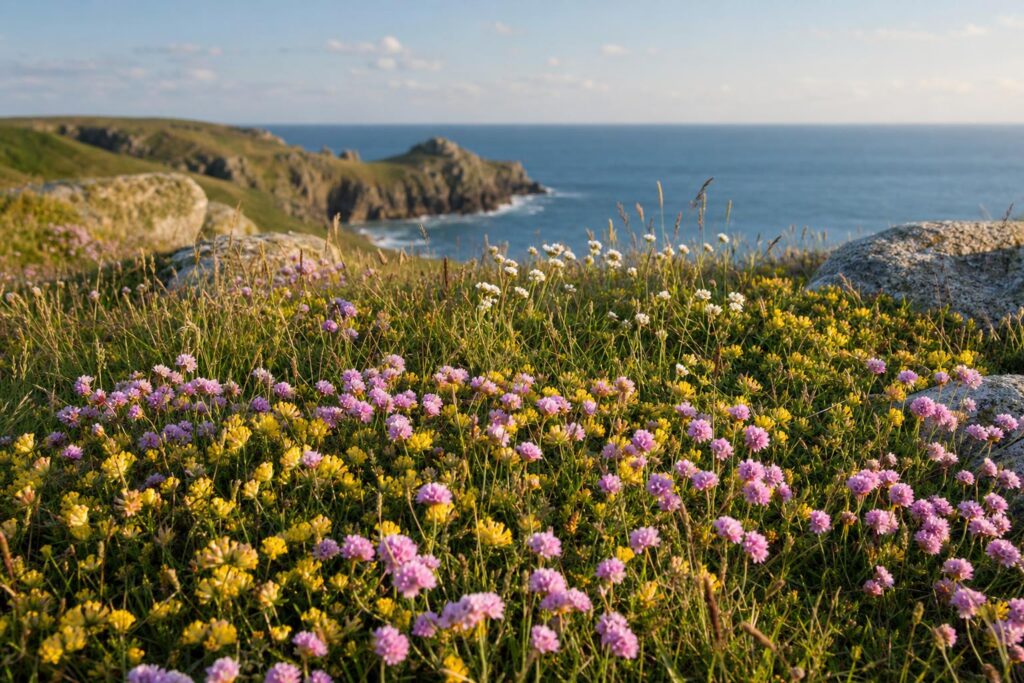
Coastal and maritime grassland — thrift (Armeria maritima), sea campion, kidney vetch and other salt-tolerant species suit cliff-top and coastal sites exposed to wind and salt spray. Our coastal 80/20 meadow mix is built around exactly this species list.
Heathland and acid grassland — on granite moorland and thinner Cornish soils generally, an acidic soils mix with heather, gorse companions and low-nutrient specialists will establish far more reliably than a general-purpose blend.
Culm grassland — Cornwall’s north coast, alongside north Devon, holds some of England’s last fragments of Culm grassland, a rare, purple moor grass-dominated wet acid grassland that has lost 92% of its former extent. If you’re restoring or managing land in this belt, read our dedicated guide to Culm grassland before sowing — it needs a specific approach rather than a standard mix.
China clay restoration ground — a restoration mix suits former clay-works land well: species selected for colonising bare, low-nutrient substrate rather than filling gaps in an already-established sward.
Cornish hedgebanks — for planting into or alongside a hedge bank, a hedgerow and banks mix reflecting the woodland-edge and grassland species already found in Cornwall’s hedges works better than an open-meadow blend.
Whichever habitat you’re working with, resist the urge to buy the showiest mix available. A meadow that looks spectacular in a catalogue photo but is full of species your soil can’t support won’t thrive — a mix matched honestly to your ground, even a quieter one, will outperform it within two seasons.
Sowing wildflower seeds in Cornwall: timing and ground preparation
Cornwall’s Atlantic climate is milder and wetter than most of England, and that changes the practical sowing calculus.
Sowing windows. Both the standard Autumn window (August to October) and a Spring window (March to April) work reasonably well in Cornwall’s milder conditions, with Autumn generally still preferred — it lets seed benefit from a Winter cold period and gives species like Yellow Rattle the chill they need to break dormancy.
Ground preparation. Whatever the soil type, the same principle applies: strip existing vegetation back to bare ground, remove the fertile topsoil layer where possible (especially important on Cornwall’s more fertile slate-derived soils), and create a fine, firm seedbed. On thin granite or china clay ground, preparation is often simpler — there’s less fertility to remove in the first place.
Wind exposure. Cornwall gets more wind than almost anywhere else in lowland England, and coastal or elevated sites need it factored in from day one. Choose lower-growing, wind-tolerant species for exposed ground, and consider a seed mat to hold seed in place on steep or open sites where rain and wind can wash a broadcast sowing away before it germinates.
Salt-burn zone. On coastal sites, salt-laden wind can reach surprisingly far inland — sometimes towards the county’s high points. Species selection for anything within a mile or two of the coast should account for this, favouring naturally salt-tolerant maritime species over general lowland ones.
Managing your Cornish wildflower meadow long-term
Establishment is a multi-year process everywhere, and Cornwall is no exception — expect leaf and root growth in year one, a partial display in year two, and a proper meadow from year three onward.
Cutting and removal. Cut and remove arisings after flowering, typically in late Summer, whatever the soil type. On Cornwall’s more fertile slate and clay-loam ground this matters even more than usual — leaving cuttings in place returns nutrients to the soil and lets coarse grasses regain the upper hand within a season or two.
Grazing. Cornwall’s small, hedge-bound fields have a long history of low-intensity grazing, and where livestock access is possible, light grazing after the main flowering period is often a more practical management tool than mechanical cutting on awkward, sloped or hedge-enclosed ground.
Wind and salt tolerance over time. An established meadow on an exposed Cornish site will naturally shift toward the wind- and salt-tolerant species in the mix over a few seasons. That’s normal, not a failure of the original sowing.
Yellow Rattle. On any Cornish ground with a grassy start, particularly the more fertile slate soils, Yellow Rattle is worth introducing early. It’s semi-parasitic on grass roots and does more than almost anything else to check grass dominance and give wildflowers room to establish.
No wildflower area in Cornwall, or anywhere else, is maintenance-free. The annual cut, and the patience to let a meadow build over three years, is the real work behind every good result.
Wildflower seeds for larger-scale projects and Biodiversity Net Gain in Cornwall
Cornwall has more large-scale wildflower activity happening right now than most counties, and it’s worth understanding the landscape if you’re planning anything beyond a garden or paddock.
Biodiversity Net Gain. Cornwall Council requires a mandatory 10% biodiversity net gain on qualifying developments — major applications since 12 February 2024, minor and other applications since 2 April 2024 — calculated using the statutory biodiversity metric. Householder applications, sites under 0.2 hectares without priority habitat, and short-term temporary development are generally exempt, but anything larger needs the metric run properly before a scheme goes in. See our BNG overview and the case for treating it as an opportunity rather than an obligation. Wildflower grassland is one of the more straightforward habitat types to deliver measurable uplift with, provided the seed mix is matched to the site’s actual soil rather than chosen off a catalogue — we go into more depth on that in BNG beyond the baseline.
A local proof of concept. The National Trust’s Cornish Coastal Meadows Project is worth knowing about even if you’re not working with the Trust directly. It’s creating 250 hectares of species-rich grassland across Cornish sites — Pentire, Botallack, Gunwalloe, Roseland and inland at Lanhydrock — by the end of 2026, sourcing around 5 tonnes of seed from healthy donor meadows within the county through partnerships with Natural England, Cornwall Council, Meadow Match and the Eden Project. It’s a real demonstration that Cornwall-scale, locally provenanced wildflower creation works, and that getting the provenance and soil-matching right pays off well beyond a single field.
Solar farms. Cornwall has some of the country’s highest concentrations of ground-mounted solar, and well-managed wildflower understorey between and around panel rows is increasingly standard practice — it supports pollinators, meets planning conditions, and costs little alongside the infrastructure already going in.
China clay land and large estates. The scale of former clay-works land around St Austell, and the substantial estate landholding across the county, both represent real opportunities for wildflower creation at a scale that moves the needle for Cornwall’s wider nature recovery, not just an individual site’s BNG obligation.
Farmers and land managers working under Countryside Stewardship or the Sustainable Farming Incentive have several relevant options, including SFI’s pollen and nectar flower mix (CAHL1) and flower-rich grass margins (CIPM2) actions, both compatible with locally matched wildflower seed.
Whether you’re a developer working through a BNG obligation, a council managing public land, or an estate planning at scale, the same rule holds as it does for a garden meadow: match the seed to the ground first, and get the provenance right. Our pages for housing and development and civic institutions cover what that looks like project by project.
Locally sourced wildflower seeds for Cornwall
Wildahome’s own seed is harvested from donor meadows in Devon and Powys — we’re honest about that rather than claiming seed grown in Cornwall itself, because provenance claims matter and we’d rather you trust the ones we make. Read more on why locally sourced, provenance-matched seed really matters.
For Cornwall, that means matching you to the South West provenance zone and the species genuinely native to Cornish conditions, rather than a mix sourced from, say, eastern England and sold as local. It’s the same principle behind projects like the National Trust’s Cornish Coastal Meadows work above, just at a different scale — provenance-matched seed outperforms generic seed because the plants are already adapted to a similar climate, similar soils and similar day length.
If you’re restoring or creating habitat at real scale in Cornwall — a farm, an estate, a development site — and want seed harvested within the county itself rather than regionally matched, that’s a conversation worth having directly. It’s the kind of bespoke wildflower seed mix project we can scope properly rather than promise generically.
Our Traditional Wildflower Meadow Mix, restoration mix and the soil-specific 80/20 blends above all draw on this same regionally matched approach, whichever part of Cornwall you’re working with.
Ready to choose the right mix?
If you’re not sure which of Cornwall’s soils you’re dealing with, or you’re scoping something larger than a single meadow — a development site, a council-owned green space, a farm-scale SFI project — talk to us before you order seed. We’d rather help you specify the right mix once than sell you the wrong one and have it fail. Get in touch, or browse the full range, including the coastal, acidic-soils and restoration mixes covered above, in the shop.
Frequently Asked Questions
What’s the best wildflower seed mix for Cornwall?
It depends on your soil. Granite moorland and most of Cornwall’s thinner ground suit an acidic-soils mix; coastal sites need salt- and wind-tolerant species; china clay spoil and other bare, low-nutrient ground suit a restoration mix. There’s no single “Cornwall mix” because the county’s geology is too varied for one blend to fit everywhere.
When should I sow wildflower seeds in Cornwall?
Autumn (August to October) is generally best, giving seed a Winter cold period before Spring germination. Cornwall’s mild Atlantic climate also makes a Spring sowing (March to April) a reasonably reliable second option, which isn’t always true further east.
Can wildflowers grow on china clay spoil?
Yes, often better than on typical agricultural land. China clay spoil is low in nutrients and free-draining, which suits wildflowers far more than the high-fertility soils left by decades of arable or improved-grassland farming. A restoration-focused mix is the right starting point.
Do I need a different wildflower seed mix near the Cornish coast?
Yes. Salt-laden wind affects a wider strip of Cornwall than most people expect, sometimes reaching well inland from exposed coastline. Species that tolerate salt and wind, such as thrift, sea campion and kidney vetch, establish far more reliably than general lowland species on exposed sites.
What is Cornwall Council’s biodiversity net gain requirement?
Cornwall Council requires a mandatory 10% biodiversity net gain on qualifying planning applications, using the statutory biodiversity metric — major developments since 12 February 2024, and minor and other applications since 2 April 2024. Small sites, householder applications and short-term temporary development are generally exempt.
Is Cornish wildflower seed the same as Devon seed?
They’re closely related but not identical. Cornwall and Devon share a broadly similar South West climate and provenance zone, which is why Devon-sourced seed is a genuinely good match for most of Cornwall. For large-scale or ecologically sensitive projects, seed harvested within Cornwall itself is still the better choice where it can be arranged.
How long does it take to establish a wildflower meadow in Cornwall?
Budget three years for a proper result: mostly leaf and root growth in year one, a partial flowering display in year two, and a full meadow from year three. Cornwall’s mild climate doesn’t shortcut this — establishment is a biological process, not a weather-dependent one.
Ready to get started?
Shop: Traditional Wildflower Meadow Mix →Frequently asked questions
What's the best wildflower seed mix for Cornwall?
It depends on your soil. Granite moorland and most of Cornwall's thinner ground suit an acidic-soils mix; coastal sites need salt- and wind-tolerant species; china clay spoil and other bare, low-nutrient ground suit a restoration mix. There's no single "Cornwall mix" because the county's geology is too varied for one blend to fit everywhere.
When should I sow wildflower seeds in Cornwall?
Autumn (August to October) is generally best, giving seed a Winter cold period before Spring germination. Cornwall's mild Atlantic climate also makes a Spring sowing (March to April) a reasonably reliable second option, which isn't always true further east.
Can wildflowers grow on china clay spoil?
Yes, often better than on typical agricultural land. China clay spoil is low in nutrients and free-draining, which suits wildflowers far more than the high-fertility soils left by decades of arable or improved-grassland farming. A restoration-focused mix is the right starting point.
Do I need a different wildflower seed mix near the Cornish coast?
Yes. Salt-laden wind affects a wider strip of Cornwall than most people expect, sometimes reaching well inland from exposed coastline. Species that tolerate salt and wind, such as thrift, sea campion and kidney vetch, establish far more reliably than general lowland species on exposed sites.
What is Cornwall Council's biodiversity net gain requirement?
Cornwall Council requires a mandatory 10% biodiversity net gain on qualifying planning applications, using the statutory biodiversity metric — major developments since 12 February 2024, and minor and other applications since 2 April 2024. Small sites, householder applications and short-term temporary development are generally exempt.
Is Cornish wildflower seed the same as Devon seed?
They're closely related but not identical. Cornwall and Devon share a broadly similar South West climate and provenance zone, which is why Devon-sourced seed is a genuinely good match for most of Cornwall. For large-scale or ecologically sensitive projects, seed harvested within Cornwall itself is still the better choice where it can be arranged.
How long does it take to establish a wildflower meadow in Cornwall?
Budget three years for a proper result: mostly leaf and root growth in year one, a partial flowering display in year two, and a full meadow from year three. Cornwall's mild climate doesn't shortcut this — establishment is a biological process, not a weather-dependent one.
More county guides
Find the right native wildflower mix for your county, or browse our full list by region.