

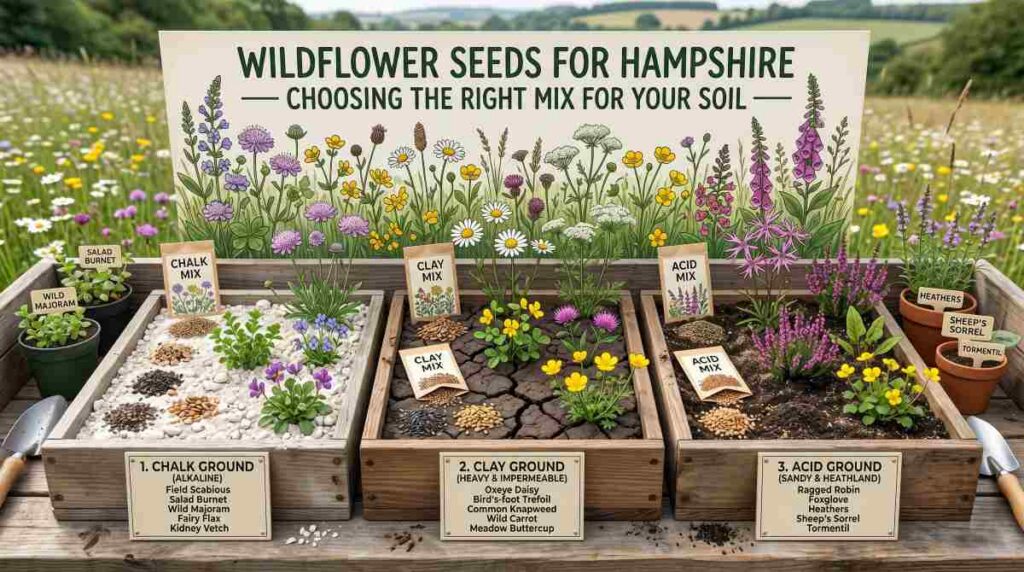
Wildflower Seeds for Hampshire — Choosing the Right Mix for Chalk, Clay, and Acid Ground
Hampshire’s Habitats and Soils
The chalk downs — running from the Wiltshire border through Winchester, Basingstoke, and towards the South Downs — are the county’s defining geological feature. Thin soils over white chalk, strongly alkaline, naturally low in fertility. These conditions are exactly what chalk grassland wildflowers need, and Hampshire’s chalk downs historically held exceptional species diversity: Cowslip, Horseshoe Vetch (Hippocrepis comosa), Clustered Bellflower, Bee Orchid (Ophrys apifera), and many more.
The New Forest occupies the south-western third of the county. Soils here are mostly acidic — sandy and gravelly outwash overlying Tertiary deposits, with some wet heath and valley bog. These are not standard wildflower meadow habitats; the Acidic Soils Mix is the appropriate choice where you are working in or adjacent to the Forest’s open heath.
The chalk river valleys — Test, Itchen, Avon — are classic flood meadow habitats. Alluvial, neutral to slightly alkaline soils that historically carried very diverse wet meadow flora. The Wetland and Pond Mix suits these settings well.
The clay vales of north Hampshire, towards Basingstoke and the Surrey border, hold heavier soils that suit Traditional Meadow species. These are workable with the right preparation but slower to establish than chalk.
Choosing the Right Wildflower Seed Mix for Hampshire
Chalk and Limestone Mix — The primary choice for any site on Hampshire’s chalk downs. Contains species characteristic of southern chalk grassland: Cowslip (Primula veris), Clustered Bellflower (Campanula glomerata), Marjoram (Origanum vulgare), Horseshoe Vetch, Kidney Vetch (Anthyllis vulneraria), and Salad Burnet (Sanguisorba minor). Sow at 3 g/m² into bare or very sparse chalk ground. The 80/20 version at 5g/m² is appropriate for larger slope and downland restoration.
Acidic Soils Mix — For New Forest heathland edges and adjacent gardens on acid, free-draining sandy soils. Species include Heather (Calluna vulgaris), Heath Bedstraw (Galium saxatile), Tormentil (Potentilla erecta), and Harebell (Campanula rotundifolia). Flowering season May to October. Do not use on chalk or clay — this mix is specific to acid ground.
Traditional Meadow Mix — For north Hampshire clay vales, loam soils, and mixed ground. Meadow Buttercup, Oxeye Daisy, Field Scabious, Meadow Cranesbill, and Red Clover. The 80/20 blend at 5g/m² is the practical choice for larger sites.
Wetland and Pond Mix — For Test, Itchen, and Avon valley sites, pond margins, and any seasonally wet or low-lying ground. Purple Loosestrife, Meadowsweet, Yellow Flag Iris, Great Burnet, and Water Forget-me-not suit the neutral alluvial soils of Hampshire’s river valleys.
Hedgerow and Banks Mix — For field margins, road verges, hedgerow understoreys, and established bank faces across the county. Wild Carrot, Cow Parsley, Garlic Mustard, and Red Campion provide cover and early nectar across the growing season.
Why Locally Sourced Seed Matters in Hampshire
Hampshire’s wildflower populations carry local genetic adaptation built up over centuries — responses to the county’s specific rainfall pattern, chalk chemistry, the longer frost-free season of the south coast compared to the northern clay, and the particular pollinators and insects that work these habitats. Seed harvested from Hampshire and southern England donor sites will germinate and establish in alignment with these conditions.
Continental seed or seed sourced from northern Britain may carry the same species name but will perform differently in the field. Provenance is not a luxury consideration — it is what separates a meadow that sustains itself from one that needs reseeding every few years.
Ground Preparation on Hampshire’s Chalk
Chalk soils reward thorough preparation. The main risk is residual fertility from previous improved grassland. Even a modest nutrient surplus will tip competition in favour of rank grasses — Yorkshire Fog, False Oat-grass, and Cocksfoot — which will shade out slower-establishing wildflowers within two seasons.
Where possible, strip or scalp the topsoil to expose bare chalk or very thin mineral soil. Where that is not practical, scarify heavily and remove the thatch before cultivating. The seedbed should be firm, fine, and low in fertility before sowing. Avoid adding any compost, mulch, or fertiliser.
Roll after sowing to press seed into the chalk surface. Chalk drains rapidly, so early moisture retention is important in the days after sowing — choose a sowing date when rain is forecast.
Sowing Windows and Establishment
Autumn sowing (August to October) is the recommended approach for Hampshire chalk and traditional meadow sites. Yellow Rattle (Rhinanthus minor) must be sown in Autumn and cannot germinate reliably from Spring sowing. Most native perennials benefit from cold stratification over winter, producing stronger germination in Spring.
Spring sowing (March to May) is viable for most mixes except Yellow Rattle. On Hampshire’s chalk, Spring sowing can work well if the ground was prepared in the previous Autumn and weed competition has been managed.
For the Acidic Soils Mix on New Forest sites, Autumn sowing into bare, scarified acid soil gives the best results. Heathland species are slow to establish and need at least three seasons before judging the result.
Expect two to three full growing seasons before a chalk meadow reaches its best. Year one will show annuals; year two, perennial rosettes; year three, first full flowering. This is normal and not a reason to intervene.
Seed Mats for Hampshire Gardens
For gardens, terraces, and smaller managed areas, Wildahome seed mats offer a simple approach to wildflower establishment. The mats are pre-seeded with a habitat-appropriate mix, laid onto prepared ground, and covered with 25mm of topsoil. Keep moist for three weeks after laying.
Seed mats work particularly well on chalk garden sites in Winchester, Basingstoke, and the Hampshire downs where the goal is a managed wildflower area within a larger garden. They can be used at any time of year, making them useful for projects where Autumn sowing was missed.
Long-Term Management
For chalk grassland, one annual cut in late Summer — late July to September — is the management cornerstone. Cut after all flowering species have set seed. Remove cuttings immediately. Delay or skip this cut and rank grasses begin to dominate within two seasons. Consistent late-summer cutting and removal is the single most important long-term management action.
Scrub control is necessary on chalk sites. Hawthorn, dogwood, wayfaring tree, and elder colonise open chalk grassland quickly. Clear encroaching scrub every two to three years to maintain open conditions. This is particularly relevant on Hampshire downs where the surrounding hedgerow and woodland provide constant seed input.
For wet meadow sites along river valleys, management is more flexible — one cut in late Summer or early Autumn, with variable grazing where available. Allow natural variation in water levels and resist tidying margins where marsh flora is establishing.
Ready to get started?
Shop: Heavy Clay Wildflower Meadow Mix →Frequently asked questions
What wildflower seeds are best for Hampshire chalk downland?
The Chalk and Limestone Mix is the correct choice for Hampshire chalk sites — it contains Cowslip, Horseshoe Vetch, Marjoram, Clustered Bellflower, Kidney Vetch, and Salad Burnet, all characteristic of southern chalk grassland. Strip back to bare chalk or thin mineral soil, sow at 3 g/m² in autumn, add Yellow Rattle for grass suppression, and expect three seasons for full establishment.
Can I sow wildflowers in the New Forest?
On or adjacent to New Forest acid heath, the Acidic Soils Mix is the right choice — it contains Heather, Heathland Bedstraw, Harebell, Tormentil, and other species suited to acid, free-draining sandy soils. Do not use chalk or traditional meadow mixes on acid ground — they will not establish well. Sow in Autumn into bare, scarified soil, and allow three or more seasons for establishment.
When is the best time to sow wildflower seeds in Hampshire?
Autumn (August to October) is the preferred window. Yellow Rattle and many chalk perennials need cold stratification to germinate well, which makes Autumn sowing essential for these species. Spring sowing (March to May) is viable for most other species. Avoid sowing in dry summer conditions without water available.
How do I manage a Hampshire chalk meadow long-term?
Cut once in late Summer after seed set, and remove all cuttings. Keep scrub (hawthorn, dogwood) in check by clearing every two to three years. Do not fertilise. Do not add organic matter. Low fertility and open conditions are what chalk grassland species need to persist. Consistent cutting and removal is more important than any other single action.
What wildflower mix works for a Hampshire river valley meadow?
The Wetland and Pond Mix suits the alluvial, neutral soils of the Test, Itchen, and Avon valleys. Key species include Meadowsweet, Purple Loosestrife, Yellow Flag Iris, Great Burnet, and Ragged Robin. Prepare a bare margin, sow at 3 g/m², and avoid competing rank grass in year one. These species establish well in moist ground and can self-seed into adjacent areas over time.
Do I need Yellow Rattle for a Hampshire wildflower meadow?
Yes, if your site has existing grass. Yellow Rattle (Rhinanthus minor) weakens grass roots semi-parasitically, opening the sward for wildflowers to colonise. It must be sown in Autumn — Spring sowing will not produce reliable germination. Include it at 1g/m² alongside your main mix, and expect its effect to build over two to three seasons.
Are seed mats suitable for chalk garden soils in Hampshire?
Yes — seed mats are well suited to Hampshire chalk gardens. Prepare the ground by removing turf or weeds and creating a fine surface, lay the mat, cover with 25mm of topsoil, and water for three weeks. The mat prevents seed movement on the free-draining chalk surface and helps maintain moisture contact during early germination. Wildahome seed mats can be laid at any time of year.
More county guides
Find the right native wildflower mix for your county, or browse our full list by region.