

Wildflower Seeds for West Sussex: Native Mixes for the South Downs, Weald and Coastal Plain
Wildflower Seeds for West Sussex: Native Mixes for the South Downs, Weald and Coastal Plain
West Sussex runs from chalk in the south to heavy clay in the north, with a lighter coastal plain and greensand band in between. The South Downs cross the county from Brighton’s edge westward to Chichester, thin and free-draining. North of the Downs, a band of Lower Greensand runs through Pulborough and Arundel before giving way to the heavier Weald Clay of the Horsham district and the High Weald fringes. South of the Downs, the Coastal Plain around Bognor Regis and the Manhood Peninsula is flatter, more fertile, intensively farmed ground. Choosing wildflower seeds for West Sussex means recognising which of these zones your land sits on.
West Sussex is also home to Knepp, one of the most influential rewilding projects in Britain, and to a South Downs National Park stretching across much of the county’s chalk country — both worth understanding before you order seed, because they show what patient, low-input land management can achieve here.
Understanding West Sussex’s soils before you sow
West Sussex’s geology runs in bands from the coast inland, each supporting a different style of grassland.
The South Downs chalk
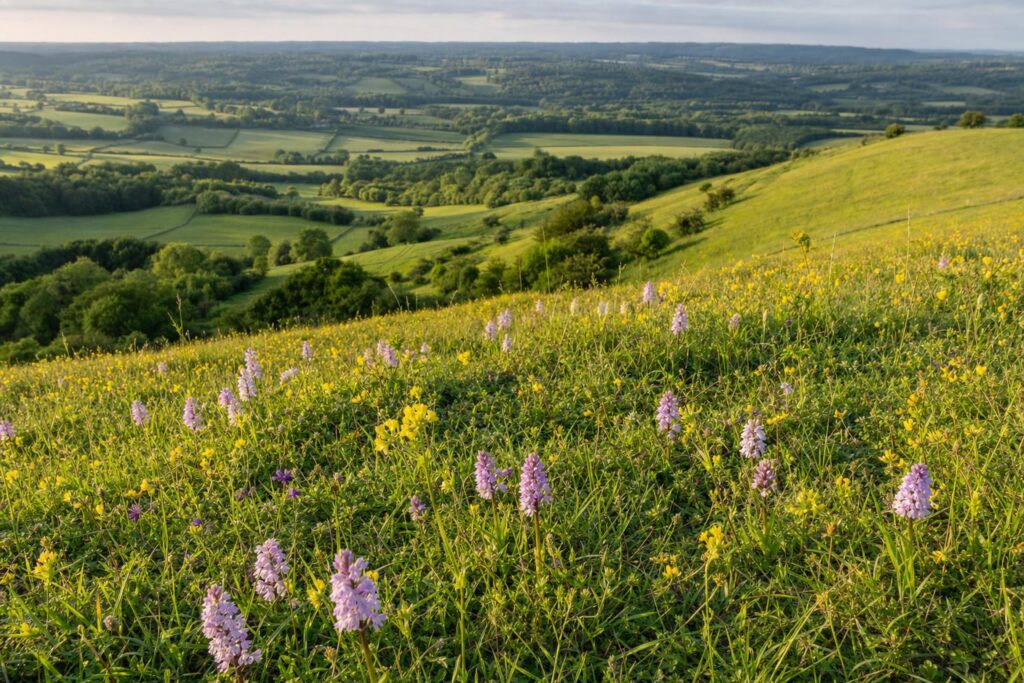
Chalk runs from Brighton’s edge westward through Worthing’s hinterland to Chichester and the Hampshire border — thin, free-draining, alkaline soils and classic low-nutrient wildflower ground. A chalk and limestone mix is the natural choice here.
The Lower Greensand band
A narrow band of lighter, more acidic sands and clays runs through Pulborough and the Arundel area, north of the Downs. Our acidic soils mix suits this lighter, sandier ground.
The Weald Clay (Low Weald)
The north and east of the county, centred on the Horsham district and the High Weald fringes, sits on heavy, poorly-drained Weald Clay — historically difficult farmland needing a heavy clay mix and more robust, competitive species.
The Coastal Plain
South of the Downs, the Manhood Peninsula, Selsey and Bognor Regis sit on flatter, more fertile sands, silts and clays — intensively farmed horticultural land. Wildflower establishment here needs particular attention to stripping residual fertility before sowing.
Choosing the right wildflower seeds for West Sussex’s habitats
West Sussex’s chalk downland has lost around 80% of its extent UK-wide since the Second World War, and now covers only about 4% of the South Downs National Park — a single square metre can still hold 30 to 40 plant species where it survives, including horseshoe vetch, round-headed rampion and early spider orchid, with Adonis blue and chalkhill blue butterflies dependent on the vetch. Sheep grazing is essential to keep the sward short enough for these species to persist.
Knepp Wildland is West Sussex’s flagship large-scale project — 1,400 hectares of former intensive arable and dairy farmland near Horsham, rewilded since 2000. Its historic parkland was seeded with a local wild meadow mix in 2001 under Countryside Stewardship funding, and free-roaming Longhorn cattle, Exmoor ponies and Tamworth pigs now drive a naturalistic mosaic of grassland, scrub and wood pasture rather than a conventionally managed meadow. The results include around 1% of the UK’s nesting nightingales, alongside turtle doves, purple emperor butterflies and reintroduced white storks and beavers.
Alongside Knepp, the National Trust-led Changing Chalk programme has restored or improved 630 hectares of South Downs chalk grassland since 2022, with 185 hectares brought back from scratch, seven historic dewponds restored and a Wart-biter bush-cricket reintroduction programme. The Arun Valley — Pulborough Brooks and Amberley Wildbrooks — is a nationally significant wetland system supporting wet grassland, nightingales and wintering wildfowl, a reminder that West Sussex’s habitat story isn’t only about chalk.
The Arun Valley adds a different dimension again. Pulborough Brooks and Amberley Wildbrooks form a nationally significant wetland system — part of the Arun Valley Special Protection Area and Ramsar site — where wet grassland, ditches and pools support nightingales, wintering wigeon and teal alongside a genuinely rich wildflower community. It’s a reminder that West Sussex’s habitat story isn’t only about chalk and Knepp; wet grassland on the county’s river valleys deserves the same careful, soil-matched approach as anywhere else.
Sowing wildflower seeds in West Sussex: timing and ground preparation
Autumn sowing, ideally August to October, is the more reliable window on the chalk and greensand, letting seed go through a proper winter chill before germinating — essential for species like Yellow Rattle (Rhinanthus minor). Our guide to why Yellow Rattle is essential for wildflower meadows explains why.
On the Weald Clay, ground preparation takes more careful timing — cultivation to break up heavy ground, avoiding a waterlogged autumn window, and a stronger reliance on Yellow Rattle to suppress vigorous grass. On the Coastal Plain’s more fertile ground, stripping topsoil fertility matters more than almost anywhere else in the county — residual nutrients from decades of intensive horticulture will favour grass over wildflowers if left unaddressed. Our guide to establishing a wildflower meadow and note on the best times to sow cover the general sequence in more depth.
Managing your West Sussex wildflower meadow long-term
Budget three years for a West Sussex meadow to reach its full potential: mostly root and leaf growth in year one, a partial flowering display in year two, and a proper sward from year three onward. An annual late-summer cut with arisings removed is the backbone of long-term management on the chalk and greensand, keeping fertility low.
On chalk downland, grazing is what keeps scrub from creeping back in and maintains the structural diversity chalk species depend on — Knepp’s naturalistic grazing model, using hardy breeds at low density across large areas, is an increasingly influential template even for smaller West Sussex sites. On the Weald Clay, ongoing attention to drainage and grass competition matters more than on lighter ground.
Wildflower seeds for larger-scale projects and biodiversity in West Sussex
West Sussex faces real development pressure on its farmland. A 49-hectare solar farm proposal at Runcton, near Chichester, has been through a lengthy planning dispute — refused by Chichester District Council, allowed on appeal, then quashed by the High Court in May 2026 over inadequate consideration of impacts on water voles — a reminder that biodiversity considerations sit at the centre of these decisions, not on the margins. A further large solar proposal is under consideration at Wisborough Green.
The mandatory England-wide 10% Biodiversity Net Gain requirement applies across West Sussex’s district and borough councils, calculated against the statutory biodiversity metric and secured for a minimum of 30 years. The South Downs National Park Authority, which is the planning authority for much of the county’s chalk country, runs its own Biodiversity Net Gain Technical Advice Note and operates ReNature Credits, a scheme selling biodiversity and carbon credits generated through habitat restoration on partner estates — including Halnaker Hill in West Sussex — to developers needing to meet BNG obligations.
West Sussex’s Local Nature Recovery Strategy, approved by the county council in February 2026 as part of a Sussex-wide set of strategies, identifies Areas of Particular Importance for Biodiversity covering 16% of the county, with a further 25% flagged as areas that could become important, concentrated around the South Downs National Park, Chichester Harbour and the High Weald. For farmers, the current Sustainable Farming Incentive window opened in mid-2026, with a minimum eligibility threshold of 3 hectares — relevant to West Sussex’s many smallholdings and estates. Our guide to wildflower seeds for Biodiversity Net Gain beyond the baseline and our housing and development page cover sourcing seed for projects at this scale.
Locally sourced wildflower seeds for West Sussex
Wildahome’s seed is harvested from donor meadows in Devon and Powys, then selected specifically as wildflower seeds for West Sussex’s chalk-to-clay soil range and the South East’s climate, rather than sold as one generic UK mix. For most gardens, paddocks and BNG sites, that regional matching gives noticeably better establishment than seed with no connection to the county’s conditions at all. Read more about why locally sourced wildflower seeds really matter.
For larger or mixed-soil West Sussex sites — land spanning chalk and Weald clay, or a habitat project responding to Biodiversity Net Gain requirements — our bespoke wildflower seed mixes service builds a blend around your actual site survey.
Ready to choose the right mix?
Whether you’re restoring chalk grassland on the South Downs, managing Weald clay pasture, or planning habitat enhancement for a West Sussex development, matching the mix to your ground is the decision everything else depends on. Browse our full range of wildflower seed mixes, explore our advice section, or get in touch if your site needs a bespoke approach.
Frequently Asked Questions
What are the best wildflower seeds for West Sussex?
It depends on which part of the county you’re in. The South Downs chalk suits a chalk and limestone mix; the Lower Greensand band and lighter soils need an acidic soils mix; and the Weald Clay in the north and east needs a heavy clay mix. There’s no single mix that fits every West Sussex site.
When should I sow wildflower seeds in West Sussex?
Autumn, ideally August to October, is the more reliable window on the chalk and greensand — it lets seed go through a proper winter chill before germinating, which species like Yellow Rattle need. On the Weald Clay, autumn sowing still works but needs careful timing to avoid waterlogged ground.
What is Knepp and is it relevant to my land?
Knepp Wildland is a 1,400-hectare former farm near Horsham, rewilded since 2000 using free-roaming grazing animals to drive a naturalistic mosaic of grassland, scrub and wood pasture. It’s an influential model, but most West Sussex landowners will get better, faster results from a conventionally sown and managed wildflower meadow — Knepp’s approach works at a scale and timeframe that suits very few sites.
What is West Sussex’s biodiversity net gain requirement?
West Sussex’s district and borough councils, and the South Downs National Park Authority within the National Park boundary, apply the England-wide mandatory 10% biodiversity net gain on qualifying developments, calculated against the statutory biodiversity metric and secured for at least 30 years.
How do I set up a BNG habitat bank in West Sussex?
The South Downs National Park Authority runs ReNature Credits, a scheme that sells biodiversity and carbon credits generated through habitat restoration on partner estates, including Halnaker Hill, to developers needing to meet BNG obligations. It’s a concrete route for landowners with suitable South Downs land to generate income from habitat creation.
Is West Sussex seed the same as seed from other counties?
Not exactly, but it’s closely matched. Wildahome’s seed is harvested from donor meadows in Devon and Powys, then selected specifically as wildflower seeds for West Sussex’s chalk-to-clay soil range and the South East’s climate, rather than sold as one generic UK mix. For most gardens, paddocks and BNG sites, that regional matching gives noticeably better establishment than seed with no connection to the county’s conditions at all.
How long does it take to establish a wildflower meadow in West Sussex?
Budget three years for a proper result, whichever part of West Sussex you’re in: mostly leaf and root growth in year one, a partial flowering display in year two, and a full meadow from year three onward. Weald Clay ground in particular tests patience — don’t judge a new meadow’s success by its first summer alone.
Ready to get started?
Shop: Traditional Wildflower Meadow Mix →Frequently asked questions
What are the best wildflower seeds for West Sussex?
It depends on which part of the county you're in. The South Downs chalk suits a chalk and limestone mix; the Lower Greensand band and lighter soils need an acidic soils mix; and the Weald Clay in the north and east needs a heavy clay mix. There's no single mix that fits every West Sussex site.
When should I sow wildflower seeds in West Sussex?
Autumn, ideally August to October, is the more reliable window on the chalk and greensand — it lets seed go through a proper winter chill before germinating, which species like Yellow Rattle need. On the Weald Clay, autumn sowing still works but needs careful timing to avoid waterlogged ground.
What is Knepp and is it relevant to my land?
Knepp Wildland is a 1,400-hectare former farm near Horsham, rewilded since 2000 using free-roaming grazing animals to drive a naturalistic mosaic of grassland, scrub and wood pasture. It's an influential model, but most West Sussex landowners will get better, faster results from a conventionally sown and managed wildflower meadow — Knepp's approach works at a scale and timeframe that suits very few sites.
What is West Sussex's biodiversity net gain requirement?
West Sussex's district and borough councils, and the South Downs National Park Authority within the National Park boundary, apply the England-wide mandatory 10% biodiversity net gain on qualifying developments, calculated against the statutory biodiversity metric and secured for at least 30 years.
How do I set up a BNG habitat bank in West Sussex?
The South Downs National Park Authority runs ReNature Credits, a scheme that sells biodiversity and carbon credits generated through habitat restoration on partner estates, including Halnaker Hill, to developers needing to meet BNG obligations. It's a concrete route for landowners with suitable South Downs land to generate income from habitat creation.
Is West Sussex seed the same as seed from other counties?
Not exactly, but it's closely matched. Wildahome's seed is harvested from donor meadows in Devon and Powys, then selected specifically as wildflower seeds for West Sussex's chalk-to-clay soil range and the South East's climate, rather than sold as one generic UK mix. For most gardens, paddocks and BNG sites, that regional matching gives noticeably better establishment than seed with no connection to the county's conditions at all.
How long does it take to establish a wildflower meadow in West Sussex?
Budget three years for a proper result, whichever part of West Sussex you're in: mostly leaf and root growth in year one, a partial flowering display in year two, and a full meadow from year three onward. Weald Clay ground in particular tests patience — don't judge a new meadow's success by its first summer alone.
More county guides
Find the right native wildflower mix for your county, or browse our full list by region.