

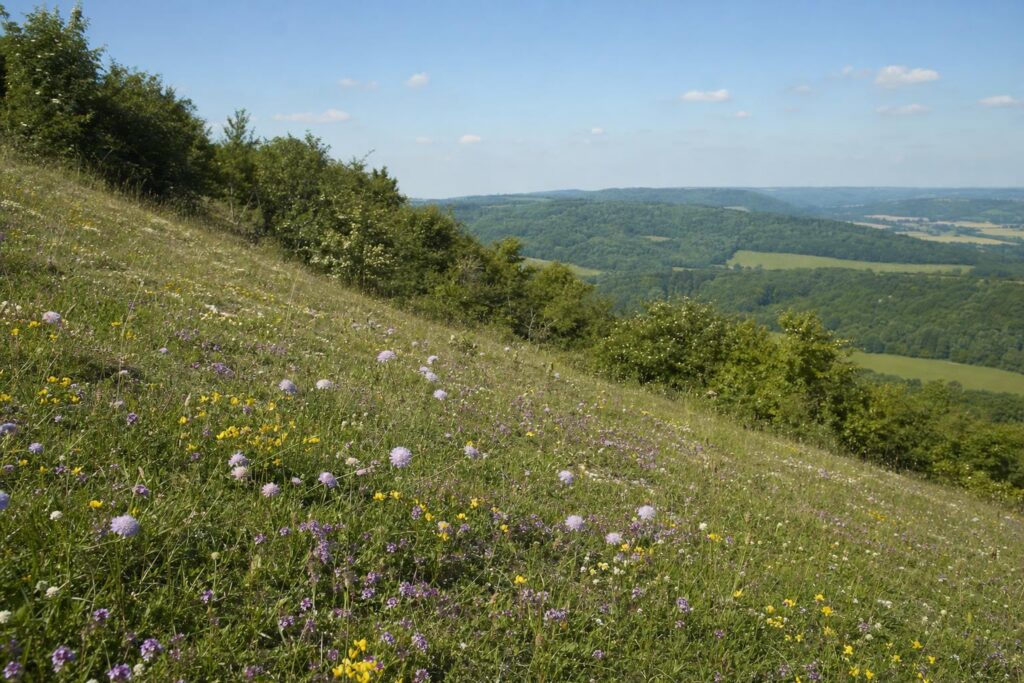
Wildflower Seeds for Surrey: Native Mixes for Chalk Downs, Greensand and Heathland
Wildflower Seeds for Surrey: Native Mixes for Chalk Downs, Greensand and Heathland
Surrey packs an unusual amount of geological variety into a small, heavily wooded county. The North Downs run chalk from Farnham through Guildford, Dorking and Box Hill towards the Kent border. South of that ridge sits the Greensand, its sandy hills rising around Dorking, Reigate, Godalming and Haslemere. Between the two lies the Vale of Holmesdale’s heavy Wealden clay, and across the west of the county — Chobham, Pirbright, Camberley, Esher, Virginia Water — the acidic Bagshot sands carry some of lowland England’s last significant heathland. Choosing wildflower seeds for Surrey starts with working out which of these four very different worlds your land sits on.
It also means reckoning with a county under real development pressure. Surrey’s annual housing target has risen sharply under the current planning framework, and solar development on farmland is a live and often contested local issue. Both are pushing Biodiversity Net Gain from an abstract policy into a practical, everyday consideration for anyone managing land here — more on that below.
Understanding Surrey’s soils before you sow
Surrey’s bands of geology run roughly west to east and north to south, and each supports a genuinely different style of grassland.
The North Downs chalk
The chalk escarpment runs from Farnham through Guildford, Dorking, Box Hill, Banstead and Ewell towards the Kent border — thin, free-draining, low-nutrient ground that is about as close to ideal wildflower territory as Britain gets, once competing grasses are kept in check. A chalk and limestone mix is the natural starting point here.
The Greensand hills
South of the chalk, the Lower Greensand forms hills around Dorking, Reigate, Godalming and Haslemere — shallow marine sands producing well-drained, acidic-to-neutral soils that support an acid grassland and heath mosaic. Our acidic soils mix suits this ground well.
The Vale of Holmesdale and Weald clay
Trapped between the Greensand ridge and the North Downs, and extending south into the Low Weald around Dorking and Horley, Weald Clay is heavy, poorly-drained and historically difficult to farm. London Clay across the north of the county, around Thames Ditton, Addlestone and Epsom, behaves much the same way. A heavy clay mix is built for exactly this kind of ground.
The Bagshot heathland sands
West Surrey — Chobham, Pirbright, Woking, Camberley, Esher, Virginia Water — sits on acidic, nutrient-poor Bagshot sands, the heart of the county’s lowland heathland and the wider Thames Basin Heaths. This is heath-and-acid-grassland country rather than classic meadow ground, and any wildflower work here should respect that heathland character rather than fight it.
Choosing the right wildflower seeds for Surrey’s habitats
Surrey’s chalk grassland can hold up to 40 plant species per square metre — wild thyme, dropwort, bird’s-foot trefoil, small scabious, kidney vetch and orchids including the bee orchid and green-winged orchid, with scrub margins of guelder rose, dogwood and hawthorn. Thirty-five of Britain’s 56 butterfly species have been recorded on Surrey’s chalk grassland, including the small blue, Britain’s smallest butterfly. Key sites — Sheepleas, Norbury Park, Pewley Meadows, Betchworth Quarry — are managed by conservation grazing with sheep and Belted Galloway cattle.
West Surrey’s heathland tells a different story. Chobham Common and Thursley hold dry-and-wet heath mosaics supporting the Dartford warbler — Surrey holds roughly a tenth of the UK’s breeding population, up from just 10 pairs nationally in the 1960s — alongside smooth snake, sand lizard, adder and nightingale.
Surrey Wildlife Trust’s Space4Nature project gives a real sense of what coordinated restoration looks like at scale. Running 2023 to 2026 with a £1.25 million grant from People’s Postcode Lottery, it has delivered 62 hectares of habitat creation and restoration across 22 sites, including over 30 hectares of wildflower-rich habitat forming part of the county’s B-Lines pollinator corridors — work spanning Puttenham Common, Chobham Common, Quarry Hangers and Painshill Park. A follow-on chalk-focused project, Surrey Chalk Lines, begins in 2026.
A second Surrey project worth knowing: Heathland Connections, one of just 12 landscape-scale Nature Recovery Projects funded nationally by Natural England, is targeting remnant lowland heath in west Surrey centred on Whitmoor Common, working with the National Trust, RSPB and local councils to restore and connect fragmented heath for species including nightjar, adder and grayling butterfly. Together with Space4Nature, it shows Surrey’s conservation effort is increasingly coordinated across landowners rather than confined to individual reserves.
Sowing wildflower seeds in Surrey: timing and ground preparation
Autumn sowing, ideally August to October, is the more reliable window across Surrey’s chalk and greensand ground, letting seed go through a proper winter chill before germinating — essential for species like Yellow Rattle (Rhinanthus minor). Our guide to why Yellow Rattle is essential for wildflower meadows explains why.
On the chalk and greensand, ground preparation follows the standard low-nutrient principle: strip vegetation, avoid deep cultivation, never add fertiliser. On the Vale of Holmesdale and London Clay, expect a harder job — heavier cultivation to break up the clay, more careful timing to avoid a waterlogged autumn window, and a stronger reliance on Yellow Rattle to suppress competitive grass. Our guide to establishing a wildflower meadow and note on the best times to sow cover the general sequence in more depth.
Managing your Surrey wildflower meadow long-term
Budget three years for a Surrey meadow to reach its full potential, whichever soil you’re working with: mostly root and leaf growth in year one, a partial flowering display in year two, and a proper sward from year three onward. An annual late-summer cut with arisings removed is the backbone of long-term management everywhere in the county, keeping fertility low.
On the Greensand and Bagshot sands specifically, ongoing scrub and bracken control matters as much as cutting the sward itself — left unchecked, both will encroach on open acid grassland and heath within a few seasons. On chalk, the main long-term task is preventing scrub succession on ungrazed slopes; conservation grazing, as used at Sheepleas and Norbury Park, is the gold standard where it’s feasible.
Wildflower seeds for larger-scale projects and Biodiversity Net Gain in Surrey
Surrey’s housing target rose sharply under the current National Planning Policy Framework, to just under 11,000 homes a year countywide — a roughly 73% increase on the previous figure, with boroughs including Elmbridge, Waverley and Reigate & Banstead seeing the steepest rises. Solar development is adding to the pressure on farmland: a solar farm at Little Flanchford Farm near Leigh, in Mole Valley, was approved in April 2026 on land classed as best and most versatile agricultural ground, generating enough power for around 5,500 homes.
Against that backdrop, Biodiversity Net Gain has become a practical everyday issue for Surrey landowners. The mandatory England-wide 10% BNG requirement applies to qualifying developments across the county’s district and borough councils, calculated against the statutory biodiversity metric and secured for at least 30 years. Surrey Nature Partnership has gone further, recommending a more ambitious 20% net gain target for the county since 2020, and Surrey Wildlife Trust — which operates as a BNG provider offering both on-site consultancy and off-site habitat bank units — works toward that same aspirational 20% figure with developers it partners with. Surrey’s first registered habitat bank went live in December 2024 at Cobham, in the River Mole Biodiversity Opportunity Area, secured through a Section 106 agreement with Elmbridge Borough Council.
Surrey County Council published the county’s Local Nature Recovery Strategy in 2026, identifying priority landscapes including the North Downs, Wealden Greensands, Thames Basin Heaths and the county’s river corridors as focus areas for habitat creation. For farmers, Farming in Protected Landscapes grants — funded by Defra and running to March 2029 — support habitat expansion and connectivity work across the Surrey Hills National Landscape, sitting alongside rather than competing with national schemes like the Sustainable Farming Incentive and Countryside Stewardship. For anyone planning habitat work tied to a planning application, our guide to wildflower seeds for Biodiversity Net Gain beyond the baseline and our housing and development page cover sourcing seed for projects at this scale.
Locally sourced wildflower seeds for Surrey
Wildahome’s seed is harvested from donor meadows in Devon and Powys, then selected specifically as wildflower seeds for Surrey’s chalk-to-clay soil range and the Home Counties’ climate, rather than sold as one generic UK mix. For most gardens, paddocks and BNG sites, that regional matching gives noticeably better establishment than seed with no connection to the county’s conditions at all. Read more about why locally sourced wildflower seeds really matter.
For larger or mixed-soil Surrey sites — land spanning chalk and clay, or a habitat project responding to Biodiversity Net Gain requirements — our bespoke wildflower seed mixes service builds a blend around your actual site survey.
Ready to choose the right mix?
Whether you’re restoring chalk grassland on the North Downs, managing heathland-fringe ground in west Surrey, or planning habitat enhancement for a Surrey development, matching the mix to your ground is the decision everything else depends on. Browse our full range of wildflower seed mixes, explore our advice section, or get in touch if your site needs a bespoke approach.
Frequently Asked Questions
What are the best wildflower seeds for Surrey?
It depends on which part of the county you’re in. The North Downs chalk suits a chalk and limestone mix; the Greensand hills and Bagshot heathland sands in the west need an acidic soils mix; and the Vale of Holmesdale and London Clay in the north do better with a heavy clay mix. There’s no single mix that fits every Surrey site.
When should I sow wildflower seeds in Surrey?
Autumn, ideally August to October, is the more reliable window on the chalk and greensand — it lets seed go through a proper winter chill before germinating, which species like Yellow Rattle need. On the Weald and London Clay, autumn sowing still works but is a harder call, needing careful timing to avoid waterlogged ground.
Can wildflowers grow on Surrey’s heathland sands?
Yes, though the Bagshot sands around Chobham, Camberley and Woking suit heathland-fringe and acid grassland species better than a conventional flowering meadow mix. These are naturally low-nutrient, acidic soils — good starting ground for wildflowers, but the aim should be to complement the heathland character rather than override it with a generic mix.
What is Surrey’s biodiversity net gain requirement?
Surrey’s district and borough councils apply the England-wide mandatory 10% biodiversity net gain on qualifying developments, calculated against the statutory biodiversity metric and secured for at least 30 years. Surrey Nature Partnership has recommended a more ambitious 20% target for the county since 2020, and Surrey Wildlife Trust works toward that higher figure with the developers it partners with.
How do I set up a BNG habitat bank in Surrey?
Surrey Wildlife Trust offers both on-site consultancy and off-site habitat bank units for landowners interested in generating biodiversity credits. Surrey’s first registered habitat bank went live in December 2024 at Cobham, in the River Mole Biodiversity Opportunity Area, secured through a Section 106 agreement with Elmbridge Borough Council — a useful template for landowners considering the same route elsewhere in the county.
Is Surrey seed the same as seed from other counties?
Not exactly, but it’s closely matched. Wildahome’s seed is harvested from donor meadows in Devon and Powys, then selected specifically as wildflower seeds for Surrey’s chalk-to-clay soil range and the Home Counties’ climate, rather than sold as one generic UK mix. For most gardens, paddocks and BNG sites, that regional matching gives noticeably better establishment than seed with no connection to the county’s conditions at all.
How long does it take to establish a wildflower meadow in Surrey?
Budget three years for a proper result, whichever part of Surrey you’re in: mostly leaf and root growth in year one, a partial flowering display in year two, and a full meadow from year three onward. Vale of Holmesdale and London Clay ground in particular tests patience — don’t judge a new meadow’s success by its first summer alone.
Ready to get started?
Shop: Traditional Wildflower Meadow Mix →Frequently asked questions
What are the best wildflower seeds for Surrey?
It depends on which part of the county you're in. The North Downs chalk suits a chalk and limestone mix; the Greensand hills and Bagshot heathland sands in the west need an acidic soils mix; and the Vale of Holmesdale and London Clay in the north do better with a heavy clay mix. There's no single mix that fits every Surrey site.
When should I sow wildflower seeds in Surrey?
Autumn, ideally August to October, is the more reliable window on the chalk and greensand — it lets seed go through a proper winter chill before germinating, which species like Yellow Rattle need. On the Weald and London Clay, autumn sowing still works but is a harder call, needing careful timing to avoid waterlogged ground.
Can wildflowers grow on Surrey's heathland sands?
Yes, though the Bagshot sands around Chobham, Camberley and Woking suit heathland-fringe and acid grassland species better than a conventional flowering meadow mix. These are naturally low-nutrient, acidic soils — good starting ground for wildflowers, but the aim should be to complement the heathland character rather than override it with a generic mix.
What is Surrey's biodiversity net gain requirement?
Surrey's district and borough councils apply the England-wide mandatory 10% biodiversity net gain on qualifying developments, calculated against the statutory biodiversity metric and secured for at least 30 years. Surrey Nature Partnership has recommended a more ambitious 20% target for the county since 2020, and Surrey Wildlife Trust works toward that higher figure with the developers it partners with.
How do I set up a BNG habitat bank in Surrey?
Surrey Wildlife Trust offers both on-site consultancy and off-site habitat bank units for landowners interested in generating biodiversity credits. Surrey's first registered habitat bank went live in December 2024 at Cobham, in the River Mole Biodiversity Opportunity Area, secured through a Section 106 agreement with Elmbridge Borough Council — a useful template for landowners considering the same route elsewhere in the county.
Is Surrey seed the same as seed from other counties?
Not exactly, but it's closely matched. Wildahome's seed is harvested from donor meadows in Devon and Powys, then selected specifically as wildflower seeds for Surrey's chalk-to-clay soil range and the Home Counties' climate, rather than sold as one generic UK mix. For most gardens, paddocks and BNG sites, that regional matching gives noticeably better establishment than seed with no connection to the county's conditions at all.
How long does it take to establish a wildflower meadow in Surrey?
Budget three years for a proper result, whichever part of Surrey you're in: mostly leaf and root growth in year one, a partial flowering display in year two, and a full meadow from year three onward. Vale of Holmesdale and London Clay ground in particular tests patience — don't judge a new meadow's success by its first summer alone.
More county guides
Find the right native wildflower mix for your county, or browse our full list by region.