

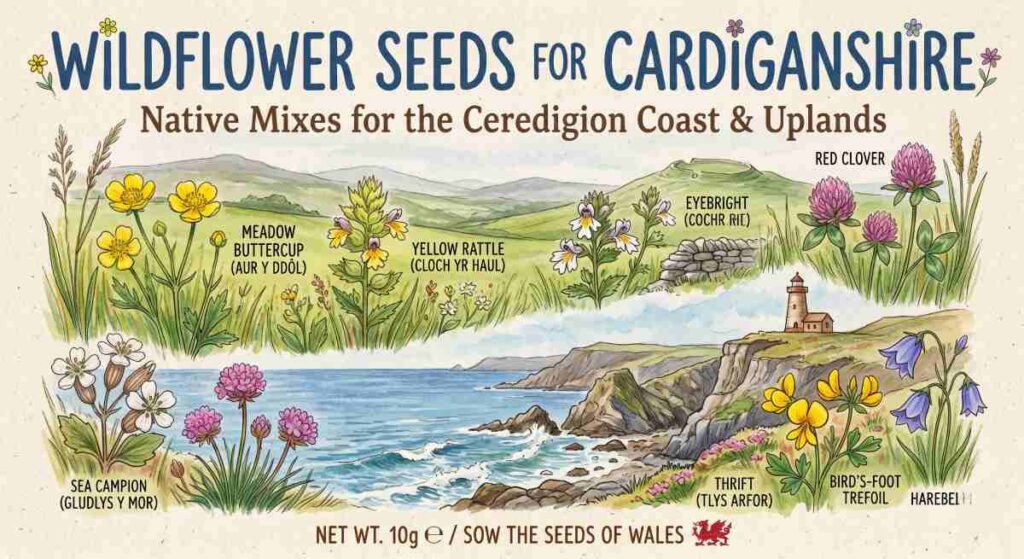
Wildflower Seeds for Cardiganshire: Native Mixes for the Ceredigion Coast and Uplands
Wildflower Seeds for Cardiganshire: Native Mixes for the Ceredigion Coast and Uplands
Cardiganshire — Ceredigion in Welsh — occupies the mid-west coast of Wales, a county of dramatic sea cliffs, upland moorland, ancient oak woodland, and traditional river valley farmland. The Cambrian Mountains form the eastern backdrop, carrying the same acidic upland habitats as Powys. The Teifi Valley cuts through the county’s heart, with alluvial meadows of real conservation significance. The Cardigan Bay coast brings coastal grassland and cliff-top habitats to the west. And the enclosed farmland of the interior — the bocage landscape of small fields and ancient hedgebanks — is one of the least intensively farmed agricultural landscapes in Wales.
Ceredigion has retained more traditional farming character than most of Wales. The small scale of its farms, low intensity of agricultural improvement in the upland fringes, and the persistence of old hedgebank networks make it exceptionally promising for wildflower establishment. The Atlantic climate — high rainfall, mild winters, long growing seasons — delivers fast germination on prepared sites but also vigorous grass competition. Yellow Rattle and thorough ground preparation are as important here as anywhere in Wales.
Cardiganshire’s soils and habitats: coast, valley, and upland
The Cambrian Mountains fringe — the eastern uplands above Aberystwyth, Tregaron, and Lampeter — carry acidic, peaty Ordovician and Silurian soils. Purple Moor-grass (Molinia caerulea), Heather (Calluna vulgaris), Cottongrass (Eriophorum angustifolium), and Sphagnum mosses characterise the highest ground. On the enclosed lower slopes and ffridd land, acidic grassland communities survive with Tormentil (Potentilla erecta), Heath Bedstraw (Galium saxatile), Devil’s Bit Scabious (Succisa pratensis), and Harebell (Campanula rotundifolia).
The Teifi Valley — running from Tregaron and the Teifi Pools south through Lampeter to Cardigan — carries alluvial meadow and riverside habitats of genuine significance. The upper Teifi holds some of the best surviving traditional hay meadows in Ceredigion, with Meadow Thistle (Cirsium dissectum), Devil’s Bit Scabious, Ragged Robin (Lychnis flos-cuculi), and Yellow Rattle (Rhinanthus minor).
The Cardigan Bay coast and sea cliff grassland carry thin, wind-scoured coastal soils with Spring Squill (Scilla verna), Thrift (Armeria maritima), and Sea Campion (Silene uniflora). Management rather than seed introduction is the priority on the best cliff-top sites.
The enclosed interior farmland — the patchwork of small fields, ancient earth hedgebanks, and green lanes — carries a surviving traditional flora wherever unimproved. The hedgebanks themselves hold Primrose (Primula vulgaris), Red Campion (Silene dioica), Herb Robert (Geranium robertianum), and Wild Garlic (Allium ursinum). On intact banks, management is the priority; on damaged banks, a hedgerow mix reintroduces native species quickly.
Choosing the right wildflower seeds for Cardiganshire
Acidic Soils Mix — the most widely applicable mix across Cardiganshire’s interior farmland and upland fringe, suited to the acidic Ordovician and Silurian soils that cover most of the county. Heath Bedstraw, Tormentil, Harebell, Devil’s Bit Scabious, Heath Spotted Orchid (Dactylorhiza maculata) precursors, and Bitter Vetch (Lathyrus linifolius) are characteristic. Sow in Autumn at 1 to 2g per m² into disturbed, low-nutrient ground.
Traditional Meadow Mix — for the Teifi Valley enclosed meadows, the lower-altitude inbye land, and any Ceredigion site with moderate-fertility, reasonably free-draining soil. Meadow Cranesbill (Geranium pratense), Knapweed (Centaurea nigra), Ox-eye Daisy (Leucanthemum vulgare), Yellow Rattle, Meadow Thistle, Ragged Robin, and Bird’s-foot Trefoil (Lotus corniculatus) are all characteristic. Yellow Rattle is essential on all sites with existing grass.
Wetland and Pond Mix — for the Teifi floodplain margins, the Cors Caron surrounds, and any site that holds water seasonally. Yellow Flag Iris (Iris pseudacorus), Ragged Robin, Meadowsweet (Filipendula ulmaria), Purple Loosestrife (Lythrum salicaria), and Marsh Marigold (Caltha palustris) suit the mildly acidic, wet conditions of Ceredigion’s valley floors. Sow in Autumn into exposed moist or wet soil.
Hedgerow and Banks Mix — for Ceredigion’s dense network of ancient earth hedgebanks, particularly where bank faces have been scraped or damaged. Red Campion, Foxglove (Digitalis purpurea), Primrose, Herb Robert, Wild Garlic, and Lesser Celandine (Ficaria verna) are characteristic. Sow in Autumn into loosened bank material.
Sowing wildflower seeds in Cardiganshire: timing and ground preparation
Ceredigion’s Atlantic climate — high rainfall (typically 1,000 to 1,500mm annually), mild winters, and warm summers — gives a generous growing season but also drives vigorous grass and weed growth. Autumn sowing (late August to October) is the preferred approach for perennial mixes. On higher upland sites, September sowing is safer than October as ground conditions deteriorate earlier.
Yellow Rattle must be sown in September on all valley and enclosed meadow sites. Ceredigion’s mild, wet climate drives rapid grass recovery after any disturbance — Yellow Rattle is the most effective tool for keeping the sward open. On naturally low-fertility upland acidic sites it is less critical but remains a valuable component.
Shallow scarification rather than deep rotovation is preferred on sloped upland sites — high rainfall and steep ground creates erosion risk on deeply disturbed sites. On lower valley farmland, standard scarification or rotovation to 50 to 70 percent bare soil is appropriate. Never add topsoil or organic matter to sites being prepared for wildflower establishment.
Managing Cardiganshire wildflower habitats for the long term
The traditional Welsh hay meadow model — cut in late July or August after wildflowers have set seed, remove all cuttings, graze the aftermath lightly with cattle or sheep through Autumn, never fertilise — is the correct model for all Ceredigion lowland and valley meadow sites. The surviving Teifi Valley meadows demonstrate what this management achieves in this part of Wales.
On the upland ffridd and acidic grassland sites, appropriate grazing pressure through the growing season — with reduced stocking in summer to allow flowering — is the key long-term management tool. Bracken control is an additional management requirement on many Ceredigion upland sites.
Natural Resources Wales administers agri-environment schemes — the Sustainable Farming Scheme and transitional Glastir arrangements — that may provide financial support for wildflower meadow restoration on eligible Ceredigion farmland. Farming Connect advisers can guide you through current scheme eligibility.
Locally sourced wildflower seeds for Cardiganshire
Wildahome sources seed from UK meadows and partner farms, including those in Wales and the border counties, with provenance matched to regional habitats wherever possible. For Ceredigion projects, the Acidic Soils, Traditional Meadow, Wetland and Pond, and Hedgerow and Banks mixes all contain species appropriate to the county’s range of habitats. Ceredigion’s Atlantic character, ancient hedgebank network, and traditional farming practices make it one of the most promising counties in Wales for wildflower establishment.
From the Teifi Valley hay meadows to the Cambrian upland fringes and the ancient hedgebanks of the interior, Cardiganshire holds wildflower habitats of real importance. Browse our seed mixes or contact us to discuss your site.
Ready to get started?
Shop: Traditional Wildflower Meadow Mix →Frequently asked questions
When's the best time to sow a wildflower mix?
Late summer to early autumn (August to September) is the best sowing window for most of the UK -- seed goes into warm, moist soil ahead of winter and gets the cold, damp period many native wildflower seeds need to break dormancy. A second window opens in spring (March to April) once the ground has warmed, though autumn sowing usually establishes faster with fewer weed problems.
Why does local seed provenance matter?
Seed grown from populations adapted to similar soil, rainfall and temperature conditions germinates more reliably and settles into a stronger, longer-lived meadow than seed sourced from a very different climate. That's why we match seed to comparable growing conditions rather than supplying one generic UK-wide mix.
Do I need to prepare the ground before sowing?
Yes, and it's the single biggest factor in whether a meadow succeeds. Existing vegetation and topsoil fertility need to be reduced, since most UK soils are too nutrient-rich for wildflowers and favour competitive grasses and weeds instead. In practice that usually means clearing down to bare soil, raking to a fine tilth, and sometimes sowing yellow rattle alongside the mix to suppress grass vigour.
How long before it looks like a proper meadow?
Most sites show flowers in year one, but a settled, species-rich meadow typically takes two to three growing seasons to establish as slower perennials build up and the balance between grasses and wildflowers matures. Very fertile ground can take longer, since excess nutrients need to be drawn down through repeated cutting and removal of cuttings.
What ongoing management does a wildflower meadow need?
An annual cut in late summer, after flowering and seed-set, with the cuttings removed rather than left to rot down, is the core of long-term management. This keeps fertility low and stops coarse grasses and scrub taking over. Spring topping and occasional scarification help in the early years, and light grazing can replace cutting on some sites.
More county guides
Find the right native wildflower mix for your county, or browse our full list by region.