

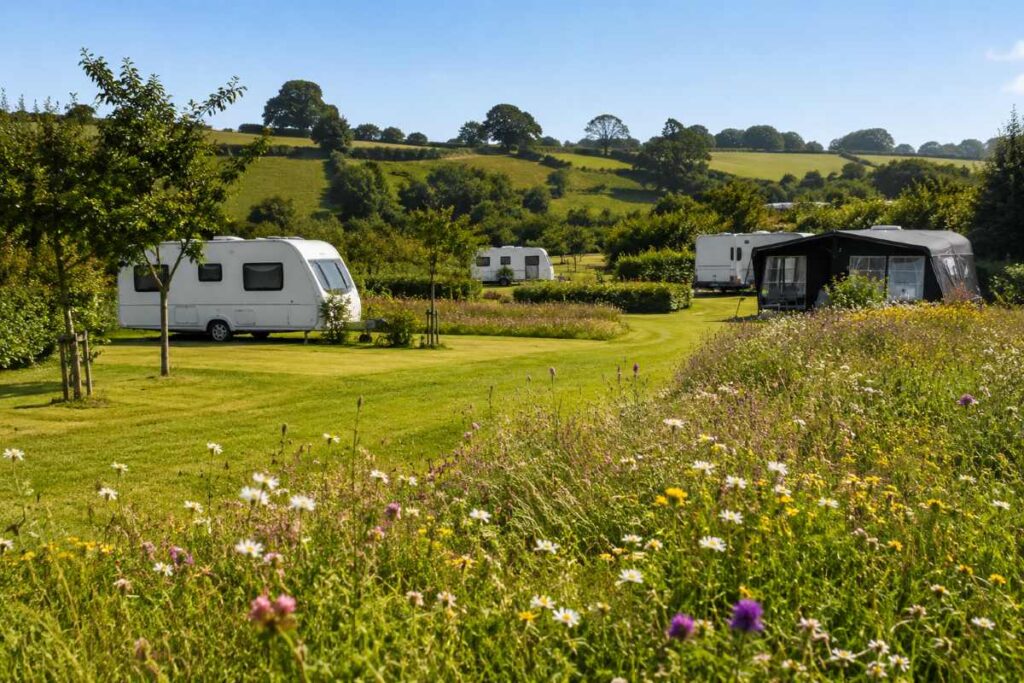
How Caravan Parks Can Become More Nature Friendly with Wildflower Seeds
Most caravan parks are, by area, mostly grass. Some of it earns its keep — pitches, play areas, walkways, turning circles. A good deal of it is mown every fortnight from April to October for no better reason than habit, at a cost in fuel, labour and machinery hours that rarely gets separated out on a spreadsheet.
That surplus grass is the opportunity. Using wildflower seeds for caravan parks is one of the few site improvements that reduces routine maintenance over time, gives guests something worth photographing, and builds real habitat on land you already own and already pay to manage. This guide covers where wildflower areas belong on a working site, how to choose a mix that suits your soil, and how to manage the result so it looks deliberate rather than abandoned.
It is also honest about the limits. Wildflower areas are not a no-maintenance option — they are a different maintenance regime, with a different calendar and different kit. A perennial meadow takes two to three seasons to look like the pictures. Sown in the wrong place, or cut at the wrong time, it fails visibly and in front of paying guests. Get the siting and the timing right and it holds up for decades.
Why nature-friendly caravan parks are becoming a business priority
Guest expectations have shifted. Families booking a week in the countryside increasingly expect the countryside to be present on site, not just visible beyond the boundary hedge. There are harder commercial drivers behind it too.
- Mowing costs keep climbing. Fuel, machinery replacement and seasonal labour are all dearer than they were five years ago, and amenity grass consumes all three.
- New development brings obligations. Extensions, new pitch areas and hardstanding in England sit within the Biodiversity Net Gain framework, and a planned habitat area is a stronger position than a retrofit under pressure.
- Accreditation schemes and booking platforms increasingly ask about environmental management. A mapped, managed habitat scheme is more persuasive than a statement of intent.
- Group bookings — schools, activity groups, walking clubs — often screen for this directly.
Do the sum before you commit. Take the area you currently mow, subtract what genuinely needs to be short — pitches, paths, play areas, sightlines, fire separation — and look at what is left. On a mid-sized park the remainder is often half a hectare to two hectares, cut fifteen to twenty times a year out of habit. A meadow on that ground is cut once or twice a year. The saving is real but not immediate: the first two seasons need more attention, not less.
What wildflower areas do for biodiversity on holiday parks
The case for biodiversity on holiday parks makes sense once you stop treating grass as a surface and start treating it as a habitat with structure.
Pollinators and invertebrates
Short amenity grass offers no nectar, no pollen, no larval food plants and no overwintering structure. A species-rich sward changes all four at once. Native forbs such as Knapweed (Centaurea nigra), Bird’s-foot Trefoil (Lotus corniculatus), Oxeye Daisy (Leucanthemum vulgare) and Field Scabious (Knautia arvensis) give a nectar sequence across the season rather than a single flush. Bird’s-foot Trefoil is also a larval food plant for several common butterflies.
Birds and small mammals
Invertebrates feed chicks. A meadow margin along a boundary hedge gives hedgerow-nesting birds a foraging strip they do not otherwise have, and seed heads left through autumn feed finches into winter. Taller grass gives cover to voles and shrews, which supports kestrels and barn owls where those are present locally.
Soil and water
Deeper-rooting perennial forbs open up ground that mowing and foot traffic tend to seal, improving infiltration where water pools on grass pitches. Uncut ground also holds moisture better through a dry summer, so meadow areas stay green when amenity grass has browned off.
Formal planting, amenity grass and naturalistic wildflower areas
Treating these three as interchangeable is a common source of disappointment. A well-run park needs all three, used deliberately.
Formal ornamental planting and amenity grass
Formal planting — bedding, shrub borders, planters — is high impact, high input, mostly non-native and of limited habitat value. It belongs at reception frontage and the clubhouse, where controlled colour matters more than ecology.
Amenity grass is short, hard-wearing and tolerant of footfall and vehicles: non-negotiable for pitches, play areas, walkways and sightlines. Do not try to convert it. Wildflower swards do not tolerate compaction or regular traffic.
Naturalistic wildflower areas
Species-rich, low-nutrient, cut once or twice a year, changing through the season — lush in June, brown and structural in August, short in September. High habitat value and low ongoing input once established, but visually variable. That variability is what you design around and explain to guests. The strongest sites layer all three: formal at the front door, amenity where people walk, naturalistic on the ground that is neither.
Where to use wildflower seeds for caravan parks without affecting access or safety
Siting is where schemes are won or lost. The rule of thumb: wildflower areas belong on ground people look at, not ground people use. Work through the constraints before you open a seed catalogue.
- Sightlines. Keep junctions, entrance approaches, crossing points and reversing areas clear. Many meadow species reach 60–90cm by midsummer. Where a strip crosses a sightline, keep the near section mown short.
- Fire separation. Site licence conditions typically govern separation between units and nearby combustible material. Dry standing vegetation in late summer is a legitimate concern around gas stores, barbecue areas and firepits. Check your conditions with the local authority before siting anything near pitches, and keep a mown buffer.
- Access for machinery. Anything you sow must be reachable in September with a cutter and something to lift the arisings.
- Ticks. Tall vegetation in some regions carries a tick risk. Mown paths and straightforward signage handle this sensibly.
- Dog walking. Most parks are dog-friendly, so meadow areas need mown routes through them or guests will make their own.
Comparing possible wildflower locations
| Location | Main benefits | Key considerations |
|---|---|---|
| Unused corners and dead ground | No loss of usable space; immediate mowing saving; often already low in fertility. | Frequently the most compacted or rubble-strewn ground on site. Check what is under the surface first. |
| Field margins and boundary strips | Links to hedgerows and adjacent farmland; strong corridor value; long, easy shapes to cut. | Shade and root competition from hedges — keep 1–2m back. Confirm boundary ownership and any grazing rights. |
| Verges along internal roads | Highly visible to arriving guests; frames the approach; narrow strips establish quickly. | Sightlines at junctions and bends. Salt and grit spray in winter. Keep the first metre from the kerb mown. |
| Embankments and banks | Unsafe to mow anyway; free-draining and usually low-nutrient, which suits meadow species. | Erosion risk during establishment — consider seed mats. Plan access for the annual cut. |
| Pond and ditch edges | Adds structure to an existing water feature; supports amphibians and dragonflies. | Needs a damp-tolerant mix, not a general meadow mix. Keep a clear viewing point and consider edge safety. |
| Areas between facility buildings | Softens hard landscaping; seen daily by every guest; small and easy to manage. | Often high in nutrients from historic feeding. Watch lighting, services and drainage runs. Keep desire lines mown. |
| Entrance and approach areas | Sets the tone before a guest reaches reception; strong signal of intent; photographs well. | Highest scrutiny — must look intentional. Pair with formal planting and crisp mown edges. |
| Overflow parking and car park islands | Used only at peak; awkward islands to mow; improves the look of a hard, open area. | Compaction and hydrocarbon residue. Vehicle overrun at busy times. Better on islands than parking surfaces. |
Designing wildflower areas so they look intentional, not neglected
This is the concern operators raise most often, and it is a fair one. A guest who paid for a pitch does not want to feel the grounds team has given up. The problem is solved by design, not species choice: what reads as neglect is usually the absence of a visible frame. Landscape architects call the fix cues to care — small, obvious signals that a person made a decision here.
- Keep a crisp mown strip, at least one mower width and ideally two, around every meadow area. A sharp edge against tall vegetation reads as a designed boundary, and costs almost nothing.
- Use deliberate shapes — clean curves or straight-sided blocks that follow site features. Ragged outlines look like a mowing failure.
- Mow paths through larger areas. A cut path invites people in, controls where they walk and answers the tick question.
- Add low-key structure: a post-and-rail run, a bench, a mown viewing bay.
- Grade the height profile — shorter nearest paths and pitches, taller further back.
- Time the annual cut so a prominent frontage is not left brown through peak booking weeks.
Choosing wildflower seeds for caravan parks: soil, aspect and drainage
The mix has to suit the ground you actually have. This sounds obvious, and it remains the most common failure on eco-friendly caravan sites, where one general wildflower mix gets sown across four different soil conditions and performs in one of them.
Match the mix to soil, aspect and drainage
- Soil type. Heavy clay, free-draining sand, chalk and limestone, and loam support quite different species. A chalk downland mix on wet clay will disappoint.
- Fertility. This matters more than soil type. Wildflowers compete poorly against vigorous grasses on rich ground, so fed amenity grass and ground near former livestock areas is usually too fertile to sow directly.
- Aspect and shade. North-facing banks and hedge-shaded margins need a shade-tolerant mix, not a full-sun meadow mix.
- Drainage. Ground that stands wet in winter needs damp-tolerant species; ground that bakes in July needs drought-tolerant ones.
- Cut regime. A mix intended for a single late-summer cut behaves differently from one you plan to cut twice.
Why native and locally sourced seed matters
Native species have long-established relationships with native invertebrates. Many specialist bees, hoverflies and moths depend on particular plant genera, and ornamental or continental cultivars do not always substitute. If the aim is habitat rather than colour, native is the starting point.
Provenance sits alongside this. Seed from populations growing in conditions similar to your own is more likely to suit your regional climate and soils — flowering timing, drought tolerance and establishment vigour all vary between populations of the same species. It also avoids diluting nearby wild populations, which matters if your park adjoins designated land.
A note on cornfield annuals
Corn Poppy, Cornflower and Corn Marigold give a dramatic first-year display, then largely disappear unless the ground is cultivated again each year. They suit an entrance bed you can rotavate annually, or temporary cover on ground awaiting development. They are not a perennial meadow, and presenting them as one leads to an awkward conversation in year two.
Ground preparation, sowing and wildflower meadow management
The work is not difficult, but the sequence matters and the timing is unforgiving.
Preparing the ground
The aim is bare, firm, low-fertility soil with the existing sward removed or badly weakened. Sowing into standing amenity grass almost never works — established grasses outcompete the seedlings.
- Strip and remove the turf, or cultivate and repeatedly work the surface through a fallow period to exhaust the weed seed bank.
- On high-fertility ground, consider removing the top few centimetres of topsoil. Expensive, but often the difference between a meadow and a nettle patch.
- Do not add compost, topsoil or fertiliser. Low-nutrient conditions are what you want.
- Create a fine, firm seedbed and roll or tread it. Wildflower seed needs contact with the soil surface, not burial.
- Deal with docks, creeping thistle and couch before sowing, not after.
Sowing
The main sowing window runs from late August to early October. Autumn sowing gives many species the cold period they need to break dormancy and lets seedlings establish while there is moisture in the ground. If you miss that window, wait for the following autumn rather than sowing in spring, when a single dry spell can wipe out young seedlings.
Sow at the recommended rate rather than heavier — crowded seedlings compete with each other. Broadcast in two passes at right angles, mixing the seed with a carrier such as dry sand so you can see where you have been, then roll or tread. Do not rake it in. On banks and awkward small areas, seed mats remove the seedbed preparation and distribution problem in one step and hold seed against rain wash.
The first year
Expect the first summer to look weedy. Annual weeds germinate from the disturbed seedbed while the perennial forbs root and produce little top growth. This is normal, and it is where most schemes get mown off in a panic. Cut to 5–8cm two or three times through the first season, whenever growth reaches 15–20cm, and remove the cuttings. Brief your team, and your directors, that year one is meant to look like this.
Long-term wildflower meadow management
From year two onward, sound wildflower meadow management comes down to one principle: cut late, and always take the cuttings away.
- Take the main cut between late July and early September, once most species have set and shed seed.
- Leave the cuttings a few days so seed drops, then remove them completely. Arisings left in place return nutrients and shift the balance back to coarse grasses — the most common long-term failure.
- An optional second cut in late autumn keeps growth in check on more fertile ground.
- Leave 10–20% uncut each year, in a different place each time, for overwintering invertebrates.
- If grasses start to dominate, sow Yellow Rattle (Rhinanthus minor) in autumn onto a short, scarified sward. It is a hemiparasite on grass roots and opens space for forbs.
- Control scrub and tree seedlings annually. Left alone, meadow reverts to scrub within a decade.
Telling guests what you are doing
An unexplained tall grass area is a complaint. The same area with a sign is a feature. Communication is part of the scheme, not an extra.
- Put a well-made sign at each area saying what it is, why it is there and when it will be cut. A line such as ‘left long until August for pollinators — please use the mown path’ answers the two questions a guest actually has.
- Mark the areas on your site map and welcome pack, which reframes them as amenities rather than unmown ground, and add an interpretation board somewhere central.
- Give the scheme a page on your website, using photographs taken in June rather than September.
- Post through the season on social media. Showing the September cut pre-empts the question about why it has been mown down.
- Brief reception and grounds staff so they give the same answer. A warden saying ‘we’ve not got round to it’ undoes the whole thing.
Supporting sustainability policies and responsible tourism
Nature-friendly caravan parks that record what they have done, and what it is doing, are in a far stronger position than those making general claims. Keep it factual and keep records.
- Map the areas, record the sown area, and log sowing dates and mix composition.
- Photograph each area from a fixed point at the same time each year — a three-year sequence is more convincing than any wording.
- Record the reduction in mown area and the fuel and labour hours saved.
- Note species observed rather than species claimed. Invite a local wildlife trust or recording group to survey — an independent species list carries real weight.
- Feed the same evidence into planning applications, BNG assessments and accreditation submissions.
Be careful what you claim. Habitat creation produces results over years, and outcomes vary with soil, weather and management. Describing what you have done and observed is credible; asserting ecological gains you have not measured is not.
Common mistakes and how to avoid them
- Sowing into fertile existing grass. The most common failure by a wide margin — established grasses win.
- Cutting at the wrong time. A tidy-up cut in June removes flowers before they set seed, and the area declines year on year.
- Leaving the cuttings on. Returns nutrients, suppresses regrowth and favours coarse grasses. Always cut and collect.
- Expecting a meadow in year one. Perennial mixes take two to three seasons.
- Choosing species by appearance. A picture-led choice ignores soil, aspect and drainage.
- Starting too big. A well-executed 200m² area builds internal support; a failed hectare kills the programme for a decade.
- Siting it where it interferes. Sightlines, fire separation and access all trump aesthetics.
- Forgetting the annual cut needs kit. A domestic mower will not cut standing meadow — budget for contract cutting or a flail collector, and confirm arisings disposal.
A practical implementation plan
For a first scheme, work through these eight steps across roughly an eighteen-month cycle.
- Audit the site. Walk the park with a map and mark every area of mown grass, noting which parts genuinely need to be short, and record slopes, shade, wet spots, services, sightlines and access.
- Select suitable areas. Shortlist candidates using the table above. For year one, choose one or two areas totalling a few hundred square metres, including one visible location.
- Assess the soil. Check texture by hand and test phosphorus and pH. High phosphorus is the strongest predictor of failure.
- Choose the mix. Match species to soil, aspect, drainage and cut regime, area by area. Specify native and, where possible, regionally provenanced seed, and decide where seed mats will be easier than loose seed.
- Prepare the ground. Strip or cultivate, deal with perennial weeds, add nothing, and produce a firm, fine seedbed, allowing a fallow period on weedy ground.
- Sow at the right time. Late August to early October, at the recommended rate, in two passes, then roll or tread.
- Manage the first year. Cut to 5–8cm two or three times when growth reaches 15–20cm and remove the cuttings. Keep the mown frame crisp, install signage and brief the team not to intervene beyond the plan.
- Review and extend. At the end of year two, photograph, record what established and what failed, then decide whether to over-sow gaps, adjust the cutting date or move to the next area.
How WildaHome can help leisure businesses choose the right seed
WildaHome supplies UK native wildflower seed and seed mats, sourced locally from meadows in Devon and Powys. For a park, the practical value is usually at the specification stage — working out which of your candidate areas need a clay mix, which need something shade-tolerant, which suit a damp-margin selection, and which would be better handled with seed mats than loose seed.
Seed mats earn their place on caravan parks in particular: banks where loose seed washes off, small awkward areas between buildings, and any job the grounds team is fitting around a busy season.
Send through a site plan with your candidate areas marked, plus what you know about soil, aspect and how each area currently gets cut, and we can talk through what suits each one and roughly what quantities you would need. We will also tell you where an area looks like a poor candidate — a shorter conversation than a failed sowing the following summer.
Getting started on your park
The best first step is the audit. Walk your site with a map and mark the ground you are cutting out of habit rather than necessity — most parks find more of it than they expect. Pick one visible area and one quiet corner, get the soil assessed over the summer, and aim for an autumn sowing.
If you would like help matching seed to your conditions, send us your site details and the areas you are considering. We will talk through what would suit, what to prepare beforehand, and what a realistic result looks like by year three.
Frequently Asked Questions
What does it cost to sow wildflower seeds for caravan parks?
Costs vary with area, ground preparation and whether you use loose seed or seed mats. Seed is usually the smaller part; ground preparation is the larger, and topsoil stripping on fertile ground adds significantly. Set against this the mowing hours saved from year two, and budget for the annual cut and arisings removal as an ongoing cost.
Will wildflower seeds for caravan parks make the site look untidy to guests?
Not if the areas are framed properly. A crisp mown edge of at least one mower width, mown paths through larger areas, deliberate shapes and a sign explaining the cutting regime all read as intentional. Guests object to what looks like neglect, not to long grass with an obvious purpose.
When is the best time to sow wildflower seed on a holiday park?
Late August to early October is the main sowing window. Autumn sowing gives many native species the cold period they need to germinate and lets seedlings establish in moist ground. If you miss it, wait for the following autumn rather than sowing in spring. Sowing after the main season also suits a quieter site.
How long before a wildflower meadow looks established?
Expect two to three growing seasons for a perennial mix. Year one usually looks weedy while perennials root, year two shows the first real flowering, and year three generally resembles the photographs. Cornfield annuals flower in the first summer but do not persist without yearly cultivation.
Do wildflower areas create a fire risk near caravans and pitches?
Dry standing vegetation in late summer is a genuine consideration near units, gas stores, barbecue areas and firepits. Caravan site licence conditions set requirements around separation and combustible material, so check yours with the local authority before siting anything near pitches, and keep a mown buffer between meadow areas and units.
Can we sow wildflower seed straight into existing grass?
Usually not with good results. Established amenity grasses outcompete wildflower seedlings, particularly on fertile ground, so you need to strip the turf or cultivate and weaken the sward first. Sowing Yellow Rattle into an existing sward in autumn is the main exception, as it weakens grasses over time.
What does wildflower meadow management involve once the area is established?
One main cut between late July and early September, with the cuttings left a few days then removed completely. An optional autumn cut on richer ground. Annual scrub and tree seedling control. Leave 10–20% uncut each year, rotating the location, for overwintering invertebrates, and keep the mown frame and paths cut through the season.
Ready to get started?
Shop: Traditional Wildflower Meadow Mix →